
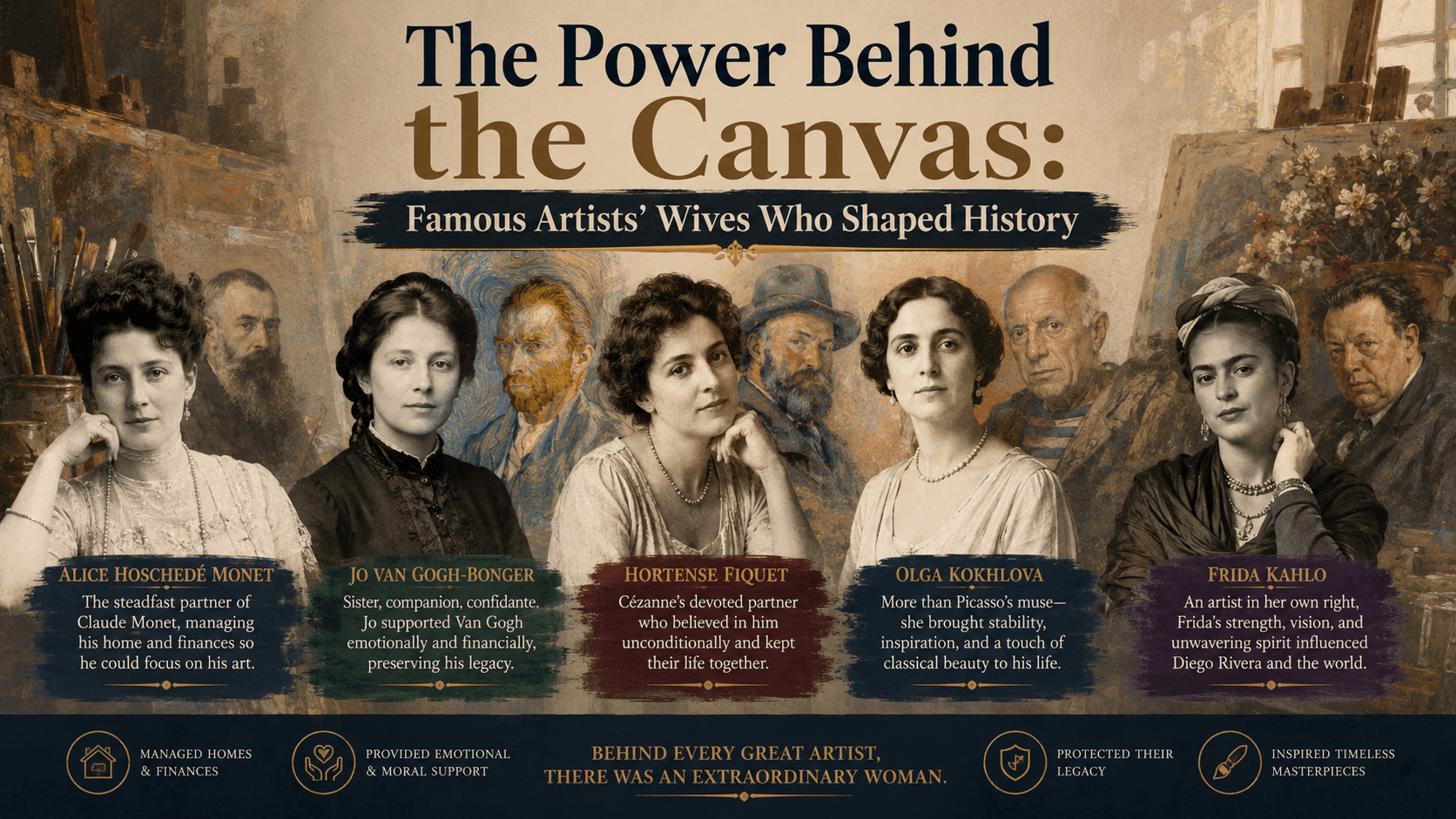
Many famous artists throughout history owe a significant portion of their creative output, stability, and even their public image to the often-overlooked contributions of their wives, who acted as muses, models, managers, critics, and emotional anchors, profoundly shaping their husbands’ artistic legacies. These women were far more than passive figures; they were active participants in the artistic process, providing inspiration, practical support, and sometimes even critical feedback that directly impacted the masterpieces we admire today.
Keypoint Summary
- Artists’ wives frequently served as primary muses and models, influencing the subject matter and emotional depth of countless works.
- Beyond inspiration, many provided crucial practical support, managing finances, households, and even careers.
- Their unwavering presence and emotional stability often allowed artists the freedom and environment necessary for creative exploration.
- Some wives were active collaborators or keen critics, offering insights that refined their husbands’ artistic vision.

Beyond the Canvas: The Multifaceted Roles of Artists’ Wives
The narrative of art history often spotlights the solitary genius, yet behind many great artists stood women whose influence was immeasurable. These wives navigated the precarious lives of artists, often sacrificing their own aspirations to foster their husbands’ careers. Their roles ranged from providing the domestic stability essential for creative work to actively participating in the artistic process itself, embodying the very subjects that would become iconic. For a broader look at women’s contributions, consider exploring women in art: a journey through history and contemporary challenges.
Who was Gala Dalí and how did she shape Salvador Dalí’s career?
Gala Dalí, born Elena Ivanovna Diakonova, was not merely Salvador Dalí’s wife and muse but a formidable force who actively managed his career, finances, and public image, becoming an integral part of his surrealist universe. She was his primary model, appearing in numerous works such as “Gala Contemplating the Mediterranean Sea which at Twenty Meters Becomes a Portrait of Abraham Lincoln (Homage to Rothko)” (1976), and her shrewd business acumen was instrumental in transforming Dalí into a global brand, as detailed by the Tate Modern.
Her influence extended to his creative process, with Dalí famously stating that he loved Gala more than his mother, more than his father, more than Picasso, and even more than money, a testament to her profound impact on his life and art. Her presence is often seen as a key to understanding the depth and complexity of Dalí’s surrealist vision, which shares thematic elements with other surrealist masters like Joan Miró, a surrealist visionary in modern art.
How did Saskia van Uylenburgh influence Rembrandt’s masterpieces?
Saskia van Uylenburgh, Rembrandt van Rijn’s first wife, profoundly influenced his work by serving as his primary model during his most prolific and prosperous period in the 1630s. She brought not only beauty but also a significant dowry and connections to the art world through her family, enhancing Rembrandt’s social standing and financial stability source: Rijksmuseum.
Saskia is immortalized in many of Rembrandt’s most celebrated paintings and drawings, including “Saskia with a Red Flower” (c. 1641) and “Self-Portrait with Saskia” (c. 1636), where she often appears in opulent attire, symbolizing his success and personal happiness. Her death in 1642 deeply affected Rembrandt, marking a shift in his artistic style towards more introspective and somber themes.
What was the impact of Hortense Fiquet on Paul Cézanne’s artistic vision?
Hortense Fiquet, Paul Cézanne’s wife, played a crucial, albeit often challenging, role in his artistic development by serving as his most frequent model for over two decades. She sat for him for approximately 27 portraits, enduring countless hours of sittings with remarkable patience, which allowed Cézanne to meticulously explore his revolutionary approach to form and color source: The Metropolitan Museum of Art.
Her stoic presence in his portraits, often depicted with a calm, almost detached demeanor, became a vehicle for his exploration of structure and volume, fundamental to his post-impressionist style. Her unwavering commitment to sitting for him provided the consistent subject matter Cézanne needed to develop his unique vision, profoundly influencing how he approached the human figure and still life, as explored in Paul Cézanne: how a misunderstood artist changed the way we see everything.

Jacqueline Roque: Picasso’s Final Muse and Constant Companion
Jacqueline Roque was Pablo Picasso’s second wife and his last great muse, influencing his work more profoundly than any other woman during the final two decades of his life. From their meeting in 1953 until his death in 1973, she appeared in over 400 of his portraits, more than any other figure in his extensive oeuvre source: Wikipedia, Jacqueline Roque.
Picasso depicted her in various styles, from realistic portrayals to highly abstracted forms, reflecting his evolving artistic language. Her distinctive profile, often with a long neck and almond-shaped eyes, became a recurring motif, symbolizing his enduring passion and the profound connection they shared. Her constant presence provided him with stability and inspiration during a period of immense creativity, making her an iconic figure among the 20 iconic paintings of women in art history.
FAQs: Famous Artists’ Wives Who Shaped History
Were artists’ wives often artists themselves?
While many wives primarily supported their husbands, a significant number were artists in their own right, such as Lee Krasner (Jackson Pollock) and Elaine de Kooning (Willem de Kooning). Their dual roles often led to complex dynamics of collaboration and competition.
How did wives support artists financially?
Many artists’ wives provided crucial financial support, whether through inheritances, managing household budgets, or selling their husbands’ works. Gala Dalí, for instance, was renowned for her business acumen in promoting Salvador Dalí’s art globally.
Did wives influence specific art movements?
Indirectly, yes. By serving as muses and models, they shaped the visual language of movements like Impressionism (Camille Doncieux for Monet) and Surrealism (Gala Dalí for Salvador Dalí), providing the subjects through which artists explored new techniques and philosophies.
What challenges did artists’ wives face?
Artists’ wives often faced significant challenges, including financial instability, social judgment, managing their husbands’ volatile temperaments, and sacrificing their own creative or personal ambitions to support their partners’ careers.

Olly
Olly Farmer M.Sc, B.Sc, PGCE 25 years experience of Watercolor Painting and AI Art; teacher for 13 years; Creator of Art Tools; Art Gallery Contributor of Art Articles to Medium.com, LinkedIn and Facebook
Continue exploring


PROMINENT PAINTING
Keep your creative momentum
Get new painting guides, practical techniques and artist stories delivered without the noise.
Occasional emails. Unsubscribe whenever you like.