
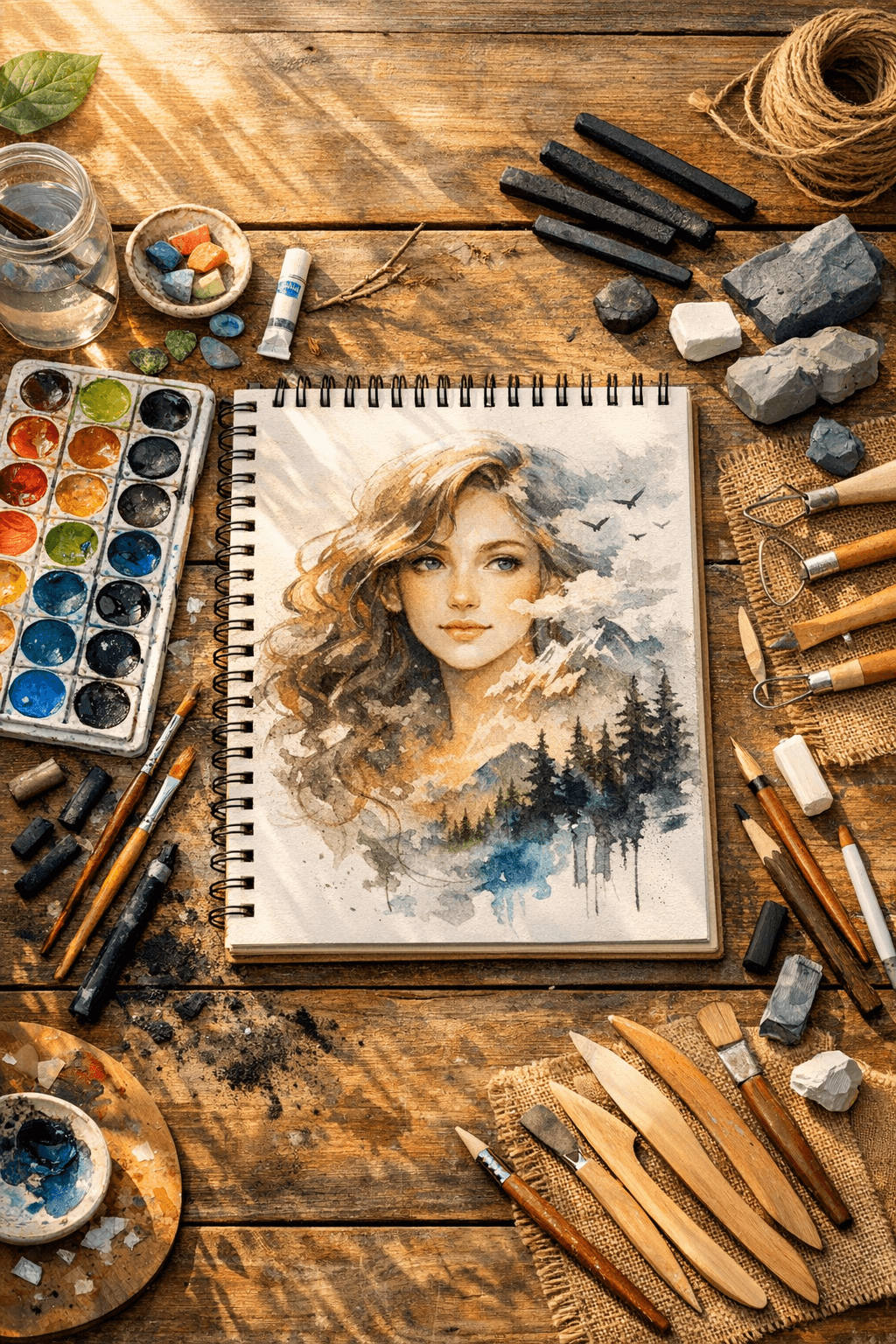
Have you ever wondered if there’s a master of all art? History shows us incredible people who excelled across many creative fields. You don’t need to limit yourself to just one medium. This guide explores famous multi-talented artists and what makes a true Renaissance person. We’ll also look at how beginners can joyfully experiment with different art forms to find their unique voice.
Walking into an art supply store can feel overwhelming for a beginner. You see aisles of oil paints, sketchpads, and clay. It’s easy to feel pressured to choose just one path. Many beginners ask themselves if there’s a master of all art. They wonder if they need to focus entirely on a single medium to be successful.
The truth is much more comforting. History is full of brilliant artists who refused to pick just one lane. Exploring different disciplines is a proud and ancient artistic tradition. When I teach my students, I always remind them that curiosity is their best tool.
You don’t have to master everything to enjoy the creative process. However, looking at the artists who tried a bit of everything can inspire us. Let’s explore the fascinating world of polymaths. We’ll discover how mixing different artistic skills can actually make you a better painter.

Is There a True Master of All Arts?
Yes, a master of all arts is called a polymath. This is a person who has deep knowledge and skill across multiple different subjects. While no human has literally mastered every single art form in existence, historical figures like Leonardo da Vinci came incredibly close.
During the Renaissance, people believed in unbound potential. They refused to be boxed into just one category. A recent look at Renaissance optimism explains how these thinkers valued broad knowledge. They studied science, math, and art all at the same time.
Today, many people still admire this approach. It reminds us that creativity doesn’t have strict borders. You can learn about famous artists and their styles to see how diverse their skills really were. Modern creators often work across different fields out of pure curiosity. In fact, many believe that contemporary artists are natural polymaths because they use so many different digital and traditional tools.
Who Is the Ultimate Renaissance Polymath?
Leonardo da Vinci is widely considered the ultimate Renaissance polymath. He didn’t just paint famous portraits. He was also a master sculptor, architect, engineer, and scientist. His endless curiosity drove him to study the world deeply and apply that knowledge to his creative projects.
Leonardo showed us what happens when art meets science. He joined a prestigious painters’ guild at age twenty. This early training blended theory with diverse technical skills. He wanted to understand how everything worked, from human muscles to water currents.
His notebooks are legendary. They contain thousands of pages of sketches and ideas. Experts note that his multidisciplinary drawing approach was a crucial tool for both scientific and artistic investigation. If you look at Leonardo da Vinci’s most famous paintings, you can see this deep anatomical knowledge in action.
He applied his massive creativity to every possible realm. This included designing bridges and flying machines. To fully grasp his world, it helps to spend time understanding Renaissance art. It was a time when learning knew no limits.
Do Modern Artists Master Multiple Mediums?
Yes, modern artists frequently master multiple mediums. They often create mixed media art by combining paints, pencils, and other materials in a single piece. Contemporary creators rarely restrict themselves to just one tool, preferring to explore whatever materials best express their current ideas and emotions.

Mixing materials is a standard practice today. The concept really took off in the twentieth century. Artists like Pablo Picasso broke traditional boundaries to combine different objects and mediums on canvas. This freedom changed the art world forever.
Another great example is Marc Chagall. He was known for his extensive use of multiple mediums, creating beautiful works in oil, watercolor, and even ceramics. This flexibility allowed him to tell stories in totally unique ways. If you want to see what’s possible, our complete guide to art mediums breaks down the most popular tools available right now.
Can Exploring Different Arts Make You a Better Painter?
Trying new artistic disciplines will absolutely improve your painting skills. When you step outside your comfort zone, you learn to see the world differently. Sketching with charcoal teaches you about dramatic shadows and highlights. Sculpting with clay helps you understand 3D forms, which makes your 2D paintings look more realistic.
Leonardo da Vinci used his varied studies to understand the mechanics of nature. By studying how water flows or how light bounces off objects, his paintings became incredibly lifelike. You can apply this same logic to your own work.
In my own teaching experience, I see this all the time. When I have students who feel stuck with watercolors, I ask them to try drawing with ink for a week. When they return to their paints, their brushstrokes are more confident. Cross-training your brain builds a much stronger artistic foundation.
How Can Beginners Start Exploring Different Art Forms?
The best way to start is by taking small and playful steps. You don’t need to buy out the entire art store to try something new. Pick one new tool that sparks your interest and add it to your current setup.
Here are a few easy combinations to try out:
| Base Medium | Fun Tool to Add | What It Teaches You |
|---|---|---|
| Watercolor | Colored Pencils | Fine details and texture control |
| Acrylics | Charcoal | Dramatic shading and contrast |
| Any Paint | Modeling Paste | 3D form and tactile feedback |
For example, you could try using colored pencils over a dried watercolor wash. This simple technique adds wonderful texture. If you’re totally new to everything, our introduction to painting is a perfect place to begin your journey.
Give yourself permission to make mistakes. Remember that even the great masters had to learn how to mix their first batch of paint. Keep a sketchbook just for messy experiments. By staying curious and having fun, you’ll naturally discover which mediums speak to you the most.
Conclusion
There may not be a single master of all art alive today. However, the spirit of the polymath is something we can all embrace. Leonardo da Vinci showed us that curiosity and a willingness to try new things can lead to incredible breakthroughs.
You don’t have to choose just one creative path. Exploring different paints, pencils, and crafts will ultimately make you a better, more well-rounded artist. The magic happens when you let go of the pressure to be perfect and simply enjoy the process of learning.
Are you ready to expand your artistic horizons? Grab a new drawing tool or a fresh set of paints this week. Check out our beginner guides to help you confidently take that exciting first step!
Frequently Asked Questions
- What does it mean to be a polymath in art?
A polymath is someone with wide-ranging knowledge across multiple subjects. In art, this means mastering several different disciplines like painting, sculpting, and architecture. Leonardo da Vinci is a famous example of an artistic polymath. - Did Leonardo da Vinci invent new art mediums?
Leonardo didn’t invent the base mediums, but he constantly experimented with them. He mixed new types of oil paints and tempera. Sometimes these experiments failed, but they pushed the boundaries of what artists could do. - What is mixed media art?
Mixed media art involves using more than one medium in a single artwork. An artist might use watercolor, ink, and collage all on the same paper. It’s a highly popular and expressive way to create. - Do I have to choose only one painting style?
Absolutely not. Beginners are encouraged to try many different styles and mediums. Experimenting helps you discover what you enjoy most and builds a stronger set of overall skills. - Who are some modern artists that use multiple mediums?
Many modern artists work across disciplines. Pablo Picasso and Marc Chagall famously used paints, ceramics, and printmaking. Contemporary artists often blend traditional painting with digital art tools.

Olly
Olly Farmer M.Sc, B.Sc, PGCE 25 years experience of Watercolor Painting and AI Art; teacher for 13 years; Creator of Art Tools; Art Gallery Contributor of Art Articles to Medium.com, LinkedIn and Facebook
Continue exploring


PROMINENT PAINTING
Keep your creative momentum
Get new painting guides, practical techniques and artist stories delivered without the noise.
Occasional emails. Unsubscribe whenever you like.