
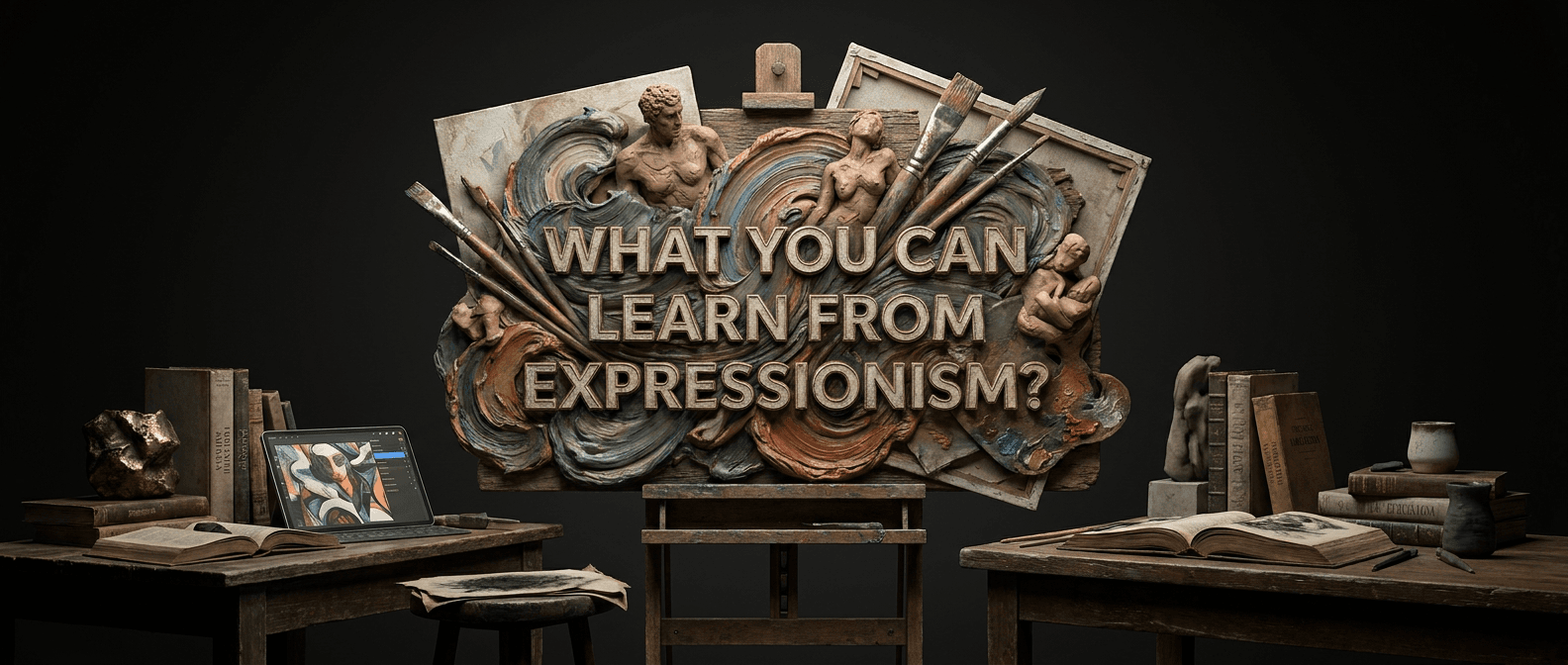
Summary: Expressionism teaches you to paint your inner feelings instead of just copying the physical world. This guide breaks down the core lessons of the movement, showing you how to use distortion, bold colors, and thick textures to free your artistic voice. You will learn to stop worrying about perfect realism and start focusing on pure emotional truth. Grab your brushes and let your mood run your studio.
Staring at a blank canvas can feel like a test you are about to fail. We often get trapped by the urge to make everything look perfectly realistic. But what if your goal was not perfection?
That is exactly the question early 20th-century artists asked when they turned away from traditional art. They did not want to paint a tree exactly as it stood in the sun. They wanted to paint how that tree made them feel inside. This shift gave birth to Expressionism, a movement that threw out the old rulebook in favor of raw emotion.

If you are just getting started, this radical style is your ultimate permission slip. It proves that a painting does not have to look like a photograph to be a masterpiece. In fact, learning what you can learn from Expressionism will completely change how you approach your studio time. By focusing on your internal world, you can beat creative blocks and discover a deep sense of artistic freedom. Let us explore how these bold techniques can transform your daily practice.
Why Did Expressionism Reject Realism?
Expressionism rejected realism because artists believed that internal emotional truth was far more valuable than copying the objective physical world. By distorting shapes and using unnatural colors, they communicated raw psychological experiences directly to the viewer.
When I talk to new students in my workshops, the biggest hurdle is always fear. Beginners worry about making realistic lines, and they look at painting mistakes beginners make as failures. Expressionism flips this script completely. Historically, the movement emerged as a powerful way to break through old academic boundaries and unlock deep personal confidence.
In our modern world, this mindset is more valuable than ever. We are constantly surrounded by crisp digital screens and automated perfection. Turning to traditional, handmade canvas work acts as a vital sanctuary from digital overload. When you step away from the need to copy reality, the pressure drops to zero. You stop trying to please an imaginary critic and start painting for yourself.
How to Use Color for Pure Emotion
Expressionism teaches you to use color symbolically rather than realistically to represent mood. Instead of painting a face with exact skin tones, you choose vibrant, contrasting pigments that immediately signal feelings like anxiety, passion, or peace.
To do this effectively, it helps to understand color theory basics before you start breaking the rules. Traditional art tells you to paint the sky blue and the grass green. Expressionists look at a landscape and ask a different question: what color is tension? What color is joy?
| Desired Emotion | Realist Choice | Expressionist Choice |
|---|---|---|
| Internal Anxiety | Soft Pale Shadows | Acid Greens & Yellows |
| Deep Passion | Natural Skin Tones | Saturated Crimson Reds |
| Melancholy Calm | Bright Sunlight | Deep Indigo & Violet |
You can start practicing this by limiting your palette to colors that match your current mood. Forget accuracy. If you are feeling restless, let an aggressive slash of orange cut across a dark background. The color becomes the language.
Embrace Imperfection and Raw Textures
You do not need smooth, invisible blending to make great art. In fact, Expressionism celebrates the physical build-up of material on the canvas. Heavy paint application, left rough and uneven, tells the viewer a human being was active in the studio.
This emphasis on tangible matter is making a massive comeback right now. Leading curators note a major cultural shift toward physical, material-heavy practices that highlight the artist’s touch. People want to see the tracks of the brush. They want to feel the energy that went into the work.
In reaction to overly polished digital imagery, a trend known as chaoticism is taking over modern studios. Chaos is not a mistake here: it is a creative force that welcomes energetic brushwork and tactile surfaces. When you paint, leave the globs of paint thick. Do not smooth out the ridges left by your palette knife. Those textures carry your physical energy, making the artwork feel alive.
Distort Reality to Land Your Point
Distorting reality means intentionally changing shapes, exaggerating proportions, and sharpening angles to highlight an underlying feeling. This technique strips away unnecessary details so the viewer focuses entirely on the core psychological message of your artwork.
Look at the current landscape of contemporary art. The modern art scene is heavily embracing naïve authenticity, visible distortions, and intentional imperfections. This is because precise replication often dilutes emotional power. If you want to show that a figure is carrying a heavy emotional burden, you can elongate their arms or slouch their shoulders past the point of physical possibility.
* Reality shows how a body looks; distortion shows how a body feels.
* Throwing out exact perspective allows you to arrange your canvas for psychological impact.
* Sharp, jagged lines inject immediate energy, while soft, melted forms invite quiet contemplation.
When you stop worrying about correct anatomy or perfect horizons, you open the door to true originality. Your focus moves from tracking proportions to amplifying meaning.
Finding Your Unique Artistic Voice
Ultimately, Expressionism is a journey inward. It provides a beautiful framework for discovering how you naturally want to create. The global art market is seeing steady exhibition volumes for traditional mediums because collectors are actively hunting for work that carries a clear trace of the person who made it. People want sincerity over sophistication.
Learning to lean into your instincts is the secret to help you find your painting style. This approach is also deeply therapeutic. Using active, intuitive painting sessions works beautifully alongside regular art therapy activities to lower stress and process complex emotions.
When you paint expressively, you learn to trust your hands. You stop overthinking every single move. Over time, those thick lines, distorted shapes, and bold color choices merge into a visual signature that belongs entirely to you.
Frequently Asked Questions
What is the main goal of Expressionist painting?
The main goal is to depict internal psychological states and emotional responses instead of copying the external world. Expressionists use dramatic tools like intense colors, visible textures, and distorted shapes to make these invisible feelings visible to the viewer.
Do I need advanced technical skills to paint in an expressionist style?
No, you do not need master-level realistic training to start painting expressionistically. Because the style prioritizes instinct and emotional immediacy over perfect perspective or anatomy, it is highly accessible for beginners who want to create without intimidation.
What kind of paint is best for creating heavy expressionist textures?
Heavy-body acrylics or oil paints are ideal for this style because they hold their shape and retain brush marks when dry. You can also mix texturing mediums, like molding paste, into your acrylics to create thick, dramatic surfaces that stand out on the canvas.
How do Expressionists choose their color palettes?
Expressionists choose colors based on emotional symbolism and mood rather than real-world accuracy. For example, an artist might use a striking lime green for a sky or a deep purple for a face if those specific choices help communicate a feeling of unease or mystery.
Is Expressionism a good style for relieving stress?
Yes, it is an excellent style for mental well-being and stress relief because it encourages free, uninhibited physical movement. Bypassing the strict rules of realism allows you to use the creative process to safely express and release tension.

Olly
Olly Farmer M.Sc, B.Sc, PGCE 25 years experience of Watercolor Painting and AI Art; teacher for 13 years; Creator of Art Tools; Art Gallery Contributor of Art Articles to Medium.com, LinkedIn and Facebook
Continue exploring
PROMINENT PAINTING
Keep your creative momentum
Get new painting guides, practical techniques and artist stories delivered without the noise.
Occasional emails. Unsubscribe whenever you like.