
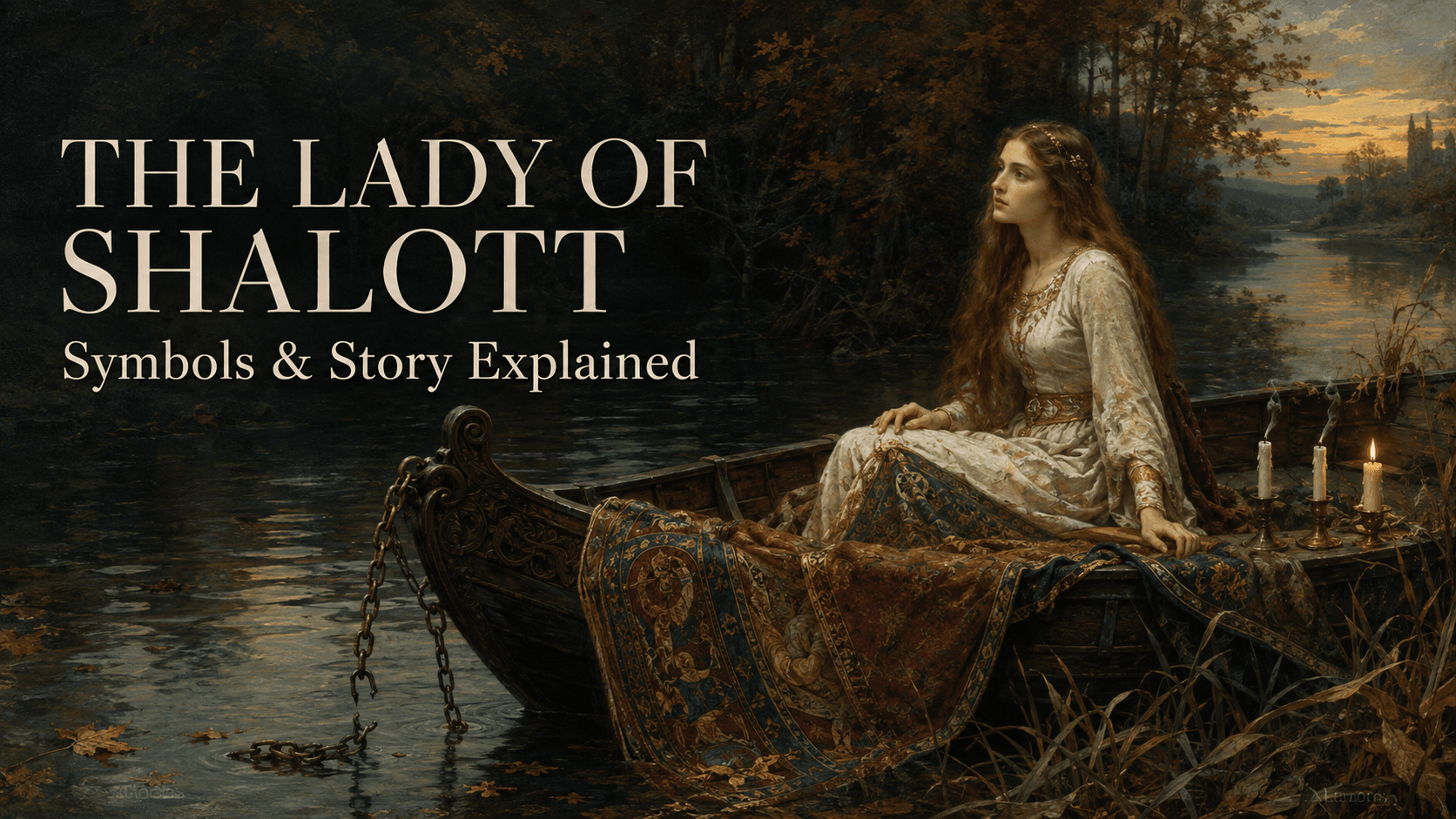
Summary: John William Waterhouse’s 1888 masterpiece, The Lady of Shalott, captures the tragic climax of Alfred, Lord Tennyson’s famous Arthurian poem. This beginner-friendly guide decodes the painting’s vital symbols, including the dying candles, embroidered tapestry, and loosened mooring chain. You will learn how Victorian narrative art combines moody lighting with botanical realism to tell an unforgettable story, giving you practical composition tools to elevate your own artwork.
A lone woman sits in a wooden boat, gripping an iron chain while staring into the cold, darkening woods. This haunting scene is John William Waterhouse’s 1888 masterpiece, and understanding The Lady of Shalott painting meaning unlocks one of the most poignant narratives in British art history. Waterhouse did not just illustrate a poem; he captured the quiet, terrifying second between total isolation and certain death.
In over a decade of teaching art, I have watched countless students stand transfixed before this canvas at Tate Britain. It pulls you in immediately. You do not need a formal art history degree to feel its emotional weight, but uncovering the hidden details transforms how you view Victorian painting forever.
What Is the Story Behind The Lady of Shalott Painting?
The Lady of Shalott illustrates Alfred, Lord Tennyson’s 1832 poem about an Arthurian maiden cursed to view the world only through a mirror. When she looks directly at Sir Lancelot riding toward Camelot, the curse strikes. Waterhouse depicts her floating downriver toward her inevitable death.
According to The Poetry Foundation’s historical text, the mysterious maiden lived isolated in a four-walled stone tower near Camelot. She was forbidden from looking out at the world under penalty of death. Instead, she spent her days weaving a magical tapestry of shadows reflected in a mirror.
When handsome Sir Lancelot rode past singing by the riverbank, she could not resist. She turned, looked out the window, and sealed her fate. The mirror cracked instantly. Waterhouse captures the moment she finds a boat, writes her name on the prow, and lets the river carry her toward Camelot as her life fades. It stands as a brilliant example of paintings with deep meaning.
What Do the Hidden Symbols in the Painting Mean?
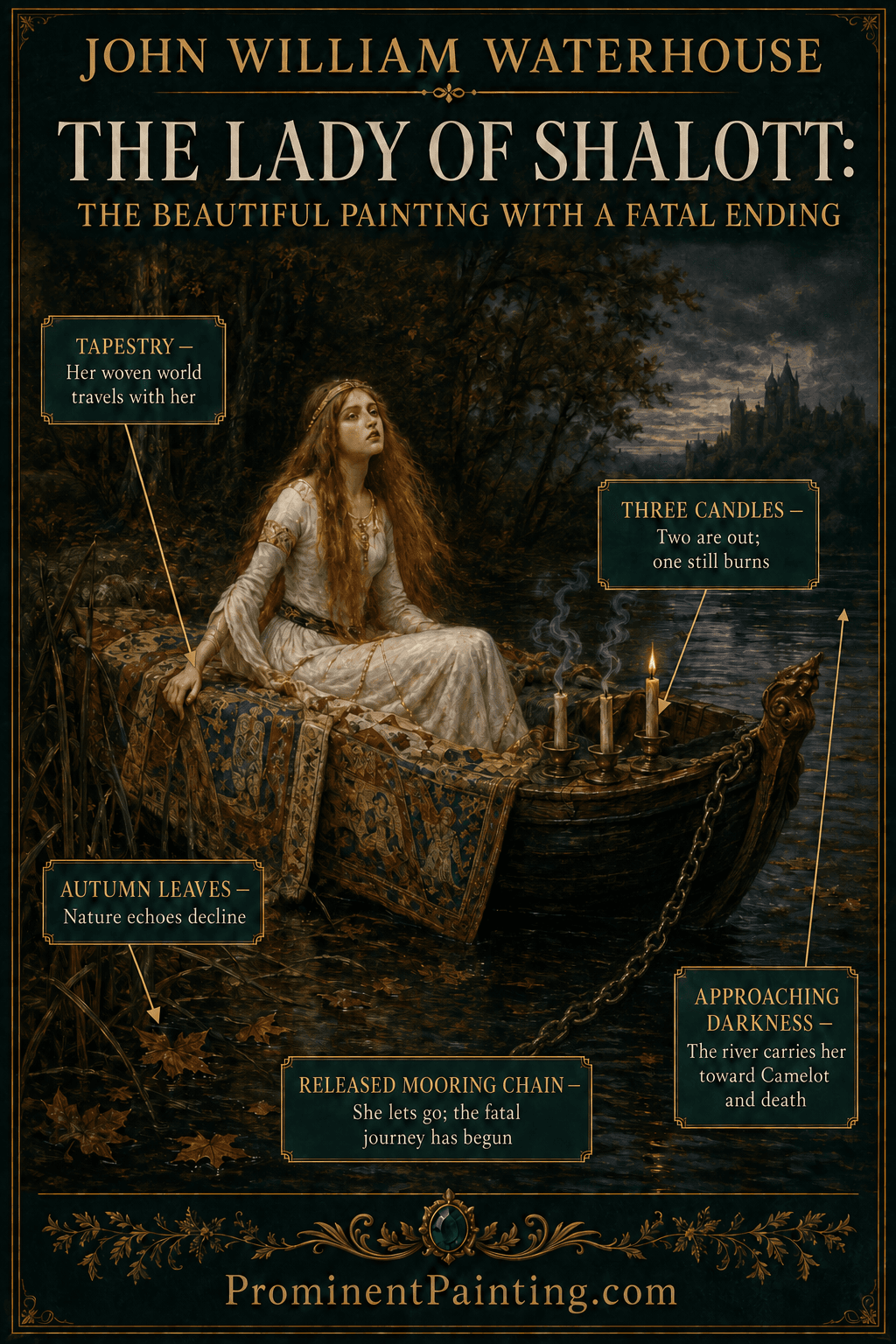
Waterhouse loaded the painting with Victorian symbolism to foreshadow the lady’s imminent demise. The three candles represent extinguishing life, the loosening chain signifies lost control, the floating tapestry represents her abandoned past, and the drifting autumn leaves symbolize physical decay and seasonal transition.
Every single object in the composition serves the narrative. Waterhouse drew heavily on traditional visual art symbolism to communicate complex emotions without relying on words.
| Symbol | Visual Detail in Painting | Symbolic Meaning |
| Three Candles | Set on the boat prow; two are blown out, one still flickers | Represents her fading life force; the final light will extinguish when she dies. |
| Mooring Chain | Held loosely in her right hand as she lets it slip | Letting go of earthly life; her fatal journey downriver has officially begun. |
| Woven Tapestry | Draped over the boat, trailing into the cold water | Her lifetime of isolated craft and memories, doomed to soak and ruin. |
| Autumn Leaves | Drifting in the dark water and resting on her gown | Nature echoing human mortality, physical decline, and the end of youth. |
| Crucifix & Rosary | Resting beside the candles at the bow | Spiritual preparation, sacrifice, and seeking salvation in her final moments. |
Looking closely at these details reveals the subtle hidden meanings in famous paintings that Victorian audiences understood immediately.
Waterhouse’s Masterful Use of Light and Mood
Waterhouse painted the landscape background outdoors in Devon and Somerset. He used authentic plein-air naturalism, capturing damp river reeds, tangled branches, and chilly evening mist with startling accuracy. This organic setting reflects the core principles of nature in Romantic art.
Notice the careful balance of light and shadow. Her ivory dress glows against the murky marshland, instantly directing your eye to her pale, expressive face. Waterhouse kept the surrounding landscape in earthy greens, rich ochres, and muddy browns. This limited palette creates a heavy, brooding atmosphere while making the single lit candle flame shimmer with fragile vitality.
Why Did Waterhouse Paint The Lady of Shalott in 1888?
Waterhouse painted The Lady of Shalott in 1888 to merge the romantic medievalism of the Pre-Raphaelites with modern French plein-air realism. Victorian audiences were obsessed with Arthurian chivalry, tragic heroines, and themes of artistic isolation, making Tennyson’s poem an ideal subject for major salon exhibitions.
The Pre-Raphaelite circle had long been fascinated by Arthurian legends, as documented in Victorian Web’s scholarly analysis of Waterhouse. Earlier artists like John Everett Millais had tackled similar themes of tragic women in nature, most famously in his painting of Ophelia.
Waterhouse updated this tradition for late-Victorian viewers. Instead of painting a stiff historical figure, he gave his heroine tangible human vulnerability. When sugar industrialist Sir Henry Tate purchased the work and gifted it to the nation in 1894, it cemented Waterhouse’s reputation as a leader in British narrative painting.
How Beginners Can Apply These Narrative Painting Techniques
You do not need to stage an elaborate medieval drama to tell compelling visual stories. You can borrow Waterhouse’s fundamental storytelling toolkit for your own work:
- Create clear visual focal points: Use high value contrast to pull the viewer’s gaze directly to the subject’s face before guiding them across secondary details.
- Incorporate narrative props: Add objects that explain the past and future of the subject rather than just filling empty background space.
- Harmonize background colors: Keep environmental colors subdued so the central figure pops without visual clutter.
Studying these structural choices is the easiest way to learn how to appreciate fine art and sharpen your own creative instincts.
The Lady of Shalott remains one of the world’s most beloved paintings because it captures universal human vulnerability. It reminds us that choosing freedom often carries risks, but living locked away in a tower of shadows is no life at all.
Take a close look at your current art project. Pick one storytelling element, whether it is a symbolic prop or a dramatic shift in lighting, and weave it into your next canvas. Art comes alive when it tells a human story.

FAQs: The Lady of Shalott Painting Meaning
Where is the original Lady of Shalott painting located?
The original 1888 oil painting hangs in the permanent collection at Tate Britain in London. It was presented to the gallery by founder Sir Henry Tate in 1894, where it remains one of the museum’s most visited and recognizable artworks.
What medium did John William Waterhouse use for The Lady of Shalott?
Waterhouse painted the piece using oil on canvas, measuring an impressive 153 by 200 centimeters. He blended traditional Pre-Raphaelite academic oil glazing techniques with spontaneous, impressionistic brushstrokes in the landscape elements.
What does the single burning candle symbolize in the painting?
The single lit candle represents the lady’s remaining life force. Two candles have already blown out in the autumn wind, signaling that her death is imminent as the cold river carries her toward Camelot.
Did John William Waterhouse paint other versions of The Lady of Shalott?
Yes, Waterhouse returned to Tennyson’s poem twice more during his career. He painted The Lady of Shalott Looking at Lancelot in 1894 and I am Half-Sick of Shadows, said the Lady of Shalott in 1915, depicting different scenes from the poem.
Is The Lady of Shalott considered a Pre-Raphaelite painting?
The painting is widely classified as late Pre-Raphaelite or Romantic Classicism. While Waterhouse painted it decades after the original Pre-Raphaelite Brotherhood formed, he retained their signature commitment to literary themes, medieval romance, and botanical realism.

Olly
Olly Farmer M.Sc, B.Sc, PGCE 25 years experience of Watercolor Painting and AI Art; teacher for 13 years; Creator of Art Tools; Art Gallery Contributor of Art Articles to Medium.com, LinkedIn and Facebook
Continue exploring

PROMINENT PAINTING
Keep your creative momentum
Get new painting guides, practical techniques and artist stories delivered without the noise.
Occasional emails. Unsubscribe whenever you like.