
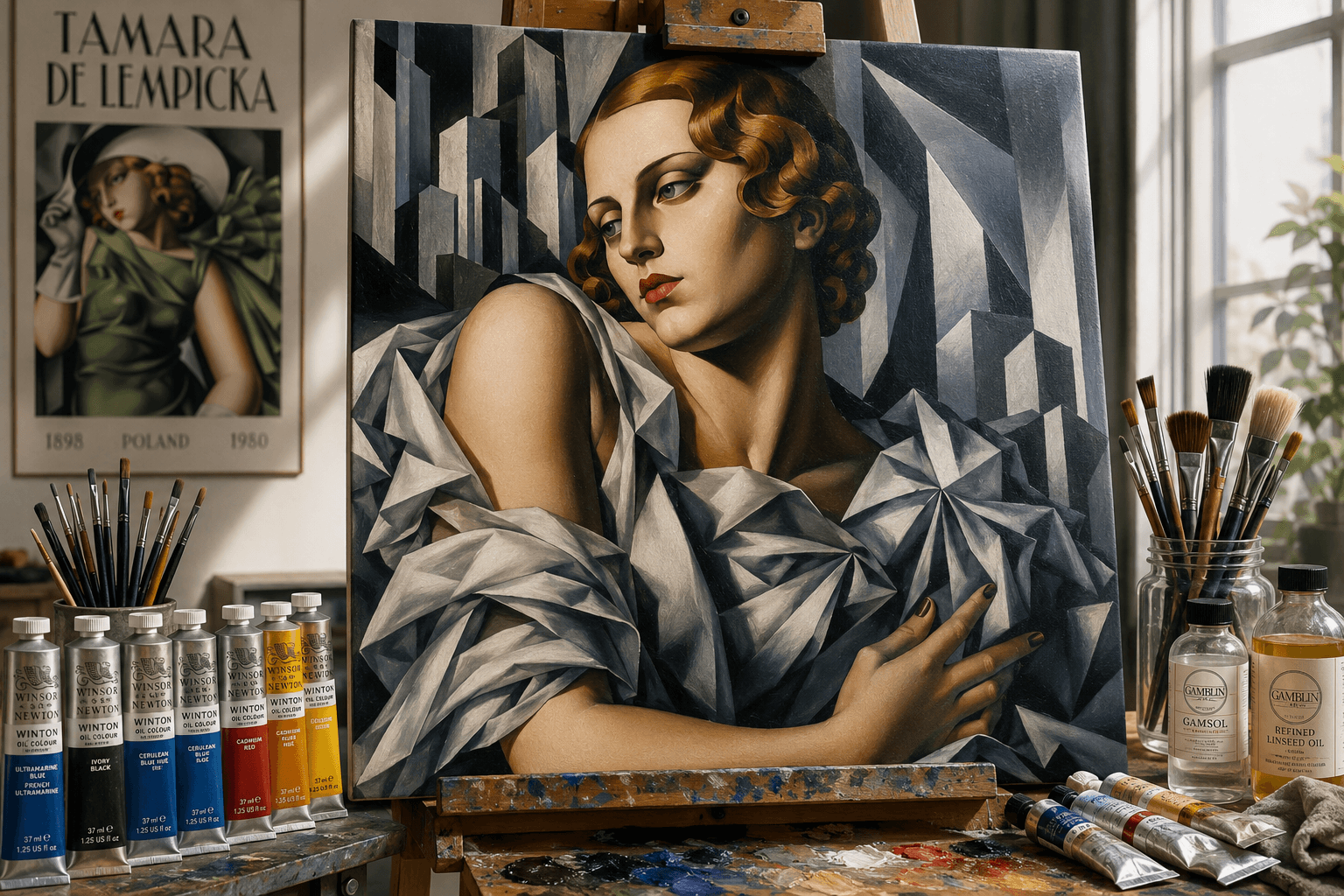
Summary: The Tamara de Lempicka painting style defined the 1920s Art Deco era through its fusion of Cubist geometry, Mannerist proportions, and metallic surface polishes. This guide breaks down her core techniques, from transparent oil glazes to sharp edge control. You will learn how to apply her sculptural portrait methods to your own artwork step by step.
You step into a gallery, and her portraits seize your attention from across the room. There is no mistaking that glass-smooth skin, those razor-sharp shadows, or that irresistible interwar confidence. Studying the Tamara de Lempicka painting style reveals how classical studio craft can merge seamlessly with modern industrial design. If you are starting oil painting for beginners, her work provides the ultimate masterclass in clean value control and dramatic light placement.
Her paintings look complex. Yet, her process relies on clean planning rather than hidden tricks. You can capture that signature 1920s sheen by understanding how she sculpted form with paint.

Who Was Tamara de Lempicka?
Tamara de Lempicka was a Polish Art Deco painter known for her sleek, sculptural portraits of 1920s high society. Her signature style blended simplified Cubist geometry with Renaissance smoothness, creating bold images that celebrated modern glamour, speed, and female independence.
Born in Poland, Lempicka established her career in Paris between the World Wars before moving to the United States. Her work gained massive cultural renewed interest, highlighted by a major US museum retrospective touring into 2025. Art critic reviews from her 2025 de Young Museum exhibition emphasize her ability to turn skin into glowing porcelain. Today, her paintings command record prices at auction. Her famous Portrait de Marjorie Ferry sold for a record $21.14 million at Christie’s.
The Industrial Machinery of Art Deco
Lempicka did not just paint sitters; she constructed them like modern architecture. Her peak creative years coincided with the rise of skyscrapers, automobiles, and factory precision. Understanding her context within the Art Deco movement helps explain why her figures look so clean and engineered.
She took human anatomy and translated it into geometric building blocks. Shoulders look like turned wood or steel cylinders. Hair swoops in solid, polished waves. Fabric folds do not drape like light cotton; they fold like stamped sheet metal. By placing high-contrast specular highlights right next to crisp shadow lines, she gave soft human bodies the gleaming reflection of polished chrome.
What Made Lempicka’s Sculptural Technique Unique?
Tamara de Lempicka’s sculptural technique was unique because she combined the sharp geometric planes of Cubism with the smooth, unblemished surface finishes of Renaissance masters like Jean-Auguste-Dominique Ingres and Sandro Botticelli.
Instead of completely fracturing her subjects like traditional Cubists, Lempicka used geometry to clarify form. In a retrospective feature from Christie’s art experts, specialists point out how her figures possess a weight that feels like ancient statuary set against machine-age backdrops. She lengthened necks and arched backs, borrowing from Italian Mannerism.
Her real magic lies in edge control:
- Soft Inner Transitions: Value changes across cheeks and shoulders blend seamlessly without visible brushstrokes.
- Hard Outer Contours: The silhouette of every jaw, arm, and dress line cuts sharply against the background.
How Did Lempicka Use Color Contrast and Glazes?
Lempicka created luminous depth by applying thin, transparent oil glazes over smooth underpaintings, allowing light to bounce through the paint layers. She balanced cool, muted backgrounds with isolated pops of high-saturation color on key focal points like lips, eyes, and luxury fabrics.
To achieve an enamel finish, Lempicka avoided heavy impasto texture. If you want to learn mastering depth in oil painting, her glazing process offers a clear template. She built tone gradually over clean, white primed surfaces.
Her color choices were equally precise. Applying basic color theory basics reveals how she directed viewer focus:
- Cool Foundations: She regularly chose slate grey, olive green, or deep navy for urban backdrops.
- Targeted Saturation: As noted in auction analysis from Artsy, her work relies on pronounced light-and-shadow contrasts paired with vivid red lips or brilliant emerald gowns.
- Unified Values: She grouped darks together to keep her compositions clean and uncluttered.
Structural Composition and Edge Control

Lempicka was a master of visual geometry. She anchored her portraits using rigid vertical and diagonal lines, often drawing inspiration from city skylines, as shown in exhibitions at The Baker Museum. She then balanced those hard architectural structures with sweeping curves in hair, hands, and silk scarves.
Mastering these core elements of composition makes your paintings feel structured and dynamic.
| Visual Element | Lempicka’s Application | Practical Studio Tip |
| Shallow Depth | Stacks buildings directly behind figures | Keep background elements simplified to avoid visual clutter |
| V-Shape Angles | Directs arms and collars toward the face | Angle clothing lines to guide the eye straight to the eyes |
| Hard vs Soft Edges | Sharp outer outlines paired with soft skin gradients | Use a soft dry brush to feather skin transitions, then clean outer edges |
| Specular Highlights | Tiny dots of pure white on metallic folds | Save pure white paint strictly for the brightest reflective spots |
Bringing Art Deco Power to Your Canvas
You do not need to copy Lempicka line for line to learn from her brilliance. Start by simplifying your next subject into clean, geometric shapes. Focus on smooth value transitions across skin, and keep your background edges sharp. As you work to find your painting style, blending classical drawing with modern structural lines is a reliable way to make your artwork pop off the wall. Grab your brushes, set your values, and let clean edges work for you.
FAQs: Tamara de Lempicka Painting Style
What medium did Tamara de Lempicka use for her paintings?
Tamara de Lempicka primarily painted with oil on canvas, though she occasionally used wooden panels. She applied thin layers and blended her paint smoothly to eliminate visible brushwork, creating an enamel-like surface finish.
What is Tamara de Lempicka’s highest auction record?
Her highest auction record is $21.14 million (£16.2 million) for Portrait de Marjorie Ferry, sold at Christie’s in London in February 2020. The painting surpassed her previous record of $13.36 million set by La Tunique Rose.
How did Cubism influence Tamara de Lempicka’s style?
Lempicka adopted what critics call “stylized Cubism.” Instead of breaking figures into abstract fragments like Picasso, she used clean geometric planes and sharp angles to give her subjects a modern, three-dimensional structure while maintaining clear realism.
Why is Tamara de Lempicka called the Queen of Art Deco?
She earned this title because her work captured the glamour, speed, and industrial design of the 1920s. Her sleek portraits of high-society figures mirrored the popular Art Deco aesthetic found in architecture, fashion, and luxury design during the interwar era.
How can beginner artists practice Lempicka’s blending technique?
Beginner artists can practice by painting a monochromatic underpainting first. Draw clear geometric shadow lines, apply skin tones using a medium value, and use a soft, dry mop brush to gently blend the transitions while keeping the outer silhouettes sharp.

Olly
Olly Farmer M.Sc, B.Sc, PGCE 25 years experience of Watercolor Painting and AI Art; teacher for 13 years; Creator of Art Tools; Art Gallery Contributor of Art Articles to Medium.com, LinkedIn and Facebook
Continue exploring



PROMINENT PAINTING
Keep your creative momentum
Get new painting guides, practical techniques and artist stories delivered without the noise.
Occasional emails. Unsubscribe whenever you like.