
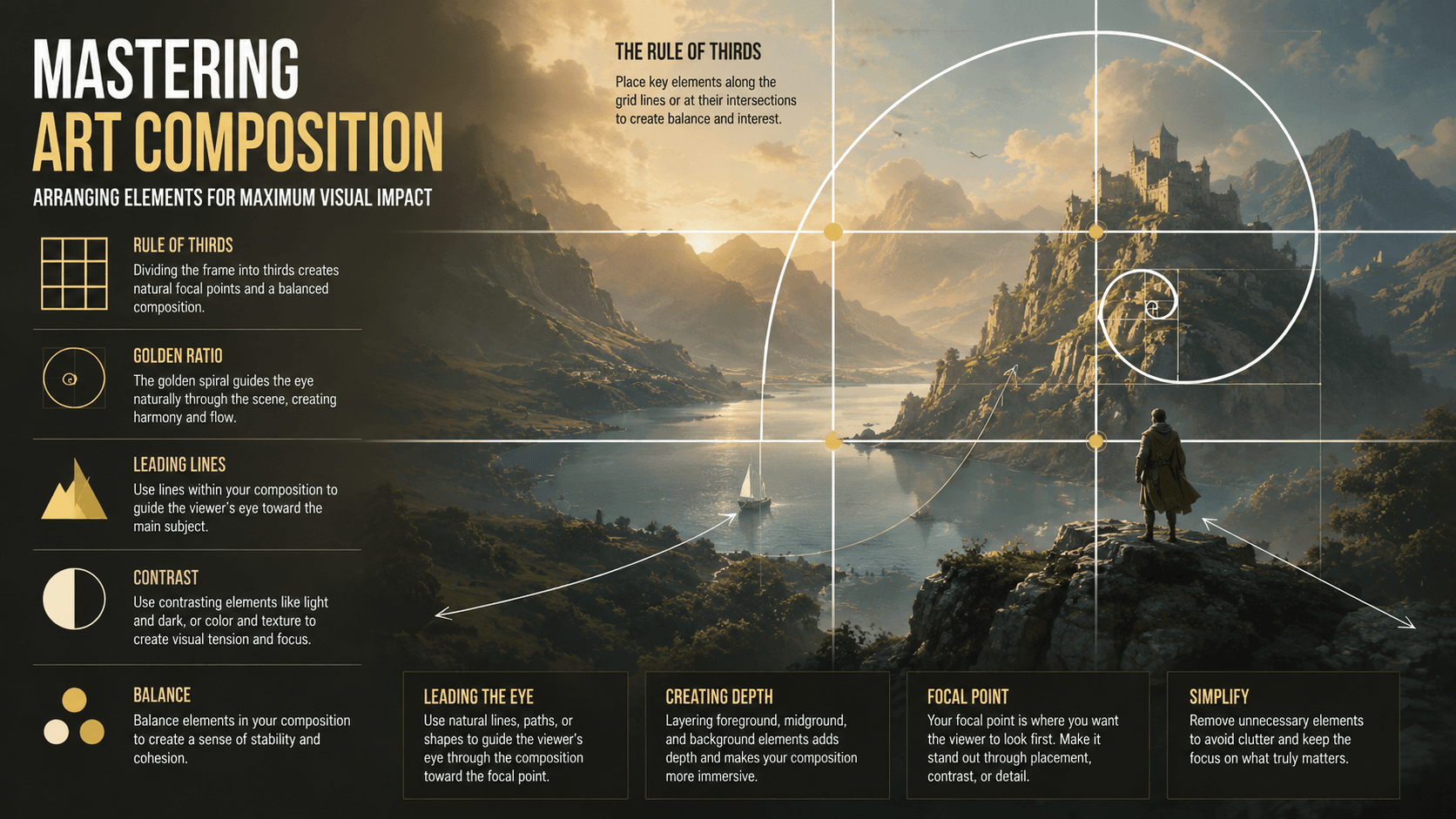
Mastering art composition involves strategically arranging visual elements within your artwork to create a cohesive, balanced, and engaging piece that effectively guides the viewer’s eye and communicates your intended message. By understanding fundamental principles like the Rule of Thirds, leading lines, and negative space, artists can transform a collection of individual components into a powerful and impactful visual narrative.
Keypoint Summary
- Composition is the thoughtful arrangement of visual elements to create a harmonious and impactful artwork.
- Strong composition guides the viewer’s eye, creates balance, and enhances the emotional resonance of a piece.
- Key principles include the Rule of Thirds, leading lines, negative space, and various forms of balance.
- Regular practice, analysis of masterworks, and sketching are essential for developing compositional skills.
What is Composition in Art?
Composition in art refers to the organization, arrangement, and grouping of the visual elements in a work of art. These elements, including line, shape, form, space, color, and texture, are carefully placed by the artist to create a unified and aesthetically pleasing whole. According to the Tate Museum, composition is fundamental to how a viewer perceives and interprets an artwork, influencing everything from emotional response to narrative understanding.
Mastering Art Composition
Learn how artists arrange elements for maximum visual impact.
Rule of Thirds
Divide the canvas into 9 equal sections. Place focal points along the intersecting lines to create more dynamic and balanced compositions.
Composition Tips
- Place important subjects near intersections.
- Avoid centering everything.
- Use empty space to support your focal point.
Why is Strong Composition Essential for Your Artwork?
Strong composition is essential because it dictates how a viewer interacts with your piece, guiding their gaze through the narrative or focal points you wish to emphasize. It creates visual harmony, prevents the artwork from appearing chaotic or unbalanced, and significantly enhances the emotional impact and overall message. Without a well-considered composition, even the most technically proficient painting can fall flat, failing to engage or resonate with its audience.
What are the Fundamental Elements of Composition?
The fundamental elements of composition are the building blocks artists use to construct their work. These include line, which defines shape and form; shape, a two-dimensional area; form, a three-dimensional object; space, the area around and between objects; color, which evokes emotion and creates contrast; texture, the perceived surface quality; and value, the lightness or darkness of a color. Understanding how these elements interact is crucial for creating effective compositions, whether you’re exploring the science of pigments or experimenting with watercolor sponge texture.
How Can You Apply the Rule of Thirds Effectively?
The Rule of Thirds is a compositional guideline that involves dividing your canvas into nine equal sections by two equally spaced horizontal lines and two equally spaced vertical lines. The key is to place your main subject or points of interest along these lines or at their intersections. The Rule of Thirds, a compositional guideline dating back to 1797 with John Thomas Smith’s ‘Remarks on Rural Scenery’ [source: Wikipedia], helps create more dynamic and balanced compositions than simply centering your subject.
What Role Do Leading Lines Play in Guiding the Viewer’s Eye?
Leading lines are actual or implied lines within an artwork that direct the viewer’s eye towards the main subject or a specific point of interest. These can be roads, fences, rivers, or even the arrangement of objects. By strategically incorporating leading lines, artists can create depth, movement, and a clear visual path, effectively controlling the viewer’s journey through the painting and enhancing the narrative, much like how artists use watercolor light and shadows to create depth.
How Does Negative Space Enhance Your Composition?
Negative space refers to the empty space surrounding and between the subjects or elements in an artwork. Far from being insignificant, negative space plays a crucial role in defining the positive space (the subject itself), creating balance, and providing visual breathing room. Thoughtful use of negative space can enhance clarity, create intriguing shapes, and add a sense of calm or tension, which is particularly evident in the abstract revolution where space is often a primary element.
Balancing Elements: Symmetry, Asymmetry, and Radial Balance
Achieving balance is fundamental to a strong composition, ensuring no single area overwhelms another.
- Symmetry involves an even distribution of elements on either side of a central axis, creating a sense of formality and stability.
- Asymmetry achieves balance through contrasting elements that have equal visual weight, offering a more dynamic and informal feel.
- Radial Balance arranges elements around a central point, radiating outwards, often found in mandalas or circular designs, creating a sense of movement and focus.
Using Contrast and Repetition for Visual Interest
Contrast and repetition are powerful tools for adding visual interest and rhythm to your composition. Contrast, whether in color, value, texture, or size, creates focal points and prevents monotony. Repetition, on the other hand, involves using the same or similar elements multiple times, which can establish patterns, create a sense of unity, and guide the viewer’s eye through the artwork. Together, they create a dynamic interplay that captivates the viewer.
Practical Exercises to Improve Your Composition Skills

To truly master composition, consistent practice and observation are key. Start by creating small thumbnail sketches of potential compositions before committing to a larger canvas. Experiment with cropping existing photographs or artworks to see how different arrangements impact the visual flow. Additionally, spend time analyzing the compositional choices in masterworks; studying the works housed at the Museum of Modern Art (MoMA) can provide invaluable insights into how renowned artists like Picasso or Matisse used composition to achieve their artistic goals. Applying these principles is crucial, even when practicing basic still life techniques.

FAQs: Mastering Art Composition
What is the most important compositional rule?
While there isn’t one single “most important” rule, the Rule of Thirds is often considered a foundational guideline for beginners due to its simplicity and effectiveness in creating balanced and dynamic compositions. However, understanding all principles, including balance and focal points, is crucial for versatile artistry.
How can I practice composition without painting?
You can practice composition without painting by sketching thumbnails, arranging objects for photography, analyzing compositions in everyday scenes, or even studying graphic design principles. Cropping existing images digitally is also an excellent way to experiment with different arrangements.
Does composition apply to all art styles?
Yes, composition applies to virtually all art styles, from traditional realism to abstract art. Even in seemingly chaotic abstract pieces, artists consciously arrange elements like color, line, and form to create a specific visual experience or convey emotion.
What is the difference between composition and design?
While often used interchangeably, composition typically refers to the arrangement of elements within a single artwork, focusing on visual harmony and impact. Design, in a broader sense, encompasses the entire creative process, including problem-solving, functionality, and aesthetic considerations across various mediums, not just fine art.

Olly
Olly Farmer M.Sc, B.Sc, PGCE 25 years experience of Watercolor Painting and AI Art; teacher for 13 years; Creator of Art Tools; Art Gallery Contributor of Art Articles to Medium.com, LinkedIn and Facebook
Continue exploring



PROMINENT PAINTING
Keep your creative momentum
Get new painting guides, practical techniques and artist stories delivered without the noise.
Occasional emails. Unsubscribe whenever you like.