
Your paint colors look muddy because your room lighting is tricking your eyes. You do not need an expensive professional studio lamp to fix this. You just need to understand color temperature and the Color Rendering Index (CRI). This guide explains how to buy standard hardware store LED bulbs to mimic daylight and where to place them to avoid annoying glare.
You spent hours mixing the perfect blue. It looked flawless on your palette. You bring the canvas into the daylight the next morning and realize it looks completely wrong.
Bad lighting ruins good color mixing. Standard living room lamps cast a warm yellow hue over your workspace. This tricks your eyes into overcompensating with cool tones. The result is a muddy painting when viewed under natural light. You might think you need to spend hundreds of dollars on specialized artist lamps to fix this. You do not.
You can build a reliable lighting setup for under $50 using basic bulbs from your local hardware store. Backed by my decade of teaching art, I have seen hundreds of students struggle with this exact problem. This guide shows you exactly what to look for on the box and how to position your lights to stop your own hand from casting shadows over your work.
Why Do My Paint Colors Look Muddy Indoors?
Your paint colors look muddy indoors because warm yellow household lighting alters how you see wet paint. Your brain automatically compensates for this yellow cast by adding more blue and cool tones to your mixtures, resulting in dull, lifeless colors under natural daylight.
The human eye is easily fooled. When you paint under standard incandescent bulbs, everything takes on an amber tint. The American Academy of Ophthalmology notes that human color perception shifts dramatically depending on the ambient light source.
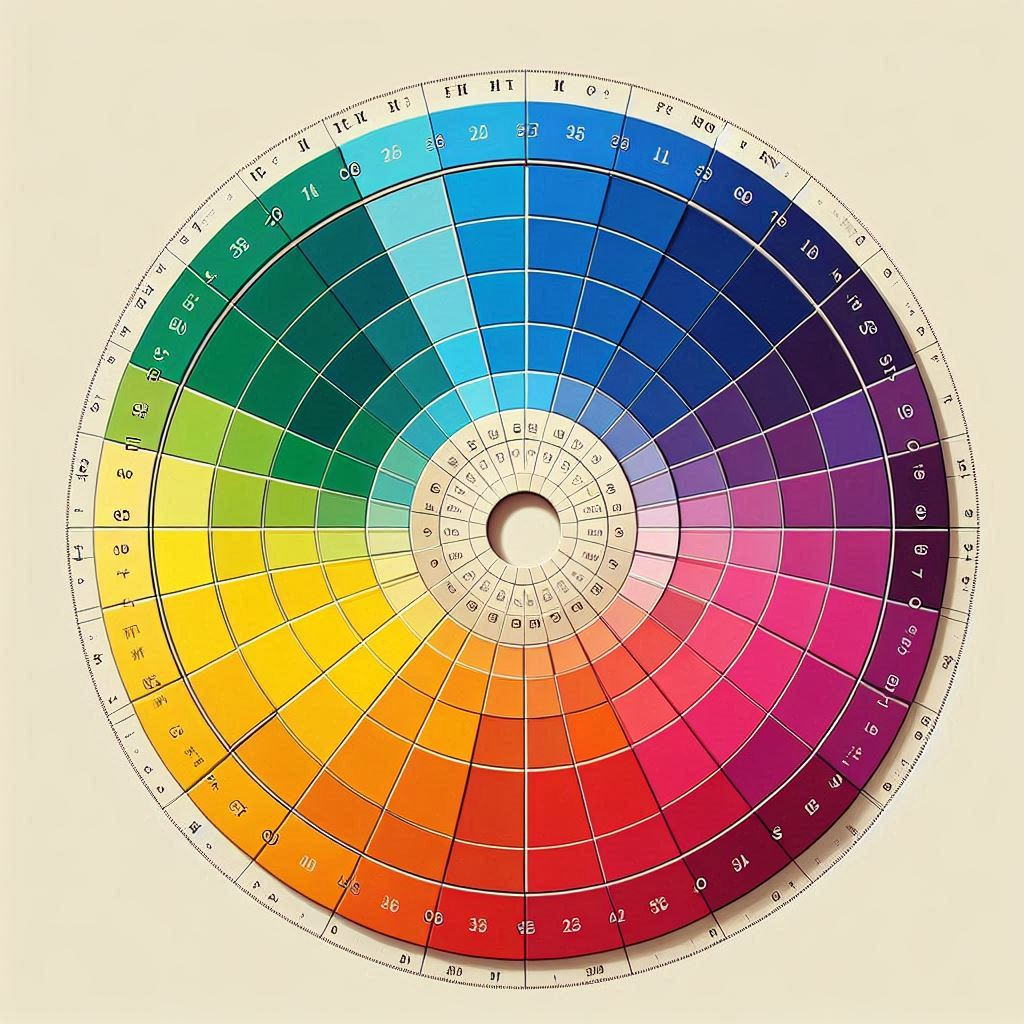
If you want to understand the basics of this interaction, mastering color theory basics is a good place to start. A poor light source makes accurate color mixing impossible.
What Is the Best Color Temperature for Art Studios?
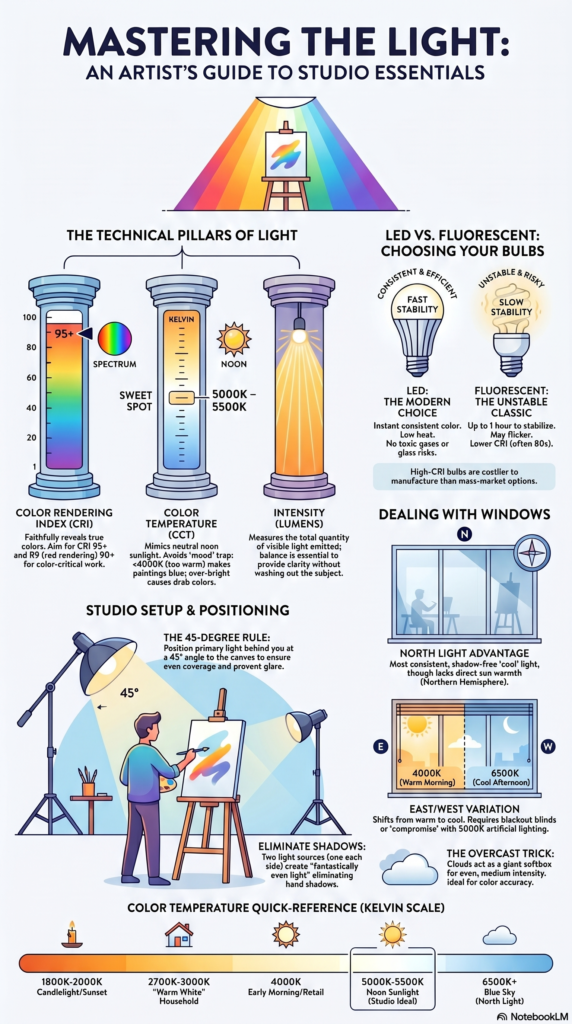
The best color temperature for an art studio is between 5000K and 5500K. This specific range mimics the cool, neutral quality of north-facing natural daylight, ensuring the colors you mix on your palette look exactly the same when displayed in a normal room or gallery.
Color temperature is measured in Kelvin (K). A standard living room lamp sits around 2700K. That is far too warm. According to the Illuminating Engineering Society, a 5000K source provides the neutral baseline necessary for accurate color matching. Buying bulbs in this exact range stops the frustrating guesswork.
What Does CRI Mean for Painting?
The Color Rendering Index (CRI) measures how accurately a light source reveals the true colors of an object compared to natural sunlight. Painters need bulbs with a CRI rating of 90 or higher to ensure reds, blues, and yellows appear vibrant and accurate.
You can have the correct 5000K color temperature but still struggle if your CRI is too low. The Department of Energy defines CRI on a scale from 0 to 100, with higher numbers indicating better color accuracy.
A cheap LED might have a CRI of 70. This makes your vibrant reds look flat and brown. Always check the packaging for a CRI of 90+.
The Budget-Friendly Hardware Store Hack
Do not type “artist studio lamp” into Amazon. You will pay a massive premium for the label. Go to a local hardware store instead. Look for standard LED garage or photography clamp lights.
Philips lighting data shows that high-CRI consumer LEDs perform nearly identically to specialized studio bulbs. Grabbing two of these clamp lights keeps your painting supplies budget low while instantly upgrading your workspace.
Where Should I Place My Lights to Avoid Glare?
You should place your studio lights at a 45-degree angle to your canvas. Position one light on your left and one on your right to eliminate harsh shadows and prevent the glossy surface of wet paint from reflecting bright glare back into your eyes.
Direct lighting causes blinding hot spots on wet oil and acrylic surfaces. Angling your lights fixes this immediately. Proper positioning also stops your own hand and brush from casting dark shadows over your workspace. Architectural Digest recommends this dual-angle approach for illuminating flat artwork effectively.
Mastering this physical light and shadow interaction makes the physical act of painting much easier.
Simple Setup Tweaks for Oil and Acrylic Painters
Different mediums reflect light differently. Wet acrylic paint is highly reflective. Golden Artist Colors explains that wet acrylics have a glossy sheen that flattens out as the water evaporates. If the glare is too much, tilt your easel slightly forward to redirect the reflection toward the floor.
If you are exploring oil painting for beginners, remember that varnishes and mediums stay glossy much longer. You must rely on that 45-degree angle rule to see your true colors clearly from start to finish.
Stop blaming your color mixing skills when your lighting is the real problem. Head to the hardware store and check the boxes for 5000K and 90+ CRI. Adjust your lamps to a 45-degree angle to kill the glare. If you are currently struggling with ruined canvases, learning about fixing painting mistakes is helpful. But fixing the light source prevents them in the first place.
Take a photo of your current painting setup. Share it in the Prominent Painting Community Gallery so we can give you specific feedback on your lighting. Fix your lights today and your colors will immediately follow suit.
Frequently Asked Questions
- Do I need fluorescent or LED bulbs for my art studio? You need LED bulbs. They run much cooler than traditional options and provide highly accurate color rendering without the flicker associated with old fluorescent tubes.
- Can I mix warm and cool lights while painting? You should never mix warm and cool lights in your studio. This creates conflicting color casts on your canvas and makes accurate color mixing impossible. Stick entirely to a uniform 5000K setup.
- How many lumens do I need to light a medium-sized canvas? A standard medium-sized canvas requires around 1500 to 2000 lumens of light. This is roughly equivalent to a traditional 100-watt bulb, ensuring your workspace is bright enough to see subtle contrast shifts.
- Why does my acrylic paint look glossy and hard to see under direct light? Wet acrylic polymer reflects light intensely. Tilting your easel forward slightly or moving your light source to a 45-degree angle will instantly remove this glare from your line of sight.
- Is north-facing natural light really better than artificial light? North-facing windows provide cool and consistent indirect sunlight throughout the day. It is the historical gold standard for painters. Modern high-CRI 5000K LEDs replicate this effect perfectly for artists who paint at night or lack big windows.