
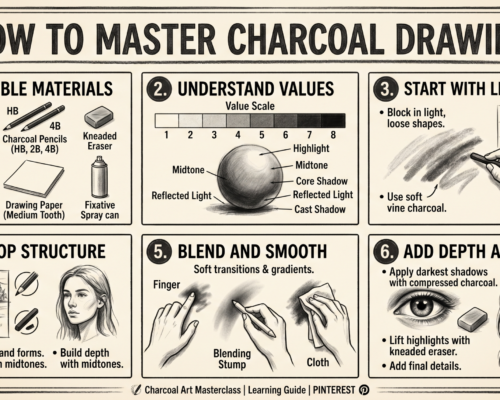
Summary: Learn how to start charcoal drawing with this simple, beginner-friendly guide. We break down the essential tools you need, from willow sticks to kneaded erasers, and show you how to master light, shadow, and blending without the mess. Read this guide to conquer your fear of the blank page and start creating dramatic, expressive art today.

Charcoal drawing is messy, intense, and completely liberating, yet many beginners avoid it because it feels impossible to control. They look at a dusty black stick and see a recipe for ruined clothes and muddy papers. The reality is much more exciting. Mastering charcoal drawing does not require years of formal training; it just requires a willingness to get your hands dirty. If you have been looking for an entry point into visual art, our drawing for beginners basics guide shows that charcoal is one of the most forgiving, immediate mediums you can choose. We will skip the complex jargon and dive straight into the foundational techniques that turn dark smudges into beautiful, high-contrast art.
What Supplies Do You Need for Charcoal Drawing?
To start charcoal drawing, you need vine or willow charcoal for light sketching, compressed charcoal for deep blacks, a kneaded eraser to lift highlights, and textured drawing paper like Canson Mi-Teintes. A rag or blending stump is also helpful for smoothing transitions.
When you walk into an art supply store, the options can feel overwhelming. Here is the simple breakdown of what actually matters for your first session:
- Willow and Vine Charcoal: These are natural burnt twigs. They are incredibly soft, light, and easy to wipe away with your thumb. Use them for your initial layout.
- Compressed Charcoal: This is charcoal powder mixed with a gum binder. It is hard, intense, and creates permanent, velvety blacks that give your work real drama.
- Kneaded Erasers: Forget the pink rubber erasers from school. A kneaded eraser looks like grey putty. You shape it into points to lift pigment off the page, effectively drawing with light.
- The Paper: Standard printer paper is too smooth. You need paper with a noticeable texture, known as a “tooth,” which acts like a grater to pull the charcoal dust off the stick and hold it in place.
How Do You Blend Charcoal Without Smudging Your Entire Paper?
Blend charcoal by using a paper tortillon, a blending stump, or a dry paper towel for precise control. If you prefer using your fingers, use the pad of your ring finger with incredibly light pressure to avoid transferring natural skin oils onto the drawing surface.
The biggest mistake beginners make is rubbing the page with their entire palm. This forces the dust into the grain of the paper permanently, creating a flat, grey fog. Instead, think of blending as a deliberate structural choice. Use a paper blending stump for tiny areas like the glint in an eye. For larger gradients, a soft piece of chamois leather or a simple household makeup sponge works beautifully. Always blend from your lighter values toward your darkest areas to keep your highlights clean.
Mastering Light and Shadow
Charcoal simplifies the visual world by stripping away the distraction of color. It forces you to look at a subject purely in terms of value, which is how light or dark something is. When you sit down to draw, do not outline the subject. Instead, look for the shapes of the shadows.
Our comprehensive guide to light and shadow outlines how blocking in large values creates three-dimensional weight. Squint your eyes at your subject until the details blur. You will suddenly see big blocks of darkness and bright patches of light. Use the side of a willow stick to mass in those dark shapes quickly. Once the background shadow is established, use your kneaded eraser to punch out the highlights where the light hits the surface directly. This push-and-pull process builds incredible depth in minutes.
Why Every Beginner Should Start with Gestural Drawing
Beginners should start with gestural drawing because it builds muscle memory, destroys the fear of the blank page, and teaches you to capture the energy and movement of a subject in less than two minutes without obsessing over tiny details.
When I teach drawing classes, I notice that beginners often freeze up when looking at a blank white sheet. They sit with a sharp charcoal pencil, trying to map out a perfect line. Gestural drawing is the antidote to this creative paralysis.
Set a kitchen timer for ninety seconds. Choose a subject from our list of easy things to draw, like a coffee mug, a houseplant, or a pair of boots. Hold your charcoal stick from the very back, using your entire arm from the shoulder rather than flexing your wrist. Move the stick rapidly across the page to capture the posture, weight, and speed of the object. Do not look at your paper; keep your eyes glued to the subject. The results will look wild and sketchy, but they will possess a striking vitality that stiff, over-calculated drawings completely lack.
Protecting Your Finished Artwork
Because charcoal is a loose powder sitting on top of paper fibers, a single stray thumb can erase an hour of hard work. To preserve your creation, you need to apply an artist’s fixative spray.
Always spray your work in a well-ventilated space or outdoors. Hold the can roughly twelve inches away from the surface and apply a very light, even mist across the page. Never flood the paper, as heavy wet fixative will dissolve your delicate grey midtones and turn them jet black. If you do not have fixative on hand, a cheap cans of aerosol unscented hairspray can work as a temporary substitute in a pinch. Once dry, store your drawings with sheets of smooth glassine paper between them to prevent friction smudging.

Conclusion
Charcoal is not a medium that rewards neatness or timid, delicate lines. It is a raw dialogue between adding darkness and revealing light. It forces you to be bold, move your entire arm, and accept the beauty of an accidental smudge. Grab a stick of willow charcoal, open your sketchbook, and make a glorious mess. If you find yourself stuck for inspiration or need an extra spark to keep your daily drawing habit alive, explore these creative sketchbook ideas to keep your creative momentum moving forward.
Frequently Asked Questions
What is the difference between vine and compressed charcoal?
Vine charcoal is raw, burnt willow wood that is soft, powdery, and incredibly easy to erase or blend. Compressed charcoal is pressed powder mixed with a clay binder, making it much darker, harder, and permanent on the page.
Does charcoal drawing rub off over time?
Yes, unfixed charcoal remains a loose powder on the paper surface and will smudge if touched. Applying a light layer of artist spray fixative binds the particles to the paper fibers permanently.
What is the best paper texture for charcoal?
The best paper has a textured surface, or “tooth,” such as pastel paper, charcoal paper, or heavy-weight mixed media paper. Smooth printer paper cannot hold onto the loose charcoal dust effectively.
Can you erase compressed charcoal completely?
No, compressed charcoal contains binders that stain the paper fibers deeply. While a kneaded eraser can lighten the mark significantly, it will rarely return the paper to pure white.
How do you keep your hands clean while using charcoal?
You can use a barrier cream before drawing, hold your sticks using a dedicated plastic charcoal holder, or keep a wet rag nearby. Many artists also wear a lightweight drawing glove that covers the pinky and ring finger.

Olly
Olly Farmer M.Sc, B.Sc, PGCE 25 years experience of Watercolor Painting and AI Art; teacher for 13 years; Creator of Art Tools; Art Gallery Contributor of Art Articles to Medium.com, LinkedIn and Facebook
Continue exploring
PROMINENT PAINTING
Keep your creative momentum
Get new painting guides, practical techniques and artist stories delivered without the noise.
Occasional emails. Unsubscribe whenever you like.