
Summary: Learn the crucial differences between original paintings and mass-produced prints. Discover simple visual tests, understand the mechanics of commercial printing, and buy your next piece of art with total confidence. Skip the guesswork and train your eyes today.
You spot a beautiful canvas across a crowded thrift store. Your pulse quickens. You step closer. You hold the artwork in your hands, wondering if the vibrant colors staring back at you are the actual strokes of a passionate artist or the mechanical output of a modern inkjet printer. The art reproduction industry has exploded recently. By 2033, the global art print market is projected to reach an astonishing $9.13 billion, driven by massive online demand. Millions of copies circulate daily. You need to know exactly what you are holding. Trusting your instincts is good, but knowing the facts is better.
How Do I Spot the Difference Using the Texture Test?

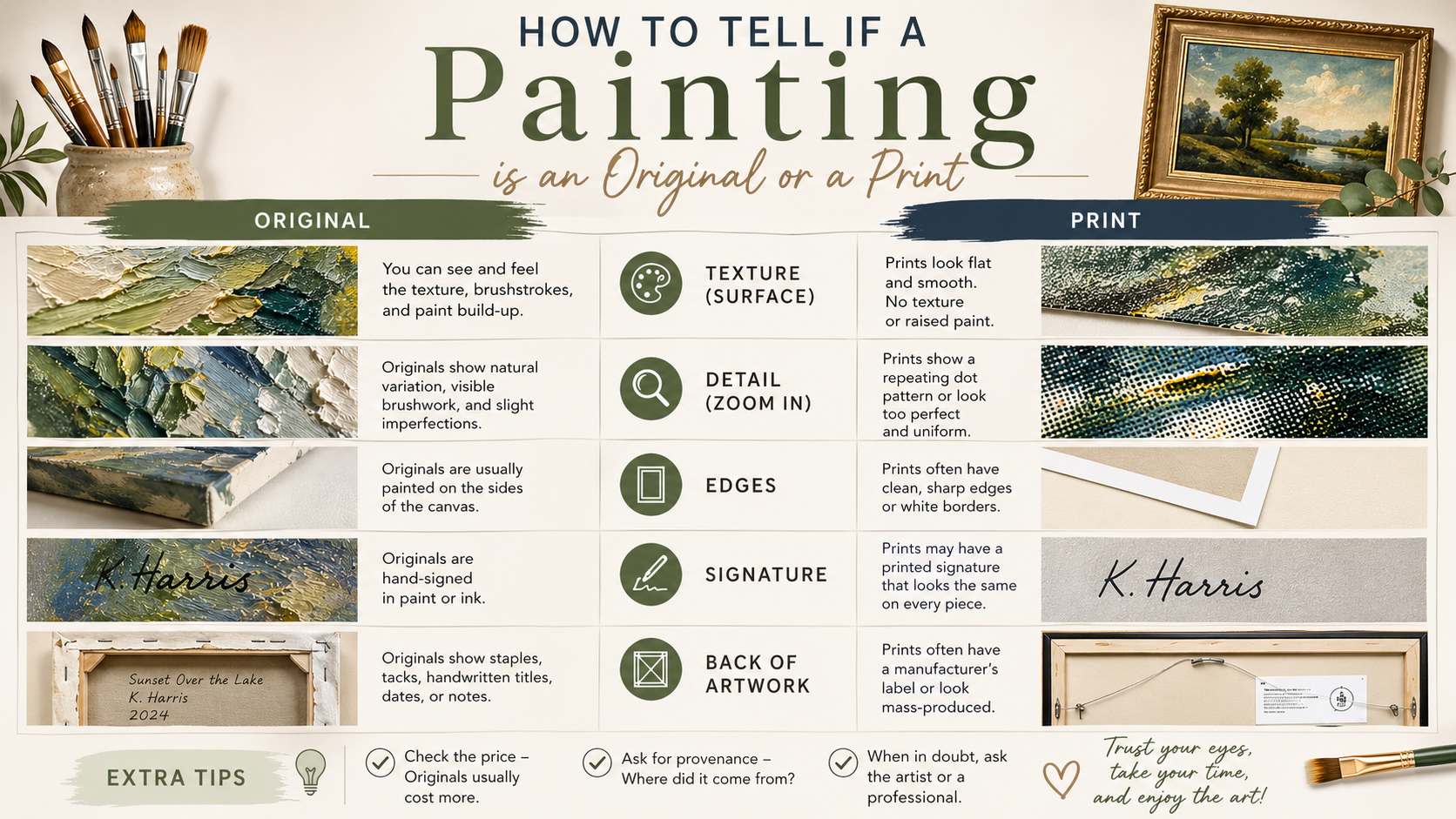
An original painting has physical depth, while a standard print lies perfectly flat against the canvas. Turn the artwork to its side and hold it near a strong light. If you see raised brushstrokes and textured paint, it is an original piece of art.
Texture is the absolute easiest giveaway. Artists use mediums like oil and acrylic that dry with a heavily raised finish. This creates a surface full of dynamic peaks and valleys. When ambient light hits an original painting, those tiny bumps cast actual shadows. A basic commercial print simply cannot replicate this physical depth.
Some sophisticated prints might have a fake, uniform texture applied over the whole surface. Real brushstrokes align perfectly with the painted image. To dive deeper into the physical properties of paint, you can explore our guide to art mediums.
What Does the Magnifying Glass Test Reveal?
A magnifying glass exposes the mechanical dot matrix pattern used by commercial printers. If you look closely and see tiny clusters of colored dots forming the image, you are looking at a print. Original artwork always displays solid, continuous layers of pigment.
Every commercial printing machine uses color layering to build an image. It sprays millions of tiny dots onto paper or canvas to create an optical illusion of a blended picture. Grab a simple magnifying glass or use the macro lens on your smartphone. If you see a grid of tiny dots, the mystery is officially solved.
Real paintings show fluid, unbroken strokes of color. There is no grid. This mechanical precision is a clear indicator to look out for when you are trying to understand what makes paintings valuable.
Inspecting the Edges and Back of the Canvas
Turn the piece over immediately. The back of a canvas tells a compelling and honest story. Original pieces often feature uneven staples, raw wooden stretcher bars, and chaotic paint splatters. The artist leaves messy, human traces behind. You will usually see drips of color wrapping organically around the wooden frame.
Prints look entirely different from behind. A factory-made print usually boasts crisp, perfectly stapled edges with an unnaturally white canvas. Mass-produced items rarely have accidental paint smudges on the back. Sometimes, a manufacturer will mirror the front image perfectly around the sides of the stretcher bars. If the back looks too perfect, it probably came from a factory line.
What Are Giclée Prints and Are They Originals?
A giclée is a high-resolution reproduction of an artwork, not a one-of-a-kind original painting. While they are printed on premium canvas using archival inks, they remain copies. They can be incredibly beautiful and highly collectible, but they are never true originals.
Giclée printing is highly respected in the art community. These prints use fade-resistant inks and capture stunning details. However, you must treat them as high-quality reproductions. Today, 59% of collectors purchase art online, skyrocketing the demand for affordable prints. Do not pay original painting prices for a giclée reproduction. If you want beautiful decorations without breaking the bank, look into budget art prints instead.
The Signature Check and Aging Signs
Look closely at the artist’s signature. A real signature is added after the painting is finished. It should sit proudly on top of the background paint. If the signature looks completely flat or pixelated under a magnifying glass, it is just a printed copy of the original signature.
Authentic older paintings also develop natural signs of aging. Over decades, genuine works often develop craquelure, a fine network of cracks across the surface. Forgers and printmakers sometimes try to fake this patina using chemicals or tea stains, but experts can spot the difference. Understanding proper art preservation will help you recognize genuine age markers quickly. If the paint smells fresh or the canvas looks pristine despite a claimed age of fifty years, walk away.
You possess the tools to spot the difference now. Physical ownership of fine art offers incredible long-term stability compared to other assets. Keep your magnifying glass handy. Turn canvases over. Look for the messy, beautiful marks of human creation. If you are ready to start building your collection with verified pieces, browse the selection to buy original artwork online in our mARTket.
Frequently Asked Questions
- What is the water test for an original painting? You can lightly wipe a damp cotton swab on a small, hidden corner of the canvas. If color comes off on the swab, you are likely dealing with water-soluble printer ink, meaning it is a print. Professional oil and acrylic paints will not smudge with plain water.
- Do all original paintings have texture? No, not all originals are textured. Watercolor paintings and some very thinly layered acrylic works feel completely smooth to the touch. You must rely on the magnifying glass test to check for dot matrix patterns in these specific cases.
- Can a print be painted over? Yes, this is known as an embellished print. An artist will take a mass-produced print and add real paint strokes over specific areas to add texture and uniqueness. You can identify these by checking if the brushstrokes cover the entire canvas or just isolated spots.
- Why do my canvas prints look like paintings? Modern printing technology uses high-resolution imaging and textured canvases to mimic the look of original art perfectly. Some companies even print a false texture onto the canvas to fool the naked eye. Always use a magnifying glass to check for pixels.
- Are numbered prints considered original art? Numbered prints belong to a limited edition, meaning the artist only authorized a specific number of copies. They are valuable and collectible, but they are still reproductions, not unique original paintings.

Olly
Olly Farmer M.Sc, B.Sc, PGCE 25 years experience of Watercolor Painting and AI Art; teacher for 13 years; Creator of Art Tools; Art Gallery Contributor of Art Articles to Medium.com, LinkedIn and Facebook
Continue exploring

PROMINENT PAINTING
Keep your creative momentum
Get new painting guides, practical techniques and artist stories delivered without the noise.
Occasional emails. Unsubscribe whenever you like.