
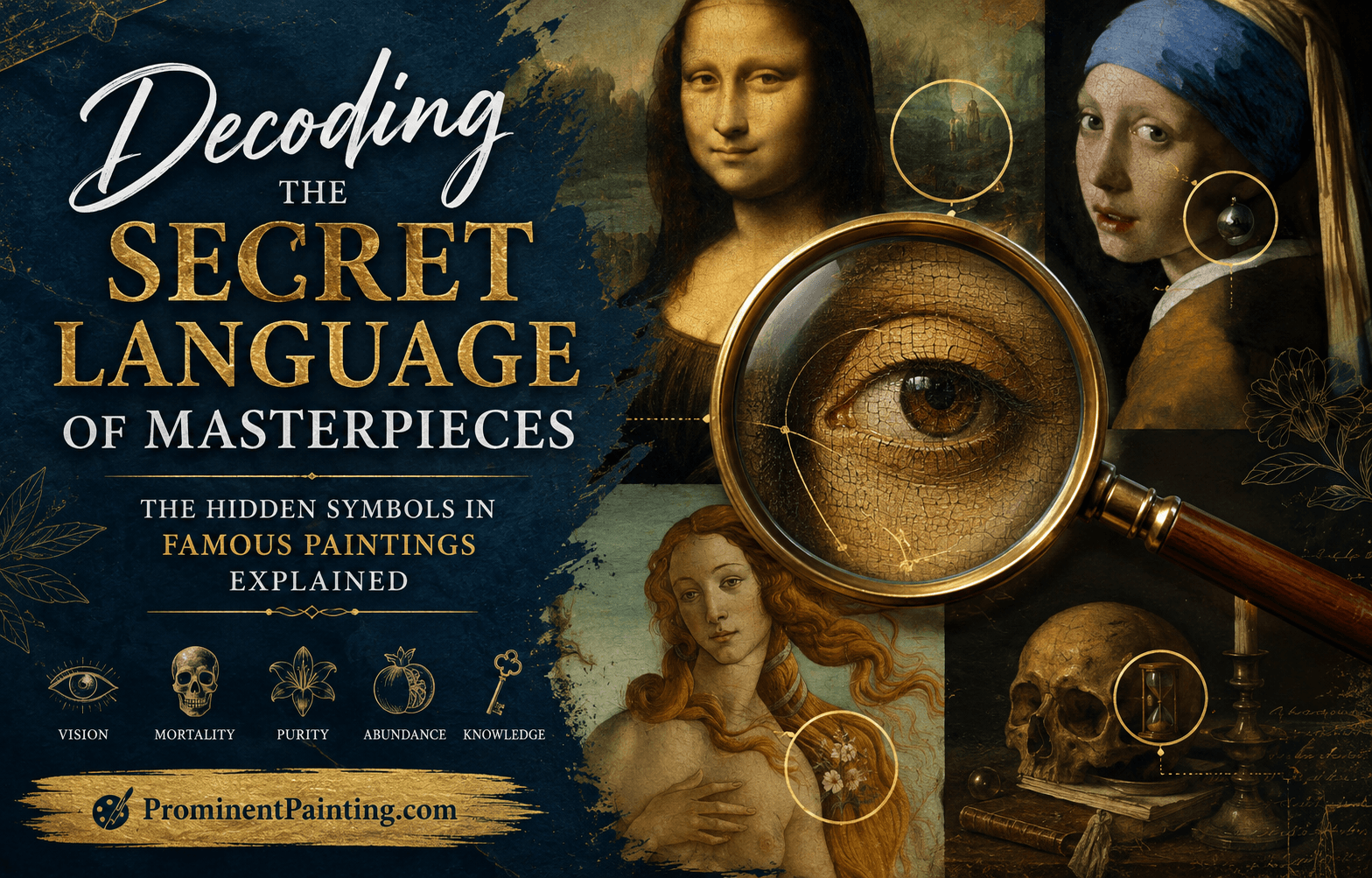
Great paintings rarely show objects by accident. You stand in front of a centuries-old oil painting, admire the brushwork, and yet you cannot shake the feeling that you are missing the real conversation. Masters like Leonardo da Vinci and Johannes Vermeer did not just paint what they saw; they hid deep secrets right in plain sight.
Learning to decode these visual puzzles completely transforms how you look at a canvas, changing you from a passive viewer into an active art detective. Art historians regularly use iconographical frameworks to show that tiny details carry massive structural narratives. By understanding why an artist added a stray dog, an oversized piece of fruit, or a broken musical string, you can peel back the layers of history. Our latest infographic highlights six legendary artworks packed with hidden meanings in famous paintings. Let us demystify these masterpieces together and unlock the silent language of the past.
Can a Single Object Completely Change a Painting’s Meaning?

Yes. Everyday objects in historical art frequently represent deep religious, cultural, or social themes rather than simple decorations. Spotting these recurring visual clues reveals the hidden narratives that artists intentionally wove into their compositions, turning a simple portrait into a complex legal or moral statement.
Take Jan van Eyck’s The Arnolfini Portrait (1434) as a prime example. To a modern viewer, it looks like a wealthy couple standing in a bedroom. However, Northern Renaissance art heavily relied on domestic item symbolism to convey status and spirituality. The small dog at the couple’s feet is not just a beloved pet; it is a literal emblem of marital loyalty and fidelity. Look up at the chandelier, and you will notice a single lit candle burning in broad daylight. This single flame represents a divine presence, serving as a heavenly witness to the couple’s vows.
Even the layout of the room functions as a narrative device. The convex mirror on the back wall reflects the entire room, revealing two hidden figures entering the doorway. One of these figures is widely believed to be van Eyck himself, transforming the canvas into a legal marriage document. Furthermore, the casual scattering of oranges on the window sill acts as a loud declaration of immense wealth. In 15th-century Flanders, fresh citrus fruits were incredibly expensive, exotic imports that signaled prosperity. Every element is a deliberate choice, proving that mastering art symbolism requires looking beyond the surface.
| Painting Element | Apparent Object | Hidden Symbolic Meaning |
|---|---|---|
| The Small Dog | Household Pet | Marital Loyalty & Fidelity |
| Single Lit Candle | Lighting Source | Divine Presence & Witness |
| Convex Mirror | Wall Decoration | The Artist’s Secret Witness |
| Fresh Oranges | Casual Snack | Wealth, Status, & Prosperity |
Hidden Messages In Renaissance Masterpieces
When we move from Flanders to Italy, the visual codes shift from domestic objects to structural geometry and dramatic human gestures. Leonardo da Vinci’s The Last Supper (1495–1498) is celebrated for its perspective, but its emotional power relies on a tightly engineered network of classical iconography.
Leonardo forces your eyes straight to the center of the chaos using a distinct mathematical layout. Christ’s body forms an explicit, stable triangle. In Renaissance art, this pyramid shape emphasizes divinity, stability, and the idea of Christ as an unshakeable foundation. The apostles are not scattered randomly across the long table either. They are arranged intentionally into four distinct groups of three. This rhythmic repetition of three echoes the Christian doctrine of the Holy Trinity, turning the physical composition of the crowd into a silent sermon.

The human drama also hides specific clues about betrayal. Look closely at Judas Iscariot. Leonardo paints him with a closed, defensive posture, physically pulling his face into shadow. Under his hand, you can spot a small container of spilled salt on the table. In ancient Mediterranean cultures, spilling salt was a highly recognizable omen of impending doom, betrayal, and social disorder. Before a single word is spoken, the architecture of the composition reveals the tragedy about to unfold.
What Do Strange Creatures and Oversized Fruit Mean in Art?
Unusual scale and bizarre figures generally serve as moral warnings or representations of human desire. In Northern Renaissance art, these surreal elements contrasted fleeting earthly pleasures with severe spiritual consequences, acting as a visual mirror to show the dark side of human nature.
Hieronymus Bosch’s The Garden of Earthly Delights (c. 1490–1510) takes this approach to an unforgettable extreme. His sprawling triptych is a chaotic playground filled with strange creatures and massive, oversized strawberries. To Bosch’s contemporary audience at the Museo del Prado, oversized fruit was a well-understood metaphor for hollow, fleeting pleasures that rot away quickly. The bizarre, hybrid beasts represents the dangerous temptations that lead humanity astray. Even the musical instruments in the hell panel cease to be joyful, turning into literal tools of physical punishment and moral warnings for a life led in sin.
| Art Element | Symbolism / Meaning |
| Oversized Fruit | Symbolizes Fleeting Earthly Pleasure |
| Strange Creatures | Symbolizes Sinful Temptation & Danger |
| Instruments in Hell | Symbolizes Moral Warning & Punishment |
A few decades later, Hans Holbein the Younger used a different kind of visual trick to send a similar message in The Ambassadors (1533). At the bottom of the dual portrait sits a strange, distorted grey shape. To see it correctly, you must stand at an extreme angle to the canvas. The object resolves into a human skull, acting as a classic memento mori, a Latin phrase reminding viewers of their own mortality. By mixing scientific tools of worldly power with a hidden skull, Holbein reminds us that death eventually humbles all human ambition.
Breaking the Fourth Wall: Visual Metaphors of the Artist
In the Baroque era, painters began using symbols to comment on the nature of painting itself. Diego Velázquez’s Las Meninas (1656) is a brilliant psychological puzzle that explores the complicated relationship between reality, illusion, and royal status.
Velázquez steps completely outside of traditional boundaries by including himself in the scene, standing at a massive canvas with his brush poised. He looks directly at us, claiming his role as an intellectual creator rather than a simple craftsman. The true trick lies in the mirror on the back wall. Instead of reflecting the room, the mirror displays the faces of King Philip IV of Spain and Queen Mariana. The royal presence exists only as a flat reflection, turning the physical space upside down. An open doorway in the background invites a sudden burst of bright light and mystery, leaving us to wonder who is truly watching whom.
Why Do Vermeer’s Portraits Feel So Intimate?
Johannes Vermeer achieved intense intimacy by using minimalist dark backgrounds and direct, engaging gazes. This clean design isolates the subject entirely, forcing a personal, quiet connection between the viewer and the painted figure without any distracting background elements.
In Girl with a Pearl Earring (c. 1665), Vermeer leaves out the busy domestic interiors that define most of his work. By placing the girl against a deep, dark void, he removes all worldly context. The large pearl earring catches a single, brilliant glint of light, symbolizing purity, luxury, and illusion all at once. Her soft gaze and parted lips create a striking sense of immediate mystery, inviting us into a private moment that feels entirely timeless.
Turning Inspection Into Creation
Cracking the code of art history does not require an advanced academic degree. It just takes a willingness to slow down, look closer, and ask questions about the unexpected details hiding on the canvas. When you understand the secret language of art, your relationship with painting changes forever. You stop merely looking at a flat surface, and you start actively participating in a historical dialogue.
If you are a beginner looking to understand your favorite works, let these master symbols inspire your own creative journey. Pick up a brush, look at our guides on paintings with deep meaning, and start telling your own stories through the objects you choose to paint.
FAQs: Hidden Symbols in Famous Paintings
Why did historical artists hide symbols in their paintings instead of writing down the meaning?
Many historical periods featured low literacy rates among the general public, making visual symbols the most effective universal language available. Furthermore, adding layered allegories allowed artists to communicate controversial political or religious ideas safely while showing off their intellectual wit to wealthy, educated patrons.
What is a memento mori symbol, and where can I find one?
A memento mori is any artistic symbol designed to remind viewers of the inevitability of death and the transience of earthly life. The most common example is a human skull, but you can also spot them as hourglasses, extinguishing candles, or rotting fruit in classic still-life paintings.
How can I tell if an object in a painting is a deliberate symbol or just a random decoration?
You can identify intentional symbolism by looking for repeated objects across works from the same era or noticing details that seem out of place. If an object receives unusual lighting, strange placement, or unrealistic scaling, the artist is almost certainly using it to convey a deeper narrative.
What does a mirror typically symbolize in classical oil paintings?
Mirrors traditionally represent truth, self-reflection, and vanity, acting as a witness to the hidden reality of a scene. In complex Baroque works, artists also used mirrors as optical tools to play with perspective and draw the viewer directly into the environment.
Are the hidden symbols in Renaissance art universally understood across all cultures?
No, artistic symbols are heavily dependent on specific historical, religious, and cultural contexts. A symbol that held a clear spiritual meaning in 15th-century Europe might represent something completely different, or carry no meaning at all, in Eastern or modern artistic traditions.
Citations:
| # | Source | Specific Insight | Section |
| 1 | The National Gallery London | Historical context on the Arnolfini Portrait symbolism | Can a Single Object Completely Change a Painting’s Meaning? |
| 2 | The Louvre Museum | Renaissance compositional geometry and Leonardo’s techniques | Hidden Messages In Renaissance Masterpieces |
| 3 | Museo del Prado | Moral warnings and fantasy analysis of Bosch’s triptych | What Do Strange Creatures and Oversized Fruit Mean in Art? |
| 4 | The Royal Collection Trust | Historical use of memento mori symbols and skulls in art | What Do Strange Creatures and Oversized Fruit Mean in Art? |
| 5 | Mauritshuis Museum | Visual analysis of Vermeer’s lighting and tronie portrait style | Why Do Vermeer’s Portraits Feel So Intimate? |
| 6 | Heidelberg University Library | Academic data regarding Northern Renaissance domestic symbolism | Can a Single Object Completely Change a Painting’s Meaning? |
| 7 | The Warburg Institute | Studies on classical iconography and hidden gestures in paintings | Hidden Messages In Renaissance Masterpieces |
| 8 | The Metropolitan Museum of Art | Research on mirror metaphors and perspectives in Baroque art | Breaking the Fourth Wall: Visual Metaphors of the Artist |

Olly
Olly Farmer M.Sc, B.Sc, PGCE 25 years experience of Watercolor Painting and AI Art; teacher for 13 years; Creator of Art Tools; Art Gallery Contributor of Art Articles to Medium.com, LinkedIn and Facebook
Continue exploring


PROMINENT PAINTING
Keep your creative momentum
Get new painting guides, practical techniques and artist stories delivered without the noise.
Occasional emails. Unsubscribe whenever you like.