
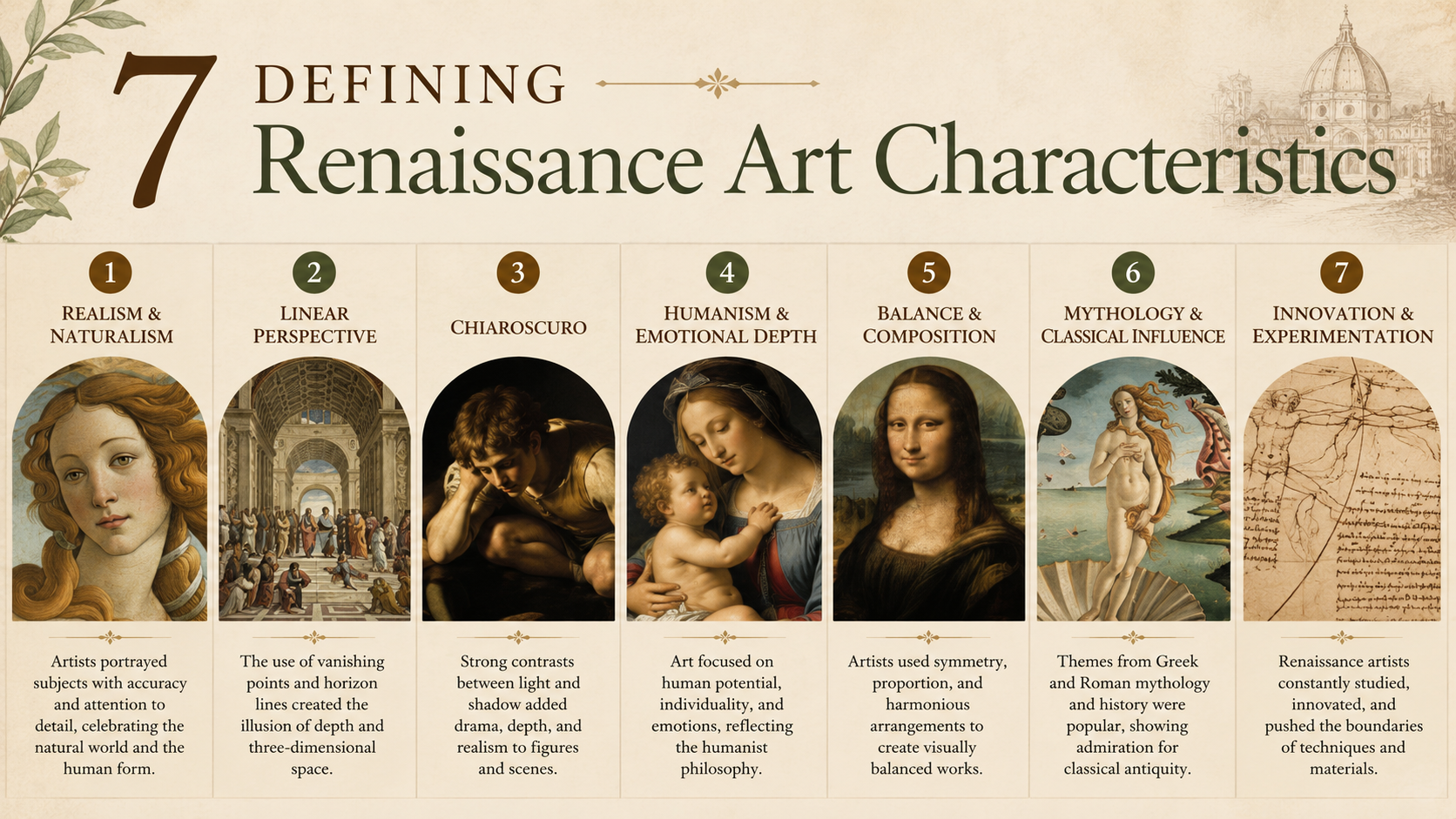
Flat, lifeless figures vanished from canvases in the fifteenth century. Artists stopped painting what they imagined and started painting what they actually saw. They became scientists, mathematicians, and careful observers of nature. Art changed forever.
I have seen my students light up when they finally grasp these concepts. They realize that the old masters were just artists solving visual problems. You do not need a time machine to understand their brilliance. You just need to look closely at the mechanics of their work. If you are exploring a beginner’s guide to Renaissance art, you will quickly notice recurring themes. They obsessed over depth, light, and the human form. By studying these seven defining characteristics, you can borrow their genius to improve your own painting practice today.
7 Defining Characteristics of Renaissance Art
| Characteristic | Description | Significance |
|---|---|---|
| Linear Perspective | A mathematical system utilizing a single vanishing point to create the illusion of depth. | Transformed flat surfaces into “windows” that realistically mimicked three-dimensional space. |
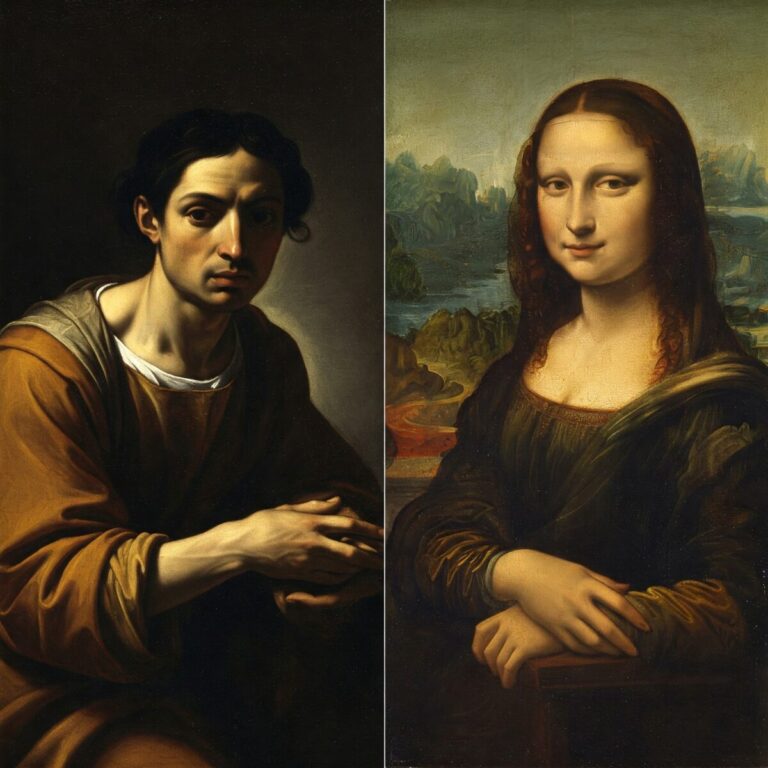
| Chiaroscuro | The treatment of light and shade in drawing and painting to create a sense of three-dimensional form. | Allowed artists to create figures that looked solid and tangible rather than flat icons. |
| Humanism | A focus on human potential, achievements, and the accurate portrayal of human emotion. | Moved art toward the “individual,” making even divine figures appear more relatable and human. |
| Naturalism | The representation of the physical world with anatomical precision and environmental accuracy. | Resulted from intense scientific observation, including the study of human musculature and botany. |
| Sfumato | A technique of blurring or softening sharp outlines by subtle blending of one tone into another. | Produced a “smoky” realism that eliminated harsh lines, notably used by Leonardo da Vinci. |
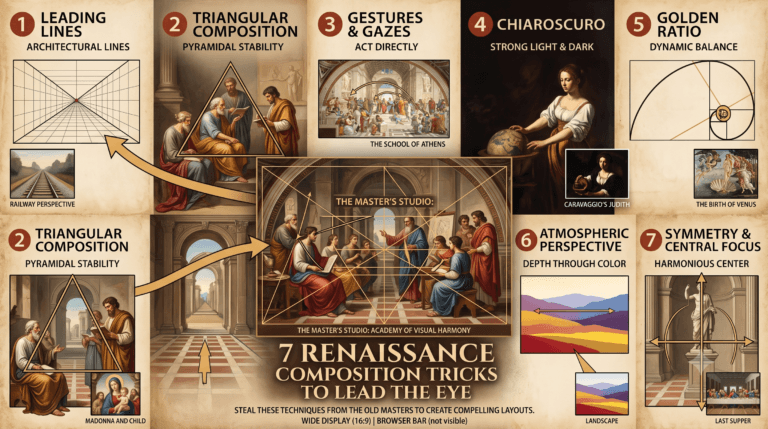
| Pyramidal Composition | Arranging the key elements of a work within an invisible triangle or pyramid shape. | Created a sense of structural stability, harmony, and a clear focal point for the viewer. |
| Secularism & Classicism | A renewed interest in Greek/Roman mythology and the depiction of everyday life and portraits. | Broadened the scope of art beyond the Church, reflecting the era’s intellectual and commercial growth. |
What is the most defining characteristic of Renaissance art?

The most defining characteristic of Renaissance art is its intense focus on realism and anatomical accuracy. Artists closely studied human proportions and the natural world to create lifelike figures that possessed genuine weight, emotion, and physical presence.
They wanted humans to look like humans. They mapped muscles. They studied movement. Before this era, religious figures looked stiff and symbolic. The Renaissance brought them down to earth. Painters rendered skin with accurate undertones and clothed figures in heavy, realistic fabrics that folded naturally.
How did Linear Perspective change Painting forever?
Linear perspective revolutionized painting by using mathematics to create a perfect illusion of three-dimensional depth on a flat surface. By aligning parallel lines to a single vanishing point, artists transformed flat wooden panels into realistic, deep spaces.
The world has depth. Artists used strict geometry to mimic it. You can see this structural genius clearly when looking at the architectural backgrounds painted by famous artists from the Renaissance. They used these mathematical rules to guide the viewer’s eye right to the focal point.
The Magic of Chiaroscuro and Sfumato
Light reveals form. Shadows hide it. Chiaroscuro uses extreme contrast between light and dark to create a sense of volume.
Sfumato takes a much softer approach. It blurs the edges. The word literally translates to evaporating like smoke. It is a technique used to create soft transitions between tones without any harsh outlines. If you want to begin understanding sfumato technique in painting, start by gently blending your edges with a dry brush. These soft transitions actually trick our brains into seeing dynamic, three-dimensional depth on a flat canvas.
Why did Painters shift from Tempera to Oil?
Painters shifted from tempera to oil paint because oil dries much slower, allowing artists to blend colors smoothly and build translucent layers. This slow process created a luminous richness and depth that quick-drying egg tempera simply could not achieve.
Egg tempera dries in seconds. Oil paint takes days. This shift changed everything. Oil paint allowed for intricate glazing techniques that brought unprecedented luminosity to the canvas. Painters could finally rework their mistakes. They could blend a sky seamlessly from deep blue to warm yellow.
Mathematical Composition and Balance
Chaos has no place here. Everything needs order. Painters arranged figures in stable triangles. They mirrored shapes across the canvas.
This is exactly why these classic paintings feel so incredibly stable. Your eye rests easily on the canvas. The balance was purposely designed to mimic the perfection of nature.
What Role did Humanism play in Subject Matter?
Humanism shifted the focus of art from strictly religious icons to the beauty of the individual human experience. It encouraged artists to explore secular subjects, ancient Greek and Roman mythology, and highly personalized portraits alongside traditional Christian themes.
People started to matter. The divine was still important, but earthly life gained immense respect. Wealthy merchants commissioned paintings of themselves. They wanted their specific faces remembered, flaws and all.
The Grand Scale of Fresco Painting
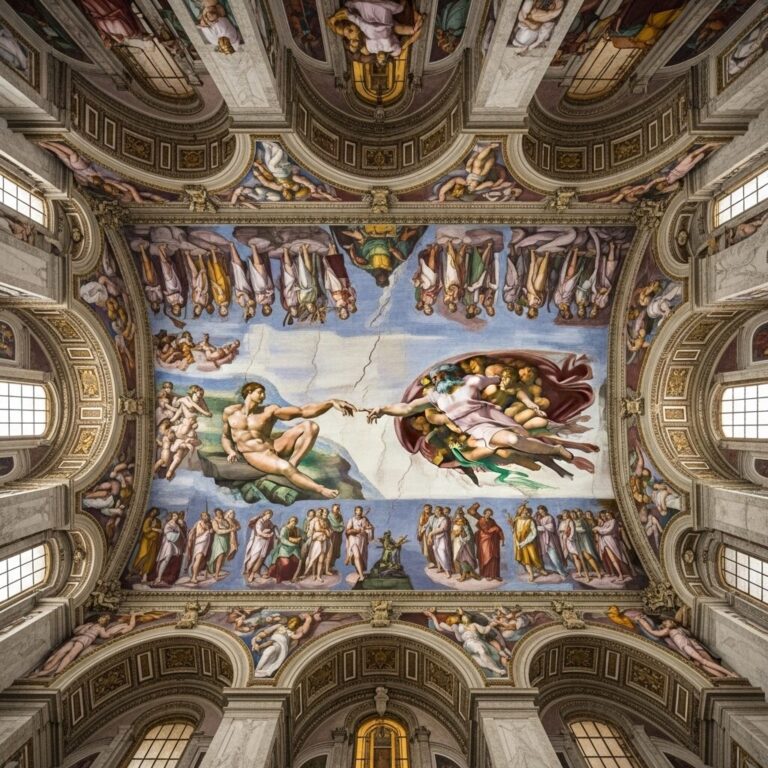
Walls became massive canvases. Fresco involves painting directly into wet plaster. The pigment physically locks into the wall as it dries. This means the painting literally becomes part of the stone architecture.
The art of fresco painting requires immense speed and supreme confidence. You cannot easily erase a mistake once the plaster cures. The artist must commit to every brushstroke.
Conclusion
The Renaissance was not just a historical period. It was a complete shift in how humans observed the world. These artists taught us how to see depth, capture light, and respect the natural proportions of life. You can take these lessons straight to your easel today. Try blending your edges softly to create smoke-like shadows. Map out a strict perspective grid before you begin your next landscape. Pick just one characteristic from this list and test it out on your canvas right now.
FAQs: Renaissance Art Characteristics
What does the word Renaissance mean in art? The word Renaissance literally translates to “rebirth” in French. In art history, it refers to the revival of classical Greek and Roman ideals. It focuses heavily on humanism, anatomical accuracy, and proportional balance.
Who are the most famous Renaissance painters? The most famous painters include Leonardo da Vinci, Michelangelo, Raphael, and Donatello. Northern Renaissance masters like Jan van Eyck are also highly celebrated for their incredible advancements in oil painting.
What is the difference between early and high Renaissance art? Early Renaissance art focused on discovering new techniques like linear perspective and basic anatomy. High Renaissance art represents the absolute perfection of these techniques. This resulted in seamlessly balanced and breathtakingly realistic masterpieces.
Did Renaissance artists use real gold in their paintings? Yes. Early Renaissance works frequently used gold leaf to represent divine light and heavenly spaces. As the era progressed, artists relied less on literal gold and more on painting techniques to create realistic light.
How can I practice sfumato at home? You can practice sfumato by using slow-drying mediums like oil paints or by adding retarders to your acrylics. Use a clean, dry, soft brush to gently feather the edges of your shadows until the hard lines completely disappear into the surrounding colors.

Olly
Olly Farmer M.Sc, B.Sc, PGCE 25 years experience of Watercolor Painting and AI Art; teacher for 13 years; Creator of Art Tools; Art Gallery Contributor of Art Articles to Medium.com, LinkedIn and Facebook
Continue exploring
PROMINENT PAINTING
Keep your creative momentum
Get new painting guides, practical techniques and artist stories delivered without the noise.
Occasional emails. Unsubscribe whenever you like.