In the mid-1950s, the art world was a place of high drama and deep, brooding paint strokes. The Abstract Expressionists – men like Jackson Pollock and Mark Rothko – were celebrated for splashing their inner turmoil onto canvases. Art was supposed to be a window into the tortured soul.
Then came the noise.
Suddenly, the “sacred” walls of the gallery were invaded by images of soup cans, comic strips, vacuum cleaners, and portraits of celebrities rendered in neon, industrial ink. This wasn’t a window into the soul; it was a mirror held up to the supermarket aisle.
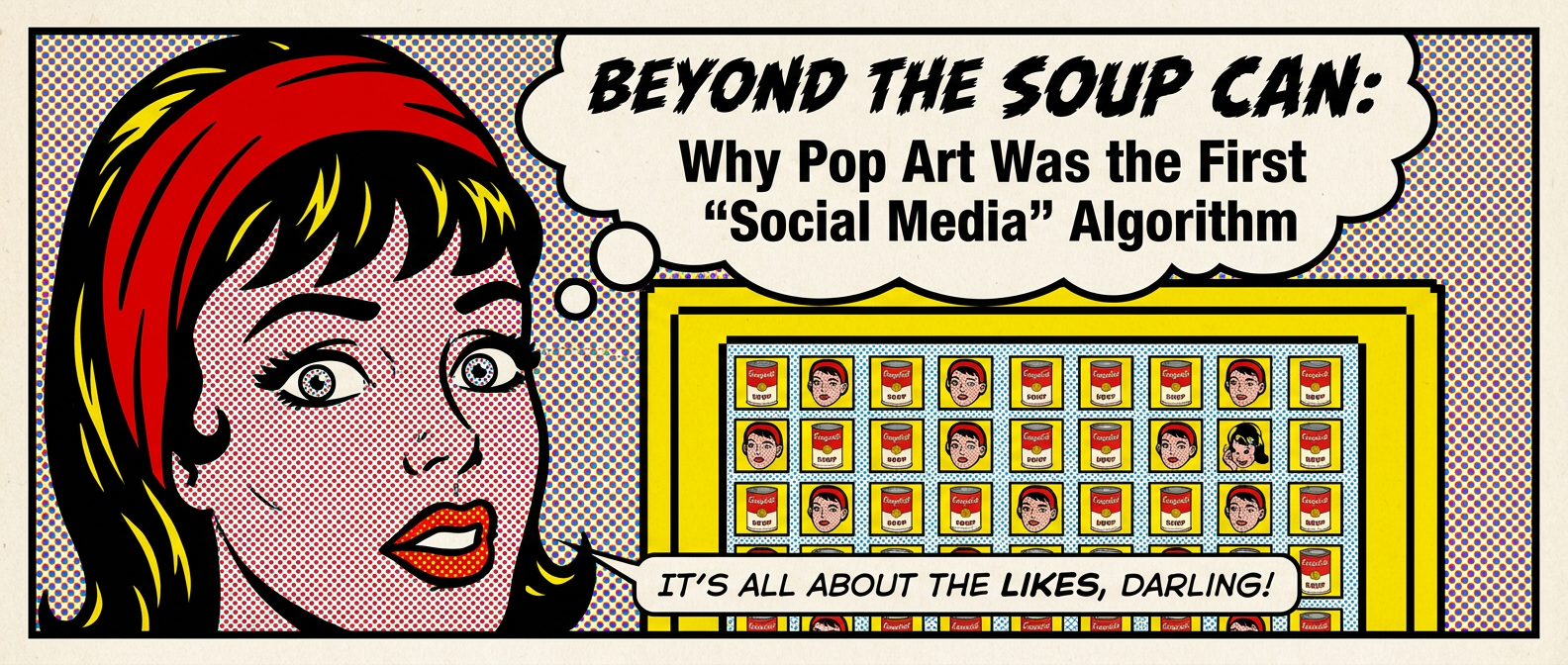
While history books often frame Pop Art as a playful rebellion against “High Art,” looking at it through a 21st-century lens reveals something more profound: Pop Art was the first human attempt to process information overload. Long before the first tweet was sent, Andy Warhol and Roy Lichtenstein were already documenting the birth of the “Main Feed” — the relentless, vibrating stream of imagery that defines our modern digital existence.
To understand why our modern world looks the way it does, we have to look past the bright colors and examine how the core characteristics of pop art mirror our digital reality.
The Mechanics of Repetition: How Andy Warhol Mastered Consumerism
If you look at Warhol’s Campbell’s Soup Cans (1962), your first instinct might be to ask, “Why are there so many?”
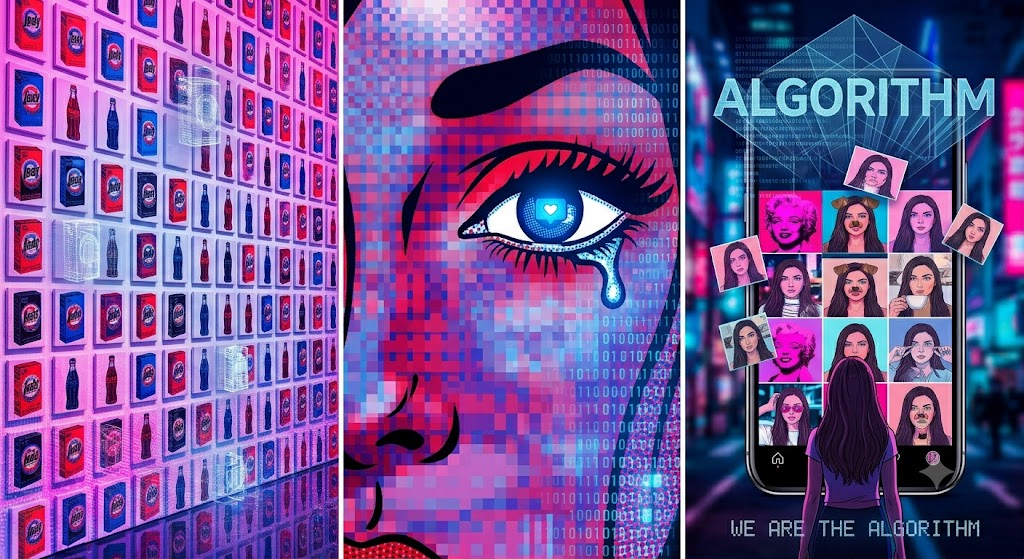
The answer lies in the mechanics of repetition. Warhol didn’t just paint; he operated “The Factory.” By using silk-screen printing, he removed the “hand of the artist” and replaced it with a production line. This was the analog precursor to content repurposing.
In 2024, a creator takes a single trending audio clip on TikTok and iterates on it until it reaches total saturation. Warhol did the same with Marilyn Monroe. He understood a fundamental truth that modern social media algorithms have since perfected: Familiarity is the primary currency of attention.
“Everything is repeated. You see it again and again. It loses its meaning, and then it gains a new one.”
— An Echo of Warhol’s Philosophy
The Lichtenstein Effect: Characteristics of Pop Art in Internet Culture
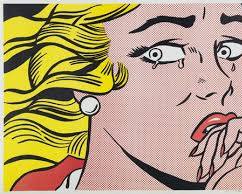
While Warhol was busy with the “feed,” Roy Lichtenstein was busy analyzing the “pixel.” By enlarging the Ben-Day dots used in cheap comic book printing, Lichtenstein did something radical: he forced the elite to look at “low-brow” culture through a microscope.
This was the birth of the aesthetic of the ordinary. Today, we see this in the way “Internet Culture” has become the dominant global culture. When a meme becomes a political statement, or when a digital “Emoji” is sold as an NFT for millions, we are living in the world Lichtenstein built. He taught us that there is no hierarchy in imagery; a comic book panel of a woman crying is just as visually valid as a Renaissance Pietà if it captures the public’s collective gaze.
The Product is the Person: The Birth of the Personal Brand
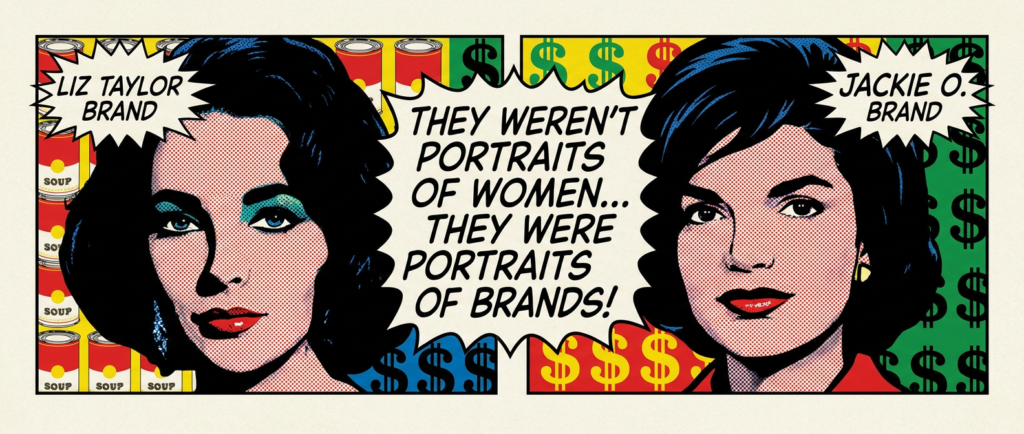
Pop Art identified early on that in a consumerist society, people become indistinguishable from the products they buy. Warhol’s portraits of Elizabeth Taylor and Jackie Kennedy weren’t portraits of women; they were portraits of brands.
To understand how far we’ve come (or haven’t), consider the evolution of how we “consume” people:
The Impact of the Pop Art Movement on Personal Branding
| Feature | 1960s Pop Art Era | 2020s Digital Era |
|---|---|---|
| Medium | Silk-screen / Print Ads | Short-form video / AR Filters |
| Object of Worship | Hollywood Movie Stars | Influencers / “Personal Brands” |
| Core Value | Recognizability | Relatability & Posting Frequency |
| End Goal | Total saturation of the public eye | Algorithm-driven viral dominance |
Today, an influencer’s “grid” on Instagram is effectively a digital Warhol canvas—a curated, filtered, and highly repetitive series of images designed to turn a human being into a recognizable, buyable commodity.
Is Pop Art Still “Critical,” or Is It Just Marketing?
The most common criticism of Pop Art is that it is “shallow.” If you paint a picture of a Coke bottle, are you criticizing consumerism, or are you just making an ad for Coca-Cola?
The brilliance of Pop Art is its inherent subversion. By mirroring our own obsessions back to us, it forces us to confront our shallowness. If you find a painting of a soup can boring, the critique isn’t directed at the canvas—it’s directed at the society that produces and consumes millions of them every day.
Modern artists like Jeff Koons or Takashi Murakami have taken this even further, creating art that is so expensive and so commercial that it becomes a parody of wealth itself. They aren’t just reflecting the market; they are the market.
Conclusion: We Are All Pop Artists Now
We no longer just look at Pop Art; we live inside of it.
The definitive characteristics of pop art—repetition, consumer branding, and the democratization of “low” culture—are no longer confined to gallery walls. They are the exact mechanics driving our daily digital feeds. Every time you choose a filter to make your breakfast look aesthetic, every time you share a meme that has been reposted ten thousand times, and every time you curate your digital identity for a faceless audience, you are practicing the core tenets of the movement.
We didn’t just inherit Warhol’s promised “15 minutes of fame.” We inherited his obsession with the surface of things. In a world of infinite scrolling, where images flash by in milliseconds, Pop Art remains the only visual language that still speaks clearly—because it is the language of the crowd, the shelf, and the screen.
Key Takeaways
- Pop Art was a reaction against the emotional intensity of Abstract Expressionism, favoring the “cool” and “commercial.”
- It predicted the digital age by focusing on repetition, curation, and the destruction of the “original.”
- The “Personal Brand” began here, as artists realized that celebrities are marketed exactly like household goods.
Next Step: Pay attention to your Instagram feed today. Ask yourself: Is this a photo, or is this a Pop Art iteration?
June 2026 AIS