
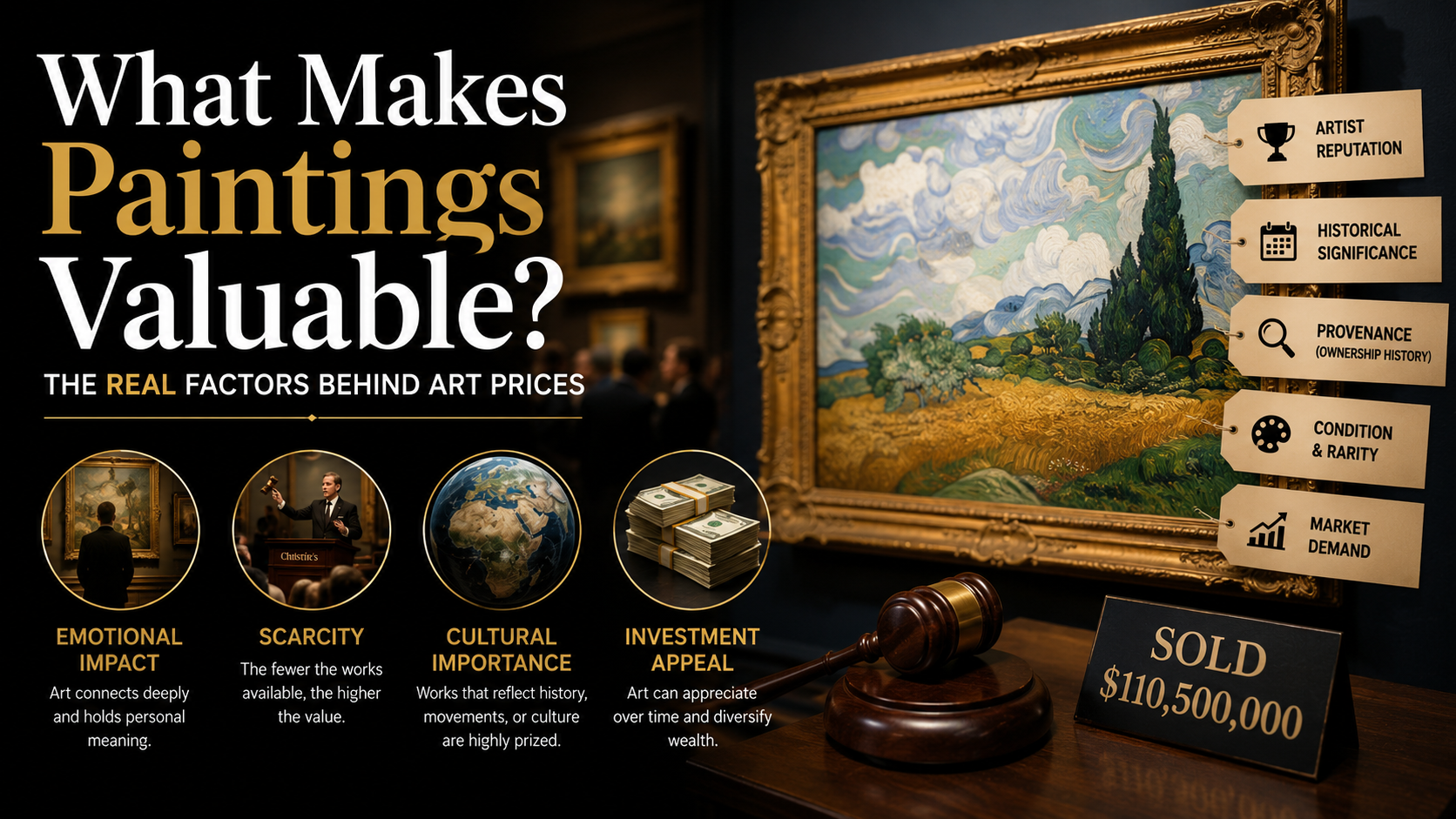
A painting becomes valuable mainly through who painted it, how rare and sought-after their work is, its condition, and its provenance — its documented history of ownership.
Before you sell, insure, or simply find out — here’s how art valuation actually works.
Key Points
- 💰 Sentimental value and market value are completely different things — and confusing them is the most common mistake people make.
- 🔍 You can do a rough valuation yourself using a handful of free, reliable sources before paying anyone.
- 🧑🎨 The artist’s reputation matters more than the subject matter — a beautiful painting by an unknown artist is still, in market terms, an unknown painting.
- 📜 Provenance — the documented history of a piece — can double or triple its value on its own.
- ⚠️ Professional appraisals exist for a reason, but they’re not always necessary. Knowing when you actually need one saves you time and money.
What Actually Makes a Painting Valuable?

If you’ve inherited a painting, found one in a charity shop, or are simply curious about something hanging on your own wall, the question “how much is this worth?” feels like it should have a simple answer. It doesn’t — but it does have a consistent one. Art valuation comes down to a small number of factors, and once you understand them, you can make a surprisingly accurate guess before anyone else gets involved.
The big ones are: who painted it, how rare their work is, what condition it’s in, and whether there’s any paperwork proving where it’s been. Subject matter and how much you personally like it barely register. A technically excellent landscape by an artist nobody can verify is worth far less than a rough, unfinished sketch by someone with an established market — that’s just how the art market works, for better or worse.
If you want to get a feel for how style and movement affect value and demand, our guide to art types and styles is a useful starting point — certain movements and periods are simply more sought-after than others, independent of how “good” any individual piece is.
Sentimental Value vs Market Value — and Why the Gap Can Be Painful
This is the part nobody enjoys hearing, so let’s get it out of the way early: the painting that means the most to you is very often worth the least to anyone else.
A portrait of your great-grandmother, painted by a relative as a hobby, might be priceless to your family and essentially unsellable on the open market — not because it isn’t good, but because there’s no demand for it beyond your own family. That’s not a judgement on the work. It’s simply how value functions: it’s driven by what someone else is willing to pay, not by the story behind the piece.
This distinction matters because it changes what you should actually do with the painting. If the value is sentimental, the right move is usually to keep it, document its history for future generations, and perhaps get it properly conserved. If you suspect there’s real market value — an unfamiliar signature, an old gallery label on the back, a style that looks like it belongs to a known period — that’s when it’s worth digging further.
How to Get a Rough Estimate Yourself
Before you spend any money, there’s a genuinely useful amount you can work out on your own. Here’s the order to go through it in.
🔍 The Five-Step Self-Check
- Look for a signature — and search it properly. Check every corner of the front and the entire back of the canvas or frame. If you find a name, search it alongside words like “painting” and “auction” rather than just the name on its own, which often returns unrelated results.
- Check for any labels, stamps, or inscriptions on the back. Gallery labels, exhibition stickers, framer’s marks, and old price tags are all part of a painting’s provenance — its documented history — and provenance can significantly affect value even when the artist is well known.
- Search recent auction results for similar work. Major auction houses publish past sale prices publicly, and these are the closest thing to a real-world price guide you’ll find. Searching Christie’s past lot results for a comparable artist, period, or style gives you a genuine sense of what similar pieces have actually sold for — not just listed for.
- Assess the condition honestly. Tears, heavy yellowing, flaking paint, water damage, and amateur “restoration” attempts all reduce value, sometimes dramatically. A condition issue that looks minor to an untrained eye can be a major one to a buyer.
- Use a pricing tool as a sense-check, not a verdict. If you’re the artist yourself, or valuing contemporary work, our art price calculator is built for exactly this — it won’t tell you what a Rembrandt is worth, but it’s genuinely useful for pricing original or living-artist work realistically.
💡 A quick reality check: if a painting were genuinely valuable in the five- or six-figure range, it would almost always come with some documentation — even if incomplete. A complete absence of any history isn’t proof of low value, but it does mean the burden of discovery falls on you.
When a Professional Appraisal Is Actually Worth It
Here’s the honest answer: most paintings don’t need a professional appraisal, and paying for one on a piece worth a few hundred pounds isn’t a good use of money. But there are specific situations where it absolutely is worth the cost.
| Situation | Get a professional appraisal? | |
|---|---|---|
| 🟢 | You’re insuring a piece for a specific value | Yes — insurers typically require a formal written appraisal |
| 🟢 | You suspect the work is by a known, listed artist | Yes — a verified attribution can change the value enormously |
| 🟢 | It’s part of an estate or inheritance for legal/tax purposes | Yes — this often needs to be a certified appraisal specifically |
| 🟡 | You just want to sell it and don’t mind a modest price | Maybe — many auction houses offer free initial estimates |
| 🔴 | It’s a print, poster, or mass-produced reproduction | No — appraisal fees would likely exceed the painting’s value |
For genuinely uncertain or potentially significant pieces, a member of the Appraisers Association of America (or your country’s equivalent professional body) is the right route — accreditation matters here, because anyone can call themselves an “art appraiser” without one.
Where to Sell Once You Know the Value
If your research points to genuine market value, where you sell matters almost as much as what you’re selling. A painting worth a few hundred pounds might do best through a regional auction house or specialist online marketplace, while anything moving into the thousands generally benefits from a recognised auction house’s reach and authentication process — buyers pay a premium for that confidence.
If you’re the artist and the painting is your own original work, the calculation is different entirely — you’re not trying to discover an existing market value, you’re setting one. Our guide on selling your art online walks through pricing your own work for platforms where you control the listing, which is a genuinely different skill from valuing someone else’s.
Common Valuation Scams to Watch For
A quick warning, because this area attracts more than its fair share of opportunists. Be cautious of:
- Anyone offering a free verbal valuation who then pressures you to sell to them immediately — a genuine appraiser has no conflict of interest in how you use their valuation.
- “Authentication” services that charge upfront fees with no recognised accreditation — legitimate authentication for major artists usually goes through the artist’s official foundation or estate, not a third-party website.
- Buyers who insist on cash, in person, same-day for anything claiming significant value. Real transactions for valuable work involve paperwork, time, and usually more than one party.
Frequently Asked Questions
Does the frame add value to a painting?
Generally, no — unless the frame itself is antique, hand-carved, or original to the work and the period (in which case it can occasionally add meaningfully to the total). A modern frame on an old painting is essentially neutral to value, though a damaged frame can sometimes detract from a piece’s overall presentation and saleability.
Can I find out a painting’s value from a photo alone?
You can get a starting point — searching for the signature, style, and similar compositions can rule things in or out. But condition, brushwork texture, and canvas details are very hard to judge from a photo, which is why serious valuations almost always involve seeing the piece in person.
Is an old painting automatically valuable?
No — age alone doesn’t create value. There are enormous numbers of competent 19th and early 20th-century paintings by amateur and minor artists that have very little market value, simply because supply vastly outweighs demand for that category of work.
Looking for more art guides like this one? Browse all our posts for everything from technique tutorials to art history deep-dives.

Olly
Olly Farmer M.Sc, B.Sc, PGCE 25 years experience of Watercolor Painting and AI Art; teacher for 13 years; Creator of Art Tools; Art Gallery Contributor of Art Articles to Medium.com, LinkedIn and Facebook
Continue exploring


PROMINENT PAINTING
Keep your creative momentum
Get new painting guides, practical techniques and artist stories delivered without the noise.
Occasional emails. Unsubscribe whenever you like.