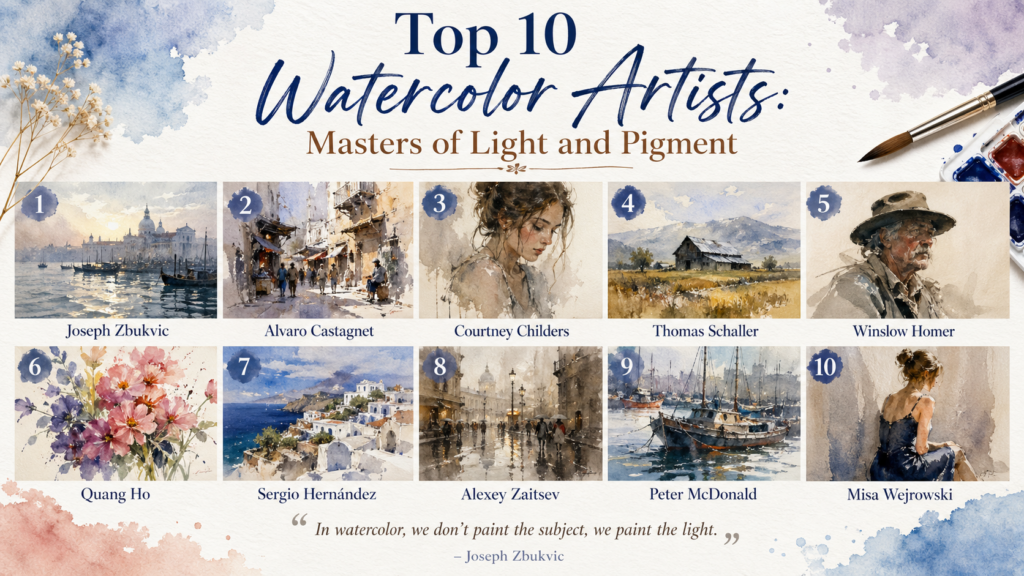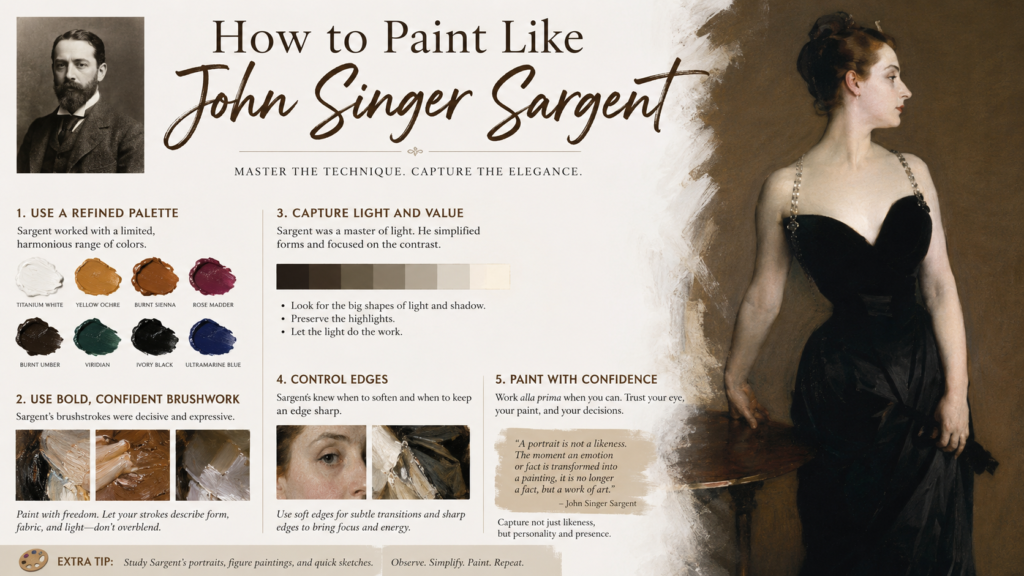
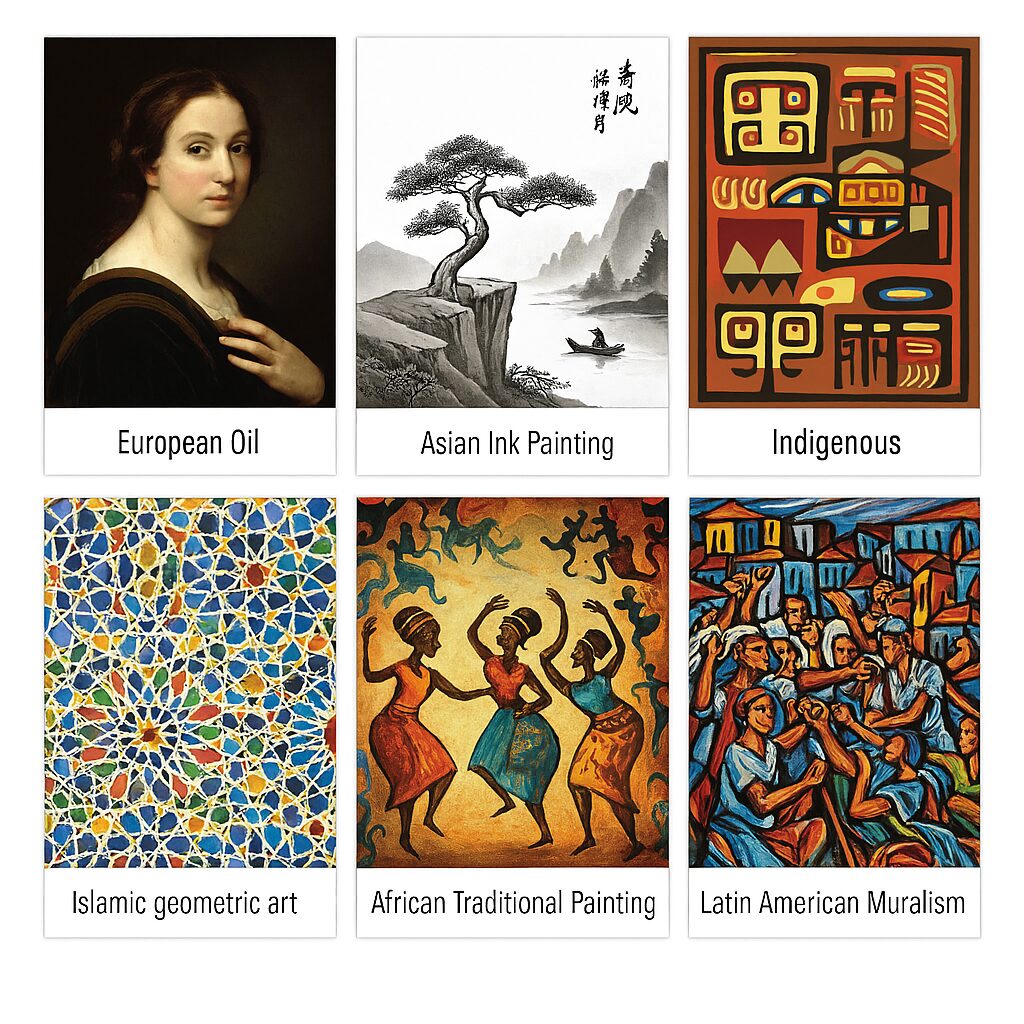
The world of painting encompasses an extraordinary diversity of art types and styles, each reflecting unique creative expressions and cultural influences. From classical realism to contemporary abstract expressionism, understanding the different types of artwork painting helps both artists and art enthusiasts appreciate the rich tapestry of visual art. Whether you’re exploring types of artistic painting for personal development or seeking to understand the various kinds of artists throughout history, this comprehensive guide will illuminate the fascinating spectrum of artistic expression.
What Are the Main Types of Art Styles?
The main art styles include Realism, Impressionism, Expressionism, Cubism, Surrealism, Abstract Art, Pop Art, and Contemporary Art. Each style has unique characteristics, techniques, and historical influences that distinguish it from other artistic movements.
Key Points Summary
- Art Type vs. Style: Explicitly distinguishes between Art Type (the medium/category like painting or sculpture) and Art Style (the visual technique or movement like Impressionism or Cubism).
- The Main Mediums: Categorizes seven primary art types: Drawing, Painting, Sculpture, Printmaking, Photography, Digital Art, and Mixed Media.
- Historical Timeline: Catalogs over 50 art movements spanning from Ancient Egypt and the Renaissance through to 21st-century Digital and AI-assisted art.
- Style “Vibes” and Traits: Breaks down iconic styles by their core characteristics (e.g., Realism is “honest,” Surrealism is “dreamlike,” and Pop Art is “commercial”).
- Technique-Medium Mapping: Matches specific materials to their best uses, such as Oils for Realism, Watercolors for Landscapes, and Acrylics for Pop/Abstract Art.
- Artist Profiles: Provides a guide to “Master Artists” (e.g., Da Vinci, Van Gogh, Kahlo) and classifies them by their signature techniques and career focus.
- Learning Roadmap: Offers a practical “Best For” guide helping beginners choose a style based on their goals, such as starting with Realism for accuracy or Abstract Art for experimentation.
Artist & Style Selection Matrix
Choosing an artistic direction requires balancing the tactile medium with the technical proficiency required to achieve professional results. The following matrix categorizes art forms by their barrier to entry and the complexity of their unique workflows.
Medium-Difficulty Classification Matrix
| Medium | Difficulty | Characteristic Styles | Primary Skills Required |
|---|---|---|---|
| Pencil & Charcoal | Beginner | Realism, Sketching | Shading depth, line control |
| Digital (Vector) | Beginner | Flat Design, Minimalism | Tool mastery, geometric logic |
| Watercolour | Intermediate | Impressionism, Botanical | Fluid management, timing |
| Acrylics | Intermediate | Pop Art, Abstract | Layering, color mixing |
| Digital (Raster) | Intermediate | Concept Art, Painting | Brush dynamics, layer modes |
| Oil Painting | Advanced | Old Masters, Photorealism | Solvent safety, “Fat over Lean” |
| Sculpture/Clay | Advanced | Figurative, Relief | Spatial awareness, structural integrity |
How Art Types and Art Styles Are Different
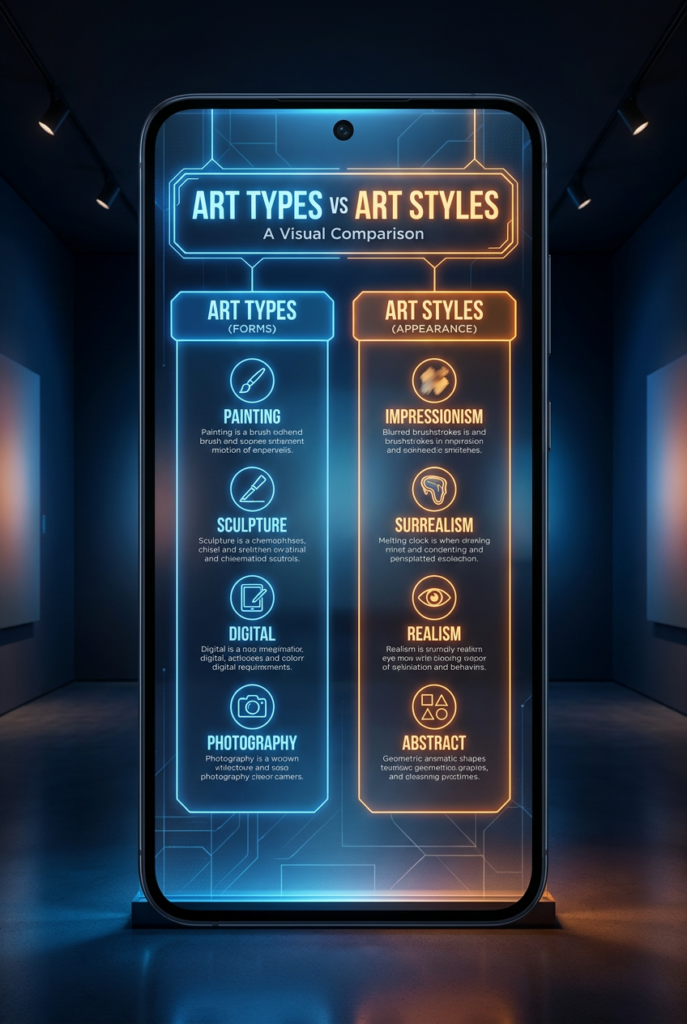
Many people use the terms “art type” and “art style” interchangeably, but they describe different things.
An art type refers to the medium or category of artwork being created. Examples include painting, sculpture, drawing, printmaking, photography, digital art, and mixed media.
An art style refers to the visual characteristics and techniques used within an artwork. Impressionism, Realism, Cubism, Abstract Art, and Pop Art are examples of styles.
Think of it this way:
- Painting is a type of art.
- Impressionism is a style of painting.
Understanding this distinction makes it easier to explore the enormous variety of artistic expression throughout history.
The Main Types of Art
The world of fine art is traditionally divided into distinct core disciplines. While each type uses different physical or digital tools, they all serve as vehicles for creative expression, visual communication, and cultural storytelling.
🖋️ 1. Drawing
Drawing stands as the absolute foundation of visual art. Artists use varied dry and liquid media to create lines, tones, and forms on two-dimensional surfaces.
- Core Mediums: Graphite pencils, charcoal, ink, conté crayons, pastels, and silverpoint.
- Defining Styles: * Realistic & Gesture Drawing: Capturing anatomical accuracy or fleeting human movement.
- Architectural Drawing: Technical, precise drafting of structural spaces.
- Cartoon, Manga & Anime: Stylized, illustrative storytelling and character design.
🎨 2. Painting
Painting involves applying liquid pigment suspensions onto a rigid or flexible support, allowing for rich explorations of color, light, texture, and depth.
- Core Mediums: Traditional oils, fast-drying acrylics, transparent watercolors, opaque gouache, and ancient beeswax-based encaustic.
- Common Supports: Stretched canvas, wood panels, heavyweight rag paper, and linen boards.
🗿 3. Sculpture
Sculpture transitions artistic expression into the third dimension, requiring the artist to manipulate physical space, weight, balance, and material tactile qualities.
Technique Classification: Sculptors typically work either subtractively (carving away from stone or wood) or additively (building up form using clay or wax).
- Primary Methods: * Carving: Chiseling stone, marble, or timber.
- Modeling & Casting: Shaping clay or wax, then pouring molten metal or resin into a permanent mold.
- Assemblage: Constructing complex dimensions out of diverse, non-traditional materials.
🖨️ 4. Printmaking
Printmaking is a masterful technical process that allows artists to transfer an image from a prepared matrix onto paper, creating original multiple impressions or limited-edition runs.
- Relief & Intaglio Methods: Woodcuts and linocuts (where ink sits on the raised surface) vs. etching and engraving (where ink settles into carved grooves).
- Planographic & Stencil Methods: Lithography (utilizing the chemical repulsion of oil and water) and screen printing (pressing ink through a stencil mesh).
📷 5. Photography
Photography utilizes light, chemical reactions, or digital sensors alongside deliberate lens optics to freeze a single moment in time, transforming reality into a composed visual narrative.
- Fine Art Photography: Utilizing composition, exposure, and tone to convey an explicit concept rather than a mere documentary record.
- Core Disciplines: Fine art portraiture, expansive landscapes, and candid street photography.
💻 6. Digital Art
Representing the contemporary frontier, digital art employs computers, tablets, styluses, and specialized software code as the primary creative tools.
- Key Manifestations: Free-hand digital painting, cinematic concept art, graphic illustration, and high-precision 3D modeling.
- Modern Evolution: The strategic integration of generative, AI-assisted art tools into traditional digital design workflows.
🧵 7. Mixed Media Art
Mixed media explicitly breaks down the barriers between individual disciplines by combining multiple distinct materials and physical techniques into a single, cohesive artwork.
- Creative Boundaries: A single canvas might seamlessly layer traditional acrylic paint, tactile textiles and fabric, embedded photographic prints, found objects, and overlaid digital elements.
50 Art Styles at a Glance — searchable table of style, period, characteristics, and famous artist
| Style | Period | Characteristics | Famous Artist |
|---|
Art Styles and Techniques Comparison Table
To help navigate the vast evolution of painting, the table below provides a quick-reference overview of history’s defining art movements. By comparing their historical eras, defining visual characteristics, and pioneering masters, you can easily identify how different techniques serve specific creative goals—whether capturing the fleeting light of a landscape or expressing an abstract, conceptual idea.
| Art Style | Time Period | Key Characteristics | Famous Artists | Best For |
|---|---|---|---|---|
| Realism | Mid-19th Century | Accurate depiction, natural lighting, everyday subjects | Gustave Courbet, Jean-François Millet | Portrait painting, social commentary |
| Impressionism | 1860s-1880s | Loose brushwork, light effects, outdoor painting | Claude Monet, Pierre-Auguste Renoir | Landscape painting, capturing atmosphere |
| Expressionism | Early 20th Century | Emotional intensity, distorted forms, bold colors | Wassily Kandinsky, Franz Marc | Emotional expression, abstract concepts |
| Cubism | 1907-1920s | Geometric forms, multiple perspectives, fragmentation | Pablo Picasso, Georges Braque | Modern portraiture, still life |
| Abstract Art | 1910-Present | Non-representational, pure form and color | Jackson Pollock, Mark Rothko | Experimental painting, color studies |
| Pop Art | 1950s-1960s | Popular culture imagery, commercial techniques | Andy Warhol, Roy Lichtenstein | Contemporary themes, graphic elements |
| Minimalism | 1960s-Present | Simplicity, essential elements, geometric forms | Donald Judd, Agnes Martin | Clean compositions, conceptual work |
Master Artists and Their Signature Styles
While broad movements define artistic eras, it is the individual innovators who push those boundaries into reality. The comprehensive reference table below profiles fifteen of history’s most influential master painters. By examining their distinct nationalities, breakthrough methods—such as Caravaggio’s chiaroscuro or da Vinci’s sfumato—and definitive masterpieces, you can trace how a single painter’s signature style can reshape the entire classification of art.
| Artist Name | Primary Art Style | Nationality/Period | Signature Technique | Famous Works | Type of Artist Classification |
|---|---|---|---|---|---|
| Leonardo da Vinci | High Renaissance | Italian, 1452-1519 | Sfumato (soft shading), scientific accuracy | Mona Lisa, The Last Supper | Portrait artist, inventor, polymath |
| Vincent van Gogh | Post-Impressionism | Dutch, 1853-1890 | Bold brushstrokes, emotional color | Starry Night, Sunflowers | Landscape/still life artist |
| Pablo Picasso | Cubism, Blue Period | Spanish, 1881-1973 | Geometric fragmentation, multiple perspectives | Les Demoiselles d’Avignon, Guernica | Abstract artist, revolutionary innovator |
| Claude Monet | Impressionism | French, 1840-1926 | Plein air painting, light studies | Water Lilies, Impression Sunrise | Landscape artist, light specialist |
| Jackson Pollock | Abstract Expressionism | American, 1912-1956 | Drip painting, action painting | No. 1 (Lavender Mist), Autumn Rhythm | Abstract artist, gestural painter |
| Georgia O’Keeffe | American Modernism | American, 1887-1986 | Close-up natural forms, color abstraction | Black Iris, Cow’s Skull | Nature artist, color specialist |
| Frida Kahlo | Surrealism/Mexican Folk | Mexican, 1907-1954 | Symbolic self-portraiture, cultural imagery | The Two Fridas, Self-Portrait with Thorn | Portrait artist, surrealist |
| Andy Warhol | Pop Art | American, 1928-1987 | Screen printing, commercial imagery | Campbell’s Soup Cans, Marilyn Diptych | Pop artist, commercial innovator |
| Johannes Vermeer | Dutch Golden Age | Dutch, 1632-1675 | Light mastery, domestic scenes | Girl with a Pearl Earring, The Milkmaid | Genre painter, light artist |
| Wassily Kandinsky | Abstract Art/Expressionism | Russian, 1866-1944 | Color theory, spiritual abstraction | Composition VII, Yellow-Red-Blue | Abstract artist, color theorist |
| Henri Matisse | Fauvism/Modernism | French, 1869-1954 | Bold color, paper cut-outs | Woman with a Hat, The Dance | Color artist, decorative painter |
| Caravaggio | Baroque | Italian, 1571-1610 | Chiaroscuro (dramatic light/dark) | The Calling of St. Matthew, Judith Beheading Holofernes | Religious painter, naturalist |
| Jean-Michel Basquiat | Neo-Expressionism | American, 1960-1988 | Graffiti-inspired, social commentary | Untitled (Skull), Hollywood Africans | Street artist, social commentator |
| Yves Klein | Conceptual Art | French, 1928-1962 | Monochrome painting, International Klein Blue | Anthropometry series, IKB paintings | Conceptual artist, color innovator |
| Katsushika Hokusai | Japanese Ukiyo-e | Japanese, 1760-1849 | Woodblock printing, landscape series | The Great Wave, Thirty-six Views of Mount Fuji | Landscape artist, printmaker |
The Most Popular Art Styles Explained: A Visual Journey
Art isn’t just about what you see—it’s about how the artist wants you to feel. From the crisp, mirror-like precision of Realism to the mind-bending dreamscapes of Surrealism, the art world is a massive sandbox of creativity.
Let’s dive into the most iconic art movements that changed how we see the world.
👁️ Realism: Truth in Every Detail
Realism doesn’t hide behind filters or idealization. It’s all about capturing life exactly as it is, mirroring the world with breathtaking accuracy and deep observation.
- The Vibe: Raw, honest, and photographic.
- The Focus: Precise proportions, everyday subjects, and masterful detail over perfection.
☀️ Impressionism: Catching Fleeting Light
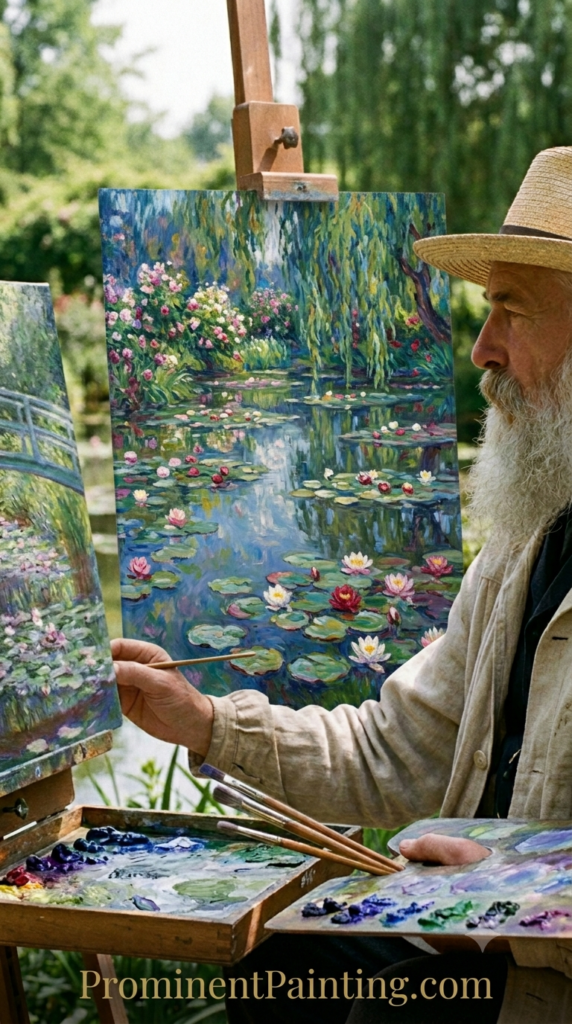
Instead of perfect details, Impressionist artists wanted to capture a mood, a moment, and the shifting quality of light. They painted fast, often outdoors, before the sun could move.
- The Vibe: Vibrant, breezy, and alive.
- Key Characteristics:
- 🖌️ Loose, visible brushwork
- 🌳 Painted en plein air (outdoors)
- 🎨 Bold, vibrant color relationships
- ✨ An absolute obsession with light
💥 Expressionism: Emotion Unleashed
Forget what the world looks like on the outside. Expressionism is all about what it feels like on the inside, turning raw human emotion into something you can see.
- The Vibe: Intense, moody, and dramatic.
- Artists often use:
- 🌀 Distorted, exaggerated forms
- 🔥 Fierce, non-literal colors
- 🎭 High-drama compositions
📐 Cubism: The Ultimate Remix
Why look at something from just one angle? Cubism shattered tradition by breaking subjects apart and stitching them back together from multiple viewpoints all at once.
- The Vibe: Geometric, revolutionary, and abstract.
- Key Characteristics:
- 🧩 Fragmented, shattered forms
- 🔄 Multiple perspectives shown simultaneously
- ⬡ Clean, simplified geometry
🌌 Surrealism: A Trip Inside the Subconscious
Surrealism unlocks the doors of the mind, blending reality with the bizarre, illogical logic of our wildest dreams and deepest subconscious.
- The Vibe: Weird, hypnotic, and thought-provoking.
- Works often contain:
- ⏳ Shocking, unexpected combinations (like melting clocks)
- 🔑 Deeply symbolic imagery
- ☁️ Eerie, dreamlike landscapes
🎨 Abstract Art: Freedom from the Form
Abstract art steps completely away from literal representation. It doesn’t try to look like a person, place, or thing—instead, it uses the pure language of shape and color to make you feel.
- The Vibe: Modern, open to interpretation, and limitless.
- The Toolkit: Pure focus on color, texture, shape, line, and composition.
🥤 Pop Art: High Art Meets Pop Culture
Born in the mid-20th century, Pop Art took art off its pedestal and put it on a grocery shelf. It hijacked the worlds of advertising, comic books, and celebrity culture.
- The Vibe: Bold, commercial, and unapologetically fun.
- The Subjects: Consumer products, mass media, Hollywood icons, and bright neon palettes.
🌐 Contemporary Art: The Art of the ‘Now’
There are no rules here. Contemporary art is the art of today, constantly evolving to reflect our current digital age, societal shifts, and cultural conversations.
The Mediums: Uses everything from traditional paint to digital screens, AI, and massive interactive installations.
The Vibe: Experimental, diverse, and cutting-edge.
Art Styles by Historical Period
Art Styles by Historical Period
Select a specific era to explore its distinct style, philosophy, and defining traits.
Ancient Egyptian Art
Art bound strictly to religion, the afterlife, and the preservation of cosmic order (Ma’at). It rejected individual creative expression in favor of continuity, permanence, and rigid mathematical canons.
- Key Traits: Hieratic scale (size denotes social importance), composite perspective (profile head with frontal eyes and torso), and durable mediums like basalt, granite, and gold.
Classical Greek Art
Driven by humanism, balance, and the pursuit of ideal beauty. Greek artists moved away from rigid stylized forms to investigate human anatomy, geometry, and natural movement.
- Key Traits: Invention of contrapposto (natural weight shift in sculpture), flawless physical proportions, architectural harmony (the Parthenon), and a focus on heroic mythology.
Roman Art
While heavily influenced by Greece, Roman art shifted from idealistic perfection to political utility, civic grandeur, and unvarnished realism to document history and project imperial power.
- Key Traits: Verism (hyper-realistic portraiture showing age and flaws), narrative historical reliefs (triumphal arches), and massive engineering feats using concrete, arches, and domes.
Byzantine Art
A transition from earthly realism to divine mysticism. Art became flat, heavily stylized, and highly symbolic, designed to transport the viewer’s mind from the physical world into the spiritual realm.
- Key Traits: Luminous gold-leaf backgrounds, rigid frontal icon paintings, elongated figures, and complex, glittering glass mosaics covering church interiors.
Gothic Art
Born out of urban growth and monastic shifts, Gothic art brought a return to delicate naturalism, emotional expression, and a monumental obsession with directing human sight toward the heavens.
- Key Traits: Soaring pointed arches and flying buttresses in architecture, narrative stained-glass windows, and increasingly expressive, freestanding architectural sculptures.
The Renaissance
A profound “rebirth” of classical antiquity paired with rigorous scientific observation. Artists championed humanism, merging Christian theology with mathematical logic to master the illusion of three-dimensional space.
- Key Traits: Linear and atmospheric perspective, chiaroscuro, anatomical accuracy through dissection, and the use of oil paints to capture rich textures and light.
Baroque Art
An art of absolute drama, theatricality, and raw emotional power. Weaponized by the Counter-Reformation and absolute monarchs, it sought to awe, overwhelm, and emotionally engage the viewer.
- Key Traits: Intense dynamic movement, diagonal compositions, asymmetry, and aggressive tenebrism (violent contrasts between deep shadows and bright spotlights).
Impressionism
The first radical break from academic studio painting. Spurred by industrialization and the invention of portable paint tubes, artists moved outdoors to capture transient, fleeting moments of light, atmosphere, and modern life.
- Key Traits: Rapid, visible brushstrokes; emphasis on the changing qualities of light; unblended, vibrant color choices; and unusual, candid framing angles.
Modernism & Abstraction
A multi-faceted rejection of traditional representation. Triggered by global wars, psychoanalysis, and technology, artists concluded that a changed world required completely new visual languages, culminating in pure abstraction.
- Key Traits: Flattened picture planes, fragmentation of form (Cubism), psychological distortion of color (Expressionism), and a focus on the structural medium of paint itself.
Art Styles by Medium
Different mediums naturally encourage different styles.
| Medium | Style | Key Characteristics |
|---|---|---|
| Oil Painting | Realism | Focuses on accurate, detailed depictions of subject matter without embellishment. |
| Impressionism | Uses visible brushstrokes, emphasis on light, and ordinary subject matter to capture a “moment.” | |
| Classical Portraiture | Formal representation of individuals, often focusing on status, anatomy, and chiaroscuro. | |
| Contemporary Realism | Modern application of realistic techniques, often featuring 21st-century themes or social commentary. | |
| Watercolour | Botanical Illustration | Scientific accuracy and surgical precision used to document plant species. |
| Landscape Painting | Exploits the transparency of the medium to capture skies, water, and atmospheric perspective. | |
| Loose Impressionistic | Uses “wet-on-wet” techniques to create soft edges and suggestive, rather than literal, forms. | |
| Urban Sketching | Typically captured on-location; combines ink line work with quick watercolour washes. | |
| Acrylic | Abstract Art | Focuses on shapes, colours, and gestural marks rather than representational imagery. |
| Contemporary Art | A broad category reflecting current global issues, often breaking traditional aesthetic rules. | |
| Mixed Media Work | Combines acrylic paint with other materials like sand, paper, or textiles. | |
| Pop Art | Features bold colours and imagery inspired by popular culture, advertising, and comic books. | |
| Pastel | Portraiture | Utilises the blendability of pastels to create smooth skin tones and lifelike textures. |
| Landscape Painting | Known for vibrant, saturated colours and the ability to layer “scumbling” effects for light. | |
| Impressionistic Work | Focuses on the “broken color” technique where strokes are layered but not fully blended. | |
| Digital Art | Concept Art | Visual representations used to convey ideas for films, video games, or products. |
| Character Design | The creation of the full aesthetic and personality of a character for media. | |
| Illustration | Narrative-driven imagery created for books, magazines, or marketing. | |
| Matte Painting | Painted representations of landscapes or sets used in filmmaking to create illusions of scale. |
Which Art Style Should You Learn?
| If you love… | Start with… | Why |
|---|---|---|
| Accuracy and detail | Realism | Builds observation and drawing skills |
| Colour and light | Impressionism | Develops colour confidence and brushwork |
| Emotion and self-expression | Expressionism | Focuses on mood rather than accuracy |
| Creative freedom | Abstract Art | Encourages experimentation |
| Fantasy and imagination | Surrealism | Ideal for imaginative storytelling |
| Popular culture | Pop Art | Uses bold graphics and contemporary themes |
| Professional illustration | Digital Illustration | Widely used in commercial art careers |
| Games and film | Concept Art | Foundation for entertainment design |
Tip: Most artists explore several styles before finding the one that suits them best.
Famous Art Styles and Their Most Recognisable Artists
| Art Style | Famous Artists |
|---|---|
| Impressionism | Claude Monet, Pierre-Auguste Renoir |
| Cubism | Pablo Picasso, Georges Braque |
| Surrealism | Salvador Dalí, René Magritte |
| Pop Art | Andy Warhol, Roy Lichtenstein |
| Abstract Art | Wassily Kandinsky, Piet Mondrian |
| Expressionism | Edvard Munch, Ernst Ludwig Kirchner |
Artists are categorized by their medium and intent. Traditional artists focus on physical craftsmanship like painting and sculpture, while digital creators leverage software for 3D modeling and illustration. Commercial artists (designers) apply aesthetics to functional products, and performance artists use time and motion. Modern “hybrid” artists often bridge these gaps, blending physical techniques with augmented reality or AI to push creative boundaries across both tangible and virtual spaces.
What Are the Different Types of Artists? From Traditional Painters to Digital Creators
| Artist Type | Primary Medium | Primary Tools | Output Type |
|---|---|---|---|
| Traditional | Canvas, Clay, Ink | Brushes, Chisels, Pens | Physical Object |
| Digital | Pixels, Vectors | Stylus, Software, AI | Digital File / Print |
| Commercial | Branding, Products | CAD, Adobe Suite | Marketable Product |
| Performance | Human Body, Time | Movement, Voice | Experience/Memory |
| Photographic | Light, Film | Cameras, Lenses | Print / Digital Image |
Frequently Asked Questions About Art Styles
How many art styles are there?
There is no exact number. Art historians have identified hundreds of styles, movements, and sub-movements throughout history.
What is the most popular art style?
Realism, Impressionism, and Contemporary Art remain among the most widely recognised and studied styles.
What art style is easiest for beginners?
Simple realism and observational drawing are often recommended because they build foundational skills.
Can an artist work in multiple styles?
Yes. Many successful artists explore several styles throughout their careers.
Final Thoughts
The world of art contains countless styles, techniques, and traditions. Whether you are interested in drawing, painting, sculpture, photography, or digital art, understanding different art types and styles can help you appreciate art more deeply and discover new directions for your own creative journey.
Citations
- Gardner, Helen. “Gardner’s Art Through the Ages: A Global History.” Cengage Learning, 2020.
- Janson, H.W. “Janson’s History of Art: The Western Tradition.” Pearson, 2019.
- Kleiner, Fred S. “Gardner’s Art Through the Ages: Backpack Edition.” Cengage Learning, 2018.
- Stokstad, Marilyn. “Art History.” Pearson, 2017.
- Metropolitan Museum of Art. “Heilbrunn Timeline of Art History.” metmuseum.org
- National Gallery of Art. “NGA Online Editions.” nga.gov
- Tate Modern. “Art Terms and Techniques.” tate.org.uk
- Museum of Modern Art. “Collection Database.” moma.org