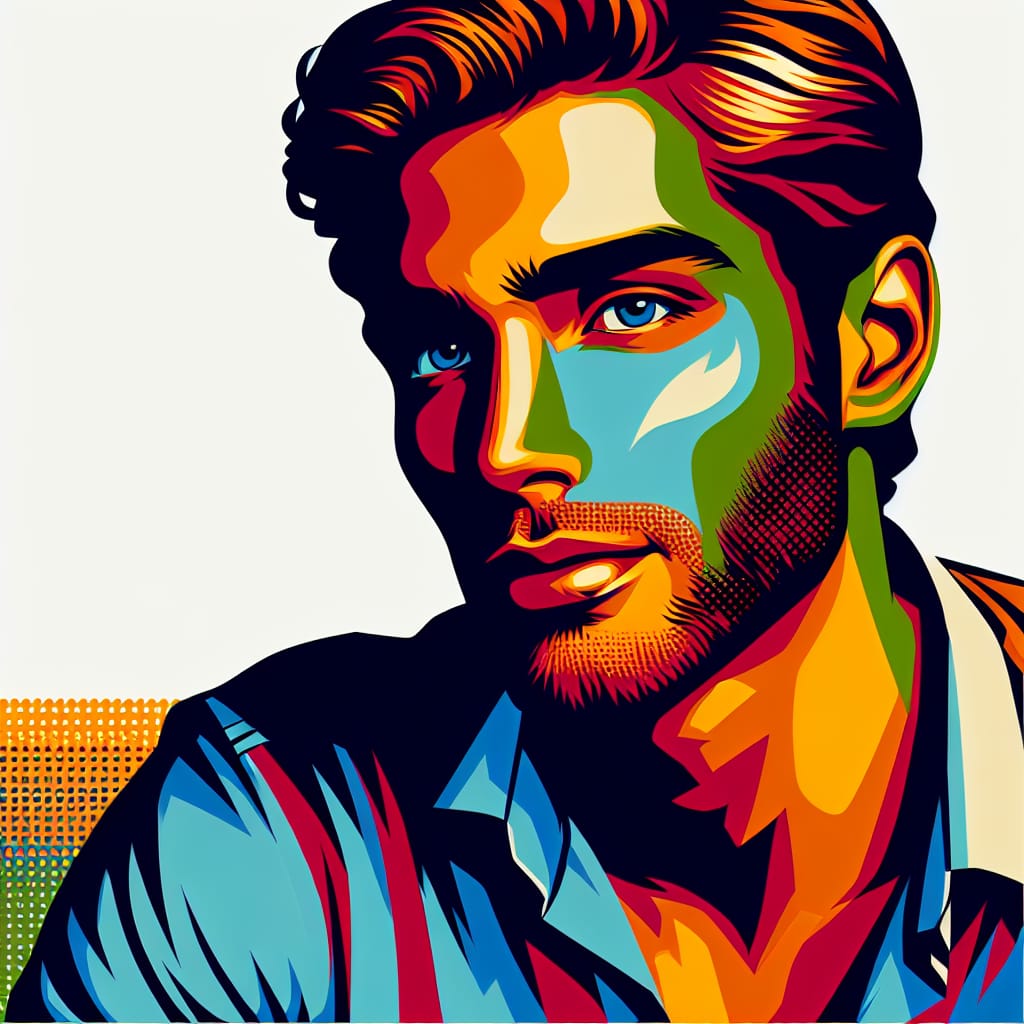

Pop Art changed everything we thought we knew about art. This bold, colorful movement emerged in the 1950s and took the art world by storm by doing something radical – it turned everyday objects like soup cans and comic books into fine art. Instead of painting landscapes or portraits like artists had done for centuries, Pop artists looked to advertising, celebrities, and consumer products for inspiration. This revolutionary approach challenged traditional art rules and created a new way of thinking about what art could be.
Key Points Summary
- Pop Art emerged in the 1950s in Britain and America, transforming everyday objects into fine art
- The movement challenged traditional “high art” by embracing popular culture and mass media
- Key characteristics include bold primary colors, repetition, and commercial imagery
- Famous artists like Andy Warhol, Roy Lichtenstein, and David Hockney led the movement
- Pop Art techniques included screen printing, collage, and mechanical reproduction methods
- The movement’s influence continues today in contemporary art, design, and digital media
- Key Points Summary
- At a Glance
- What is Pop Art? Breaking Down the Movement
- The Birth of Pop Art: Where It All Began
- Key Characteristics That Define Pop Art
- What Did Pop Artists Paint? Subject Matter and Imagery
- Pop Art Techniques: How Artists Created Their Works
- Famous Pop Art Artists Who Changed Everything
- Cultural Impact: Why Pop Art Mattered
- Pop Art's Lasting Legacy in Today's World
- Frequently Asked Questions About Pop Art
- Conclusion: Pop Art's Revolutionary Legacy
- Additional Resources
At a Glance
| Key Feature | Pop Art Definition |
|---|---|
| Roots | Post-war consumerism & Comic Books |
| Key Artists | Warhol, Lichtenstein, Rosenquist |
| Primary Techniques | Silk-screening, Ben-Day dots, Collage |
| Modern Heir | Street Art, Viral Memes, Digital Filters |
What is Pop Art? Breaking Down the Movement
Pop Art is an art movement that challenged fine art traditions by including imagery from popular culture, mass media, and everyday commercial products. The name “Pop Art” comes from “popular art,” showing how these artists embraced the mass-produced, commercial images that people saw every day in the 1950s and 1960s.
Unlike the abstract expressionist movement that came before it, Pop Art didn’t focus on inner emotions or pure abstract forms. Instead, Pop artists turned their attention to the outside world – the world of advertisements, comic books, celebrity culture, and consumer goods that surrounded people in their daily lives.
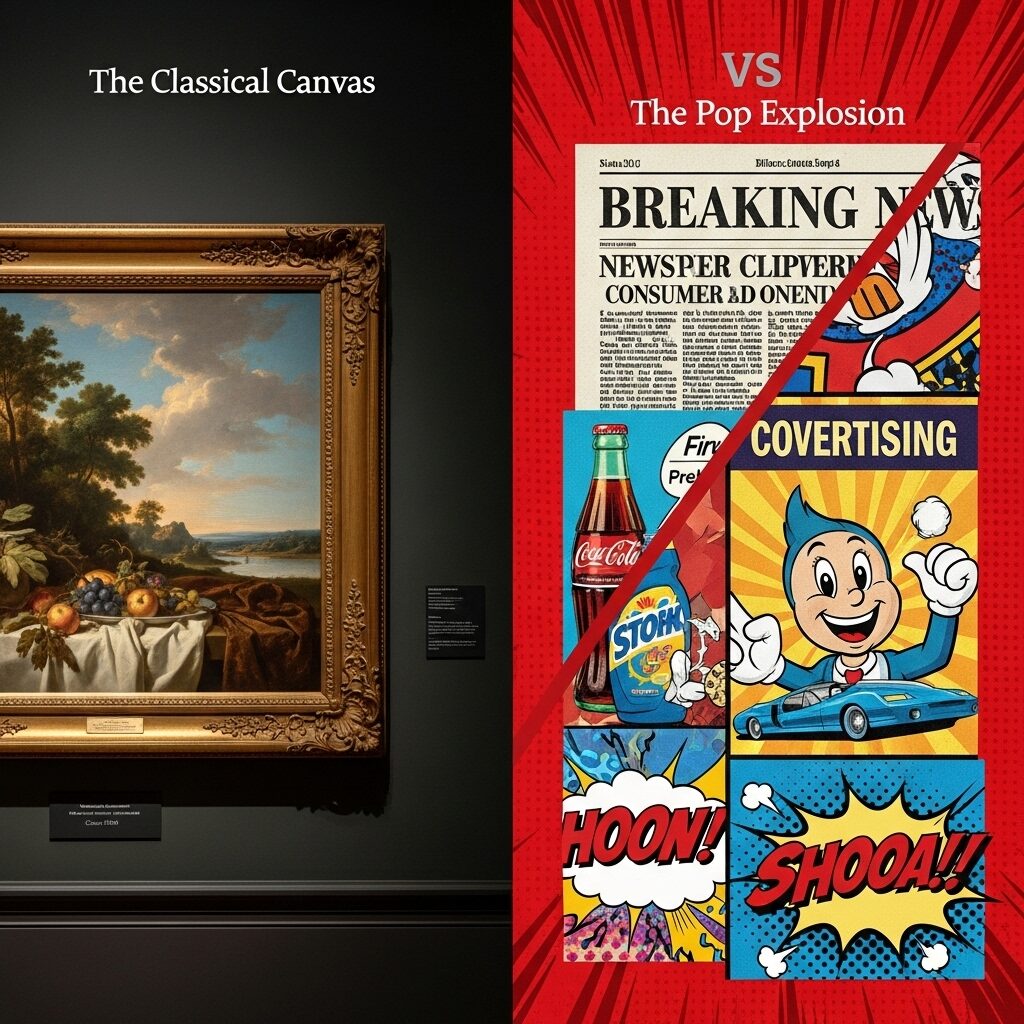
The movement aimed to blur the lines between “high” art (the kind you’d see in museums) and “low” culture (like advertisements and comic books). This was revolutionary because for centuries, people believed that fine art should be completely separate from and better than commercial or popular culture. But that’s not the whole story…
The Birth of Pop Art: Where It All Began
Pop Art in Britain: The Independent Group
Pop Art first took shape in Britain during the mid-1950s with a group called the Independent Group in London. These young artists, writers, and critics were fascinated by American popular culture flooding into post-war Britain – glossy advertisements, Hollywood movies, and shiny consumer products that seemed exciting and new.
English Pop Artist Richard Hamilton created one of the first definitions of Pop Art in 1957, describing it as: “Popular (designed for a mass audience), Transient (short-term solution), Expendable (easily forgotten), Low cost, Mass produced, Young (aimed at youth), Witty.” This definition became the foundation for understanding what Pop Art was all about.
American Pop Art: The New York Explosion
While Pop Art started in Britain, it truly exploded in America during the late 1950s and early 1960s. The American version reflected the country’s booming economy and the rise of television, advertising, and mass media as powerful cultural forces.
Artists like Andy Warhol, Roy Lichtenstein, Claes Oldenburg, and James Rosenquist became the faces of American Pop Art. They emerged from the influence of the Neo-Dadaists and created what we now consider classic New York Pop Art.
Key Characteristics That Define Pop Art
Visual Elements and Style
Pop Art has several distinctive characteristics that make it instantly recognizable:
| Characteristic | Description | Purpose |
|---|---|---|
| Bold Primary Colors | Bright reds, blues, and yellows | Mirror eye-catching commercial advertising |
| Hard Edges | Clean lines and sharp contrasts | Reflect mechanical, mass-produced aesthetics |
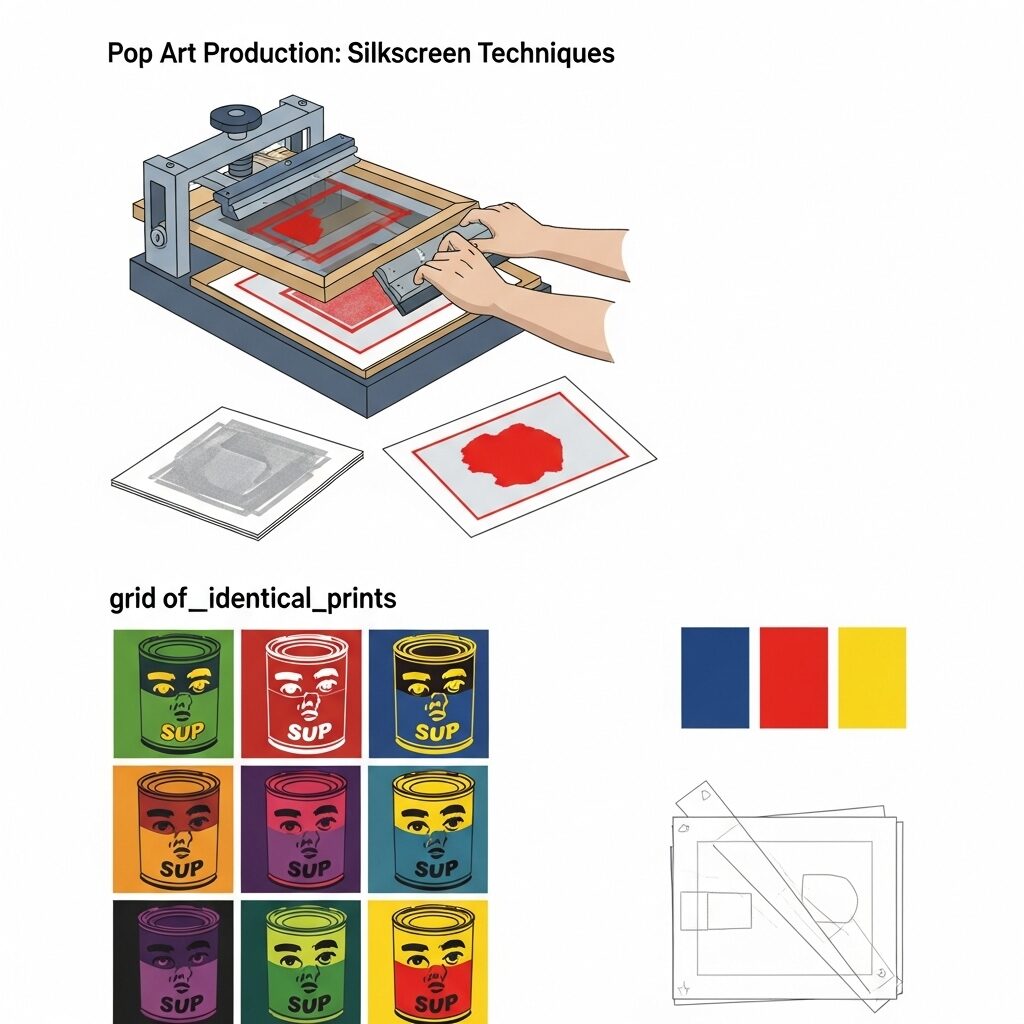
| Repetition | Multiple identical or similar images | Mimic mass-production processes |
| Commercial Imagery | Ads, products, celebrities | Challenge traditional art subjects |
Colors and Techniques
Pop Art is characterized by bold colors, particularly primary colors that were bright and similar to comic strip palettes. These vibrant colors weren’t used to express the artist’s emotions (like in earlier art movements) but rather to mirror the eye-catching nature of commercial advertising.
The hard-edged style, with clean lines and sharp contrasts, reflected the mechanical, mass-produced nature of the imagery being depicted. This was completely different from the gestural, expressive brushwork of abstract expressionism.
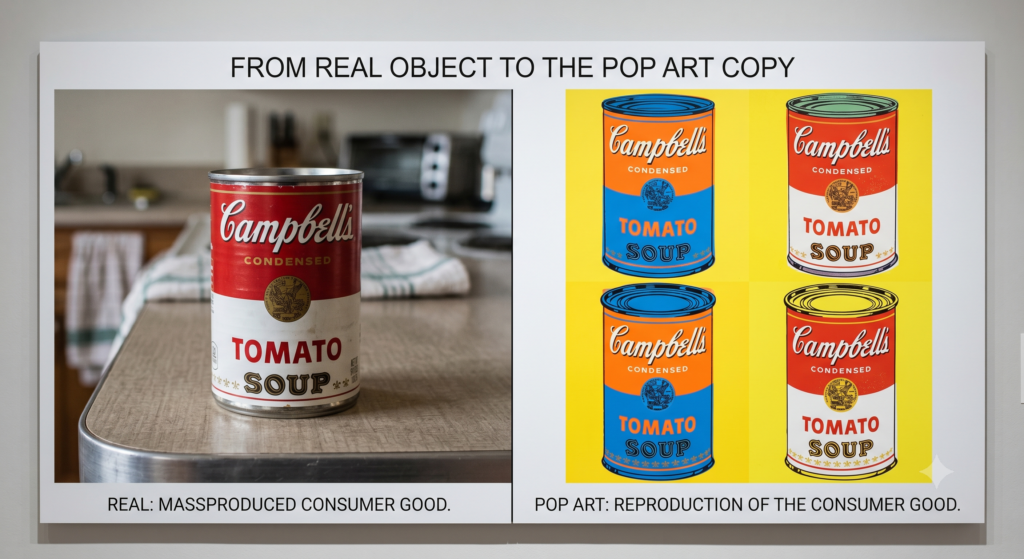
Pop Art introduced the Simulacrum: the “copy of a copy.” Unlike traditional art that mimics nature, Pop Art mimics media. Warhol’s Marilyn wasn’t a portrait of a person, but an iteration of a promotional photograph. It proves that in a consumerist society, we interact with brands and images rather than reality. Today, from Instagram filters to deepfakes, we live in Warhol’s prophecy: a world where the “image” is more influential than the original.
What Did Pop Artists Paint? Subject Matter and Imagery
Pop Art drew its inspiration from the everyday world around us, including:
- Advertising imagery: Print ads, billboards, and commercial graphics
- Comic books and cartoons: The distinctive visual language of comics
- Consumer products: Soup cans, soap boxes, and household goods
- Celebrity culture: Movie stars, musicians, and public figures
- News media: Images from newspapers, magazines, and television
This was radical because traditional art focused on “serious” subjects like religious scenes, historical events, or beautiful landscapes. Pop artists said, “Why can’t a soup can be just as important as a bowl of fruit?”
Pop Art Techniques: How Artists Created Their Works
Screen Printing (Serigraphy)
Screen printing became one of the most important techniques in Pop Art. This commercial printing method allowed artists to create multiple identical images – perfect for exploring themes of mass production and repetition. Andy Warhol famously used screen printing to create his iconic portraits and product images.
Collage and Mixed Media
Many Pop artists combined photographs, printed materials, and painted elements to create hybrid works that bridged the gap between fine art and commercial design. This technique allowed them to directly incorporate real advertisements and media images into their artwork.
Mechanical Reproduction
Pop artists deliberately adopted the look of mechanical reproduction, using techniques that eliminated visible brushstrokes and personal artistic “handwriting.” They wanted their art to look mass-produced, not handmade.
Famous Pop Art Artists Who Changed Everything
Andy Warhol: The King of Pop Art
“In the future, everyone will be world-famous for 15 minutes.”
Andy Warhol
Andy Warhol is probably the most famous Pop artist of all time. When people think of Pop Art, Warhol is usually the first name that comes to mind. His contributions include:
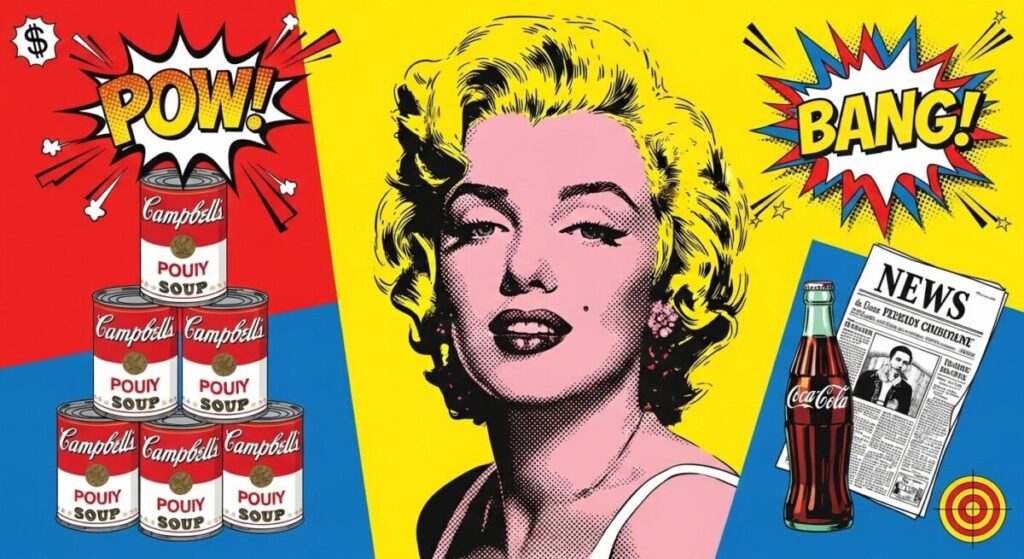
- Campbell’s Soup Cans (1962): A series of 32 canvases, each showing a different soup variety
- Marilyn Diptych (1962): Silkscreen portraits of Marilyn Monroe that became movement icons
- The Factory: His studio became a hub for Pop Art creation and celebrity culture
Roy Lichtenstein: Master of Comic Art
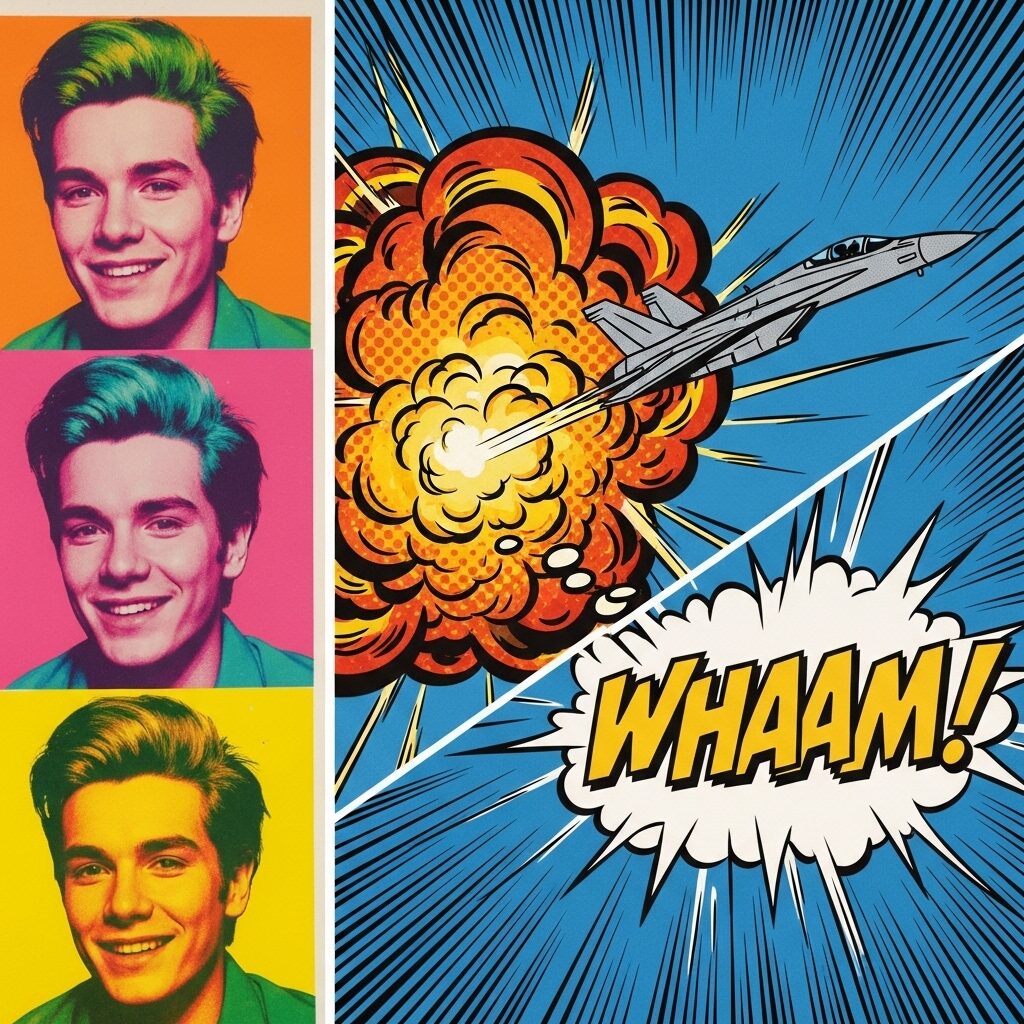
Lichtenstein transformed comic book imagery into high art using a distinctive technique of Ben-Day dots (the printing technique used in comic books) and bold primary colors. His works like “Whaam!” (1963) and “Drowning Girl” (1963) became synonymous with Pop Art’s aesthetic.
David Hockney: British Pop Pioneer
David Hockney brought Pop Art to Britain and is considered a pioneering figure in British Pop Art. Along with other British artists like Peter Blake and Richard Hamilton, Hockney helped establish Pop Art as an international movement.
Cultural Impact: Why Pop Art Mattered
Challenging Traditional Art Rules
Here’s where it gets interesting… Pop Art’s most important contribution was proving that there’s no hierarchy of culture – art can borrow from any source. This democratization of artistic subject matter opened doors for future movements and continues to influence contemporary art today.
The movement served as both a celebration and critique of post-war consumer culture. While embracing the visual language of advertising and mass media, many works also contained subtle commentary on the superficiality of modern consumer society.
Influence Beyond the Art World
Pop Art’s impact extends far beyond museums and galleries:
- Graphic design and advertising: Pop Art aesthetics became integrated into commercial design
- Fashion and lifestyle: The movement’s bold, colorful aesthetic influenced fashion and interior design
- Digital and social media art: Contemporary artists continue exploring themes of mass media and popular culture

Pop Art’s Lasting Legacy in Today’s World
Contemporary Connections
Pop Art’s influence can be seen in contemporary movements such as:
- Neo-Pop: Artists like Jeff Koons and Takashi Murakami continue Pop Art traditions
- Street Art: The accessibility and popular imagery of Pop Art influenced street and graffiti artists
- Digital Art: Internet culture and social media provide new sources for Pop-inspired artwork
The movement’s exploration of media influence on artistic expression remains incredibly relevant in our digital age, where social media and online culture dominate our visual landscape.
Educational Importance
Major museums worldwide feature extensive Pop Art collections, recognizing the movement’s historical importance and continued relevance. Educational programs often use Pop Art to discuss consumerism, media literacy, and the relationship between art and society.
Students can learn about different art movements and see how Pop Art fits into the broader story of artistic development throughout history.
Pro Tip: The Pop Art Scavenger Hunt to truly understand what is Pop Art, try this simple scavenger hunt. Look around your home right now. Find five objects that have logos or are mass-produced. A soda can, a cereal box, a brand of shampoo, a comic book. Now, imagine painting them, huge, with bright, solid colors. Would they feel different? Would they look important? You’ve just created a Pop Art piece in your mind. This exercise helps you see the artistic potential in the things you normally take for granted, which is the whole point of the movement!
The Artist as a Machine: Inside “The Factory”
To truly understand Pop Art, you have to look beyond the canvases (read: Modern Techniques to Express Your True Self) and into the silver-clad walls of Andy Warhol’s legendary studio, The Factory. From 1962 to 1984, this wasn’t just a place where art was made; it was a subversion of the very definition of “The Artist.”
For centuries, the Western world viewed the artist as a solitary, tortured genius—someone who labored over a single “original” masterpiece. Warhol found this concept exhausting and outdated. His solution? He transformed his studio into a literal production line. By hiring assistants to execute his designs and utilizing industrial silk-screening processes, he effectively removed the “human touch” from his work.
Warhol famously stated: “I want to be a machine.”
By embracing the mechanical, Warhol was making a radical statement: In a world of mass production, why should art be any different? If we can produce a billion Coca-Cola bottles that all look identical, we should be able to do the same with a portrait of a celebrity. He wasn’t just creating images; he was creating a brand that existed independent of his own hand.
The AI Connection: Was Warhol the First “Prompt Engineer”?
Looking at The Factory today, it’s hard not to draw a parallel to our current digital landscape. We are living in the age of Generative AI, where tools like Midjourney and DALL-E 3 can create high-fidelity art from a simple text command.
Warhol operated exactly like a human version of these algorithms. He:
- Sourced Data: He took existing “datasets” (press photos of Marilyn Monroe or advertisements for Brillo boxes).
- Applied Filters: He chose high-contrast color palettes and repetitive grids.
- Prompted Execution: He directed his team to “output” the final product.
If Warhol’s goal was for the artist to be a machine that processes culture into commodities, then he essentially predicted the AI-generated art movement sixty years before it arrived. In his eyes, the “idea” was the art; the execution was just mechanical labor.
Food for thought: If Andy Warhol were alive today, would he even pick up a paintbrush—or would he simply be the world’s most famous AI prompt engineer? Does the lack of a “human hand” make a work of art less valuable, or is the vision behind the machine all that matters?CopySave
Frequently Asked Questions About Pop Art
What makes Pop Art different from other art movements?
Pop Art is unique because it embraced popular culture and commercial imagery instead of traditional “fine art” subjects. Unlike movements like Impressionism or Cubism, Pop Art celebrated mass-produced objects and celebrity culture.
Why did Pop Art become so popular?
Pop Art became popular because it was accessible and relatable. People could recognize the subjects – soup cans, comic books, movie stars – making art feel less intimidating and more connected to everyday life.
Is Pop Art still relevant today?
Absolutely! Pop Art’s themes of consumer culture, celebrity worship, and mass media are more relevant than ever in our social media-driven world. Contemporary artists continue to explore these themes using new technologies and platforms.
What techniques did Pop artists use?
Pop artists used screen printing, collage, mixed media, and mechanical reproduction techniques. They often employed repetition and bold primary colors to create their distinctive aesthetic.
Who were the most famous Pop artists?
The most famous Pop artists include Andy Warhol, Roy Lichtenstein, David Hockney, Claes Oldenburg, and James Rosenquist. Each brought unique perspectives and techniques to the movement.
Conclusion: Pop Art’s Revolutionary Legacy
Pop Art fundamentally changed the art world by proving that art could engage directly with contemporary life and popular culture while maintaining artistic integrity. The movement’s characteristics – bold colors, commercial imagery, repetition, and accessibility – created a new visual language that reflected the realities of modern life in the mid-20th century.
By challenging traditional artistic hierarchies and embracing popular culture, Pop Art democratized art and made it more accessible to general audiences. Today, as we navigate our increasingly media-saturated world, Pop Art’s exploration of consumerism, celebrity culture, and mass media remains as relevant as ever. The movement’s most significant achievement was creating a new paradigm for artistic expression that continues to inspire artists, designers, and cultural commentators around the world.
Additional Resources
- Museum of Modern Art – Pop Art Collection – Comprehensive collection of Pop Art works
- Tate Modern – Pop Art Movement – Detailed explanation of Pop Art history and techniques
- Smithsonian American Art Museum – Pop Art – American Pop Art collection and educational resources
- Andy Warhol Museum – Dedicated museum to the most famous Pop artist
- Roy Lichtenstein Foundation – Official foundation preserving Lichtenstein’s legacy
- Google Arts & Culture – Pop Art – Virtual exhibitions and Pop Art exploration
Updated June 26 AIS