
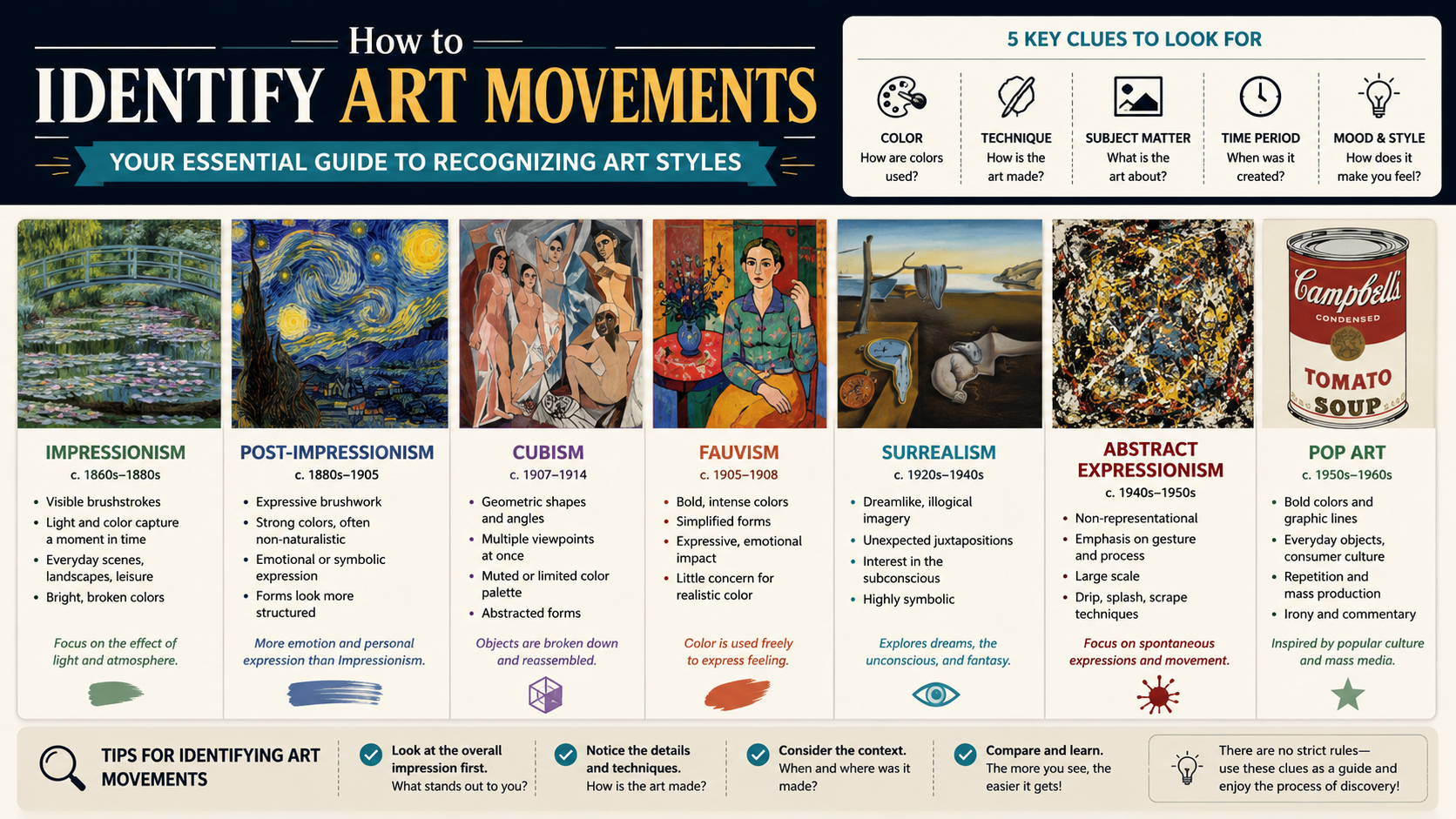
Identifying art movements involves understanding key visual characteristics, historical context, and the philosophical underpinnings that define a particular style. By examining elements like brushwork, subject matter, color palette, and the artist’s intent, you can begin to recognize the distinct traits of various artistic periods and schools, transforming your appreciation for art into an informed understanding.
Keypoint Summary
- Learn to analyze visual cues such as brushwork, color, and composition to discern distinct art styles.
- Understand the historical, cultural, and technological contexts that influenced the emergence and evolution of each movement.
- Familiarize yourself with iconic artists and their signature techniques, as they often embody the core principles of their respective movements.
- Develop an eye for the underlying philosophies and societal shifts that shaped artistic periods, from realism to abstraction.
Becoming an Art Detective: Unlocking the Secrets of Art Movements
Every artwork tells a story, not just through its imagery, but also through the style in which it was created. Recognizing art movements is like learning a visual language, allowing you to connect with the artist’s era, intentions, and the broader cultural conversation. This guide will equip you with the tools to become an art detective, capable of identifying various art styles at a glance. For those looking to deepen their appreciation, understanding these movements is a crucial step in how to appreciate art: a beginner’s guide.

What are the fundamental elements to look for when identifying an art movement?
To identify an art movement, focus on several core elements: subject matter, composition, color palette, brushwork, and the overall emotional or intellectual impact. These components act as clues, revealing the stylistic choices and underlying philosophies of the period. For instance, a focus on everyday life might suggest Impressionism, while fragmented forms could point to Cubism.
How can brushwork and technique reveal an art style?
Brushwork and technique are often the most immediate indicators of an art movement. Smooth, almost invisible brushstrokes characterize the academic tradition and much of the Renaissance, aiming for a polished, idealized reality. In contrast, visible, energetic brushstrokes are a hallmark of Impressionism, capturing fleeting moments and the artist’s immediate perception of light and color. Understanding the tools artists use, such as the best paint brushes for beginners, can also offer insight into the techniques employed.
What role does subject matter play in recognizing art movements?

Subject matter is a powerful identifier. Classical and Renaissance art frequently depicted religious narratives, mythological scenes, and portraits of nobility, often with an emphasis on human anatomy and idealized forms. The Dutch Golden Age, conversely, saw a rise in genre scenes, still lifes, and landscapes, reflecting a burgeoning merchant class and a shift in patronage. Later, movements like Surrealism delved into the subconscious, presenting dreamlike and often unsettling juxtapositions, as explored in the works found at the Tate Modern’s Surrealism collection.
How do color and light define different artistic periods?
The use of color and light is central to defining many art movements. Renaissance masters meticulously used chiaroscuro to create dramatic contrasts between light and shadow, giving figures a three-dimensional quality. Impressionists, however, were revolutionary in their use of broken color and capturing the changing effects of natural light, often painting outdoors to observe these nuances directly. This focus on light and color is a defining characteristic, as detailed in our guide to Impressionist art characteristics.
Key Art Movements and Their Hallmarks
Explore the evolution of art through history.
Renaissance
Realism, perspective, classical influence, anatomy, balanced compositions.
Rococo
Elegance, ornamentation, pastel colors, playful aristocratic themes.
Romanticism
Emotion, imagination, dramatic landscapes, individual expression.
Realism
Ordinary life, social truth, accurate depictions, anti-idealism.
Impressionism
Loose brushwork, light effects, outdoor scenes, fleeting moments.
Post‑Impressionism
Bold color, structure, symbolism, expressive brushstrokes.
Expressionism
Distorted forms, emotional intensity, vivid color, psychological themes.
Cubism
Geometric forms, multiple viewpoints, fragmented compositions.
Surrealism
Dream imagery, subconscious exploration, bizarre juxtapositions.
Abstract Expressionism
Gestural paint, spontaneity, abstraction, emotional energy.
Pop Art
Mass culture, commercial imagery, bold graphics, irony.
Contemporary Art
Mixed media, conceptual ideas, diversity, experimentation.
Exploring Key Art Movements and Their Hallmarks
Renaissance (c. 1400-1600)
The Renaissance marked a rebirth of classical ideals in art, emphasizing humanism, realism, and scientific perspective. Artists like Leonardo da Vinci and Raphael mastered techniques such as linear perspective and sfumato to create depth and lifelike figures. Works from this period, often found in collections like the Renaissance Portraits, typically feature balanced compositions, rich symbolism, and a profound sense of order and harmony.
Impressionism (c. 1870-1890)
Born in France, Impressionism sought to capture the fleeting moment and the sensory impression of a scene, rather than precise detail. Artists like Claude Monet and Pierre-Auguste Renoir used visible, loose brushstrokes, vibrant colors, and focused on the effects of light on landscapes and everyday life. Their revolutionary approach to painting outdoors, or en plein air, transformed how light and color were depicted.
Cubism (c. 1907-1914)
Pioneered by Pablo Picasso and Georges Braque, Cubism shattered traditional perspective, depicting subjects from multiple viewpoints simultaneously. Characterized by geometric forms, fragmented objects, and a muted color palette, Cubism challenged the very notion of representation. This radical departure from traditional art is vividly illustrated in the collections of the Museum of Modern Art (MoMA). The exploration of shapes and lines in abstract art can provide a deeper understanding of Cubist principles.
Surrealism (c. 1920s-1960s)
Emerging from Dadaism, Surrealism explored the subconscious mind, dreams, and irrationality. Artists such as Salvador Dalí and René Magritte created bizarre, dreamlike imagery through unexpected juxtapositions and meticulous detail, often blurring the lines between reality and fantasy. The movement was heavily influenced by Sigmund Freud’s theories of psychoanalysis.
Abstract Expressionism (c. 1940s-1960s)
This American art movement emphasized spontaneous, gestural, or field painting, prioritizing emotional expression over representational forms. Artists like Jackson Pollock with his drip paintings and Mark Rothko with his color fields, sought to convey profound emotions and universal themes through non-representational means. This movement often involved bold, energetic application of paint, similar to techniques explored in abstract painting techniques.
FAQs: Identify Art Movements

What is the easiest way to start identifying art movements?
Begin by observing the general “feel” of a painting: Is it realistic or abstract? Are the colors bright or muted? Are the brushstrokes visible or smooth? Then, look for key characteristics like subject matter or recurring motifs.
Do all artists fit neatly into one art movement?
No, many artists evolve throughout their careers, experimenting with different styles or blending elements from multiple movements. Some artists, like Vincent van Gogh, are difficult to categorize entirely within one strict movement, often bridging styles.
How can I learn more about specific art movements?
Visit museums, both in person and virtually, to see examples firsthand. Read art history books, explore online art encyclopedias like Wikipedia’s list of art movements, and consider taking art history courses or workshops.
Are new art movements still emerging today?
Yes, art is a constantly evolving field. Contemporary art continues to see the emergence of new styles and movements, often influenced by technology, social changes, and global perspectives, such as digital art and various forms of street art.

Olly
Olly Farmer M.Sc, B.Sc, PGCE 25 years experience of Watercolor Painting and AI Art; teacher for 13 years; Creator of Art Tools; Art Gallery Contributor of Art Articles to Medium.com, LinkedIn and Facebook
Continue exploring
PROMINENT PAINTING
Keep your creative momentum
Get new painting guides, practical techniques and artist stories delivered without the noise.
Occasional emails. Unsubscribe whenever you like.