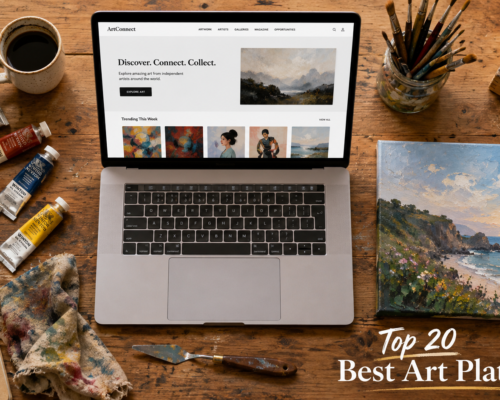
This guide cuts through the noise. Below you’ll find the 20 best art platforms for painters and visual artists in 2026, grouped by purpose, with honest notes on who each one suits best. Whether you’re an emerging painter looking for your first buyer or an established artist ready to reach serious collectors worldwide, there’s a platform here for you.
Quick tip: Most working artists use more than one platform. Think of these as complementary channels — a marketplace for sales, a portfolio site for credibility, and social platforms for reach.
Best Platforms for Selling Original Artwork
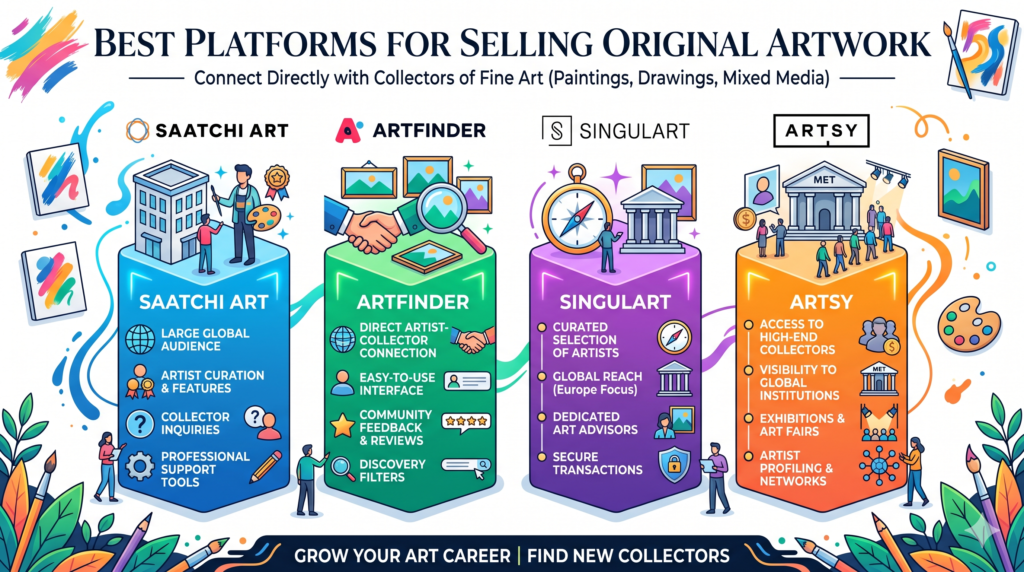
If you create original paintings — oils, watercolours, acrylics, mixed media — these platforms connect you directly with collectors actively looking to buy fine art.
1. Saatchi Art
Best for: Painters who want to reach international collectors with zero logistics headaches.
Saatchi Art is one of the world’s largest online art galleries, with millions of monthly visitors and a strong reputation among serious collectors. The platform handles packaging, shipping, and customs on your behalf, so you can stay focused on the studio rather than the warehouse. A free curator-driven advisory service recommends work to buyers, which can generate sales without any additional marketing effort on your part. The tradeoff is that you’re competing with roughly 110,000 other artists, which makes strong photography and smart keyword use essential.
Commission: 35% of sale price.
Best media: Paintings, photography, sculpture, printmaking.
2. Artsy
Best for: Established artists seeking gallery-level exposure online.
Artsy positions itself at the intersection of art world credibility and digital reach. It partners with thousands of galleries, art fairs, and institutions — meaning your work sits alongside names from the contemporary art canon. The platform suits artists who already have some exhibition history and want to scale their reach to a wealthier, more international collector base. Artsy is invitation or gallery-affiliate access only, which keeps quality high but makes entry less straightforward for emerging artists.
Commission: Varies by gallery partnership.
Best media: All fine art media.
3. Singulart
Best for: Mid-career artists wanting curated placement among serious collectors.
Paris-based Singulart operates as a curated gallery rather than an open marketplace. Artists must apply, and the platform’s admissions committee reviews your portfolio, CV, and market potential before accepting you. That rigorous vetting keeps quality high and signals credibility to buyers — but it comes at a cost, with commissions on the higher side. For artists who are accepted, Singulart actively promotes work through editorial content and targeted campaigns to an affluent European and American collector base.
Commission: 50% of sale price.
Best media: Paintings, drawings, photography.
4. Etsy
Best for: Emerging painters selling affordable originals, prints, or illustrations.
With over 90 million active buyers, Etsy offers more built-in traffic than almost any other platform. It works especially well for prints, smaller originals, and anything with a handmade or gift angle. Because Etsy shoppers often browse for home décor and unique gifts, painters benefit from a natural demand for personal, story-led artwork. The platform is competitive — millions of listings vie for attention — so good photography, strong SEO titles, and consistent uploads make the difference. It’s also a strong first platform for painters new to selling online.
Fees: £0.16 listing fee + 6.5% transaction fee.
Best media: Prints, small originals, illustrations, watercolour studies.
If you’re still developing your painting practice, our guide on how to critique your own paintings can help you identify which works are ready to list.
5. ArtPal
Best for: Artists who want to sell with zero fees and full price control.
ArtPal is one of the few platforms that charges no membership fees and takes zero commission on sales. Artists set their own prices, keep 100% of the revenue, and can sell original work alongside print-on-demand products from the same profile. While it lacks the marketing muscle and collector base of Saatchi or Artsy, it’s a genuinely risk-free way to test the market with your paintings and build an online sales history.
Commission: 0%.
Best media: Paintings, photography, sculpture.
6. Foundmyself
Best for: Artists who want direct-to-buyer sales with integrated print-on-demand and AI tools.
One of the oldest independent art marketplaces online (founded 2003), Foundmyself lets artists keep 100% of their sales with transactions handled directly between buyer and seller. Artists can sell originals and print-on-demand products from the same platform, and the site offers a suite of AI tools including an art critique generator, image description writer, and keyword builder — useful for artists who want to optimise their listings without a marketing background.
Commission: 0% on originals.
Best media: All media; strong for paintings and prints.
Best Print-on-Demand Platforms for Artists
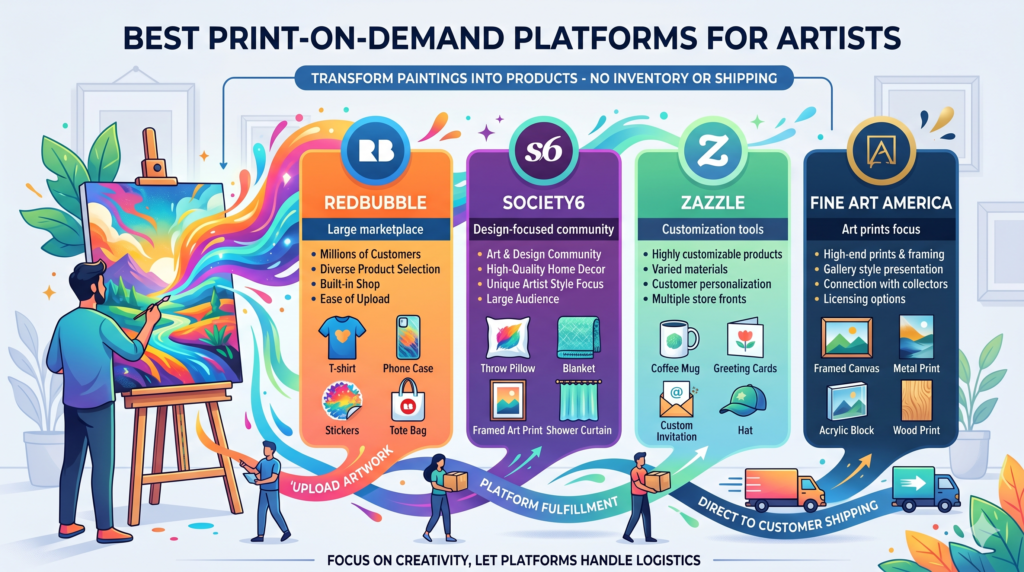
Print-on-demand lets you turn your paintings into products — framed prints, canvases, phone cases, tote bags — without managing inventory or shipping. They’re particularly powerful for painters who have a strong visual style that translates to product design.
7. Fine Art America / Pixels
Best for: Painters who want maximum product variety and a dedicated art-buyer audience.
Fine Art America is the world’s largest print-on-demand platform specifically built around visual art, with over 16 million images and products available. Painters upload their work and set a markup above the base production cost; Fine Art America handles printing, framing, packaging, and shipping. Products include fine art prints, framed prints, canvas prints, metal prints, acrylic prints, greeting cards, and phone cases. The sister site Pixels serves a broader product audience. A key advantage is the built-in collector audience actively searching for wall art.
Commission: Artist sets own markup above base cost.
Best media: All visual art, particularly painting and photography.
8. Society6
Best for: Painters with a design-led style that suits lifestyle products.
Society6 allows artists to upload their work and have it printed across hundreds of product types — from art prints and canvas prints to furniture, bedding, and apparel. Artists set their own profit margins on prints; for other products, Society6 sets the base price and artists earn a standard royalty. The platform has a strong aesthetic identity that skews towards illustration, pattern-making, and bold graphic art — but painters with a distinctive visual style can find a real audience here.
Commission: 10% base royalty on most products; adjustable on prints.
Best media: Illustration, pattern-based painting, bold visual art.
9. Redbubble
Best for: Artists who want passive income from a high-traffic marketplace without promotion effort.
Redbubble is one of the highest-traffic print-on-demand platforms, with millions of monthly shoppers browsing for art-printed products. Artists upload designs, set a markup percentage, and earn royalties automatically when products sell. There’s no upfront cost and no inventory to manage. The platform’s audience leans younger and tends to search for niche, pop-culture, and fandom-adjacent themes — but painters with distinctive or recognisable styles can carve out a consistent passive income stream.
Commission: Artist sets markup (typically 10–30% above base).
Best media: All visual art; especially illustration and painterly graphics.
10. Printful
Best for: Artists building their own branded shop with integrated fulfilment.
Printful is a fulfilment platform rather than a marketplace — meaning you drive your own traffic (through your own website, Etsy shop, or Instagram) and Printful handles production and shipping behind the scenes. It integrates with Shopify, WooCommerce, Etsy, Amazon, and most major e-commerce platforms. For painters who want to build a serious, branded online store without managing stock, Printful is the professional-grade backbone. Products include fine art prints, canvas prints, framed posters, and apparel.
Commission: No platform fee; you pay production cost and keep the margin.
Best media: Any painterly or illustrative work suited to product printing.
Best Portfolio Platforms for Painters
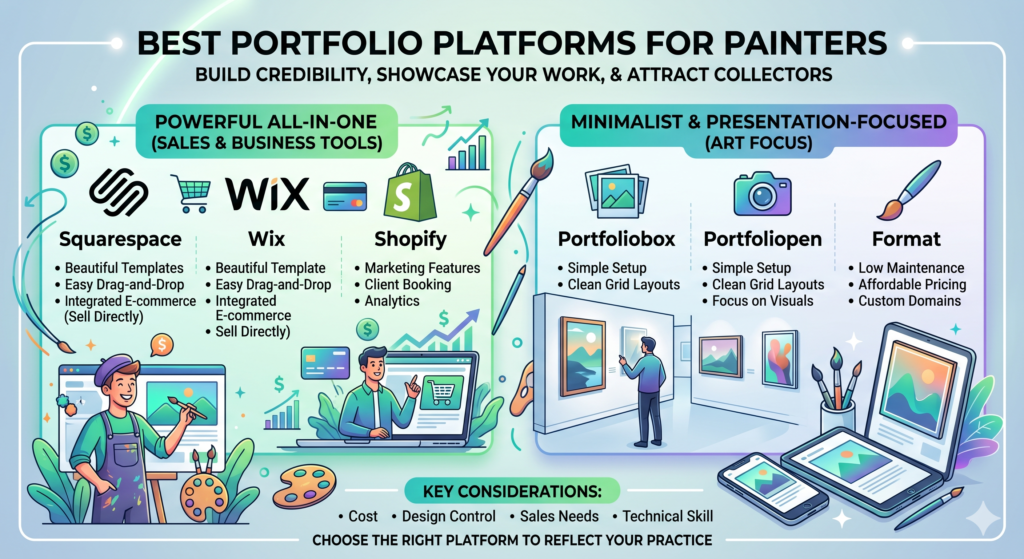
Before a collector buys your work, they research you. A clean, professional portfolio signals credibility and shows the depth of your practice. These platforms help you build that presence — some with sales tools, some focused purely on presentation.
11. Squarespace
Best for: Painters who want a polished, design-led portfolio with minimal technical effort.
Squarespace has long been the preferred website builder for visual artists who prioritise aesthetic quality and typography. Its templates are genuinely beautiful, image-first, and highly customisable without needing to write code. Built-in e-commerce lets you sell originals and prints directly, and SEO tools help collectors find you through organic search. The platform is particularly well suited to painters who want their website to feel like a gallery experience rather than a marketplace listing.
Cost: From approx. £13/month.
Best for: Fine artists, painters, mixed-media artists.
12. Behance (Adobe)
Best for: Painters who also work digitally or in illustration and want industry visibility.
Owned by Adobe, Behance is the world’s largest creative portfolio network, with millions of designers, illustrators, and artists sharing work. For traditional painters who also work in digital media — or who produce concept art, editorial illustration, or design-adjacent work — Behance’s integration with Adobe Creative Cloud and its direct connection to recruiters and art directors makes it particularly valuable. It’s free, widely indexed by search engines, and respected as a professional signal in the creative industries.
Cost: Free.
Best for: Painters with crossover into digital art, illustration, or design.
13. ArtStation
Best for: Artists working in concept art, game art, or visual development alongside traditional painting.
ArtStation is the dominant platform for professional concept artists and game designers, and its Marketplace allows artists to sell digital brushes, tutorials, 3D models, and prints alongside portfolio work. Recruiters from major studios actively scout on the platform. For painters who bridge traditional and digital disciplines — or who teach — ArtStation’s combination of portfolio, community, and e-commerce makes it uniquely powerful. Less suited to purely traditional painters with no digital output.
Cost: Free basic plan; Pro plan ~$8/month.
Best for: Traditional-digital crossover artists, concept painters.
14. Portfoliobox
Best for: Artists who want a simple, professional portfolio live within 30 minutes.
Portfoliobox positions itself as the fastest route to a professional online portfolio — with a five-step setup (sign up, add galleries, design, connect domain, share) that requires no technical knowledge. Crucially, it charges zero e-commerce commissions across all tiers, meaning whatever you sell, you keep. E-commerce supports physical products, digital downloads, services, and courses. Rated 4.3/5 on G2, it’s a strong option for painters who want a clean digital presence without the complexity of Squarespace or Wix.
Cost: Free plan available; paid from ~£10/month.
Best for: Painters wanting quick, professional portfolio setup with commission-free selling.
Best Social Platforms for Artists
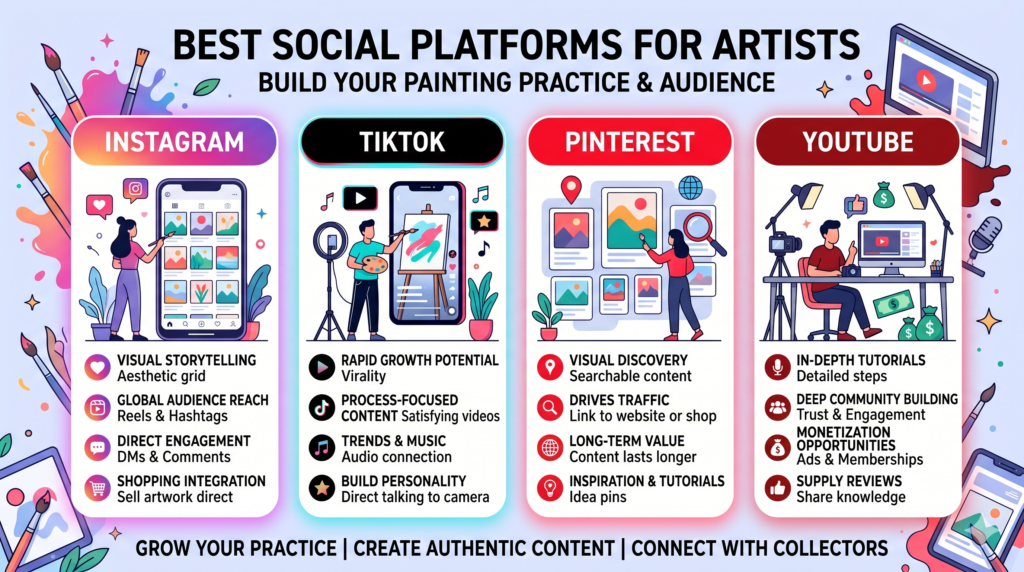
Social media remains the most powerful way to build an audience around your painting practice. The right platform depends on your medium, your content style, and whether you’re optimising for reach, community, or direct sales. Understanding how social platforms are shaping contemporary painting can also inform how you present your work.
15. Instagram
Best for: All visual artists — the most important platform for painters in 2026.
Instagram remains the single most valuable social platform for painters. Its feed functions as a live portfolio; Reels allow you to reach entirely new audiences with time-lapses and process videos; Stories keep existing followers engaged day-to-day. Instagram Shopping lets you tag and sell work directly from posts. For painters, the platform works best when the grid maintains a coherent visual identity — consistent lighting, framing, and colour palette signal professionalism to potential buyers and gallery scouts. Artists report needing 10–15 hours per week for an effective presence across 2–3 platforms, so Instagram is often the one to prioritise.
Cost: Free.
Best content: Finished works, process carousels, time-lapse Reels, studio moments.
Looking for inspiration for your next painting? Our guide to finding art inspiration offers practical strategies that translate directly into shareable content.
16. Pinterest
Best for: Painters who want long-term organic traffic and a search-driven audience.
Pinterest functions like a visual search engine rather than a social feed — which means a well-optimised pin can continue driving traffic to your shop or portfolio for months or even years after posting. For painters, this makes it particularly valuable for building passive discoverability. Room-mockup pins showing your painting in a home setting perform especially well. Unlike Instagram, where posts decay within 48 hours, Pinterest rewards longevity. It’s also 100% free to use, with ad costs only arising if you choose to promote pins.
Cost: Free.
Best content: High-resolution painting images, room mockups, step-by-step guides.
17. TikTok
Best for: Painters willing to create short video content and comfortable with viral reach.
TikTok has become a serious discovery engine for painters in 2026. Process videos — particularly satisfying time-lapses of a painting coming together — can reach millions of viewers regardless of follower count. The algorithm prioritises content quality over audience size, meaning a new painter with compelling videos can achieve instant visibility that would take years on Instagram. Monetisation is less direct than other platforms, but the audience growth and brand-building potential are unmatched for video-native creators. We explored how TikTok is reshaping painting styles in an earlier post — it’s worth reading before you start your channel.
Cost: Free.
Best content: Time-lapses, painting reveals, technique demonstrations under 60 seconds.
18. YouTube
Best for: Painters who want to build deep authority through tutorials and long-form content.
YouTube is the platform of choice for painters who want to teach. Long-form tutorials, technique deep-dives, and studio vlogs build the kind of trust and loyalty that converts viewers into buyers and students. YouTube’s search-driven model means well-optimised videos continue attracting new viewers for years, creating a compounding content library. It’s the most time-intensive platform on this list, but for painters with genuine teaching ambition, it offers unmatched depth of connection with an audience. If you teach watercolour, our beginner’s guide to watercolours is the kind of evergreen content YouTube audiences love.
Cost: Free.
Best content: Tutorials, painting process videos, supply reviews, studio tours.
Specialist and Emerging Platforms Worth Knowing
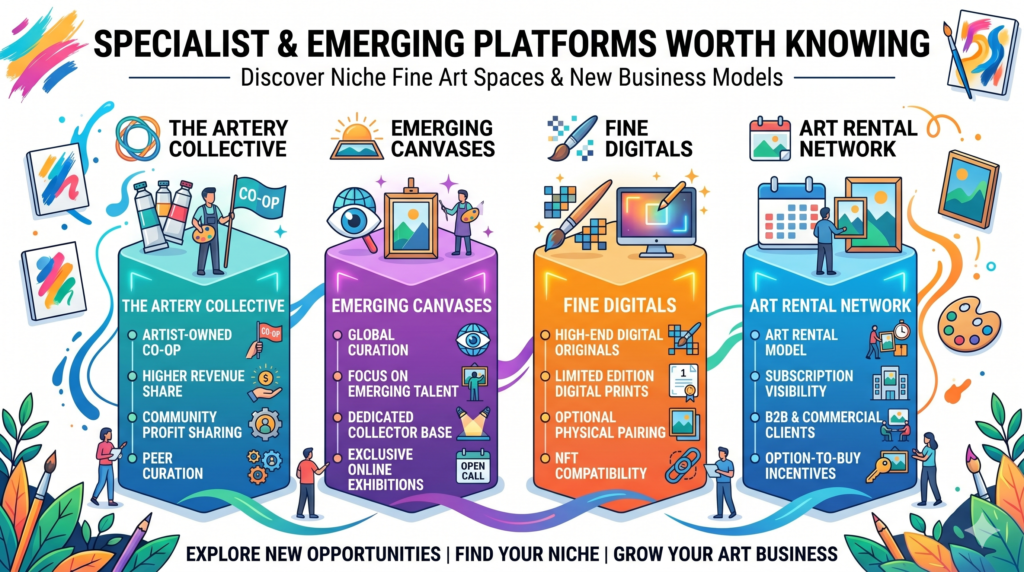
Beyond the mainstream options, several platforms cater specifically to painters and fine artists with distinct advantages.
19. Cara
Best for: Artists concerned about AI training of their work, seeking a community of human-made art.
Cara has emerged as one of the fastest-growing artist-first platforms, driven by a community commitment to human-made art and explicit protections against AI training data scraping. It integrates with Glaze (a tool that adds invisible perturbations to images to disrupt AI style copying) and has built a strong, ethically minded creative community. For painters who care about protecting their visual style and connecting with like-minded artists, Cara offers something no mainstream platform does: a genuine community stance on AI and intellectual property.
Cost: Free.
Best for: Painters concerned about AI ethics; community-focused creators.
20. Shopify (Your Own Store)
Best for: Established painters ready to build a direct-to-collector brand with full control.
Shopify isn’t an art marketplace — it’s the platform that lets you build your own one. Rather than competing in a shared marketplace, your Shopify store gives you complete control over presentation, pricing, brand voice, and customer relationships. You keep a far greater proportion of revenue and build an email list of buyers you actually own. It integrates with Instagram, TikTok, and Pinterest Shopping, and connects seamlessly with Printful for print-on-demand fulfilment. For painters at the stage where their name is the brand, Shopify is the natural next step. The art market is growing — owning your slice of it directly is the long-term play.
Cost: From ~£22/month.
Best for: Artists with an established collector base ready to go direct.
Quick Comparison: Top 20 Art Platforms at a Glance
| Platform | Primary Use | Commission / Cost | Best For | |
|---|---|---|---|---|
| 1 | Saatchi Art | Selling originals | 35% commission | Fine artists, painters |
| 2 | Artsy | Gallery-level exposure | Varies | Established artists |
| 3 | Singulart | Curated marketplace | 50% commission | Mid-career painters |
| 4 | Etsy | Prints & originals | 6.5% + listing fee | Emerging painters |
| 5 | ArtPal | Zero-fee selling | 0% | All painters |
| 6 | Foundmyself | Direct sales + AI tools | 0% on originals | Originals + POD |
| 7 | Fine Art America | Print-on-demand | Artist sets markup | All painters |
| 8 | Society6 | Print-on-demand | 10% royalty base | Bold / pattern styles |
| 9 | Redbubble | Print-on-demand | Artist sets markup | Passive income focus |
| 10 | Printful | POD fulfilment | No platform fee | Own-store artists |
| 11 | Squarespace | Portfolio + store | From ~£13/month | Fine artists |
| 12 | Behance | Professional portfolio | Free | Digital / mixed artists |
| 13 | ArtStation | Portfolio + marketplace | Free / ~£8/month | Concept / game artists |
| 14 | Portfoliobox | Portfolio + store | Free / ~£10/month | Quick-setup portfolio |
| 15 | Social reach + sales | Free | All painters | |
| 16 | Discovery + traffic | Free | Long-tail SEO artists | |
| 17 | TikTok | Viral reach | Free | Video-comfortable artists |
| 18 | YouTube | Tutorials + authority | Free | Artists who teach |
| 19 | Cara | Community + ethics | Free | Human-art advocates |
| 20 | Shopify | Own store | From ~£22/month | Established artists |
How to Choose the Right Art Platform
There’s no single best platform — there’s only the right combination for your goals, your medium, and the time you’re willing to invest. Here’s a simple framework:
If you’re just starting out and want to test whether your paintings sell, start with Etsy or ArtPal. Zero barrier to entry, built-in audiences, and no financial risk.
If you make fine art paintings and want gallery-level exposure without gallery gatekeeping, Saatchi Art or Singulart are the most effective routes to serious collectors.
If you want passive income from your existing body of work, Fine Art America or Redbubble let you upload once and earn from print sales indefinitely.
If you want to build a lasting brand and own your relationship with collectors, pair a Squarespace or Portfoliobox portfolio with a Shopify store and Printful fulfilment. This is the long-term play.
For social reach, prioritise Instagram for feed-based presence, Pinterest for long-tail discoverability, and TikTok if you’re comfortable on camera and can show your painting process in short video form.
Understanding how collectors discover and appreciate art can also help you frame your work — and your platform profile — more effectively.
What Every Strong Artist Platform Profile Needs
Whichever platforms you choose, the quality of your profile determines whether browsers become buyers. These fundamentals apply across all 20 platforms above:
Photography matters more than you think. Collectors cannot touch your work online. High-resolution images photographed in natural light, with no distracting backgrounds, are the single biggest lever you control. On print-on-demand platforms especially, the quality of your uploaded image determines the quality of the printed product.
Your bio is your handshake. Explain who you are, what you paint, and why in plain language. Avoid art-world jargon that distances casual buyers. The first two sentences of your bio are what most visitors read; make them count.
Titles and descriptions drive search. On marketplace platforms, your painting’s title and description are how potential buyers find you through search. Be specific: “Loose watercolour landscape painting of Scottish Highlands — original A3” will perform better than “Landscape Study No. 4.”
Consistency is the compound interest of online presence. Regular uploads, regular posting, and a coherent visual identity build trust over time. An artist who posts consistently for 12 months on Instagram will almost always outperform a more talented artist who posts sporadically.
If you’re working to develop that consistency and identity, our guide on critiquing your own paintings helps you develop the discernment to know which work to share — and which to keep in the studio.
The Art Market in 2026: A Platform-Driven Opportunity
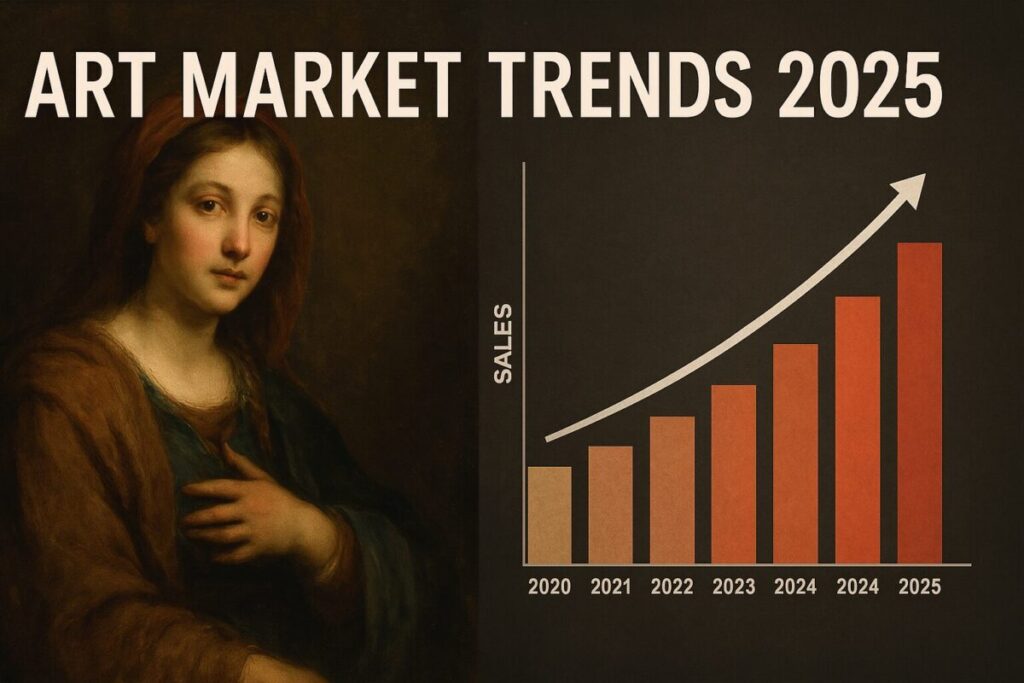
The global art market continues to grow, with online sales representing a larger share than ever. According to recent Art Basel data, over 70% of collectors now research artists online before purchasing — and personal artist websites are among the most trusted sources. That shift means your digital presence isn’t supplementary to your practice anymore; it is your practice’s public face.
The platforms on this list represent the primary channels through which painters are building sustainable careers in 2026. The artists doing it most effectively aren’t necessarily the most technically accomplished — they’re the ones who understand their audience, choose the right platforms for their goals, and show up consistently.
Human-made art is increasingly valued in a world of AI-generated imagery. Platforms like Cara are emerging specifically in response to that shift. But the core opportunity — reaching collectors, building community, and selling your work — has never been more accessible. You don’t need gallery approval or an art school pedigree. You need good work, a clear voice, and the right digital home for it.
For a broader picture of where the art market is heading, see our post on the growing art market and what it means for painters.
Frequently Asked Questions
What is the best platform for selling original paintings?
For most painters, Saatchi Art offers the best combination of collector reach, built-in logistics support, and credibility. For emerging artists or those starting with lower price points, Etsy provides the largest built-in buyer audience. Zero-commission alternatives like ArtPal are worth considering if you want to keep all revenue on early sales.
Can I use multiple art platforms at once?
Yes — and most working artists do. A common strategy is to list originals on Saatchi Art, sell prints via Fine Art America or Redbubble, maintain a portfolio on Squarespace, and drive traffic through Instagram and Pinterest. The key is ensuring your pricing and presentation are consistent across platforms.
Do I need my own website as an artist?
Increasingly, yes. Over 70% of collectors research artists online before buying, and your own website signals professionalism and longevity in a way that a marketplace profile cannot. Squarespace and Portfoliobox are the most accessible entry points for painters with no web development experience.
Is Etsy still worth it for artists in 2026?
Yes, particularly for prints, affordable originals, and illustration. The platform’s 90 million+ active buyers still represent one of the largest ready-made audiences for handmade art. Increasing competition means strong SEO, good photography, and consistent uploads matter more than ever — but the opportunity is real.
What social media platform is best for painters?
Instagram remains the most important social platform for painters in 2026 — particularly for building a coherent portfolio-style presence and reaching buyers. Pinterest is the best platform for passive, long-term discoverability. TikTok offers the fastest route to new audiences for those comfortable creating short video content around their process.
How do I choose between print-on-demand platforms?
Fine Art America is the strongest choice for painters who want a dedicated fine art buyer audience. Redbubble suits artists focused on passive income with a broad product range. Society6 works well for bold, pattern-driven painting styles. Printful is the right choice when you want full brand control and are building your own store.
Final Thoughts
The 20 platforms on this list collectively cover every stage of a painter’s career — from the first Etsy listing to a curated Singulart profile, from a TikTok process video to a full Shopify store with Printful fulfilment. None of them require gallery connections, prestigious art school degrees, or expensive marketing budgets. They require consistency, quality, and the willingness to show your work.
Start where you are. If you’re painting regularly and haven’t listed a single piece online yet, Etsy or ArtPal can be live within an hour. If you already have sales and want to reach collectors at a higher price point, Saatchi Art or Singulart is your next move. If you want to build a lasting brand that you own and control, the Squarespace + Shopify + Printful combination is the long-term answer.
The art market in 2026 belongs to artists who show up — digitally, consistently, and with work they believe in. The platforms are ready. The collectors are searching. The only question is where they’ll find your paintings.
Want to make sure your work is ready before you list it? Our guide to critiquing your own paintings gives you a practical framework for self-assessment that will make every listing you create stronger.