
Learning to paint watercolor clouds doesn’t have to be intimidating. This guide covers the essential wet-on-wet techniques, the right supplies, and the secrets to preserving pristine white space. You’ll discover step-by-step methods to lift pigment and create soft, airy skies. Grab your brushes. Let’s turn that blank canvas into a beautiful atmospheric sky today.
You drop blue paint onto the paper and watch in horror as your beautiful sky turns into a flat, grey puddle. We’ve all been there. Painting watercolor clouds feels like trying to control the weather. It’s frustrating. It makes you want to quit. But the secret to the basics of watercolor painting is actually letting the water do the heavy lifting.
When I started teaching, I saw countless students overwork their skies until they looked like solid blocks of concrete. Over my decade of teaching art, I learned that watercolor clouds require patience. You have to let go of total control.
This guide will show you exactly how to achieve those soft, fluffy edges. We’ll look at proper timing. We’ll explore how to lift pigment without ruining the paper. By the end of this, you’ll understand exactly how the water and pigment interact. Let’s get your brushes wet.
What Is the Best Technique for Watercolor Clouds?
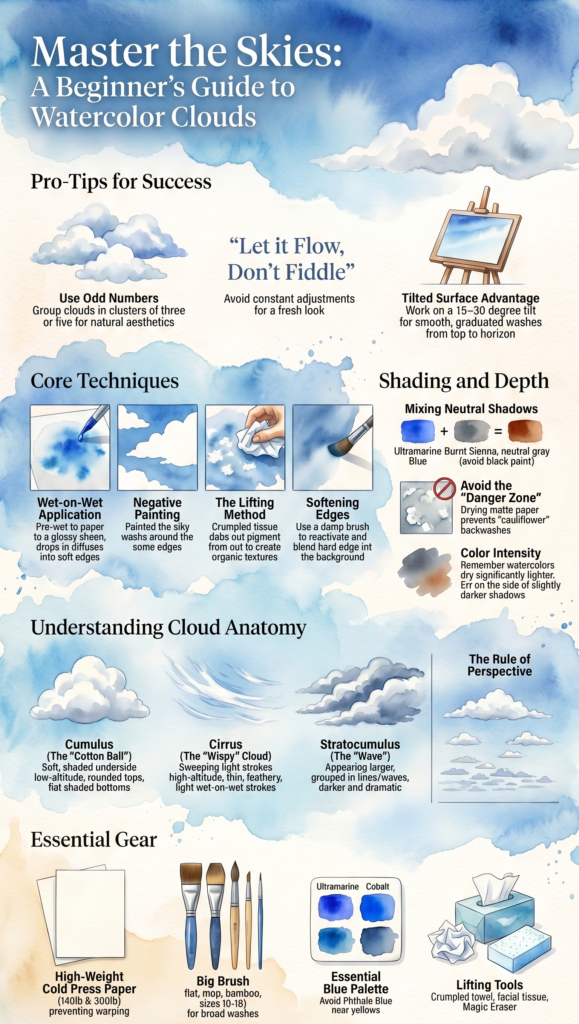
The best technique for watercolor clouds is the wet-on-wet method. You apply clean water to your paper first and then drop blue pigment onto the damp surface. The water naturally pulls the paint to create soft, diffuse edges that perfectly mimic fluffy clouds.
This approach works because the water does the blending for you. You don’t have to scrub the paper with your brush. If you want to explore more simple wet-on-wet techniques, remember that timing is everything. Historically, the wet-on-wet technique has been used for centuries to create atmospheric depth because dropping paint when the paper has a soft sheen yields the most natural gradients.
Essential Supplies for Dreamy Skies
You can’t paint a great sky on bad paper. Your materials dictate how the water behaves.
First, you need 100% cotton watercolor paper. Wood pulp paper dries too fast and leaves harsh lines. Genuine cotton paper is prized for its superior strength and moisture retention, meaning the pure cotton fibers absorb water evenly to give you more time to work. If you need help choosing watercolor paper, always check the label for 100% cotton.
Next, grab a large mop brush. Small brushes require too many strokes. You also want a quality blue pigment. Cerulean blue is a synthetic pigment composed of cobalt stannate that naturally granulates to create beautiful texture. Alternatively, ultramarine is a deep blue pigment originally made by grinding lapis lazuli, which provides a richer, warmer tone for afternoon skies.
How Do You Keep White Space for Clouds?
You keep white space for clouds by painting around the shapes or lifting wet pigment. Use a clean, damp brush to soak up wet blue paint from the paper. This creates natural, soft white clouds against your blue sky.
The white of your paper is your most precious resource. Once you cover it, getting it back is incredibly difficult. You can simply leave dry paper where you want the clouds to live. Alternatively, the lifting technique is incredibly effective. This lifting process relies on the core science of watercolor painting, where pigments are suspended in a water-based solution, allowing you to easily pull that solution off the page before it dries.
Step-by-Step: Painting Your First Fluffy Cloud
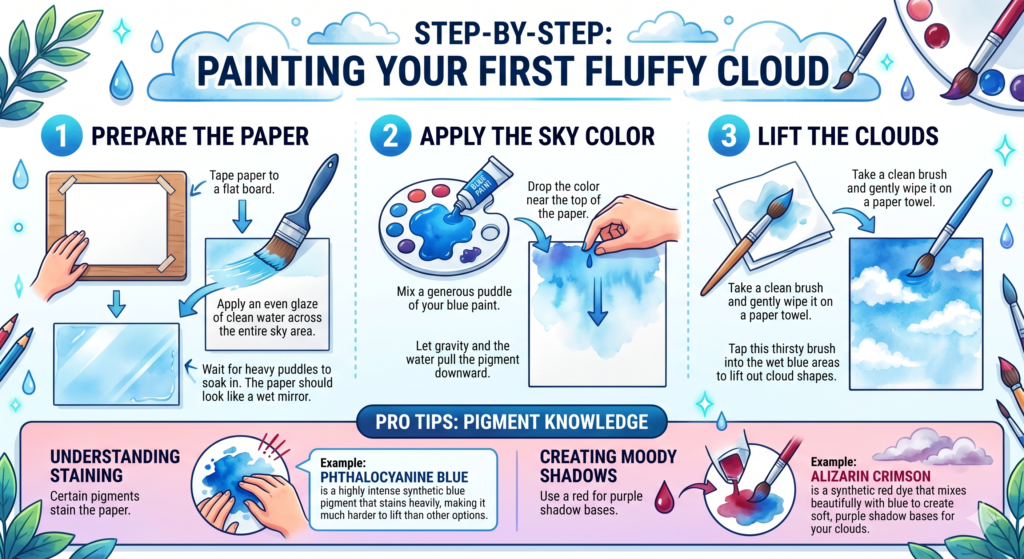
- Start by taping your paper to a flat board. Apply an even glaze of clean water across the entire sky area. Wait for the heavy puddles to soak in. The paper should look like a wet mirror.
- Mix a generous puddle of your blue paint. Drop the color near the top of the paper. Let gravity and the water pull the pigment downward.
- Take a clean brush and gently wipe it on a paper towel. Tap this thirsty brush into the wet blue areas to lift out cloud shapes. Remember that certain pigments stain the paper. For example, phthalocyanine blue is a highly intense synthetic blue pigment that stains heavily, making it much harder to lift than other options. If you want a moody sky, alizarin crimson is a synthetic red dye that mixes beautifully with blue to create soft, purple shadow bases for your clouds.
How Do You Fix Overworked Watercolor Clouds?
You fix overworked watercolor clouds by letting the paper dry completely before gently lifting mistakes with a damp brush. If the sky becomes muddy, you must stop painting immediately. Scrubbing wet paper will only damage the surface and ruin the painting.
Sometimes the best action is no action. Watercolor requires you to know when to step away. If things go wrong, let it dry. You can often learn to fix watercolor mistakes by simply re-wetting specific areas later.
Great Watercolor Cloud Painting Artists
| Artist Name | Era / Style | Watercolor Cloud Style & Focus |
|---|---|---|
| J. M. W. Turner | 18th-19th C. / Romanticism | The undisputed master of atmospheric watercolor. Famous for luminous, turbulent, and emotive skies, manipulating wet-in-wet washes to seamlessly blend clouds, light, and atmosphere. |
| Thomas Girtin | 18th-19th C. / Romanticism | A pioneer of the English watercolor landscape. Revolutionized the medium by using broad, sweeping washes of color to create deep, moody, and expansive skies over open terrain. |
| David Cox | 19th C. / English School | Celebrated for his dynamic and expressive weather effects. Mastered the depiction of blustery, wind-swept skies, fast-moving cumulus clouds, and rainstorms using loose, rapid watercolor brushwork. |
| John Robert Cozens | 18th C. / Early English School | Relied entirely on watercolor and ink wash to create melancholic, poetic landscapes. His skies focus on soft, diffused clouds and alpine mist built through subtle, monochromatic layering. |
| Cindy Briggs | Contemporary | A modern instructor and artist who specializes in accessible watercolor techniques. Highly focused on using fluid, wet-in-wet applications to capture soft, glowing, and vibrant cloud formations. |
| Yu Huan Huan | Contemporary | Fuses Western watercolor transparency with traditional Chinese brushwork. Her skies feature highly finessed, delicate, and ethereal cloud structures that evoke a strong sense of poetry and calm. |
Conclusion
Perfection is the enemy of a beautiful painting. The sky is never perfect, and your watercolor clouds shouldn’t be either. The water has a mind of its own. Let it flow. Let the pigment settle where it wants to settle. Your job is simply to guide it, not to force it.
Grab a scrap piece of 100% cotton paper right now. Wet the surface and drop in one single color. Practice lifting out just three simple clouds. If you’re ready for more, check out our guide on getting started with watercolors. Grab your favorite blue and make a mess today.
Frequently Asked Questions
- What colors make the best watercolor clouds? Cerulean Blue and Ultramarine Blue are excellent choices for skies. You can add a tiny drop of Alizarin Crimson to the base of the clouds for soft shadows.
- Can I use white watercolor paint for clouds? You can use white gouache or watercolor, but it often looks chalky. Because gouache is an opaque watercolor paint, it sits heavily on the paper and blocks out the natural light. The best white is the natural white of your watercolor paper.
- Why do my watercolor clouds look muddy? Muddy clouds happen when you overwork the wet paint or mix too many colors. Apply the paint confidently and leave it alone to dry.
- How much water should I use for wet-on-wet skies? Your paper should have a wet, glossy sheen without any standing puddles. If water pools at the edges, your paper is too wet.
- What is the lifting technique in watercolor? Lifting involves using a clean, damp brush or paper towel to soak up wet pigment from the paper. This technique reveals the white paper underneath to create soft cloud shapes.