Updated 2026: Watercolor is notoriously difficult to control. A handful of visionary historical artists figured out how to tame the medium and turned simple pigments into fine art. This post breaks down the exact techniques used by famous painters like Turner and Sargent. You will learn how these historical methods still shape modern art and how you can apply their proven secrets to your own painting practice today.
Watercolor painting looks easy until you actually try it. The water moves unpredictably. The pigment bleeds across the page. You lose control of your shapes almost instantly. Many beginners give up because they think they lack talent.
The truth is that you just need to understand the mechanics of the medium. A few brilliant historical painters already solved these problems for us. They figured out how to guide the chaos. They turned a simple sketching medium into respected fine art. Their techniques still dictate how we paint today.
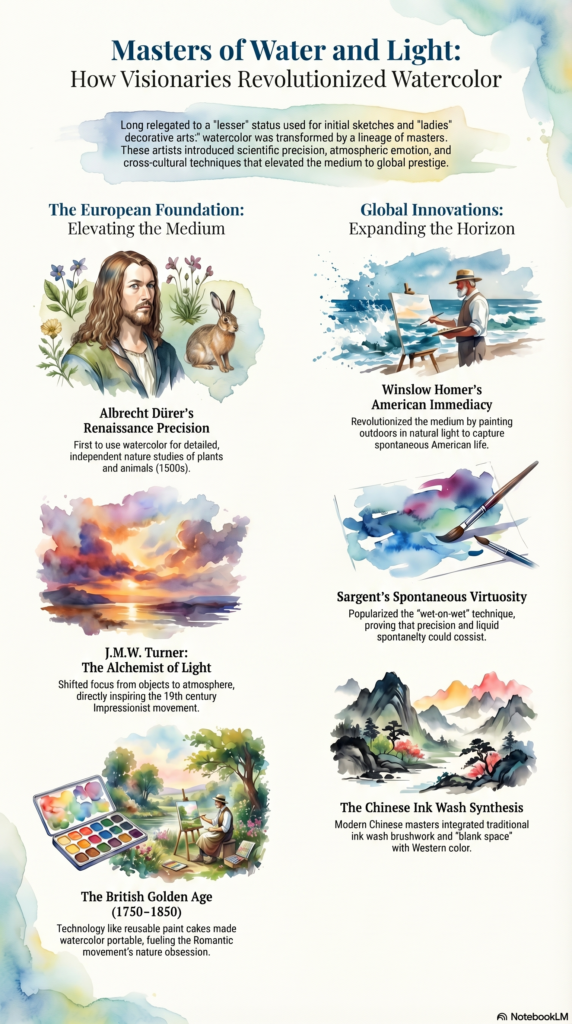
Learning about the 10 watercolor masters is not just a history lesson. It is a shortcut to better painting. When you study how J.M.W. Turner handled water or how Winslow Homer scraped his paper, you stop fighting the paint. You start working with it. Let us look at how these influential artists broke the rules and shaped the entire art world.
How Did J.M.W. Turner Change Watercolor Painting?
J.M.W. Turner changed watercolor painting by treating it as a serious medium rather than just a tool for quick sketches. He used heavy washes and layered pigments to capture complex atmospheric effects like fog and rain.
Before Turner came along, artists mostly used watercolors for cheap botanical illustrations or fast outdoor studies. He proved the medium could handle massive emotional subjects. He dragged wet paint across wet paper to create soft skies. He wiped away pigment with rags to create aggressive highlights. If you want to understand his true impact, look at Turner’s watercolors. He showed the world that you could literally paint light itself
“Turner’s watercolors were a revelation. He showed us that light itself could be the subject.”
Claude Monet
John Singer Sargent and the Art of Light
Sargent made watercolor look completely effortless. He painted outside and captured exact moments in time with just a few strokes. He relied heavily on negative space. He left the stark white paper showing through to represent bright sunlight hitting skin or stone.
It was a highly risky way to paint. One mistake and the bright highlights were lost forever. You can easily spot John Singer Sargent’s watercolor technique by looking at how he simplified complex scenes. He did not paint every leaf on a tree. He painted the feeling of the shadow the tree cast.
Why Is Winslow Homer Important to American Art?
Winslow Homer is important to American art because he transformed watercolor into a bold medium for documenting harsh realities. He recorded violent ocean storms and rugged outdoor life using strong compositions and intense colors.
Homer didn’t paint polite garden scenes. He painted the ocean looking heavy and dangerous. Winslow Homer threw out the traditional rules of delicate translucent washes. He scraped his paper with knives to create texture. He used thick opaque paints to force the medium to do exactly what he wanted. He made watercolor feel muscular and permanent.
Andrew Wyeth and Drybrush Precision
Andrew Wyeth took the water out of watercolor. He used a technique called drybrush. He drained almost all the moisture out of his brush before touching the paper to create incredibly precise textures.
His paintings look almost photographic. They capture the rough texture of old wood and dry winter grass perfectly. Andrew Wyeth proved that the medium can be highly controlled. You don’t have to paint loose washes if you prefer tight details.
How Do Modern Masters Continue the Tradition?
Modern watercolor masters continue the tradition by combining these historic techniques with new technologies and contemporary subjects. They mix traditional atmospheric washes with bold modern color palettes to push the boundaries of the medium.
Today’s painters still borrow heavily from these historical figures. The top watercolor artists working today use Sargent’s white space trick constantly. They use Homer’s aggressive scraping techniques to build texture in urban landscapes. The tools have improved but the core foundational rules remain exactly the same.
You do not need to invent entirely new techniques to be a successful painter. You just need to understand what worked before and apply it to your own ideas. Pick up a brush and try using lots of water like Turner. Then try squeezing the brush dry like Wyeth. Find the method that feels right in your own hands. Go set up your paints and try one of these techniques right now.
The Continuing Ripple Effect
The influence of these masters extends far beyond the world of watercolor. Their innovations have:
- Blurred the lines between fine art and illustration
- Influenced digital art and photography
- Inspired new approaches in art education
- Encouraged a more expressive and personal approach to art-making across all mediums
As we look to the future, we can see the ripples of their influence continuing to spread, inspiring new generations of artists to push the boundaries of what’s possible with pigment and water. Whether you’re an aspiring artist, a seasoned professional, or simply an art enthusiast, these ten masters offer endless inspiration and a reminder of the enduring power of watercolor.
So, the next time you see a watercolor painting, remember – you’re not just looking at pigment on paper, but at the latest wave in a tradition that has been shaping the art world for centuries. What ripples will you create?
Frequently Asked Questions
Who is considered the father of watercolor painting? Many historians consider Albrecht Dürer to be the early father of watercolor because he used it extensively for botanical and wildlife studies in the early 1500s. J.M.W. Turner is credited with elevating it to a major fine art medium later on.
What is the drybrush technique? Drybrush is a painting method where the artist removes most of the water from their brush before picking up pigment. This allows for highly textured and precise marks on the paper. Andrew Wyeth famously used this technique for his detailed landscapes.
Why did painters leave white paper showing? Watercolor paint is naturally transparent and artists cannot easily paint light colors over dark colors. Leaving the stark white paper exposed is the most effective way to show bright highlights or direct sunlight. John Singer Sargent mastered this specific approach.
Can you use opaque paint in watercolor? Yes. While traditional watercolor relies on transparent layers, many masters used opaque white paint called gouache to add highlights or fix mistakes. Winslow Homer frequently mixed opaque paints into his work to create solid textures.
Is watercolor harder than oil painting? Many artists find watercolor harder initially because it is difficult to correct mistakes and the water behaves unpredictably. Oil paint stays wet longer and allows you to easily paint over errors. Watercolor requires planning and confident brushstrokes.