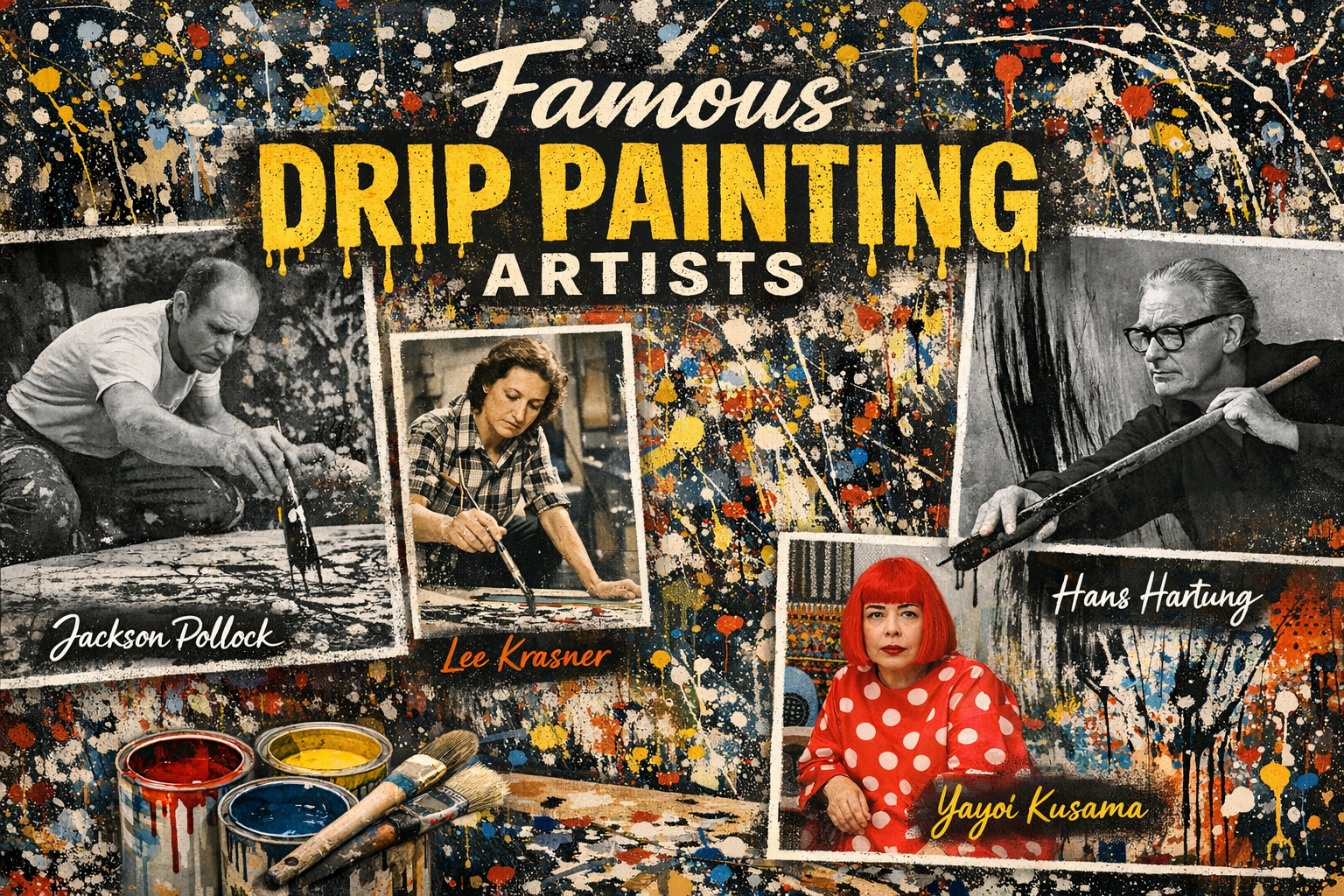
Drip painting is more than just throwing paint. It is a partnership between an artist and gravity. Jackson Pollock is the most famous name but others like Janet Sobel started the movement. Artists like Pat Steir still push boundaries today by creating liquid waterfalls. This guide introduces the most influential famous drip painting artists and the techniques that made them masters of controlled chaos.
Most people look at a drip painting and think their toddler could do it. It looks like a random mess. The most famous drip painting artists did not just spill paint. They choreographed it. They traded traditional brushes for sticks or syringes or punctured buckets. These creators moved the canvas from the easel to the floor.
This shift changed how we think about the act of painting. It turned the studio into a stage. The paint became a record of movement. We are going to look at the people who mastered this “controlled accident” and how they influenced each other. There is a deep logic behind the splatters. Once you see it you will never look at a messy canvas the same way again.
Who are the most famous drip painting artists?
The most famous drip painting artists include Jackson Pollock who made the style popular. Janet Sobel first used the technique in the 1940s. Other major figures are Sam Francis and Pat Steir. These artists use gravity to create different effects like waterfalls or open space.
These artists represent different ways to use physics. Pollock worked on the floor. Steir works on a wall. Both rely on the liquid properties of paint to do the hard work.
Janet Sobel: The Hidden Mother of Modern Drip
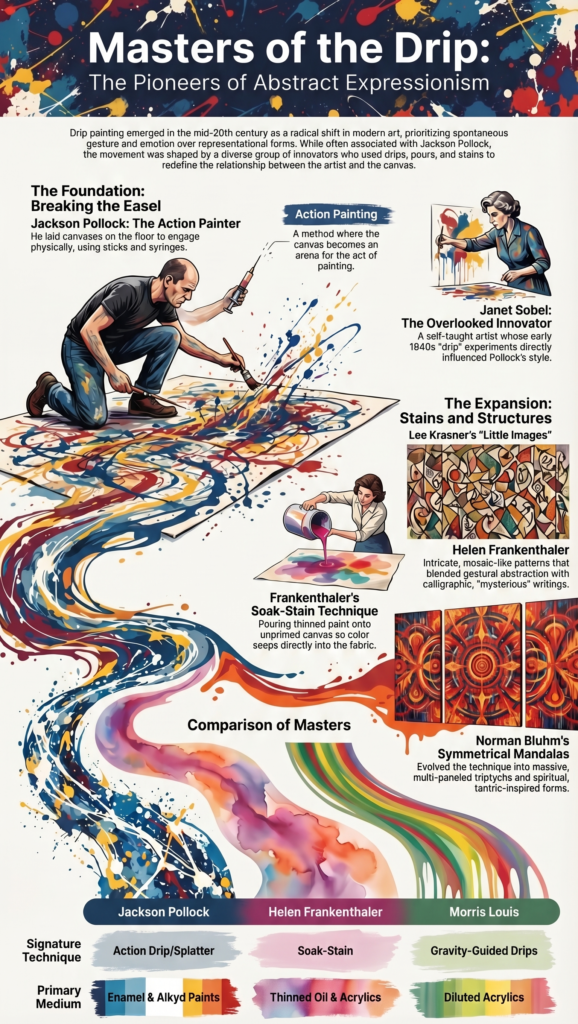
History almost forgot Janet Sobel. This Ukrainian-born artist was a self-taught grandmother living in Brooklyn when she started to experiment. She developed an “all-over” technique. She used glass pipettes to blow paint across the surface. This created a dense web of lines that felt entirely new.
Her work predates the most famous experiments of other artists. The Museum of Modern Art (MoMA) notes that Sobel worked rapidly with enamel paint. Famous critics admitted her work made a strong impression on Pollock. She was one of the first abstract artists who changed modern art by removing the focal point. She showed that every inch of the canvas could be equally important.
How did Jackson Pollock change action painting?
Jackson Pollock moved the canvas to the floor to work from all sides. He used sticks and hardened brushes to drip industrial house paint like Duco or Davoe. This turned painting into a physical act where his body movements determined the final image.
This process became known as Action Painting. The final image was a map of his movements. You can see his specific tools in our guide to Jackson Pollock drip painting on our site. The Guggenheim Museum explains that this transition happened around 1947. He proved that the physical act of creating can be just as important as the finished piece.
Gravity, Chaos & Drip Painting
Explore the explosive energy of drip painting inspired by Jackson Pollock, Janet Sobel, and the masters of Abstract Expressionism.
What makes Pat Steir’s waterfall technique different?
Pat Steir works with vertical canvases and thinned oil paint. She applies horizontal strokes at the top and lets gravity pull the paint down in long lines. The Brooklyn Museum describes her Waterfall series as a collaboration with nature to create abstract images that look like running water.
Steir has a different approach. Pollock used his whole body to direct the paint. Steir sets the paint in motion and lets the Earth do the rest. Her work shows how thin colors can create a sense of light. It is a calm take on a style that people often think is aggressive.
Sam Francis and the Art of Empty Space
Sam Francis used drips to focus on the edges of his paintings. He often left the middle of the canvas empty. The Guggenheim Museum notes that his style was influenced by Japanese art after a visit in 1957. These drips create a sense of movement and help the viewer focus on the open space around the color.
Francis brought a sense of air to the style. He was less interested in a thick tangle of lines. He cared about how a single drip could change a large white space. His drips feel very intentional. They often look like islands of color floating in a large void. If you want to understand how he picked his colors check out our post on color theory basics.
Modern Puddles and Pendulums
Drip painting did not stop in the 1950s. Max Ernst played with a punctured bucket on a string long before the style was popular. He used a compound pendulum to create mathematical loops of paint. Today artists like Ian Davenport create Puddle Paintings where vertical stripes of color pool at the bottom of the wall.
You can find many of these pioneers on our list of famous abstract artists. The technique has changed from a rebellious act into a tool for exploring how liquid moves. Artists still want to see what happens when they stop fighting physics. They use syringes or high-tech pouring to find new shapes.
Drip painting is not about losing control. It is about choosing where to give it up. Pollock used rhythmic splashes. Steir uses vertical streams. These artists show us that paint has a life of its own. If you have been watching from the sidelines then grab a cheap can of paint and a stick. Start small. See how the paint moves when you do not force it. The best way to understand these masters is to try expressive art techniques for yourself. Stop worrying about the mess. Just start.
Frequently Asked Questions
Did Jackson Pollock invent drip painting? No he did not. While he made it famous artists like Janet Sobel were using the technique years before his 1947 breakthrough. According to the BBC Sobel was largely written out of this history. Pollock changed the method by using industrial paints.
What kind of paint do drip artists use? Many early drip artists used house paints because they were thin. Modern artists like Ian Davenport often use vibrant acrylics mixed with chemicals to help the paint flow.
What is the difference between drip painting and pour painting? Tate defines drip painting as a gestural style where tools like sticks splash paint. Pour painting involves pouring paint directly from a cup to create a marble look.
Is drip painting considered Abstract Expressionism? Yes it is part of that movement. It is often called Action Painting because it focuses on the physical work of the artist.
How do artists control the drips? Control comes from how thick the paint is and how fast the artist moves. Thinner paint runs faster. The height of the hand also changes the shape of the splash.