
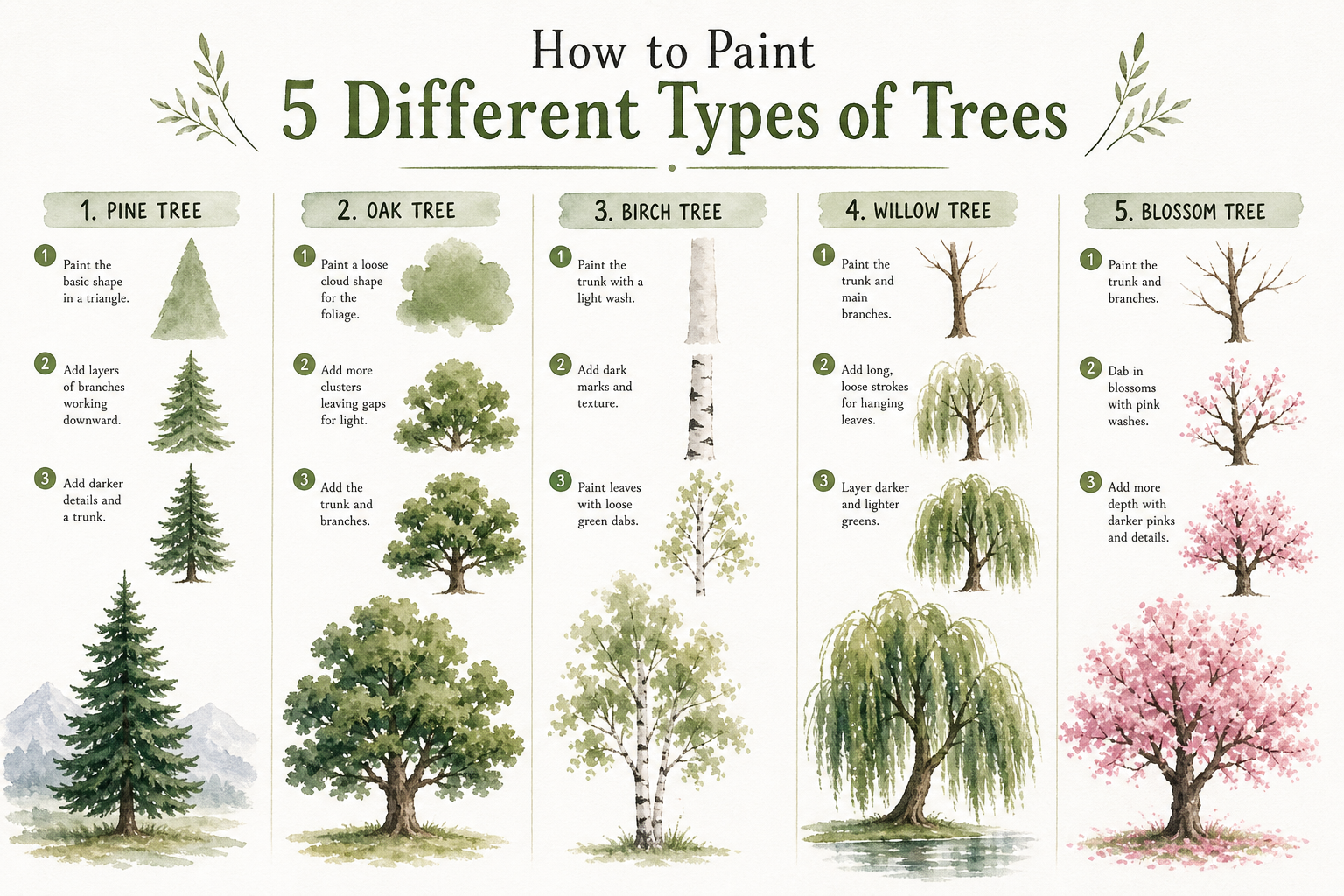

Summary: Learning how to paint trees doesn’t have to be frustrating. This guide breaks down simple techniques for painting oak, pine, birch, willow, and palm trees. You’ll discover the right brushes, color mixing tips, and layering methods to make your landscapes pop. Grab your supplies and let’s start building a beautiful forest.

Look at the canvas in front of you. It’s completely blank. You know you want a lush forest or a single sweeping oak. But when you pick up your brush, panic sets in. Trees can look incredibly complex. They have thousands of leaves. Their branches twist in unpredictable directions. It feels impossible to capture all that detail.
Stop worrying about every single leaf.
You must break free from the idealized version of a tree in your head. Beginners often default to basic shapes and flat greens. Real trees are built from layered light, shadows, and varied color temperatures. Whether you’re using acrylics or watercolors, the secret is capturing the overall mass. You paint the impression of the tree.
We’ll tackle five iconic trees. Each one teaches you a different fundamental skill. You’ll learn how to handle texture, mix realistic greens, and build convincing volume. Mastering these five varieties gives you a complete toolkit for any landscape you want to create. Let’s dive into the methods that will make your paintings come alive.
How Do You Paint a Realistic Oak Tree?
You paint a realistic oak tree by treating the foliage as large masses of light and shadow rather than individual leaves. Start by blocking in the darkest values using a mix of ultramarine blue and yellow ochre. Add lighter mid-tones only after establishing the deep shadows.
Oaks are massive and solid. Their canopies catch sunlight in big, rounded clumps. When you look at an oak, squint your eyes. This helps you ignore the tiny details. Focus entirely on the broad shapes of light and dark.
A great tip from professional artists is to leave room for the sky. These gaps are called “sky holes.” They prevent your tree from looking like a solid green balloon. Work with a large bristle brush to block in the canopy. Keep your brushstrokes loose. Once the dark foundation dries, layer your lighter greens on the side facing the light source. Mixing the right greens relies heavily on strong color theory basics.

What Are the Best Brushes for Painting Pine Trees?

The best tool for painting pine trees is a stiff flat brush. You can use the dry brushing technique to dab the bristles directly onto the canvas. This creates a natural, prickly texture that perfectly mimics pine needles without requiring you to paint them individually.
Pines and evergreens are all about the silhouette. Start by painting a dark, slender trunk. Then, load your flat brush with very dark green or black paint. Wipe off the excess water. Lightly dab the brush along the trunk.
Remember that branches grow wider and denser near the bottom of the tree. Keep the top sparse. Leave empty spaces between the branches to let the background show through. Once your dark silhouette is established, you can dab a lighter, yellow-toned green on the tips of the branches to catch the sunlight. Having the right paint brushes makes this texture work effortless.
Painting Birch Trees with a Palette Knife
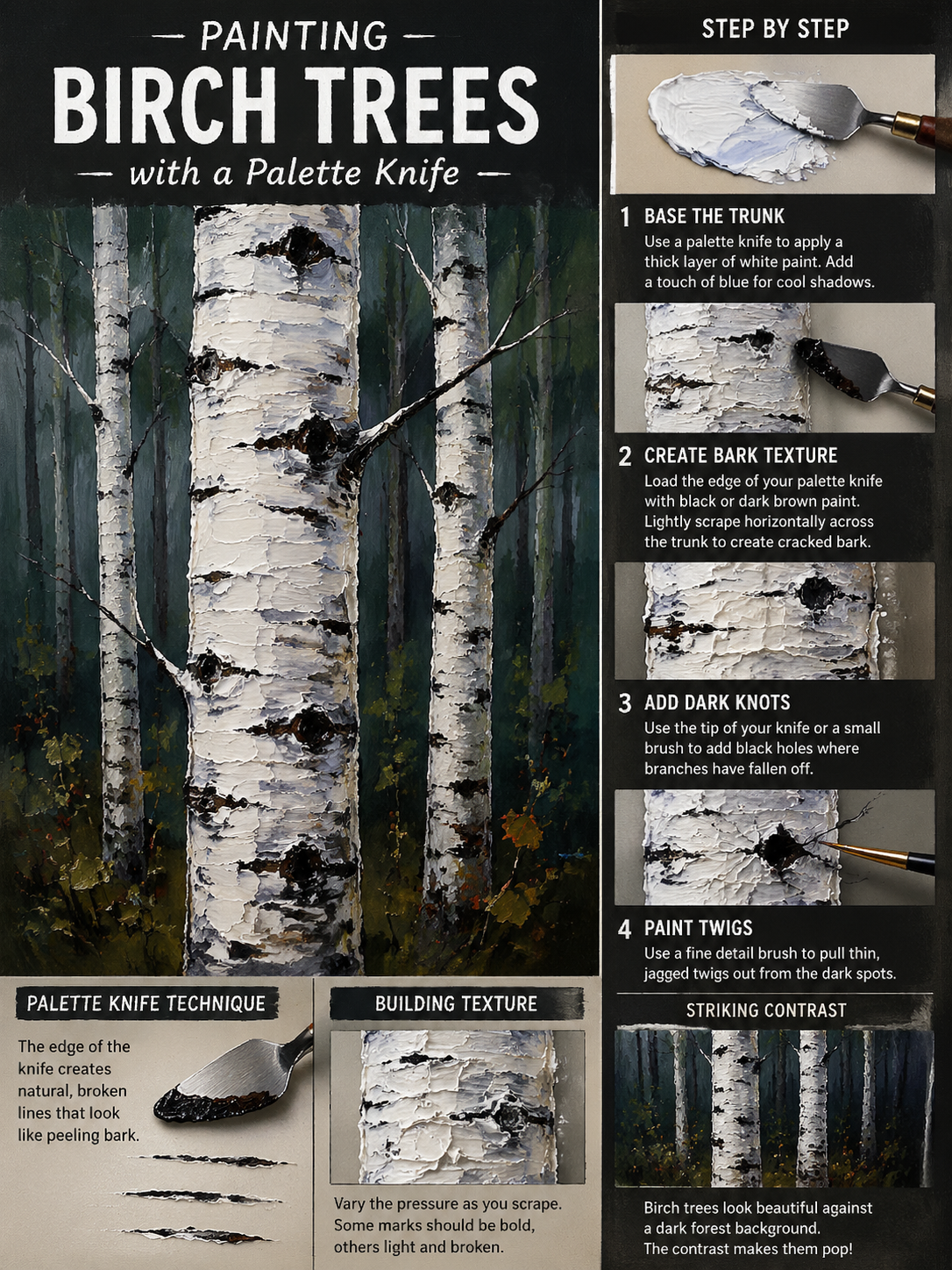
Birch trees are incredibly fun to paint. They offer a break from mixing endless shades of green. The magic of a birch tree lies in its textured, peeling bark.
Instead of a brush, grab a palette knife. Paint your trunk with a base of white and a tiny bit of blue for shadows. Then, load the edge of your palette knife with black or dark brown paint. Lightly scrape the edge horizontally across the trunk. This immediately creates the illusion of cracked bark.
Add small black holes where old branches have fallen off. Use a fine detail brush to pull thin, jagged twigs out from these dark spots. Birch trees are wonderful for practicing texture. They look striking against a dark forest background. Many beginner painting courses teach this exact method because it builds confidence quickly.
How Can You Capture a Weeping Willow?
You capture a weeping willow by focusing on vertical, sweeping brushstrokes that mimic gravity pulling the branches downward. Use a thin liner brush with heavily watered-down paint to create the delicate, cascading leaves that define the tree’s shape.
Willows require a soft touch. Start with a sturdy trunk that splits into several main upward branches. From there, everything must flow down.
Mix a vibrant, warm green. Thin it out with water so it flows easily off your brush. If you’re learning to paint trees in watercolor, this is the perfect time to use the wet-on-dry technique. Pull your brush down in long, sweeping motions. A recent study on landscape composition highlights how overlapping different shades builds volume. Keep the darkest greens near the top and underneath the canopy. Let the lightest greens cascade down the outside.

Creating Tropical Vibes with Palm Trees
Palm trees bring instant warmth to a landscape. They look completely different from deciduous trees. Their structure is essentially a long cylinder with a burst of fronds at the very top.
Start with the trunk. Palm trunks are rarely perfectly straight. Give it a gentle curve. Use a medium brush and mix a warm brown. Add horizontal bands along the trunk to show the texture of old leaf bases.
For the fronds, use a small round brush. Start from the center point at the top of the trunk. Flick your brush outward in an arching motion. Create five or six main stems. Then, go back over those stems and flick tiny, hair-like strokes downward along each one. This creates the classic feather look of a palm leaf. Using proper blending techniques on the trunk will give it a rounded, three-dimensional feel.

Conclusion:
Painting trees is a journey of observation and simplification. You don’t need to reproduce a photograph perfectly. You just need to capture the energy, light, and mass of the tree in front of you. Practice these five varieties to build your muscle memory. Mix your greens carefully. Trust the process of layering darks before lights. Now, set up your easel, squeeze out some fresh paint, and start growing your own forest on canvas.
Frequently Asked Questions
Why do my painted trees look flat?
Your trees likely look flat because they lack contrast between light and shadow. Ensure you establish a very dark base layer before adding mid-tones and highlights. Using a single shade of green destroys the illusion of volume.
What colors make the best realistic greens?
Avoid using pre-mixed green straight from the tube. Mix ultramarine blue with yellow ochre for natural, earthy greens. Add a touch of cadmium yellow for bright highlights, or a tiny bit of burnt sienna to mute the green for shadows.
How do I stop my tree from looking like a lollipop?
Break up the solid outline of the canopy. Add “sky holes” by leaving gaps in the leaves where the background sky can peek through. Paint branches that extend beyond the main mass of the leaves.
Can I use acrylics and watercolors to paint trees?
Yes. Both mediums work beautifully for trees. Acrylics allow you to build thick texture for bark and leaves. Getting started with watercolors teaches you how to use transparent layers and soft washes for atmospheric background trees.
What is the best way to practice painting branches?
Practice painting branches by using a liner brush with thin, fluid paint. Start at the trunk and press down slightly. As you pull the brush outward, gradually lift the pressure to make the branch taper into a fine point.

Olly
Olly Farmer M.Sc, B.Sc, PGCE 25 years experience of Watercolor Painting and AI Art; teacher for 13 years; Creator of Art Tools; Art Gallery Contributor of Art Articles to Medium.com, LinkedIn and Facebook
Continue exploring



PROMINENT PAINTING
Keep your creative momentum
Get new painting guides, practical techniques and artist stories delivered without the noise.
Occasional emails. Unsubscribe whenever you like.