Have you ever stood in front of your canvas, brush in hand, wondering if you should add one more stroke or call it done? Knowing when an abstract painting is finished is one of the most challenging aspects of creating non-representational art. Unlike traditional paintings where completion is often obvious, abstract art doesn’t come with clear stopping points. You’re not trying to match reality, so how do you know when to step back and declare victory? This guide will help you recognize the signs that your abstract painting is complete, saving you from the common trap of overworking your masterpiece.
Key Points:
- Abstract paintings are finished when they achieve visual balance and emotional impact
- Overworking is a common problem that can ruin otherwise successful pieces
- Using specific evaluation techniques helps determine completion objectively
- Taking breaks and getting fresh perspectives reveals whether a painting is truly done
- Professional artists use concrete criteria to assess finished abstract works
- Trusting your intuition becomes easier as you gain experience with abstract art
Understanding the Challenge of Knowing When to Stop
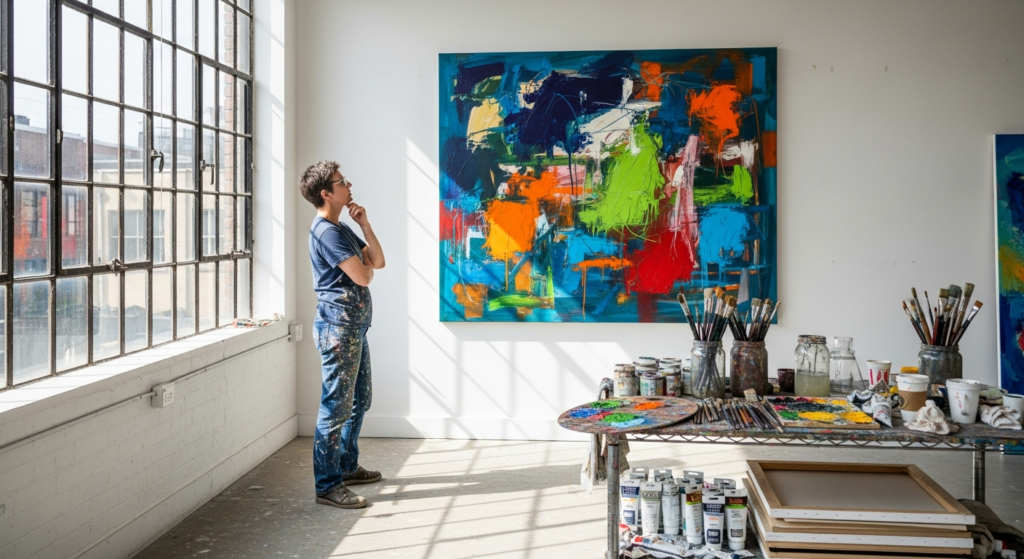
The question of when an abstract painting is finished has puzzled artists for generations. Without a realistic subject to guide completion, abstract painters must rely on different criteria. Famous abstract artists like Mark Rothko and Jackson Pollock developed their own methods for determining when their paintings reached completion, often based on emotional resonance rather than technical perfection.
When working with abstract painting techniques, you’re essentially creating visual relationships between colors, shapes, and textures. The challenge lies in knowing when these relationships are harmonious enough to stop adding elements. Too few elements and the painting feels incomplete; too many and you’ve crossed into overworked territory.
Signs Your Abstract Painting Is Finished
Visual Balance Has Been Achieved
Balance is one of the clearest indicators that an abstract painting is complete. This doesn’t mean symmetrical balance—abstract art often thrives on asymmetry. Instead, look for visual weight that feels distributed across the canvas in a way that doesn’t make your eye get stuck in one spot or feel like something is missing.
Understanding composition principles helps tremendously here. When your painting exhibits proper balance, no single area dominates so strongly that it throws off the entire piece. Colors, shapes, and textures all work together to create a cohesive whole.
Indicators of visual balance:
- Your eye moves naturally around the entire composition
- No single area feels uncomfortably heavy or empty
- Negative space works as effectively as positive space
- The painting feels stable when viewed from different distances
- Color distribution creates harmony rather than jarring discord
The Painting Tells a Complete Story
Even though abstract art doesn’t depict recognizable subjects, it should still communicate something. When your abstract painting is finished, it conveys a clear emotional message or creates a specific atmosphere. This might be energy, calm, tension, joy, or mystery—whatever you intended or discovered during the creative process.
Many artists working in modern abstract painting describe their work as conversations between themselves and the canvas. When that conversation reaches a natural conclusion, the painting is finished.
You Can’t Identify What’s Missing
One practical test for completion: Can you specifically identify what’s missing from your painting? If you feel it’s incomplete but can’t articulate what needs to be added, it’s probably finished. This ambiguous feeling often stems from the natural difficulty of knowing when to stop rather than any actual deficiency in the work.
Conversely, if you can clearly identify a specific problem—”The upper left corner needs a warm accent” or “The composition lacks a focal point”—then you have clear direction for what to add.
The Work Satisfies Your Original Intention
When you started the painting, you likely had some intention, even if it was just to experiment with a particular color palette or technique. When an abstract painting successfully fulfills that original goal, it’s often finished. This applies whether you were exploring specific abstract painting ideas or simply expressing an emotion.
Common Mistakes: The Danger of Overworking
Understanding Overworking
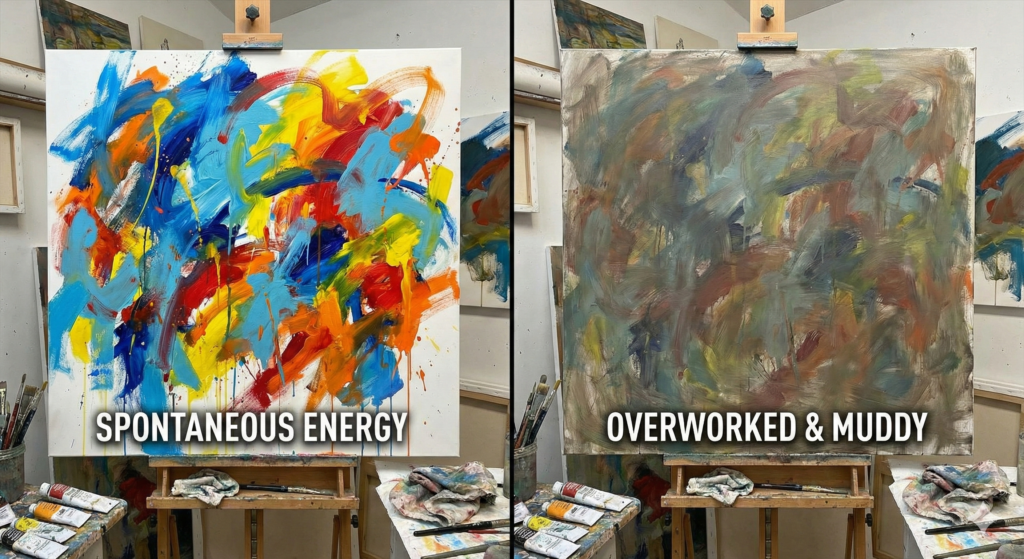
Overworking is the enemy of knowing when an abstract painting is finished. It happens when you continue adding elements, adjusting colors, or refining details past the point where the painting communicated most effectively. Many abstract paintings are ruined in their final hours by artists who couldn’t recognize completion.
The problem with overworking is that it often happens gradually. You make one small adjustment, which seems to call for another, then another. Before you know it, you’ve obliterated the spontaneity and energy that made the painting special in the first place.
Warning Signs of Overworking
You’re making changes without clear purpose. When you start adding brushstrokes or colors just because you feel you should be doing something rather than because the painting needs it, you’re likely overworking. Abstract painting techniques for beginners emphasize the importance of intentional marks.
The painting has lost its spontaneity. Abstract art often derives power from spontaneous, energetic marks. If your continued work has made everything feel overly controlled or fussy, you’ve probably gone too far.
You’re covering up what you loved earlier. If you find yourself painting over sections that you previously thought were successful, stop immediately. This is a clear sign the painting was finished before your most recent interventions.
You can’t remember what the original problem was. If you’ve been working so long that you can’t recall what bothered you about the painting initially, it’s time to put down the brush.
Practical Evaluation Methods
The Time-Away Test
One of the most reliable methods for knowing when an abstract painting is finished is simply taking a break. Put the painting away for at least 24 hours—a week is even better. When you return with fresh eyes, you’ll immediately see whether it’s complete or needs adjustment.
This technique works because we become blind to our own work through familiarity. The painting you’ve been staring at for hours becomes impossible to evaluate objectively. Distance provides clarity that’s impossible to achieve in the moment.
The Mirror Test
Hold your painting up to a mirror or photograph it and flip the image horizontally on your phone. This simple technique reveals compositional weaknesses immediately. If the painting still looks balanced and complete when reversed, it’s likely finished. If glaring problems suddenly appear, you have clear direction for improvement.
The Squint Test
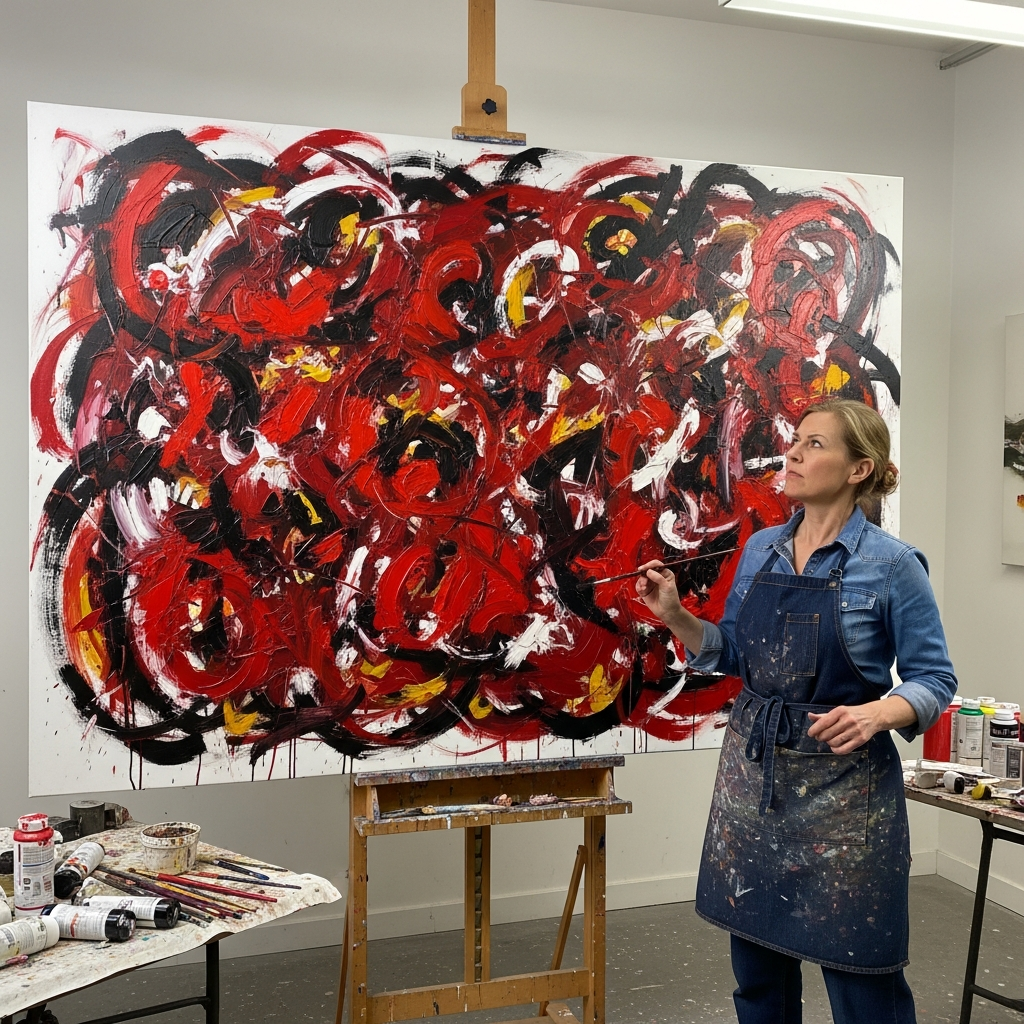
Squinting at your abstract painting reduces it to its most basic elements: values, shapes, and color relationships. If the painting holds together when squinted at—meaning you can still see a cohesive composition without getting lost in details—it’s probably finished. This test is particularly useful for evaluating focal points and overall balance.
The Multiple Angle Test
View your painting from different distances and angles:
- From across the room (does it have visual impact at a distance?)
- From very close (are the details and textures interesting?)
- From the sides (does it have physical presence?)
- Upside down (does the composition still work?)
If your painting succeeds from all these viewpoints, it’s likely finished. Understanding the principles of painting helps you evaluate these different perspectives more effectively.
The Photography Test
Photograph your painting and view it on a small screen. This removes the physical presence of the work and lets you evaluate it purely as a visual composition. You’ll immediately notice if anything feels unfinished or unbalanced. This test is particularly valuable for large-scale abstract works where physical size can be overwhelming.
Developing Your Completion Criteria
Establishing Personal Standards
Every abstract artist needs to develop their own criteria for what constitutes a finished painting. These criteria evolve as you gain experience and develop your artistic voice. The philosophy of abstract art emphasizes that there’s no single “correct” standard—what matters is that your work communicates effectively.
Questions to ask yourself:
- Does this painting achieve what I set out to create?
- Does it evoke the emotional response I intended?
- Would I be proud to show this to others?
- Does it represent my current skill level and artistic vision?
- Has it challenged me as an artist?
Learning from Each Painting
Keep notes on when you decide each painting is finished and why. Over time, patterns will emerge. You might discover that your best work happens when you stop after three layers, or that your most successful paintings are those where you trusted your first instincts about completion.
Some artists photograph their paintings at multiple stages. This creates a visual record that helps you identify your optimal stopping point for different types of work.
The Role of Intuition in Knowing When to Stop
Trusting Your Gut Feeling
While objective criteria are helpful, intuition plays a crucial role in knowing when an abstract painting is finished. That gut feeling that whispers “it’s done” or “something’s not right yet” becomes more accurate as you gain experience. Many successful abstract artists describe completion as a feeling they sense rather than a checklist they complete.
Abstract expressionism particularly values this intuitive approach. The movement’s pioneers believed that over-intellectualizing the creative process could stifle authenticity.
Developing Your Artistic Intuition
Intuition isn’t magical—it’s pattern recognition developed through experience. The more paintings you complete, the better your intuition becomes at recognizing when a work is finished. This is why experimenting with innovative abstract painting ideas accelerates your development as an artist.
Ways to strengthen your intuition:
- Complete many paintings rather than endlessly reworking a few
- Study finished work by artists you admire
- Analyze what makes certain paintings feel complete while others don’t
- Practice stopping earlier than feels comfortable
- Get comfortable with imperfection
Getting External Perspective
When to Seek Feedback
Other people’s opinions can help determine if an abstract painting is finished, but timing matters. Seeking feedback too early can derail your creative process, while waiting too long means you might overwork the piece before getting input.
The ideal time to seek feedback is when you think the painting might be finished but aren’t certain. Present it as complete and ask if it feels resolved. The responses will help calibrate your own judgment.
Choosing the Right Feedback Sources
Not all feedback is equally valuable. Choose people who:
- Understand abstract art
- Know your work and artistic goals
- Can articulate specific observations
- Won’t simply tell you what you want to hear
Fellow artists, art instructors, and experienced collectors usually provide more useful feedback than friends and family who may not have the vocabulary to discuss abstract work meaningfully.
Filtering Feedback Effectively
Remember that feedback is subjective opinion, not objective truth. If three people say the painting feels complete but one person suggests major changes, the majority opinion probably indicates the work is finished. However, if that one person identifies a specific, concrete issue that you can immediately see once pointed out, it’s worth considering their input.
Special Considerations for Different Abstract Styles
Gestural and Expressionistic Work
For abstract painting techniques that emphasize spontaneous gesture and emotional expression, knowing when to stop is particularly crucial. These paintings derive power from their immediacy and energy. They’re typically finished sooner than you think they should be.
With gestural work, trust your first strong instincts. If you feel the urge to declare it finished, it probably is. Additional work often diminishes rather than enhances these pieces.
Geometric and Minimal Abstract Work
Geometric abstraction and minimalist pieces require more deliberate decision-making. These paintings are often finished when every element has a clear purpose and nothing can be added or removed without disrupting the whole. The completion point is often more obvious because the work follows specific structural logic.
Color Field Painting
Color field paintings present unique challenges in knowing when they’re finished. Because they emphasize large areas of color and subtle transitions, the completion point can be elusive. These paintings are typically finished when the color relationships create the desired emotional atmosphere and the surface quality has reached the intended level of refinement.
Creating a Completion Checklist
Objective Criteria
Develop a personal checklist for evaluating whether your abstract paintings are finished. This might include:

Compositional elements:
- Visual balance achieved across the canvas
- Clear focal area or intentional lack thereof
- Effective use of negative space
- Unified color palette
- Consistent or deliberately varied texture
Technical considerations:
- Surface quality matches intention (smooth, textured, layered, etc.)
- No unintended drips, smudges, or marks
- Edges treated appropriately (crisp, soft, or raw)
- Proper paint application (no excessive buildup unless intentional)
- Signature or documentation method determined
Emotional and conceptual factors:
- Painting evokes intended feeling or atmosphere
- Work aligns with your artistic goals
- Title determined (if applicable)
- Prepared to show the piece publicly
The Importance of Series Work
Learning Through Repetition
Working in series—creating multiple paintings exploring similar themes, colors, or techniques—dramatically improves your ability to know when individual pieces are finished. When you create ten paintings using similar abstract painting ideas, you’ll quickly learn which stopping points produce the strongest results.
Series work also removes some pressure from any single painting. If you overwork one piece, you have others to compare it against, which helps you identify exactly where you went wrong.
Comparing Multiple Pieces
Having several pieces in progress simultaneously provides comparison points. When you evaluate them side by side, it becomes much clearer which ones feel complete and which need development. This comparative approach is how many professional abstract artists work.
When “Finished” Doesn’t Mean “Successful”
Accepting That Some Paintings Fail
An important distinction: a finished painting isn’t necessarily a successful one. Sometimes you complete a work and realize it simply didn’t achieve what you wanted. This is completely normal and part of every artist’s journey. Understanding painting genre and subject matter helps you recognize when a piece hasn’t met its potential.
The key is learning to distinguish between “I overworked this” and “This didn’t work out as planned.” The first is a problem of not knowing when to stop; the second is simply a painting that didn’t succeed, which happens to all artists.
Moving On Versus Giving Up
There’s a difference between accepting that a painting is finished (even if flawed) and giving up on a painting because it’s challenging. If you’re considering abandoning a work, first make sure you’ve tried all the evaluation methods discussed above. Sometimes what feels like failure is actually a complete painting that’s different from what you envisioned.
Professional Practices for Determining Completion
Setting Time Limits
Some abstract artists set strict time limits for completing paintings. For example, you might decide that a painting must be completed in one four-hour session or over exactly three days. These constraints force decisive action and prevent endless tinkering.
Time limits work particularly well for certain painting techniques for beginners, as they encourage spontaneity and prevent overthinking.
The “No More Than Three Sessions” Rule
Many professional abstract painters follow a personal rule of never working on a painting for more than three sessions. If it’s not finished by the third session, they either declare it finished as-is or abandon it and start fresh. This rule prevents the endless revision that can plague abstract work.
Documentation as a Decision Tool
Photograph your painting at the end of each working session. These images create a timeline that shows the painting’s evolution. Often, you’ll discover that the painting was actually finished several sessions ago, and subsequent work has made it worse rather than better.
Practical Exercise: The Completion Journal
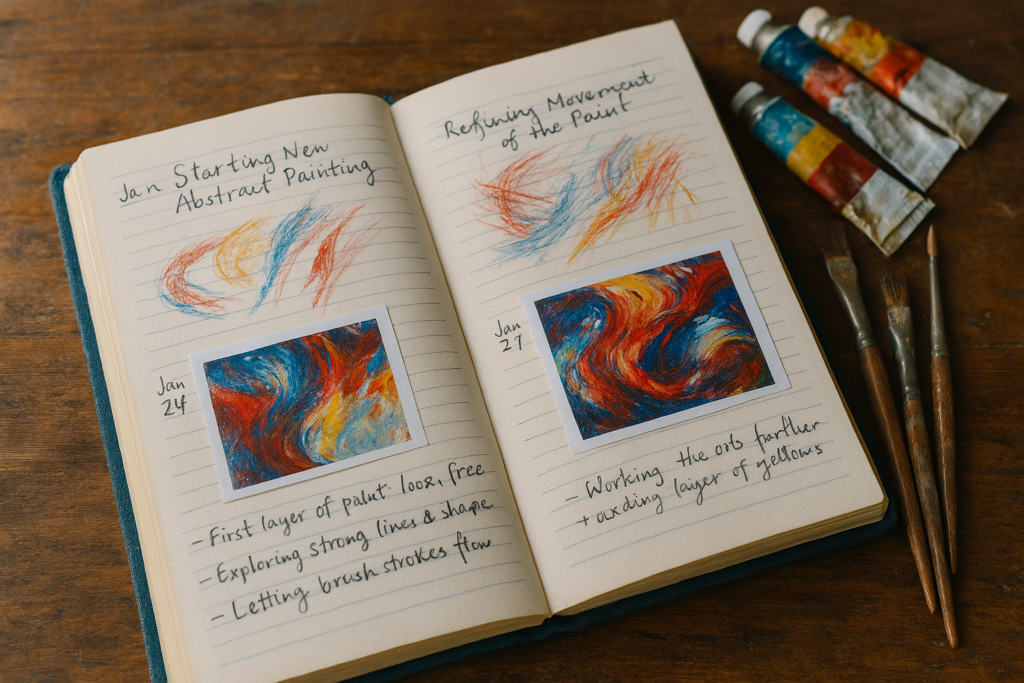
Start a completion journal for your abstract paintings. For each piece, record:
Pre-painting:
- Your initial intention or concept
- Expected completion timeframe
- Specific goals for the piece
During painting:
- Number of sessions or hours worked
- Major decisions made
- Moments of doubt or confidence
At completion:
- Why you decided it was finished
- How long total time invested
- Whether it met your initial goals
- What you learned about your completion criteria
Three months later:
- Do you still think it was finished at the right point?
- Would you change anything now?
- What does this teach you about your judgment?
This documentation reveals patterns in your decision-making and helps refine your ability to recognize when paintings are complete.
Conclusion: Trusting the Process
Learning to know when an abstract painting is finished is a journey that never truly ends. Even experienced artists sometimes struggle with this decision. The difference is that they’ve developed reliable methods for evaluation and learned to trust their judgment.
Remember these key principles: Use objective criteria like visual balance and compositional strength, but also honor your intuition. Take breaks and view your work with fresh eyes. Don’t be afraid to stop earlier than feels comfortable. Overworking destroys more paintings than underworking. And finally, understand that your ability to recognize completion improves with every painting you create.
The question “How do you know when an abstract painting is finished?” ultimately has a personal answer that varies for each artist and even for each painting. By applying the techniques and evaluation methods discussed in this guide, you’ll develop your own reliable sense of when to put down the brush and declare your abstract painting complete. Trust yourself, learn from each piece, and remember that knowing when to stop is just as much an art form as the painting itself.
Frequently Asked Questions
How long should it take to finish an abstract painting?
There’s no standard timeframe for finishing an abstract painting. Some pieces come together in a single session lasting a few hours, while others develop over weeks or months. The important factor isn’t time invested but whether the painting has achieved visual balance and communicates effectively. Many professional artists work on multiple pieces simultaneously, allowing some to develop slowly while others progress quickly. Focus on whether the piece feels complete rather than how long you’ve worked on it.
Can you add to an abstract painting years later?
Technically yes, but it’s rarely advisable. Abstract paintings are often most successful when they capture a specific moment or emotion. Returning to add elements years later usually results in a disconnected feeling because you’re no longer the same artist with the same sensibilities. If you truly feel a years-old painting is incomplete, carefully evaluate whether the issue is the painting itself or your evolved artistic standards. Sometimes it’s better to create a new piece inspired by the old one rather than altering the original.
What should I do if I’ve overworked my abstract painting?
If you realize you’ve overworked a painting, you have several options. First, try putting it away for several weeks and reassessing with completely fresh eyes—sometimes overworked pieces aren’t as damaged as they seem in the moment. Second, you might be able to simplify the painting by covering overly busy areas with large, bold strokes or blocks of color. Third, consider whether the painting can work as an underpainting for an entirely new piece. Finally, accept it as a learning experience, document what went wrong, and move forward to your next painting with better judgment about when to stop.
Should abstract paintings always be signed when finished?
Signing your abstract painting signals to yourself and others that you consider it complete. However, the timing and placement of signatures varies by artist preference. Some artists sign immediately upon completion, while others wait days or weeks to ensure they don’t want to make changes. Sign on the front if you want the signature visible as part of the composition, or on the back if you prefer it hidden. Digital documentation (photographing and dating the work) is also important for tracking your artistic development regardless of whether you physically sign the piece.
How do professional artists know when their abstract work is finished?
Professional abstract artists typically develop personalized criteria through years of practice. They often use a combination of objective evaluation techniques (visual balance, compositional strength, effective color relationships) and intuitive judgment refined through completing hundreds of paintings. Many professionals also rely on trusted colleagues for feedback, photograph works at multiple stages to track development, and have learned to recognize the specific feeling that indicates completion. Experience teaches them to differentiate between “this needs more work” and “I’m just nervous about stopping,” which is crucial for avoiding overworking.
Is it normal to never feel certain that an abstract painting is finished?
Yes, some degree of uncertainty is completely normal, especially for newer abstract artists. Unlike representational painting where completion is often obvious (the portrait looks like the person, the landscape includes all necessary elements), abstract art has inherently ambiguous stopping points. Many successful abstract artists report occasionally feeling uncertain even after declaring pieces finished. The key is developing reliable evaluation methods that help you make confident decisions despite some lingering doubt. As you complete more paintings, this uncertainty typically decreases, though it may never disappear entirely—and that’s okay.
Citations
- Tate Museum. “Abstract Art.” Tate. https://www.tate.org.uk/art/art-terms/a/abstract-art
- The Museum of Modern Art. “What Is Abstract Expressionism?” MoMA. https://www.moma.org/learn/moma_learning/themes/abstract-expressionism/
- National Gallery of Art. “Abstract Expressionism.” National Gallery of Art. https://www.nga.gov/collection/art-style/abstract-expressionism.html
- Guggenheim Museum. “Abstract Expressionism.” Guggenheim. https://www.guggenheim.org/artwork/movement/abstract-expressionism
- Golden Artist Colors. “Paint Application Techniques.” Golden Paints. https://www.goldenpaints.com/technicalinfo
- Artsy. “How to Know When Your Painting Is Finished.” Artsy Editorial. https://www.artsy.net/article/artsy-editorial-know-painting-finished
- Artists Network. “When Is a Painting Finished?” Artists Network. https://www.artistsnetwork.com/art-mediums/when-is-a-painting-finished/
- Jackson’s Art Blog. “How Do You Know When a Painting Is Finished?” Jackson’s Art Supplies. https://www.jacksonsart.com/blog/2019/03/18/how-do-you-know-when-a-painting-is-finished/