The Russian painter who built the philosophical framework that the Abstract Expressionists lived inside — and the surprising human chain that carried his ideas to New York
📌 TL;DR
Kandinsky was the first painter to argue, in writing, that abstract forms and colours could carry genuine emotion without depicting anything. His 1911 book gave the Abstract Expressionists the philosophical permission they needed to abandon representation entirely. But ideas don’t travel on their own — a specific chain of people, exhibitions, and institutions physically carried Kandinsky’s thinking from Munich to New York, and that transmission story is what almost every other account leaves out.
Key Points
- 🎨The idea: Kandinsky’s concept of “inner necessity” — art must arise from the artist’s genuine spiritual impulse, not technique or convention
- 📖The manifesto: Concerning the Spiritual in Art (1911) gave non-representational painting its first serious intellectual foundation
- 🌊The transmission: Armory Show (1913), Hans Hofmann’s New York school (1933), and the Museum of Non-Objective Art (1939)
- 👤The human bridge: Hans Hofmann translated Kandinsky-adjacent ideas directly to the generation that became the Abstract Expressionists
- 🖌️The artists: Pollock, Rothko, Gorky, de Kooning, and Newman each absorbed a different strand of his vision
What did Kandinsky believe about art that was so revolutionary?
Kandinsky argued that colour and form could carry pure emotion without depicting anything — and in 1911 published a systematic proof of this, giving abstract painting its first serious intellectual foundation.
Before Kandinsky, painting without a recognisable subject was seen as decoration at best, incompetence at worst. What his book Concerning the Spiritual in Art did was reverse that judgment: representational painting was the lesser art form, he argued, because it forced the viewer to decode a subject rather than feel an emotion. True art required nothing but the viewer’s soul.
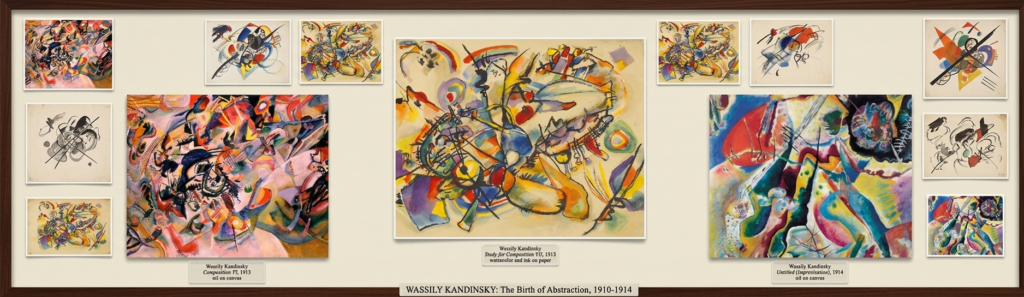
This wasn’t mysticism for its own sake — Kandinsky built a systematic case. Different colours had consistent psychological effects: blue was spiritual and receding; yellow was unsettling and aggressive; red was warm and powerful. Different forms carried distinct emotional charges: sharp angles were tense and aggressive, gentle curves were calm and yielding. The artist’s job was to orchestrate these elements the way a composer orchestrates instruments — not to depict, but to create an experience.
For any painter who wanted to abandon representation entirely, this framework was transformative. See how Kandinsky’s colour theory sits within the broader arc of colour in art history.
| Colour | Kandinsky’s Emotional Meaning | Which AE Artist Used It |
|---|---|---|
| Blue | Spiritual, deep, receding — evokes the infinite | Rothko (dark blue fields in the Chapel paintings) |
| Yellow | Unsettling, aggressive, earthly — cannot be deepened | Pollock (raw energetic grounds) |
| Red | Warm, powerful, purposeful — lacks the depth of blue | de Kooning (slashing reds in the Woman series) |
| Black / near-black | Total silence — the end of possibility | Rothko (Rothko Chapel; the final series) |
What was Kandinsky’s “inner necessity” — and why did the Abstract Expressionists make it a creed?
“Inner necessity” was Kandinsky’s insistence that authentic art arises only from the artist’s genuine spiritual impulse — not skill display or convention — and the Abstract Expressionists made it the central justification for their entire movement.
Kandinsky used the phrase to distinguish art that was merely competent from art that was alive. Brilliant technique without genuine inner feeling produced, in his view, dead work. Only when the creative impulse arose from the artist’s authentic interior life — real emotional and spiritual experience — did the painting acquire meaning.
For artists arriving in post-war New York, with a world that had shattered every inherited certainty, this principle felt right. Jackson Pollock’s famous claim that he painted “from the subconscious” is a direct echo of inner necessity. Mark Rothko’s insistence that his paintings were about “basic human emotions — tragedy, ecstasy, doom” rather than formal composition replicates Kandinsky’s framework almost exactly.
The concept also shifted the locus of meaning from subject matter to process — which directly defined Action Painting. If the authentic inner impulse was what made art real, then the physical act of painting (Pollock’s drip, de Kooning’s slashing brush) could itself be the meaning, rather than merely the means to an image.
How did Kandinsky’s ideas actually reach New York? The transmission chain the other accounts leave out
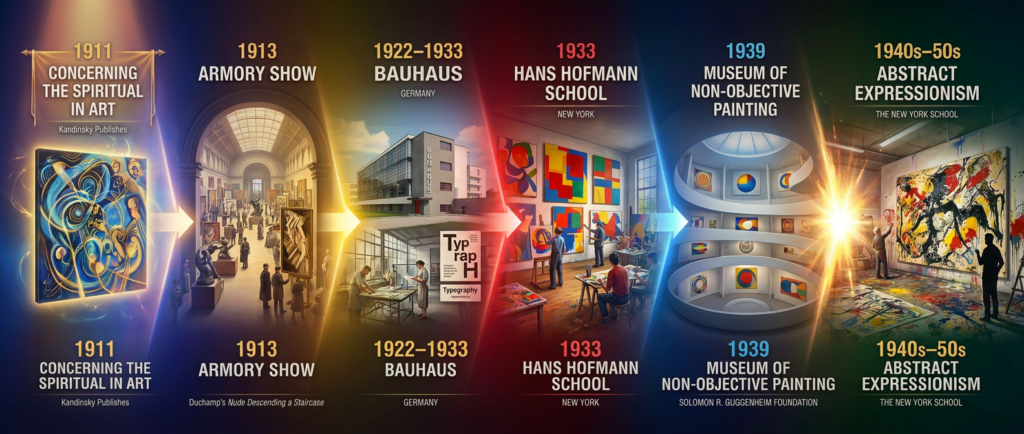
Kandinsky’s philosophy reached American artists through three specific routes — an exhibition, a school, and a museum — not through vague cultural osmosis, and each route had a name attached to it.
Academic research by Olga S. Zdanovics (Northern Illinois University, 1991) documents that American modernists were aware of Kandinsky even before the First World War, and that his influence was absorbed as an integral part of the philosophical structure of Abstract Expressionism — not a surface detail but a deep foundation. Here is the specific chain, and the people who made it happen:
Route 1 — The 1913 Armory Show
The International Exhibition of Modern Art, held in New York in 1913, was the moment American artists first encountered European avant-garde work at scale. The show introduced Cubism, Fauvism, and the kind of radical abstraction that Kandinsky’s theoretical framework had helped make thinkable. Young American modernists began debating in earnest whether a painting could mean something without depicting anything. verify: confirm Kandinsky’s direct representation at the show
Route 2 — Hans Hofmann and His School (1933)
This is the single most important and least-told part of the story. Hans Hofmann studied in Munich in the early 1900s — the same intellectual atmosphere that shaped Kandinsky. He opened his School of Fine Arts in New York in 1933, the same year the Nazis closed the Bauhaus and Kandinsky left Germany for good. Hofmann taught the primacy of emotional energy in colour planes — ideas that directly paralleled Kandinsky’s. His students included Lee Krasner; Arshile Gorky and John Graham were among the strongest early proponents of Kandinsky’s work in the New York circle. Zdanovics (1991) specifically identifies Hofmann as “particularly useful in transmitting these philosophies to the emerging Abstract Expressionist artists.”
Route 3 — The Museum of Non-Objective Painting (1939)
Hilla Rebay, a German artist and devoted advocate for Kandinsky, persuaded Solomon Guggenheim to build a permanent collection around non-objective art. The Museum of Non-Objective Painting — the direct predecessor of today’s Guggenheim — opened in New York in 1939 with Kandinsky’s work given central place. For the first time, New York artists had a permanent, accessible, serious institutional home for exactly the kind of painting Kandinsky had theorised. verify: confirm founding year and Kandinsky’s centrality to the collection
| Date | Event | Who Was Responsible | Significance |
|---|---|---|---|
| 1911 | Concerning the Spiritual in Art published | Kandinsky | Abstract painting given its first serious intellectual framework |
| 1913 | Armory Show, New York | International organisers | American artists first encounter European abstraction at scale verify |
| 1922–1933 | Kandinsky teaches at the Bauhaus | Kandinsky / Gropius | Ideas systematised into a teachable curriculum |
| 1933 | Bauhaus closed; European artists emigrate | Nazi regime (forced) | Bauhaus teachers scatter to American institutions |
| 1933 | Hans Hofmann opens NYC school | Hans Hofmann | Kandinsky-adjacent principles taught directly to future AE generation |
| 1939 | Museum of Non-Objective Painting opens | Hilla Rebay / Solomon Guggenheim | Kandinsky permanently on view in New York verify |
| c.1943–1950 | Abstract Expressionism reaches maturity | Pollock, Rothko, de Kooning et al. | The movement emerges, drawing on Kandinsky’s foundations |
How did Kandinsky’s colour theory shape Mark Rothko specifically?
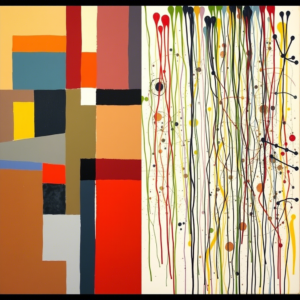
Rothko took Kandinsky’s premise that colour carries spiritual and emotional weight without depicting anything, then pushed it as far as paint allows — vast fields of pure colour designed to produce direct, pre-verbal emotional experience.
Kandinsky had argued that colour affected viewers at a level that bypassed intellectual analysis. Rothko didn’t copy these associations literally, but he inherited the underlying premise completely. His signature format of soft-edged floating rectangles was, in essence, an experiment in whether Kandinsky’s theory held up: could pure colour really move a viewer the way music moves a listener?
By the time Rothko painted the Rothko Chapel (dedicated 1971), he had answered that question in the affirmative. The near-black canvases were designed to create an experience of confronting the limits of perception and feeling — precisely the “transcendental expression” Kandinsky had identified as art’s highest purpose sixty years earlier.
Was Jackson Pollock directly influenced by Kandinsky?
Yes — Pollock was specifically drawn to Kandinsky’s late biomorphic paintings and to his conviction that spontaneous, subconscious gesture was the most authentic possible form of artistic expression.
Pollock’s drip technique, developed from the mid-1940s, is often presented as a bolt from nowhere. But Kandinsky had been there first in spirit. His “Improvisations” series — paintings described as arising from rapid inner impulse, without deliberate composition — gave Pollock a historical precedent. If Kandinsky’s gestural marks were serious art, then Pollock’s even more radical spontaneity was serious art too.
What Pollock absorbed was not a style but a permission structure. The idea that the physical act of painting — the performance of it — could itself be the meaning, rather than merely the means to a finished image: Kandinsky suggested this; Pollock made it explicit and definitive.
What role did Kandinsky’s Bauhaus teaching play in transmitting his ideas?
At the Bauhaus, Kandinsky turned his ideas into a teachable curriculum — and when the Nazis closed the school in 1933, Bauhaus-trained artists carried that curriculum directly into American art institutions.
Kandinsky joined the Bauhaus in Weimar in 1922 and taught there until the school’s forced closure in 1933, developing courses in colour theory, analytical drawing, and the formal elements of painting. The 1933 closure scattered this community across the Atlantic. László Moholy-Nagy founded the New Bauhaus (later the School of Design) in Chicago in 1937. Walter Gropius joined the faculty at Harvard. The ideas were transplanted and institutionalised in America’s most prestigious art schools, creating the intellectual climate in which Abstract Expressionism matured.
Explore the full arc of painting styles and movements that shaped modern art.
Artist by artist: who took what from Kandinsky
The diversity of Abstract Expressionism — from Pollock’s explosive action to Rothko’s meditative stillness — reflects Kandinsky’s own range: different artists responded to different phases of his evolving practice.
| AE Artist | Kandinsky Strand Absorbed | How It Manifested |
|---|---|---|
| Mark Rothko | Colour as direct spiritual and emotional transmission | Pure colour fields; Chapel paintings designed to produce transcendent experience |
| Jackson Pollock | Spontaneous gesture; subconscious as legitimate creative source | Drip technique; the act of painting as the meaning |
| Arshile Gorky | Biomorphic abstraction; the “inner eye” rendering nature’s spirit | Fluid, organic shapes derived from feeling rather than observation |
| Willem de Kooning | Rejection of representation; expressive mark-making as content | Slashing gestural brushwork; figures fragmented into feeling |
| Barnett Newman | Art as spiritual act; confrontational scale as presence | Vertical “zip” paintings; canvases as objects that confront the viewer |
| Lee Krasner | Via Hofmann: colour plane dynamics; emotional energy in composition | Layered abstract rhythms; large-scale colour field work |
Frequently Asked Questions
Did Kandinsky ever meet the Abstract Expressionists in person?
Kandinsky died in France in December 1944, just as the Abstract Expressionists were reaching their mature phase in New York. He never met Pollock, Rothko, or de Kooning. His ideas reached them through his books, through exhibitions, and above all through educators — particularly Hans Hofmann — who had absorbed his philosophy at close quarters in Europe.
Is Kandinsky the “father of Abstract Expressionism”?
He is better described as the movement’s philosophical grandfather rather than its parent. Abstract Expressionism emerged in New York from American artists responding to a post-war world; Kandinsky worked in Munich and Paris a generation earlier. What he gave the movement was its foundational premise — that abstraction could carry genuine spiritual and emotional truth — not its specific style or cultural character.
What is Concerning the Spiritual in Art and why does it matter?
Written in 1911 and first published in German, it is Kandinsky’s argument that non-representational art is not a failure of depiction but the highest form of expression. It laid out a colour psychology, described the spiritual mission of the artist, and gave abstract painters a serious intellectual framework. Abstract Expressionists read and discussed it; its ideas saturate the movement’s philosophy even where they are not directly quoted.
How did Kandinsky’s synesthesia affect his work and its influence on the Abstract Expressionists?
Kandinsky experienced synesthesia — colours triggered sound sensations in him, and vice versa. This shaped his approach to composition: he structured paintings like musical scores, with tension, resolution, harmony, and dissonance built in. Abstract Expressionists absorbed the musical analogy enthusiastically. Pollock spoke of painting “as a state of being”; Rothko wanted his canvases to perform for viewers the way music performs — present, enveloping, and not requiring interpretation to be felt.
Which single Kandinsky painting had the greatest impact on Abstract Expressionism?
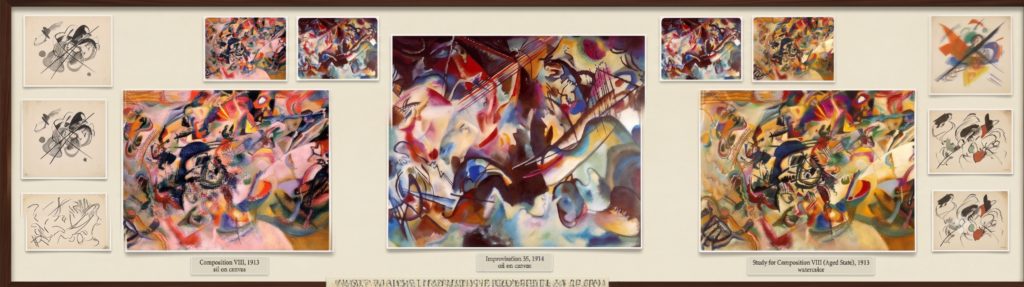
Composition VII (1913) is most frequently cited by scholars. At over three metres wide, it was one of the most ambitious abstract canvases yet attempted — complex, non-referential, operating at monumental scale. It demonstrated that abstract painting could be serious, demanding, and large. Pollock’s great drip canvases share exactly this ambition: paintings as events rather than objects, requiring total attention rather than a quick glance.
Sources and Further Reading
1. Kandinsky, Wassily. Concerning the Spiritual in Art (1911). Dover Publications.
The primary source for all claims about Kandinsky’s own colour theory, the concept of inner necessity, and the philosophy of non-representational painting. Widely available in the Dover Thrift Edition. Supports: the entire theoretical framework section; the colour association table; inner necessity discussion.
2. Zdanovics, Olga S. (1991). The Influences of Wassily Kandinsky on the New York School of Abstract Expressionism. Northern Illinois University M.A. thesis.
Available via Huskie Commons, NIU. Supports: Hans Hofmann as the critical pedagogical transmitter; Gorky, Graham, and Pollock as direct proponents; pre-WWII American awareness of Kandinsky; the Symbolist evocation framework shared by Kandinsky and the NY School.
3. The Art Story — Wassily Kandinsky.
Available at theartstory.org. Supports: the three-phase visual vocabulary; Pollock’s interest in Kandinsky’s late biomorphic work; Rothko’s debt to the colour field theory; Gorky’s biomorphic development.
4. Solomon R. Guggenheim Museum — Institutional History and Hilla Rebay Documentation. verify before publishing
The Guggenheim’s own published institutional history documents Rebay’s role in championing Kandinsky and the founding of the Museum of Non-Objective Painting. Verify the specific founding year and Kandinsky’s centrality to the collection at Guggenheim.org before adding the link to your live post. Updated June 2026