
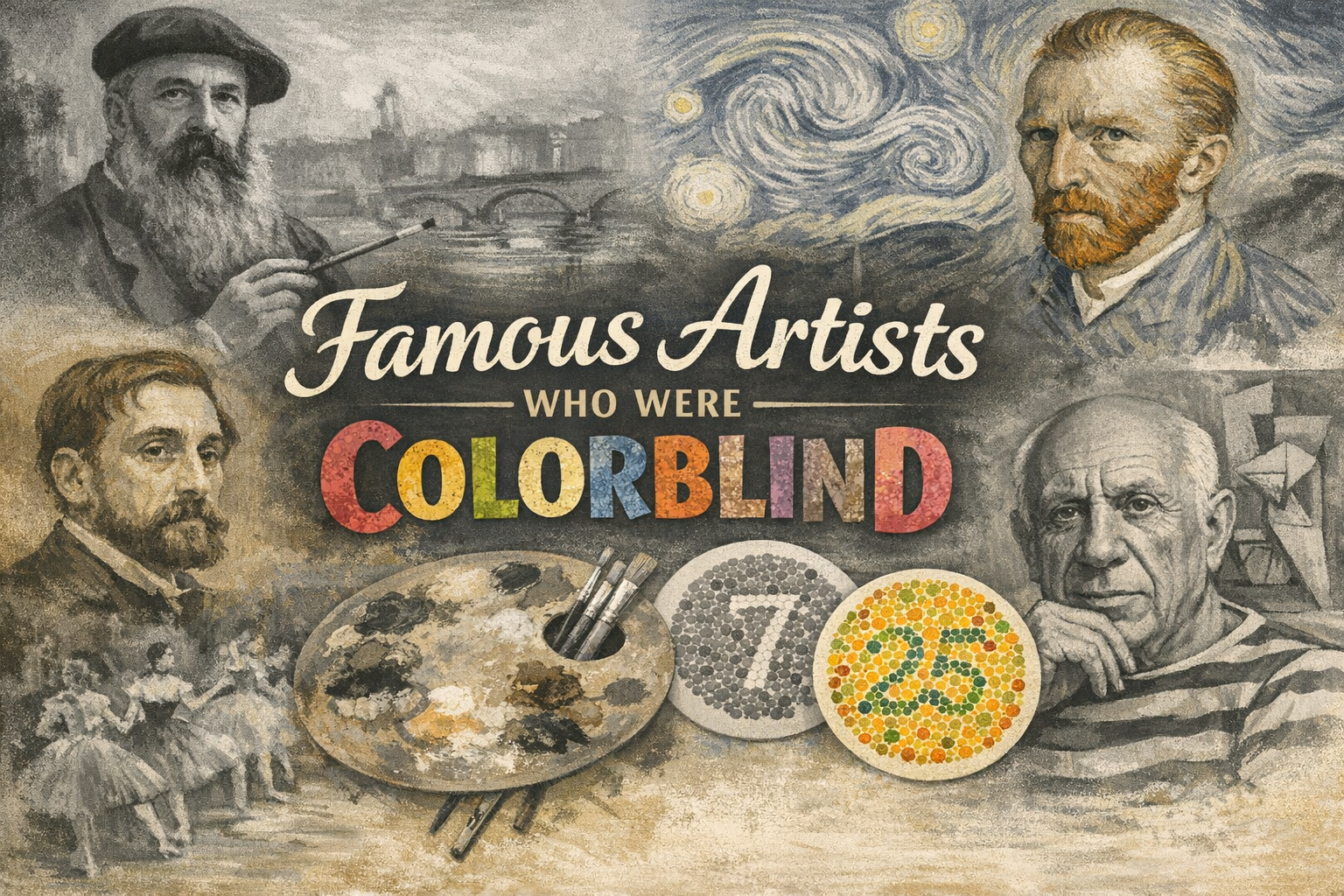
This post explores the surprising reality of famous artists who were colorblind and how they adapted to create masterpieces. You’ll discover that vision challenges don’t have to stop your creative journey. The key takeaway is that adapting your techniques can turn an obstacle into a unique artistic style. Keep reading to learn how you can apply these lessons to your own art.
Have you ever worried that you can’t see colors well enough to paint? You aren’t alone. Many beginners feel intimidated by color mixing and worry their vision might hold them back. But what if I told you that some famous artists who were colorblind faced the exact same fear?
In fact, several historical creators used their unique vision to shape the art world. Let’s explore how these painters turned a perceived weakness into their greatest strength.
Many famous artists have navigated color blindness (color vision deficiency), using unique palettes and focusing on contrast or texture to create masterpieces. Renowned examples include Claude Monet (who developed vision issues later in life), Edgar Degas, and likely William Blake. Contemporary colorblind artists include Daniel Arsham, who works in monochromatic palettes, and cyborg artist Neil Harbisson.
What Does It Mean to Be a Colorblind Artist?

A colorblind artist is a creative person who experiences a color vision deficiency, meaning they see certain hues differently than most people. Instead of seeing a full spectrum, they might confuse reds and greens or see colors as varying shades of blue and yellow.
It’s a common myth that colorblindness means seeing the world purely in black and white. The reality is much more nuanced. For example, some people have protanopia, which is a severe form of red-green color blindness. This means they lack the specific retinal cones needed to easily distinguish between greens, reds, and yellows.
If you struggle with colors, checking out a color mixing primer can help you build confidence. Understanding your own vision is the first step to mastering your palette.
The Story of Charles Meryon
Charles Meryon was a brilliant French artist from the 19th century. Early in his career, he realized he had a congenital color vision defect. This condition made it very difficult for him to succeed as a traditional painter.
Instead of giving up, Meryon pivoted to etching and printmaking. He worked almost entirely in this medium because it relied on line and contrast rather than color as opposed to other types of art. Today, he is widely recognized as the most significant etcher of 19th-century France.
His most famous works capture a dramatic, gothic vision of Paris. If you want to try working with heavy contrast, learning about types of paint brushes can help you create striking black-and-white art.
Did Colorblindness Stop Clifton Pugh from Painting?
No, colorblindness didn’t stop Clifton Pugh from painting. Despite having a severe red-green vision deficiency, he became a highly successful Australian painter. He adapted by using a restricted palette, structuring his award-winning portraits around reliable browns, blacks, and blues while avoiding greens.
Pugh adapted by using a highly restricted color palette. He preferred to build his compositions using brown, black, and blue, while using greens and purples very sparingly. This strategic choice allowed him to create striking, emotional works without getting confused by problem colors.
His massive success proves that a severe color vision deficiency is not a barrier to fame. If you find yourself overwhelmed by too many hues, exploring color theory basics can simplify your choices.
How Arthur Burdett Frost Mastered Grayscale
Arthur Burdett Frost was a famous American illustrator during the late 19th and early 20th centuries. He was also red-green colorblind. This visual challenge actually helped him develop an excellent use of grayscale and photorealistic painting.
Frost didn’t shy away from color completely, however. He managed to work successfully in color by keeping his palette highly organized. Biographies mention that he painted successfully by carefully putting his colors in a pre-arranged sequence, and sometimes his son helped arrange the paints.
This shows the power of having a reliable system. By setting up a consistent palette, you can paint with absolute confidence. This is a great tip for anyone wanting to understand color theory in art.
How Can Colorblind Artists Adapt Their Techniques?
Colorblind artists adapt their techniques by using limited palettes, organizing their paint tubes systematically, and focusing heavily on values like light and dark. Many also shift their focus to highly textured mediums or grayscale artwork to turn their unique vision into a signature style.
You can embrace your vision and make bold, unusual color choices your trademark. Alternatively, you can rely entirely on black and white to emphasize tone over hue. Some artists even check the labels on their paint tubes obsessively to ensure accuracy.
Remember that art is highly subjective. Your distinct way of seeing the world can lead to some of the most inspiring paintings. Don’t be afraid to lean into your natural perspective.
Comparing Adaptive Strategies for Artists
To help you see how different artists manage their vision, I’ve put together a simple comparison. This table outlines the practical strategies used by the famous creators we just discussed.
| Artist | Visual Condition | Primary Adaptive Strategy |
| Charles Meryon | Congenital color defect | Switched from painting to etching and printmaking |
| Clifton Pugh | Protanopia (red-green blind) | Used restricted palettes of brown, black, and blue |
| Arthur Burdett Frost | Red-green colorblind | Focused on grayscale and strictly sequenced his palette |
You can easily borrow these methods for your own practice. Whether you limit your colors or focus on line work, there is always a path forward. The key is to experiment and find what feels comfortable for you.
Final Thoughts
The stories of famous artists who were colorblind remind us that perfect vision is not a requirement for creating beautiful things. By adopting limited palettes, focusing on contrast, or changing mediums, these artists left a massive mark on history. You have the power to do the same by embracing how you uniquely see the world.
Don’t let fear keep you from picking up a brush today. Check your paint labels, grab a limited palette, and start creating!
Frequently Asked Questions
1. Can you be a successful painter if you’re colorblind?
Yes, you can absolutely be a successful painter. Many acclaimed artists, like Clifton Pugh, achieved massive success despite severe color vision deficiencies. They simply adapted their techniques to suit their vision.
2. What colors do colorblind artists struggle with the most?
It depends on the specific condition, but red and green are the most commonly confused colors. Protanopes, for example, have trouble distinguishing between reds, greens, and yellows. This is why many adapt by focusing on blues and browns.
3. How did Charles Meryon deal with his colorblindness?
Charles Meryon realized his colorblindness made traditional painting too difficult. He decided to focus entirely on etching and printmaking. This allowed him to master line and contrast, making him a legend in 19th-century France.
4. Do colorblind artists only paint in black and white?
No, many colorblind artists paint in full color. They often use strict systems, like organizing their palette in a specific order, or reading paint labels carefully. Others intentionally use bold, unusual colors to create a unique style.
5. Should I tell people my art is made by a colorblind artist?
That’s entirely up to you and your comfort level. Some artists find that sharing their condition helps others understand their unique aesthetic choices. It can also inspire other beginners who face similar challenges in their creative journey.

Olly
Olly Farmer M.Sc, B.Sc, PGCE 25 years experience of Watercolor Painting and AI Art; teacher for 13 years; Creator of Art Tools; Art Gallery Contributor of Art Articles to Medium.com, LinkedIn and Facebook
Continue exploring

PROMINENT PAINTING
Keep your creative momentum
Get new painting guides, practical techniques and artist stories delivered without the noise.
Occasional emails. Unsubscribe whenever you like.