
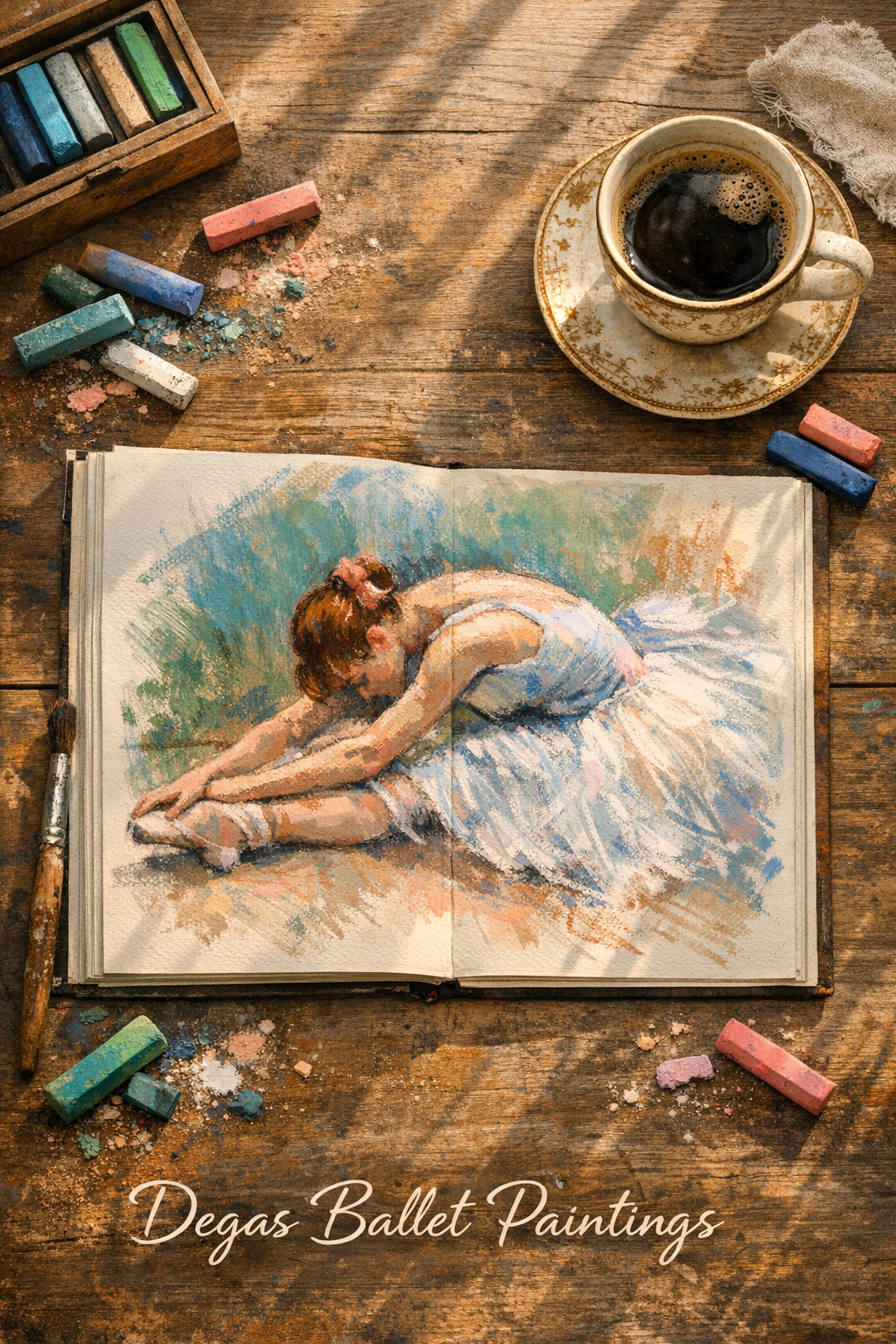
Discover how Edgar Degas revolutionized art by capturing the raw, behind-the-scenes movement of Paris ballet dancers. This post breaks down his unique pastel techniques, unconventional framing, and deep fascination with the human body in motion. You will learn why he chose dancers as his primary subjects and how to apply his observational secrets to your own painting journey. Grab your sketchbook and let’s dive in.
Have you ever tried to paint someone in motion? It is one of the hardest skills to master. Long before smartphones could freeze time, Edgar Degas figured out how to capture the exact kinetic energy of a human body. He is famous worldwide for his stunning Edgar Degas ballet paintings.
But Degas was not just painting pretty girls in tutus. He was obsessed with the grueling physical labor and the quiet moments behind the curtain. By treating the Paris Opéra as his living studio, he studied the dancers as they worked through exhausting routines. He wanted to strip away the glamour to show the real, breathing people underneath.
In this post, we will look at how Degas used unconventional compositions, bold pastels, and a sharp eye to bring his canvases to life. If you want to see the world through Edgar Degas’s eyes, there is a lot we can learn from his revolutionary approach to movement.
Why Did Edgar Degas Paint Ballet Dancers?
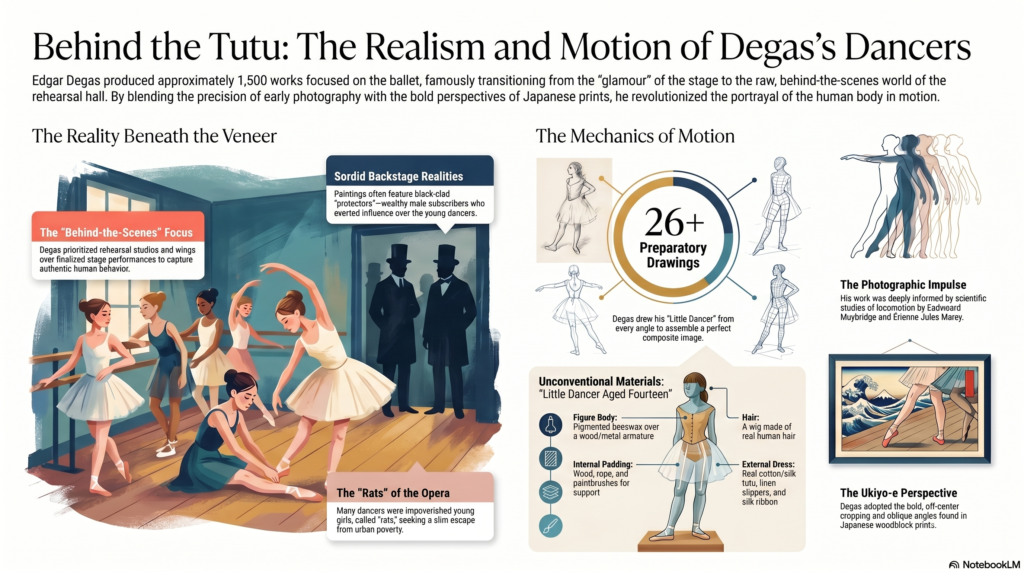
Edgar Degas painted ballet dancers because they provided the perfect subjects to study the human body in continuous movement. Rather than focusing on glamorous performances, he used dancers to explore grueling physical effort, authentic resting poses, and the harsh realities of their daily training.
Degas was different from his peers in the Impressionist art movement. While others painted outdoor landscapes, he preferred the indoor world of the Paris Opéra. He viewed the ballet as a modern way to study classic human forms. He was fascinated by the relentless work ethic of the dancers.
These young women were often called “opera rats” due to their grueling schedules. According to art historians, his work serves as a brilliant commentary on the hard working-class labor of these performers. He showed them stretching, yawning, and rubbing sore muscles.
This focus on the exhausting reality of the opera rats highlights his deep respect for their dedication. As an art teacher, I always remind my students to look for these authentic moments. Real life is often found in the quiet pauses between the action.
How Did Degas Capture Movement on a Flat Canvas?
Unlike some contemporaries who relied on energetic, blurred brushwork to imply speed, Degas used sharp, precise linework to freeze inherent movement. He captured motion using dynamic, off-center compositions and bold foreshortening.

Degas shifted his focus toward pastel painting techniques during the 1880s. This medium allowed him to draw and paint at the exact same time. By the late 19th century, pastels became his primary tool for capturing these frenzied spectacles. He used strong, directional strokes that followed the shape of a dancer’s arm or leg.
This technique creates implied lines that guide your eye right across the paper. Experts note that he used scratched brushwork to inject raw kinetic energy into his pieces. He also built up layers of color to give his subjects a glowing, lifelike quality. Studies show his unique method of layering allowed him to essentially draw with color while relying heavily on his sharp memory. This approach made his artwork feel incredibly vibrant and structurally sound.
The Secret Influence of Photography and Japanese Prints
Degas completely changed the rules of traditional painting. He was heavily inspired by the rising popularity of early photography and imported Japanese Ukiyo-e woodblock prints (a stylistic shift that completely transformed European Impressionism, as we’ve explored in our previous posts). These new art forms taught him to look at the world differently, prompting him to use dynamic compositions that felt like candid snapshots.
Curators highlight how these Japanese prints and early photos inspired his cropped, off-center pictorial space. Instead of placing his main subject right in the middle, he pushed them to the edges. He would even cut off half of a dancer’s body at the edge of the frame.
This technique tricks your brain into thinking the scene continues beyond the canvas. It makes the painting feel like a brief, fleeting moment in time.
| Feature | Traditional Composition | Degas’s Composition Style |
|---|---|---|
| Placement | Subject placed in the direct center | Subject pushed to the far edges |
| Balance | Perfect, balanced symmetry | Asymmetrical, off-center weight |
| Visibility | Full body always visible | Figures abruptly cropped by the frame |
| Perspective | Formal, posed studio lighting | Candid, high-angle snapshot perspective |
What Is the Meaning Behind The Dance Class?

The Dance Class highlights the exhausting reality of ballet training rather than a polished final performance. By showing dancers scratching their backs, stretching, and looking away, Degas emphasizes the unglamorous, repetitive labor required to achieve perfection on the stage.
The Dance Class is arguably one of his most famous masterpieces. It perfectly summarizes his approach to the ballet. The painting features a strict ballet master directing a group of tired students. You can see girls adjusting their outfits and resting their tired feet.
An analysis of the painting reveals his brilliant use of a steep diagonal perspective and a total lack of sentimentality. He leaves a large, empty space of wooden floorboards in the center. This empty space balances the crowded group of dancers on the side. When I paint watercolors in my studio, I often try to use empty space just like this to let the painting breathe. It is a powerful lesson in composition.
Exploring Degas’s Wax Sculptures of Dancers
Painting was not his only way to study movement. Degas actually created dozens of small wax sculptures in his studio. He used these three-dimensional models to better understand human anatomy from every possible angle.
Researchers have documented at least 38 recorded wax sculptures that he used to study form. The most famous example is The Little Fourteen-Year-Old Dancer. By building these figures with his own hands, he learned exactly how muscles stretch and bones align.
This physical understanding naturally transferred over to his two-dimensional pastel drawings. This is a great reminder that experimenting with different mediums can massively improve your core skills.
Bridging the 19th Century with Modern Practice: Your Digital Opéra
Edgar Degas did not just paint dancers; he dissected their movements. He used the Paris Opéra not merely as a glamorous backdrop, but as a live reference studio—a laboratory where he could relentlessly study the biomechanics of the human body under extreme physical stress. He was fascinated by the grueling reality behind the illusion of effortless grace, sketching the awkward adjustments, the stretching, and the tension of muscle and bone.
For today’s artists, replicating Degas’ exhaustive anatomical studies doesn’t require a backstage pass to a world-class ballet company. You can bridge his historical techniques with modern practice by creating your own digital reference studio.
The Modern Artist’s Laboratory Just as Degas observed endless rehearsals to understand how a body balances on a single pointe, you can harness modern AI generation tools to build out dynamic reference poses.
The Challenge: Try using an AI image generator to conceptualize complex figures in mid-motion. Write prompts that focus on extreme angles, dramatic lighting, or the exact millisecond of weight transfer during a leap. Do not treat these generations as finished art. Instead, use them exactly as Degas used his rapid charcoal sketches: as raw, unpolished data to study anatomy, torque, and the physics of human movement before bringing those lessons into your own canvas.
Deconstructing Degas: A Visual Exercise Degas was a master of utilizing emptiness to create dynamic tension. To truly grasp how he orchestrated movement without painting a single blur line, visual learners should attempt a structural breakdown of his work.
Take a high-resolution, public domain image of his masterpiece, The Dance Class, or the striking Swaying Dancer. Drop the image into a digital painting program like Procreate or Photoshop (or simply print it out and grab some tracing paper), and map out the composition:
- Block out the Positive Space: Draw bold outlines over the figures—the dancers adjusting their slippers, the ballet master leaning on his cane.
- Highlight the Negative Space: Shade in the expansive, sweeping floorboards and the empty air above their heads.
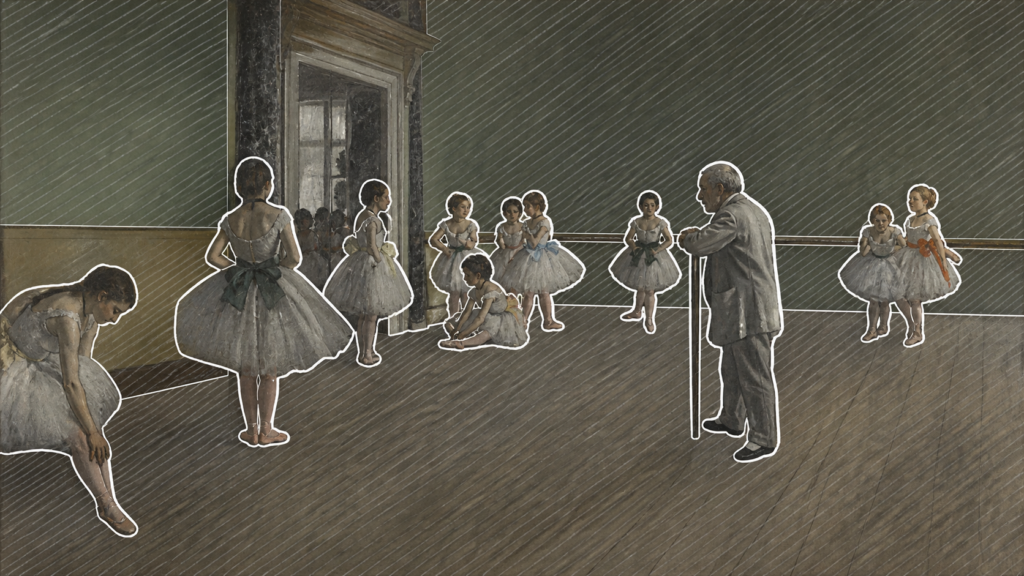
What you will immediately notice is that the negative space in a Degas painting is never passive. The vast, empty expanses actively push against the figures, forcing the viewer’s eye toward asymmetrical clusters of dancers and amplifying the feeling of a spontaneous, fleeting moment. By physically drawing over his work to map these zones, you train your own eye to see the structural skeleton beneath his pastel dust.
Frequently Asked Questions
1. Did Edgar Degas ever dance himself?
No. Edgar Degas was strictly an observer of the ballet and did not dance himself. He preferred to sit backstage and sketch the dancers as they worked through their exhausting routines.
2. What paint medium did Degas use for his ballet artworks?
He primarily used oil paints early in his career before switching to pastels. Pastels allowed him to draw with color while relying heavily on his sharp memory. This gave his later ballet works a very vibrant and energetic texture.
3. How many ballet paintings and sculptures did Degas create?
He created hundreds of paintings and sketches of dancers throughout his long career. In addition to his two-dimensional works, experts have identified at least 38 recorded wax sculptures that he used to study form.
4. Why are Degas’s paintings often cropped at the edges?
He wanted his paintings to feel like candid, unposed snapshots of real life. He was heavily influenced by how Japanese prints and early photos inspired his cropped, off-center pictorial space.
5. What is Degas’s most famous ballet artwork?
The Dance Class is widely considered one of his most famous and celebrated ballet paintings. It is renowned for its steep diagonal perspective and a total lack of sentimentality.