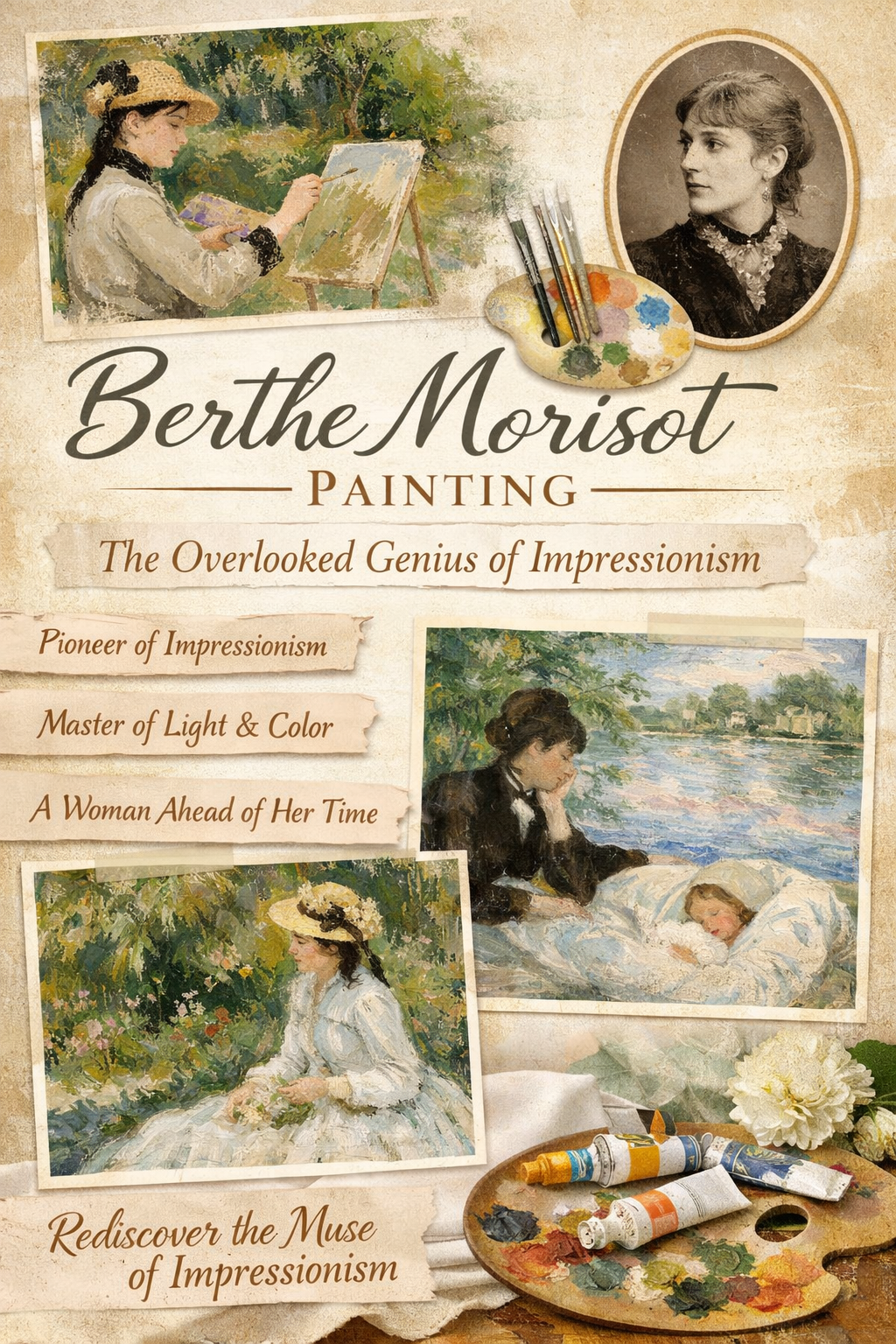
Berthe Morisot paintings offer a breathtaking look into the daily lives of women in the 19th century. This post explores her vital role as a founding member of the Impressionist movement. You will discover the secrets behind her quick brushstrokes and learn why her legacy was overlooked for decades. Whether you are a beginner or a seasoned artist, study her work to find fresh inspiration for your own creative journey.
Berthe Morisot was a founding member of the Impressionist movement, yet her specific, radical approaches to brushwork, solvent use, and color theory remain underexplored.
This guide deconstructs Morisot’s distinct methodology, transforming historical appreciation into actionable instruction for your own studio practice.
Key Takeaways: Understanding Morisot’s Method
- Watercolor Fluidity in Oils: Morisot heavily diluted her oil paints, treating them like aqueous washes to achieve unparalleled luminosity.
- Strategic Impasto: She contrasted thin, solvent-heavy layers with aggressive, targeted impasto strokes to guide the viewer’s focal point.
- The Unprimed Canvas: By leaving raw, unprimed canvas exposed, she utilized the linen’s natural weave as a crucial mid-tone in her compositions.
- Mastery of White: Her optical mixing relied heavily on unblended lead and zinc whites to create atmospheric, chromatic greys.
The Influence of Watercolor on Morisot’s Oil Practice
Before establishing her reputation in oils, Morisot was an exceptional watercolorist. The core of her genius lies in how she refused to separate the rules of the two mediums. While many of her male contemporaries layered thick, opaque oils, Morisot translated the relationship between water, pigment, and paper directly onto the canvas.
Achieving Luminous Transparency
To emulate Morisot, an artist must master solvent control. By aggressively thinning her oil paints with turpentine, she created translucent washes that mimicked watercolor transparency. This technique allowed light to penetrate the paint film and bounce off the canvas beneath, creating an internal glow that opaque painting cannot achieve.
This approach requires supreme confidence. Just as historical watercolor masters had to anticipate how wet pigment would dry on paper, Morisot had to predict how her thinned oils would settle into the canvas weave without lifting the layers beneath.
Mastering Texture: The Strategic Use of Impasto
While Morisot is famous for her airy, delicate washes, her work derives its structural integrity from her highly intentional application of texture. Unlike the uniform, dotted textures seen in later movements like Pointillism, Morisot’s brushwork was explosive, multidirectional, and highly varied in thickness.
She utilized heavy impasto layers strictly in areas of high importance—such as the collar of a dress, the crest of a wave, or the highlight on a cheekbone. By contrasting flat, thinned washes in the background with thick, tactile paint in the foreground, she created a physical depth of field that pulled the subject away from the background.
You can observe this masterful balance of textures in her original works held at the Musée d’Orsay and The National Gallery.
In February 2013, her stunning 1881 painting titled “Après le déjeuner” went to auction. It sold at Christie’s in London for an incredible $10.9 million. At the time, this massive sale set a brand new world record for any female artist at auction.

The ‘Unfinished’ Canvas and Ground Preparation
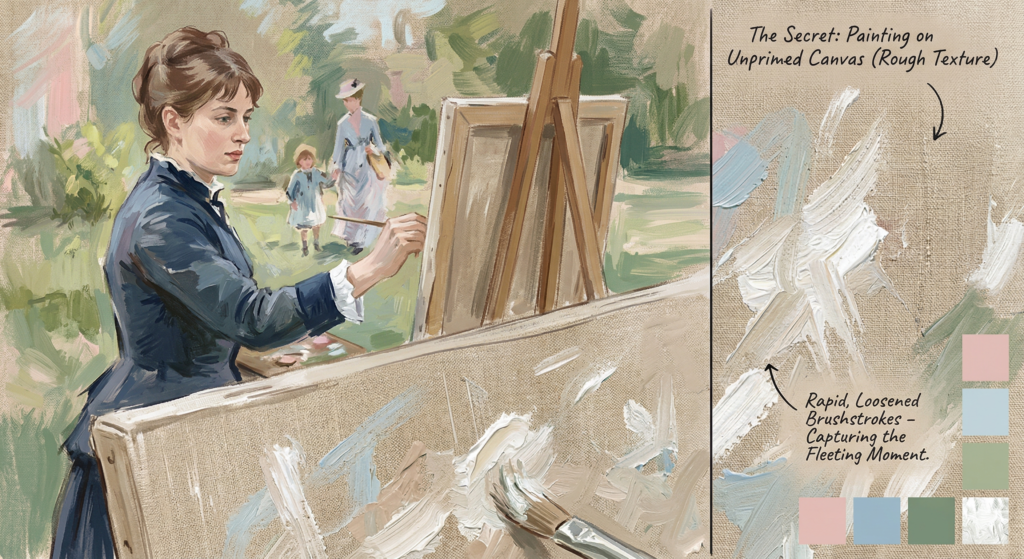
Academic painting of the 19th century demanded a perfectly smooth, heavily gessoed surface. Morisot actively rebelled against this. She frequently painted on unprimed or very lightly sized linen.
This was not a shortcut; it was a calculated technical decision. The raw, warm tone of the linen acted as a harmonious mid-tone. By utilizing a sketchy, fâcheux (unfinished) aesthetic, she intentionally left large areas of the canvas completely bare. The exposed weave interacted with her sweeping brushstrokes, allowing the painting to “breathe” and forcing the viewer’s eye to optically complete the image.
Color Theory: The Power of Zinc White and Chromatic Greys
Morisot avoided the heavy blacks and muddy earth tones favored by the traditional Salon. Instead, she achieved contrast through temperature shifts.
Her palette was dominated by complex, chromatic greys—created by mixing complementary colors rather than adding black. She would juxtapose a cool, silvery-green shadow directly against a warm, peachy highlight. To make these colors vibrate, she applied rapid, unblended strokes of pure zinc or lead white directly over her mid-tones. This created a shimmering effect that captured the fleeting, momentary nature of natural light.
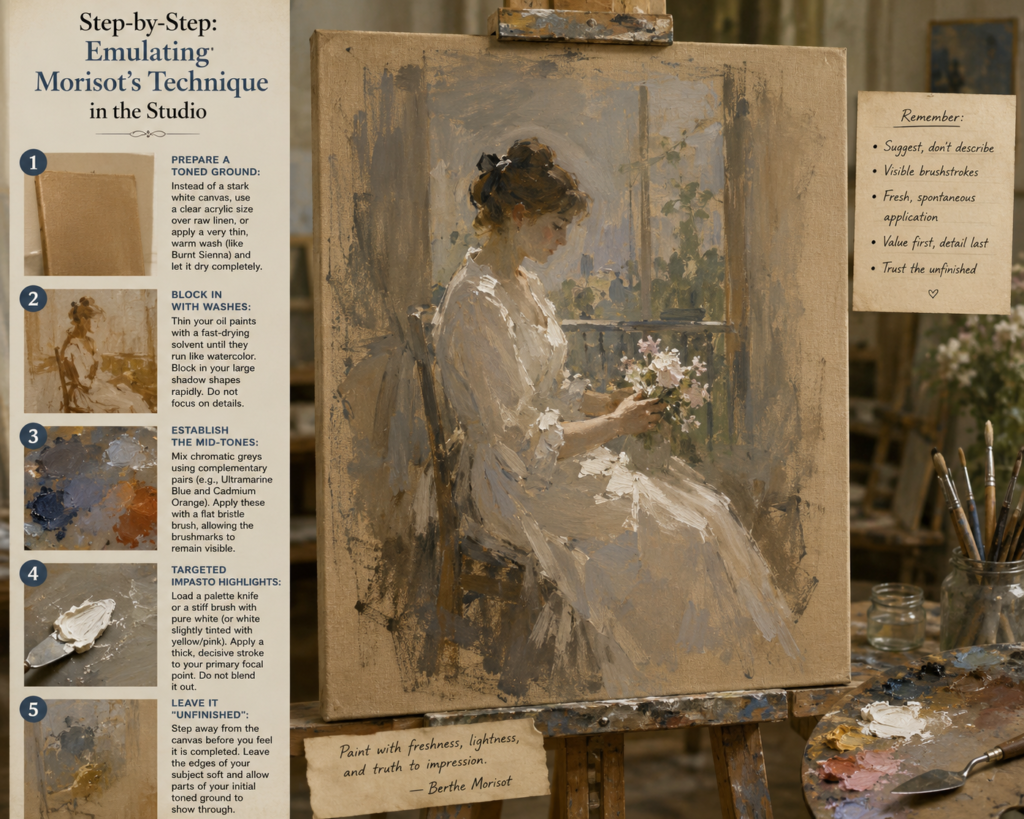
Step-by-Step: Emulating Morisot’s Technique in the Studio
To integrate Morisot’s methods into your art education and daily practice, follow this structured exercise:
- Prepare a Toned Ground: Instead of a stark white canvas, use a clear acrylic size over raw linen, or apply a very thin, warm wash (like Burnt Sienna) and let it dry completely.
- Block in with Washes: Thin your oil paints with a fast-drying solvent until they run like watercolor. Block in your large shadow shapes rapidly. Do not focus on details.
- Establish the Mid-Tones: Mix chromatic greys using complementary pairs (e.g., Ultramarine Blue and Cadmium Orange). Apply these with a flat bristle brush, allowing the brushmarks to remain visible.
- Targeted Impasto Highlights: Load a palette knife or a stiff brush with pure white (or white slightly tinted with yellow/pink). Apply a thick, decisive stroke to your primary focal point. Do not blend it out.
- Leave it ‘Unfinished’: Step away from the canvas before you feel it is completed. Leave the edges of your subject soft and allow parts of your initial toned ground to show through.
Frequently Asked Questions
What painting mediums did Berthe Morisot use? Berthe Morisot was an expert in both oil and watercolor. She famously bridged the gap between the two by heavily diluting her oil paints with solvents to create transparent, fluid washes similar to aquarelle techniques.
Why do Berthe Morisot’s paintings appear unfinished? Morisot intentionally used a sketchy, rapid brushwork style and frequently left the raw canvas exposed. She believed that capturing the immediate, fleeting impression of atmosphere and light was more vital than rendering perfectly smoothed, academic details.
How did Berthe Morisot achieve texture in her paintings? She achieved texture through a highly contrasted application method. Morisot placed thick, targeted impasto strokes in her focal areas over the top of very thin, heavily diluted background washes, creating a dynamic, three-dimensional surface. (PU)