
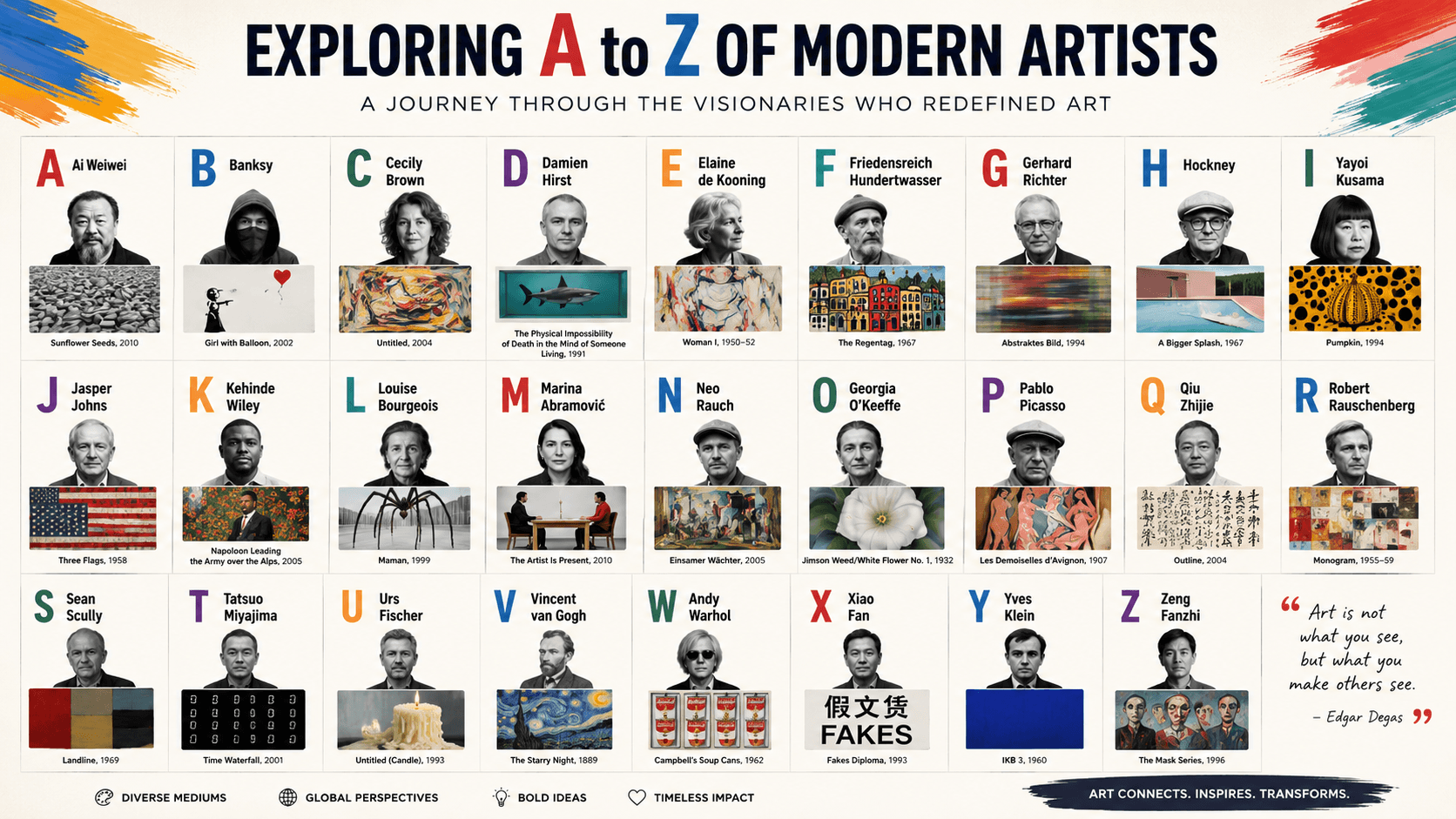
Modern artists are those who radically broke from traditional artistic conventions, primarily from the late 19th century through the mid-20th century, introducing new styles, subjects, and techniques that redefined art itself. Figures like Vincent van Gogh, Pablo Picasso, and Frida Kahlo exemplify this era, each contributing distinct innovations that continue to influence contemporary art practices and challenge viewers’ perceptions.
Keypoint Summary
- Modern art emerged from the late 19th century, challenging established academic traditions.
- Artists like Van Gogh, Picasso, and Kahlo pioneered new visual languages and expressive techniques.
- Key movements include Impressionism, Cubism, Surrealism, and Abstract Expressionism.
- Understanding these artists offers insight into the evolution of artistic expression and technique.
The Rapid-Fire A-Z Cheat Sheet
Skim this to sound like a genius at your next art class.
- A is for Andy Warhol: Proved that painting everyday objects (like soup cans) over and over again is a valid way to explore mass production.
- B is for Banksy: Uses high-contrast stencils to create powerful street art overnight, proving you don’t need perfect brush control to make a statement.
- C is for Paul Cézanne: Realized that if you break nature down into basic cylinders, spheres, and cones, painting landscapes becomes a lot less intimidating.
- D is for Marcel Duchamp: Put a bicycle wheel on a stool and called it art, teaching us that the idea behind the art is sometimes more important than the technical skill.
- E is for Edgar Degas: Ignored the glamorous stage performances and painted ballerinas stretching and resting, showing us the beauty in behind-the-scenes moments.
- F is for Frida Kahlo: Used self-portraits to paint her physical and emotional reality, proving that your personal experiences are always valid subject matter.
- G is for Paul Gauguin: Threw “realistic” color out the window and painted grass red and skies yellow just to see how it made the viewer feel.
- H is for Edward Hopper: Mastered the art of painting quiet, lonely lighting in empty diners and hotel rooms.
- I is for Impressionism: The movement that realized your brain will mix two separate dabs of blue and yellow paint into green, so you don’t have to blend it perfectly on the canvas.
- J is for Jasper Johns: Painted flags and targets because he wanted to paint things the brain already recognizes, freeing him to focus purely on the texture of the paint.
- K is for Wassily Kandinsky: Heard music when he looked at colors, leading him to create some of the first purely abstract paintings in history.
- L is for Roy Lichtenstein: Took the cheap, printed dots of comic books and blew them up to massive gallery sizes.
- M is for Henri Matisse: When illness prevented him from standing at an easel, he simply started cutting shapes out of painted paper, inventing a whole new way to compose.
- N is for Barnett Newman: Painted massive fields of single colors divided by thin “zips,” challenging us to feel the scale and weight of a single hue.
- O is for Georgia O’Keeffe: Zoomed in so close on flowers that they became abstract landscapes, forcing viewers to actually look at things they usually ignore.
- P is for Pablo Picasso: Shattered the rules of perspective by painting the front and side of a face at the exact same time (Cubism).
- Q is for Quik: A pioneer of graffiti art who brought the complex lettering and vibrant colors of the subway trains into fine art galleries.
- R is for Pierre-Auguste Renoir: Captured the dappled, messy, beautiful way sunlight filters through trees and hits people’s skin.
- S is for Georges Seurat: Skipped mixing paint on a palette entirely, placing millions of tiny dots of pure color next to each other for the eye to blend.
- T is for Toulouse-Lautrec: Immersed himself in the cabarets of Paris, capturing the chaotic movement and harsh gaslighting of the nightlife.
- U is for Umberto Boccioni: Tried to sculpt and paint what “speed” and “motion” actually looked like in a modern, industrialized world.
- V is for Vincent van Gogh: Used thick, swirling, aggressive brushstrokes to paint his anxiety and awe, proving that how you apply paint matters as much as what you paint.
- W is for Willem de Kooning: Smeared, scraped, and slashed his canvases, showing that the physical act of painting can be an emotional release.
- X is for Xanti Schawinsky: Blended theater, design, and painting, reminding us that art doesn’t have to stay flat on a wall.
- Y is for Yayoi Kusama: Covered entire rooms in polka dots and mirrors to create infinity spaces, exploring obsession and scale.
- Z is for Zao Wou-Ki: Beautifully merged the sweeping, philosophical brushstrokes of traditional Chinese landscapes with Western abstract expressionism.

What Defines a Modern Artist?
A modern artist is characterized by a deliberate departure from the academic and classical traditions that dominated art for centuries, embracing experimentation with form, color, and subject matter. This period, roughly from the 1860s to the 1970s, saw artists prioritizing personal expression, psychological depth, and societal commentary over realistic representation Source: [Tate]. Their work often reflected the rapid social and technological changes of their time.
How Did Impressionism Pave the Way for Modern Art?
Impressionism, emerging in the 1870s, was a pivotal movement that challenged traditional painting by focusing on capturing fleeting moments and the changing effects of light and atmosphere. Artists like Claude Monet and Pierre-Auguste Renoir used visible brushstrokes and vibrant colors, often painting en plein air (outdoors), to convey immediate sensory impressions rather than precise details Source: [MoMA]. This emphasis on subjective experience and visible technique laid crucial groundwork for subsequent modern art movements, encouraging artists to explore personal interpretations.
Which Artists Revolutionized Form with Cubism?
Pablo Picasso and Georges Braque are credited with inventing Cubism around 1907, a revolutionary style that fragmented subjects into geometric shapes and depicted multiple viewpoints simultaneously Source: [Metropolitan Museum of Art]. This technique dismantled traditional perspective and challenged the viewer to reconstruct the image mentally, profoundly impacting how artists approached form and space. For a deeper dive into this groundbreaking movement, you can read about what is Cubism in a beginner’s guide.
What Techniques Characterized Abstract Expressionism?
Abstract Expressionism, prominent in the 1940s and 1950s, was characterized by large-scale, non-representational paintings that emphasized spontaneous, energetic application of paint. Artists like Jackson Pollock, known for his “drip” technique, and Mark Rothko, with his luminous color fields, sought to express profound emotional and psychological states through abstract forms. This movement championed individual expression and the raw power of the artistic gesture. If you’re interested in exploring similar creative approaches, consider learning about abstract painting techniques for beginners.
How Did Frida Kahlo Blend Personal Narrative and Symbolism?
Frida Kahlo, a Mexican artist active from the 1920s to the 1950s, is renowned for her deeply personal and often surreal self-portraits that explored themes of identity, pain, and post-colonialism. Her vibrant use of color and rich symbolism, drawing from Mexican folk art and pre-Columbian cultures, created a unique visual language Source: [Frida Kahlo Museum]. Kahlo’s work stands as a powerful testament to art’s capacity for autobiographical storytelling and cultural commentary, influencing countless artists and cementing her place among the most influential artists and their influence on other painters.
Exploring the Impact of Modern Art on Contemporary Practice
The innovations of modern artists continue to resonate deeply within the contemporary art world. Their willingness to experiment with materials, challenge conventions, and explore new conceptual frameworks paved the way for the diverse artistic landscape we see today. From the expressive brushwork of Van Gogh to the conceptual depth of Marcel Duchamp, modern art taught us that art is not merely about imitation but about interpretation, emotion, and intellectual engagement. Understanding these foundational shifts can greatly enhance your ability to appreciate art without feeling overwhelmed. The exploration of color theory basics also became increasingly important as artists moved away from strict realism.

FAQs: A to Z of Modern Artists
Who is considered the first modern artist?
While there’s no single definitive answer, Édouard Manet is often cited as a pivotal figure, particularly with his 1863 painting Olympia, which challenged academic conventions and shocked the Parisian art world, ushering in new ways of seeing and painting [Source: Wikipedia].
What are the main characteristics of modern art?
Modern art is characterized by a rejection of traditional realism, an emphasis on experimentation, individualism, and a focus on abstract forms, symbolism, and emotional expression. It often reflects the social, political, and technological changes of the late 19th and 20th centuries.
Is contemporary art the same as modern art?
No, modern art generally refers to art produced from the 1860s to the 1970s, encompassing movements like Impressionism, Cubism, and Abstract Expressionism. Contemporary art, in contrast, refers to art created from the late 20th century up to the present day, often engaging with current social issues and new media.
How did modern artists change painting techniques?
Modern artists introduced numerous technical innovations, including visible, expressive brushstrokes (Impressionism), fragmented forms and multiple perspectives (Cubism), automatic drawing (Surrealism), and action painting (Abstract Expressionism). They also experimented with new materials and moved away from traditional methods of depicting space and light.

Olly
Olly Farmer M.Sc, B.Sc, PGCE 25 years experience of Watercolor Painting and AI Art; teacher for 13 years; Creator of Art Tools; Art Gallery Contributor of Art Articles to Medium.com, LinkedIn and Facebook
Continue exploring
PROMINENT PAINTING
Keep your creative momentum
Get new painting guides, practical techniques and artist stories delivered without the noise.
Occasional emails. Unsubscribe whenever you like.