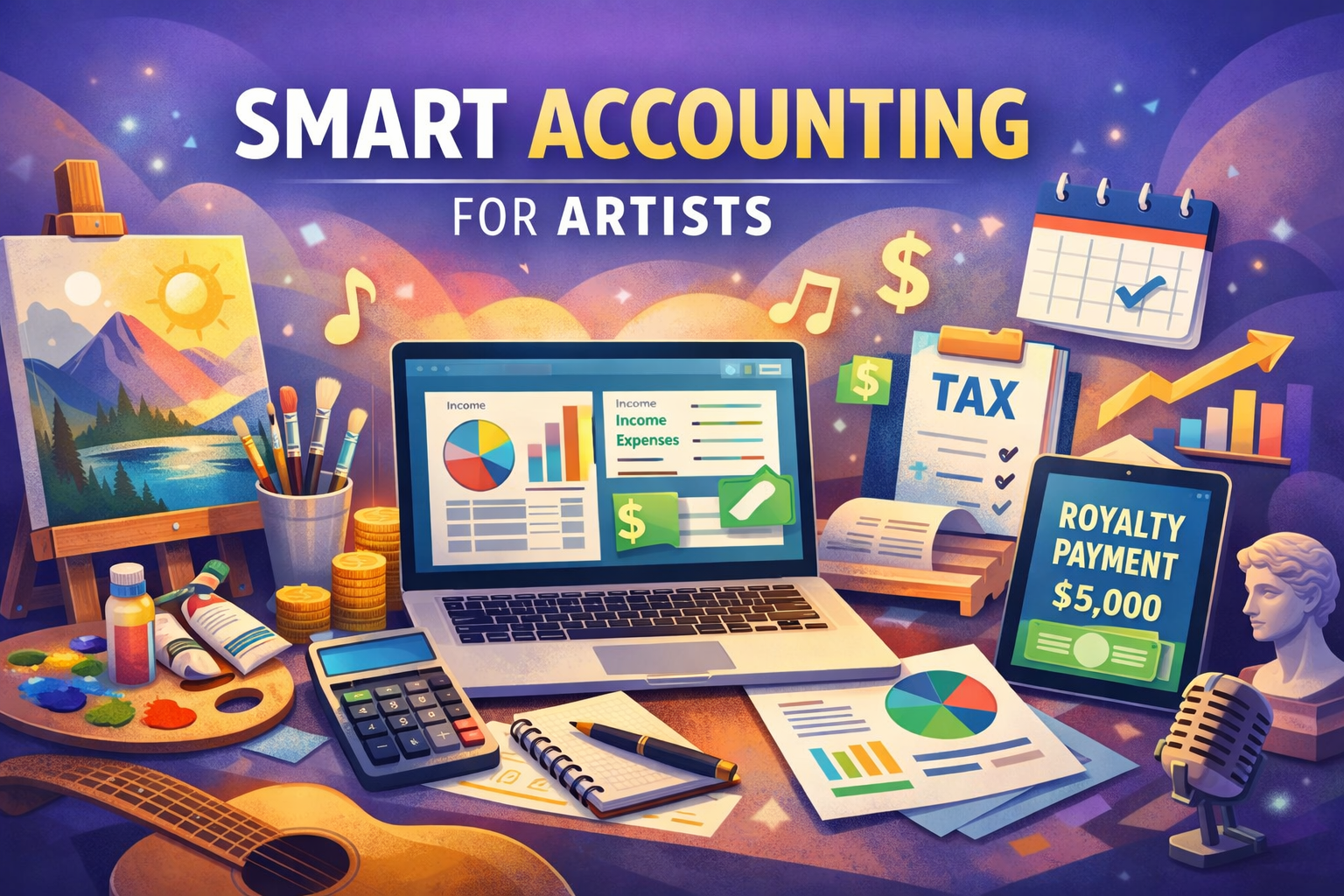
Smart Accounting for Artists: Keep More of What You Earn
Because knowing your numbers is just as important as knowing your craft.
📋 Key Points
💰 Your art income is taxable — commissions, sales, prints, licensing, and teaching income all need to be declared.
🧾 Your art expenses are deductible — materials, software, studio costs, travel, and merchant fees can all reduce your taxable profit.
🛠️ Use the StudioTax calculator below — plug in your figures for a clear snapshot of your tax health.
📁 Keep records as you go — one small habit now saves enormous stress at year-end.
📅 Know your deadlines — missing them costs money before anyone’s even looked at what you owe.
The Part of Being a Professional Artist Nobody Warns You About
Art school teaches you to paint. It doesn’t teach you to file a self-assessment.
That’s not a criticism — it’s just how creative education works. Most artists spend years (rightfully) focused on their craft, and the money side gets dealt with reluctantly, in a panic, around January or April depending on which side of the Atlantic you’re on.
But here’s what shifts things: once you realise that understanding your finances isn’t the opposite of being a creative person — it’s what sustains you as one — the whole thing becomes a lot less threatening. When you know what you can claim, what you owe, and roughly where you stand throughout the year, you make better decisions about pricing your commissions, spending on materials, and whether that next piece of kit is a genuine investment or just a nice-to-have.
This guide walks through the essentials. It’s not a substitute for professional advice, but it will give you a clear framework — and a calculator to start putting real numbers to it. Don’t forget to Invoice quickly to generate income fast!
What Counts as Taxable Income?
If money comes in because of your art, it almost certainly needs to be declared. That includes:
| Income Type | Examples |
|---|---|
| 🎨 Commissions | Portraits, pet paintings, murals, digital work |
| 🖼️ Original Sales | Studio sales, art fairs, gallery representation |
| 🖨️ Prints & Reproductions | Limited edition prints, cards, merchandise |
| 🎓 Teaching & Workshops | In-person classes, online courses, YouTube memberships |
| ©️ Licensing | Designs used commercially, pattern licensing, stock art |
The category doesn’t matter much — the principle does. Track it all.
💡 Smaller one-off payments add up fast. A £150 commission here, a £40 print sale there — across a year, those figures are meaningful both to your income and to your tax authority.
What You Can Deduct
This is where artists consistently leave money on the table — not through dishonesty, but through simply not knowing what qualifies. Here’s what you can typically claim as a legitimate business expense:
| Expense | Examples |
|---|---|
| 🎨 Materials & Supplies | Paints, canvas, brushes, paper, varnish, gesso |
| 💻 Software & Subscriptions | Adobe Creative Cloud, Procreate, website hosting, Clip Studio |
| 🏠 Studio Rent & Utilities | Dedicated workspace, proportion of home bills if you work from home |
| 🚗 Travel & Promotion | Art fair travel, client visits, advertising spend, photography for your portfolio |
| 💳 Merchant Fees & Other | PayPal, Stripe, Etsy, Square, and similar platform fees |
The golden rule: the expense must be wholly and exclusively for your business. A set of brushes you use only for commissions? Absolutely. A laptop you also use for streaming? Only the business-use proportion.
For anyone selling art online, merchant fees are particularly easy to overlook — Etsy and PayPal fees can quietly consume 5–15% of your revenue. Claiming them back is straightforward and genuinely worth doing.
Try the StudioTax Calculator
We’ve built a simple tax estimator into this post so you can put real numbers to all of the above.
Enter your total income from commissions and sales, then fill in your deductible expenses across the five categories — materials, software, studio costs, travel and promotion, and merchant fees. The calculator gives you your estimated taxable profit and a rough read of your tax position for the year.
It’s not a substitute for professional advice, but it’s a brilliant starting point — especially if you’ve never actually sat down and added it all up before.
⚠️ Disclaimer: The information in this article is intended for general guidance only and does not constitute professional financial, tax, or legal advice. Tax rules vary by country, change regularly, and depend on your individual circumstances. Always consult a qualified accountant or tax adviser before making decisions based on anything you read here. The StudioTax calculator provides estimates only and should not be relied upon as an accurate statement of your tax liability.
Making it EASY – Accounting with Xero
Building a Record-Keeping Habit That Sticks
The artists who find tax time least stressful aren’t necessarily the most naturally organised people. They just have a system they actually use. Here’s one that works without requiring a degree in accountancy.
🏦 1. Separate Your Money
Open a dedicated bank account — or at minimum a separate savings pot — for business income. When a payment arrives, immediately move a percentage aside for tax. A reasonable starting figure: 20–25% of your profit. It’s a lot easier to put it away than to find it later.
🧾 2. Log Expenses When They Happen
Don’t save receipts to deal with in January. A photo in a labelled folder, a quick note in a spreadsheet, or a simple app like Wave or QuickBooks Self-Employed — whatever you’ll actually use consistently is the right choice. Perfection isn’t the goal; regularity is.
📆 3. Do a Monthly Check-In
Ten minutes at the end of each month reviewing your income and expenses keeps you in control all year long. Pair this with a broader look at your art business health — not just the tax side, but whether the work is actually profitable and sustainable.
📂 4. Keep Receipts for Six Years
In the UK, HMRC can investigate up to six years back. Keep digital copies of everything — cloud storage is cheap and receipts in a carrier bag are not a system.
💡 The single biggest upgrade most artists can make isn’t better software. It’s the habit of recording expenses at the time, not months later when the context is long gone.
Know Your Deadlines
Penalties kick in automatically once a deadline is missed — before anyone has even looked at what you owe. Mark these in your calendar now.
| Location | Deadline | Notes |
|---|---|---|
| 🇬🇧 UK — HMRC | 31 January | Online self-assessment for the previous tax year |
| 🇺🇸 US — IRS | 15 April | Federal income tax return; state deadlines vary |
| 🇪🇺 EU | Varies by country | Check your national revenue authority |
For full UK guidance, HMRC’s self-employed tax pages are the authoritative starting point. For plain-English explanations and a sanity check on your position, MoneySavingExpert’s tax guides are consistently reliable and updated annually.
Frequently Asked Questions
Do I need to register as self-employed if I only sell art occasionally?
In the UK, if your trading income exceeds £1,000 in a tax year, you need to register with HMRC and complete a self-assessment return. Below that threshold, the Trading Allowance covers you and no return is required. It’s a generous buffer for hobbyists testing the water.
Can I claim art supplies I bought before I started selling professionally?
You may be able to claim pre-trading expenses that were incurred in preparation for your business — but the rules have conditions. Keep all receipts and check with an accountant or the HMRC guidance on this specifically.
I have a full-time job and also sell art on the side. Do I still need to declare it?
Yes — you’ll need to declare your art income through self-assessment even if tax is already deducted from your main salary via PAYE. The good news is that your allowable expenses still apply, reducing the additional amount you owe.
Is my home studio deductible?
A proportion of your home costs — rent or mortgage interest, utilities, broadband — can be claimed if you use a defined space exclusively and regularly for work. HMRC also offers a simplified flat-rate option if you’d rather avoid the maths.
Do I need an accountant?
Not necessarily. Many artists manage their own returns comfortably, particularly in earlier years when income and expenses are straightforward. But as your income grows and your situation becomes more complex, a good accountant typically saves more than their fee.