
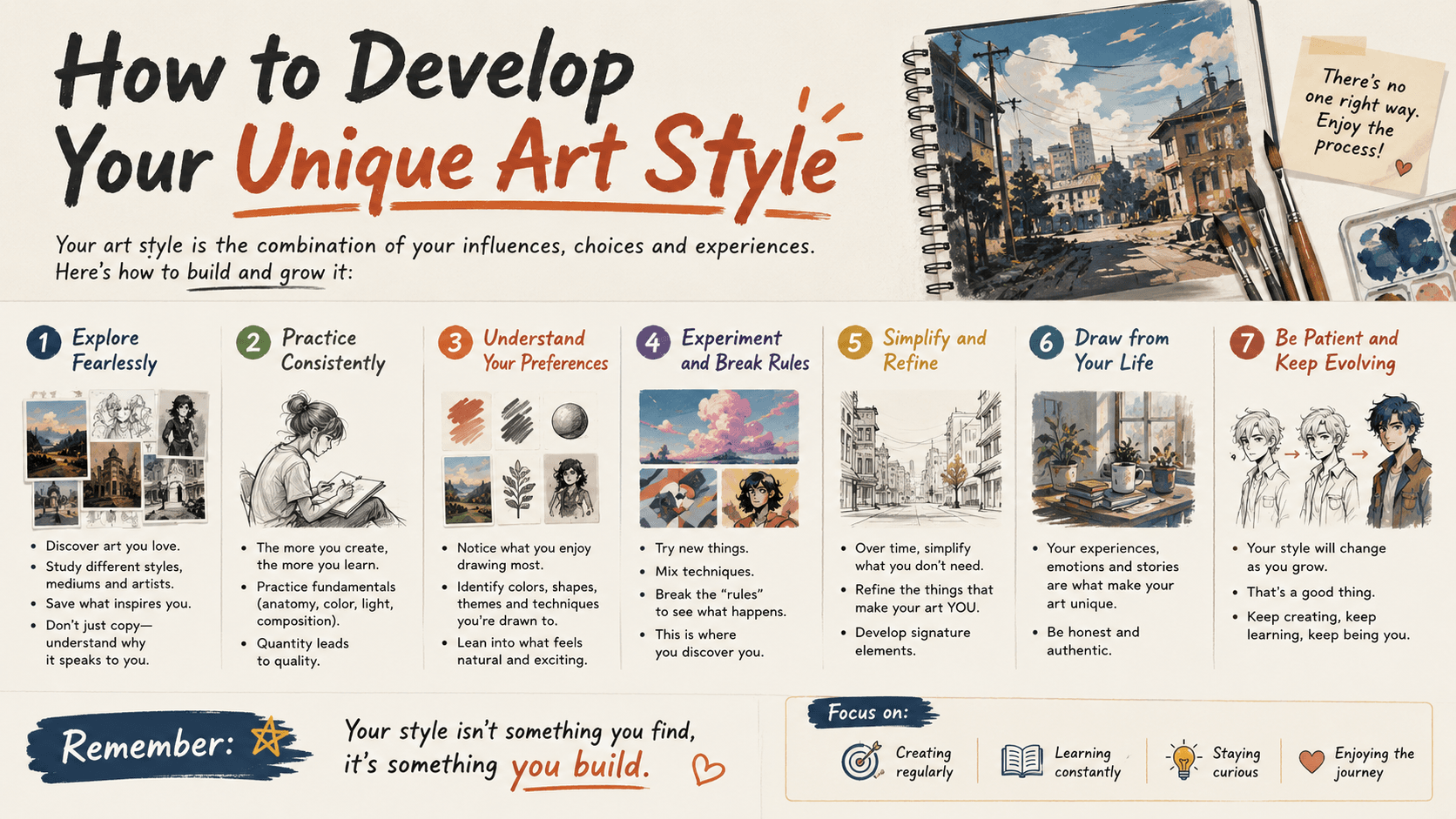
Developing your unique art style is a journey of self-discovery and consistent practice, involving experimentation with various techniques, mediums, and subjects to uncover what truly resonates with your artistic vision. It’s about blending influences, personal experiences, and technical skills into a visual language that is distinctly yours, allowing your work to stand out and communicate your individual perspective effectively.
Keypoint Summary
* Explore and Experiment: Actively try different mediums, techniques, and subjects to broaden your artistic horizons and discover new preferences.
* Study and Deconstruct: Analyze the work of artists you admire, understanding why their style appeals to you, rather than simply copying.
* Practice Consistently: Regular creation is crucial for refining skills and solidifying your unique visual vocabulary.
* Embrace Self-Reflection: Critically evaluate your own work to identify strengths, weaknesses, and areas for growth, guiding your stylistic evolution.
What is an Artistic Style and Why Does it Matter?
An artistic style is the distinctive manner in which an artist expresses themselves through their work, encompassing their chosen techniques, recurring themes, color palettes, brushwork, and overall aesthetic. It matters immensely because it acts as your artistic signature, making your work recognizable and allowing you to communicate your unique perspective and emotions without words. A well-developed style can also enhance your professional identity and connect you with an audience who appreciates your particular vision.
How Can You Begin to Discover Your Artistic Voice?
To begin discovering your artistic voice, start by immersing yourself in a wide array of art and actively creating without judgment. Experiment with different materials, subjects, and approaches to understand what excites you and what feels most authentic to your expression. This initial phase is about broad exploration, not perfection.
Embrace the Exploration Phase

The initial stage of finding your style is all about casting a wide net. Don’t be afraid to try everything. Pick up a new medium, like watercolors, even if you’ve always worked with oils. Explore diverse subjects, from still life to abstract concepts. This experimental approach helps you understand your natural inclinations and the techniques that feel most comfortable and expressive in your hands. Consider exploring resources like “Unleash Your Inner Artist: The Ultimate Guide to Finding Art Inspiration” to kickstart your creative journey.
Study the Masters and Contemporaries
Deep diving into art history and contemporary art is not about copying, but about learning. Analyze the works of artists whose styles you admire. Ask yourself: What specific elements draw you in? Is it their use of color, their composition, their subject matter, or their unique mark-making? Understanding these components can provide valuable insights into how different styles are constructed. For instance, studying the symbolism in Frida Kahlo’s art can reveal how personal narrative shapes a distinct style.
You might find inspiration in the bold brushstrokes of Impressionists, the emotional depth of Expressionists, or the meticulous detail of Renaissance masters. Websites like The Metropolitan Museum of Art’s Heilbrunn Timeline of Art History offer extensive resources for exploring various art movements and artists.
What Role Does Experimentation Play in Developing Your Style?
Experimentation is the cornerstone of developing your unique art style, allowing you to push boundaries, discover new techniques, and identify what truly resonates with your creative vision. It involves stepping outside your comfort zone, trying unconventional methods, and embracing unexpected outcomes as part of the learning process.
Play with Mediums and Techniques

Venture beyond your usual tools. If you typically paint, try sketching. If you use acrylics, experiment with pastels or even digital art. Each medium presents its own set of challenges and opportunities, forcing you to adapt and potentially uncover new ways of expressing yourself. Learning how to digitize traditional art, for example, can open up new creative avenues. Similarly, mastering shadow in art can dramatically alter the mood and form in your pieces, regardless of the medium.
Develop Your Own “Rules”
Once you’ve explored various techniques, you’ll start to notice patterns in what you enjoy and what works for you. Perhaps you prefer a limited color palette, or you have a particular way of rendering textures. These emerging preferences are the building blocks of your style. Don’t be afraid to break traditional art rules to establish your own. Art is subjective; what matters is what feels authentic to you.
How Can Consistent Practice Refine Your Artistic Voice?
Consistent practice refines your artistic voice by strengthening your technical skills, solidifying your preferred methods, and allowing you to create a cohesive body of work that reflects your evolving artistic identity. Regular engagement with your craft helps embed your unique visual language into your muscle memory and creative instincts.
The Power of Repetition
Practice isn’t just about getting better; it’s about making your artistic choices more intuitive. The more you create, the more your hand and eye become accustomed to your preferred marks, compositions, and color schemes. This repetition helps to solidify your unique visual vocabulary. Regular practice is also essential for self-critique, as detailed in guides like “How to Critique Your Own Paintings and Improve“.
Keep an Art Journal or Sketchbook
A dedicated sketchbook or art journal is an invaluable tool for stylistic development. Use it to quickly capture ideas, experiment with small studies, and record your thoughts on your artistic process. It’s a low-pressure environment where you can freely explore without the expectation of creating a finished masterpiece. This habit fosters a continuous dialogue with your creative self.
Why is Self-Reflection Crucial for Stylistic Growth?
Self-reflection is crucial for stylistic growth because it allows artists to critically assess their work, understand their motivations, identify areas for improvement, and consciously guide the evolution of their unique artistic voice. It transforms mere creation into purposeful development.
Analyze Your Work Objectively
Step back from your finished pieces and view them with a critical eye. What aspects do you love? What would you change? What emotions or ideas does your art convey? This objective analysis helps you pinpoint the elements that are becoming consistent markers of your style and those that still need refinement.
Seek Constructive Feedback
While your style is deeply personal, external perspectives can offer valuable insights. Share your work with trusted peers, mentors, or art communities. Be open to constructive criticism, but always filter it through your own artistic vision. Remember, the goal isn’t to please everyone, but to grow.
What Resources Can Help You on Your Journey?

There are numerous resources available to help you on your journey to developing your unique art style. Online courses, art books, workshops, and even digital tools can provide guidance, inspiration, and technical instruction.
For example, exploring free online art courses can provide structured learning and exposure to new techniques without financial burden. Additionally, websites like Artcyclopedia offer comprehensive databases of artists and art movements, which can be excellent for research and inspiration.
FAQs
How long does it take to develop a unique art style?
Developing a unique art style is an ongoing process that varies greatly for each artist, often taking years of consistent practice, experimentation, and self-reflection to fully emerge and mature. It’s less about a fixed timeline and more about continuous evolution.
Can my art style change over time?
Yes, your art style can and often will change over time as you grow as an artist, learn new techniques, encounter new inspirations, and your personal perspectives evolve. This natural progression is a sign of artistic development and maturity.
Is it okay to be influenced by other artists?
It is absolutely okay and even beneficial to be influenced by other artists, as long as you use their work as a springboard for your own creativity rather than simply copying it. Studying influences helps you understand different approaches and integrate elements that resonate with you into your unique vision.
What if I feel stuck and can’t find my style?
If you feel stuck, try revisiting the exploration phase by experimenting with entirely new mediums or subjects, taking a break to refresh your perspective, or seeking inspiration from non-artistic sources like nature, music, or literature. Sometimes, a fresh perspective is all it takes to reignite your creative flow.

Olly
Olly Farmer M.Sc, B.Sc, PGCE 25 years experience of Watercolor Painting and AI Art; teacher for 13 years; Creator of Art Tools; Art Gallery Contributor of Art Articles to Medium.com, LinkedIn and Facebook
Continue exploring
PROMINENT PAINTING
Keep your creative momentum
Get new painting guides, practical techniques and artist stories delivered without the noise.
Occasional emails. Unsubscribe whenever you like.