
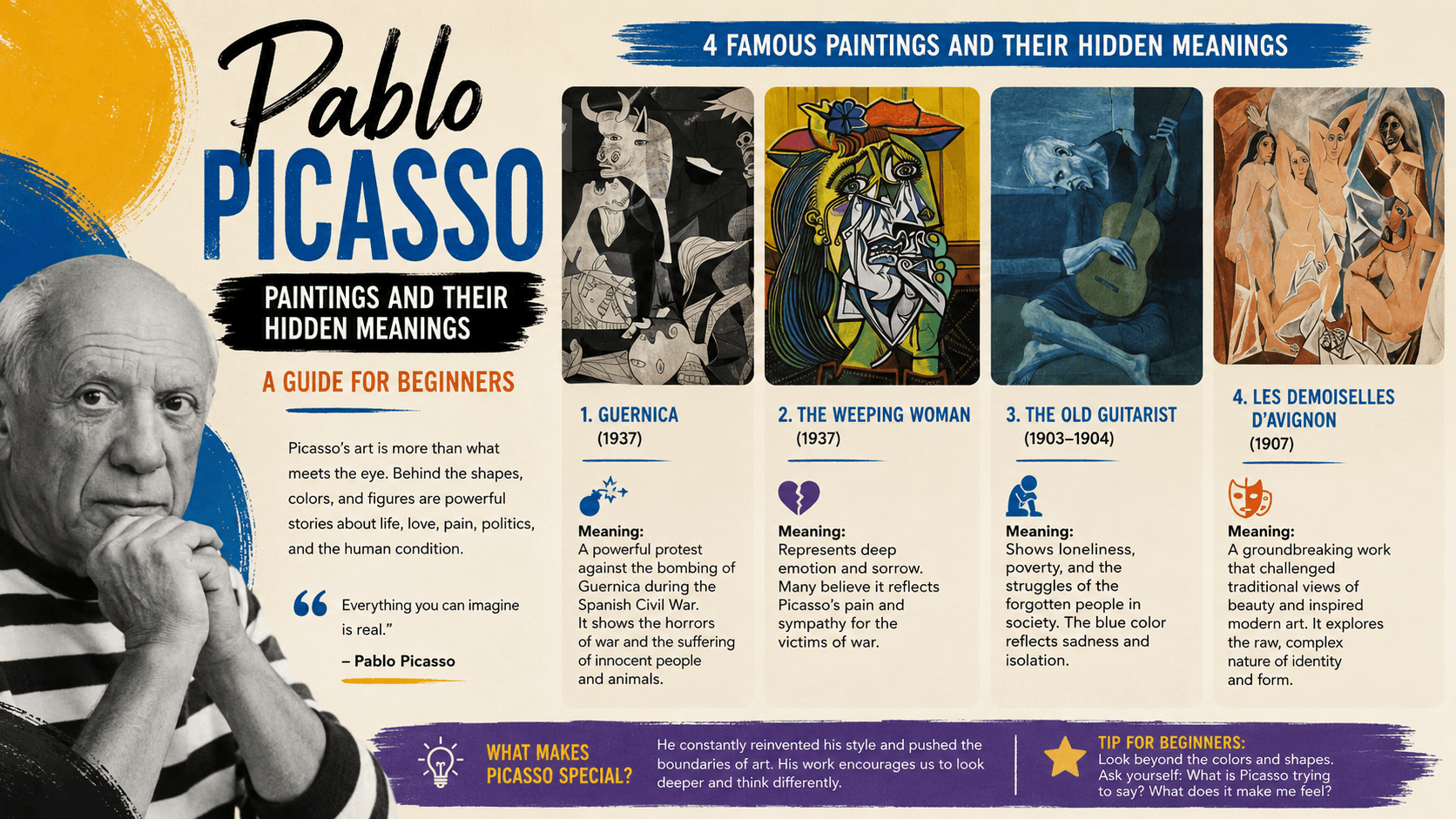
Have you ever looked at a painting and thought, “Wait, why does that person have an eye on their cheek?” or “Why is that guitar shaped like a puzzle?” If so, you’ve probably seen the work of Pablo Picasso.
Pablo Picasso was one of the most famous artists in history. He didn’t just paint things as they looked in real life; he painted how they felt or how they looked from five different angles all at once. This can be confusing for beginners, but once you know the “secret code,” his art becomes a thrilling adventure.
Who Was Pablo Picasso?
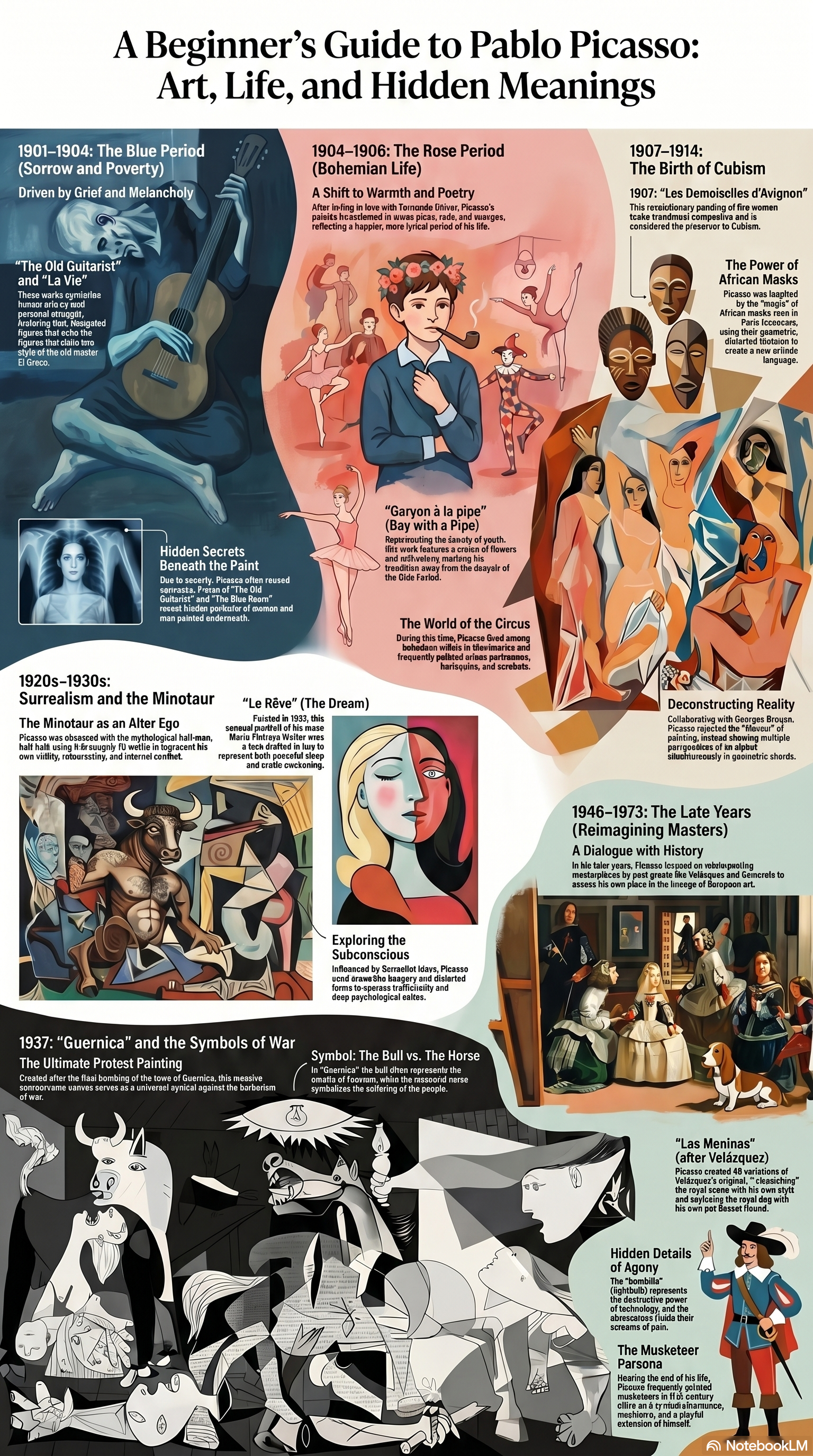
Born in Spain in 1881, Picasso was a child prodigy. He could draw perfectly realistic pictures before he even hit his teens. But as he grew older, he got bored with “perfect.” He wanted to challenge the world. He spent his life changing his style, moving through different “periods” (which are basically chapters of his artistic life).
The Different “Chapters” of Picasso’s Art
To understand the meanings in his paintings, you first need to know which “chapter” he was in when he painted them.
1. The Blue Period (Sadness and Struggle)
After a close friend passed away, Picasso became very depressed. He started painting almost everything in shades of blue and blue-green.
- The Meaning: Blue represents loneliness, poverty, and sorrow.
- What to look for: Thin people, sad faces, and cold-looking rooms.
2. The Rose Period (Hope and Happiness)
Eventually, Picasso fell in love and became happier. His palette shifted from cold blues to warm pinks, oranges, and reds.
- The Meaning: These colors represent romance, circus performers, and a lighter mood.
- What to look for: Harlequins (clowns), acrobats, and softer expressions.
3. Cubism (The “Puzzle” Phase)
This is what Picasso is most famous for. Along with Georges Braque, he invented Cubism. Instead of painting a bowl of fruit from one spot, he would walk around the bowl, look at it from the top, the side, and the bottom, and then smash all those views into one image.
- The Meaning: It’s about seeing the “total truth” of an object rather than just one snapshot.
- What to look for: Geometric shapes, fragmented faces, and overlapping lines.
Famous Paintings and Their Hidden Meanings
Let’s dive into a few of his most iconic works to see what he was actually trying to say.
Guernica (The Cry Against War)
This is a massive, grayscale painting that looks like a nightmare. You see a screaming horse, a grieving mother, and a broken sword.
- Hidden Meaning: Picasso painted this after a town called Guernica was bombed during the Spanish Civil War. The lack of color makes it feel like a newspaper photograph. It isn’t just a picture of a city; it is a protest against the cruelty and chaos of war.
Les Demoiselles d’Avignon (Breaking the Rules)
This painting shows five women, but their faces look like African masks and their bodies are sharp and jagged.
- Hidden Meaning: Picasso was exploring “primitivism.” He wanted to move away from the “pretty” art of the past and create something raw and powerful. It was a signal to the world that the old rules of art were dead.
The Weeping Woman (Pure Emotion)
Unlike a traditional portrait, this woman’s face is shattered into pieces, and she is clutching a handkerchief.
- Hidden Meaning: This represents the universal feeling of grief. By breaking the face apart, Picasso shows that when we are truly devastated, our world feels like it is falling to pieces.
Quick Reference Guide: Picasso’s Style
| Period | Primary Colors | Main Emotion | Key Subjects |
|---|---|---|---|
| Blue Period | Blue, Teal, Grey | Sadness, Loneliness | The poor, the exiled |
| Rose Period | Pink, Orange, Red | Joy, Romance | Circus performers, kids |
| Cubism | Browns, Greys, Ochre | Intellectual Curiosity | Still lifes, portraits |
| Later Works | Bright, Bold Colors | Playfulness, Energy | Animals, mythology |
Tips for Beginners: How to “Read” a Picasso
If you find yourself in a museum staring at a Picasso and feeling lost, try these three steps:
- Ignore the “Realism”: Don’t ask “Does this look like a real person?” Instead, ask “How does this make me feel?”
- Look for the Shapes: Try to find the circles, triangles, and squares. Picasso used these to build a structure, much like an architect builds a house.
- Check the Colors: Is it blue (sad)? Is it orange (happy)? Is it grey (serious)? The color is usually the biggest clue to the meaning.
Why Picasso Still Matters Today
You might wonder why we still talk about a guy who painted “weird” faces 100 years ago. It’s because Picasso gave artists permission to be different.
Before him, art was mostly about copying nature. Picasso taught us that art can be about an idea, a feeling, or a political statement. Every time you see a modern logo with a cool geometric design or a weirdly edited photo on Instagram, you are seeing a little bit of Picasso’s influence.
Final Thoughts
Pablo Picasso’s paintings are like riddles. They aren’t meant to be solved instantly; they are meant to be experienced. Whether it’s the deep sorrow of the Blue Period or the mind-bending shapes of Cubism, his work encourages us to look at the world from more than one perspective.
Next time you see a Picasso, remember: he isn’t trying to trick you. He’s just inviting you to see the world through his eyes where a face can be a puzzle and a painting can be a shout for peace.
References:
- PabloPicasso.org Comprehensive biography, period breakdowns, and painting analyses: https://www.pablopicasso.org/
- Britannica Pablo Picasso Detailed biography, life, career, and legacy: https://www.britannica.com/biography/Pablo-Picasso
- PabloPicasso.org In-depth analysis of Picasso’s anti-war masterpiece: https://www.pablopicasso.org/guernica.jsp
- Britannica Guernica Historical context and significance of the painting: https://www.britannica.com/topic/Guernica-by-Picasso
- The Metropolitan Museum of Art Picasso Essay Scholarly overview of Picasso’s life and work: https://www.metmuseum.org/essays/pablo-picasso-1881-1973

Opal Jonson
Experienced Artist
Continue exploring

PROMINENT PAINTING
Keep your creative momentum
Get new painting guides, practical techniques and artist stories delivered without the noise.
Occasional emails. Unsubscribe whenever you like.