Summary: Rhythm in art isn’t just for the pros; it is the secret to making your paintings feel alive. This guide breaks down the five main types of visual rhythm in simple terms. You will learn how to use regular, alternating, progressive, flowing, and random repetition to guide the viewer’s eye. Start mastering these visual heartbeats today to turn static sketches into dynamic masterpieces.
Look at a great painting and you will feel your eyes dancing across the canvas. That is not an accident. It is rhythm. Just like a drummer keeps a band in sync, an artist uses visual rhythm to keep a composition organized and moving. For beginners, understanding the types of rhythm in art is the fastest way to move from simply drawing things to actively designing art.
In this post, we are stripping away the jargon. We will look at how simple repetition creates a visual tempo that tells your audience exactly where to look. Whether you are picking up a brush for the first time or trying to refine your watercolor composition skills, mastering these patterns gives your work a professional edge. Think of rhythm as the invisible path you build for your viewer.
What Are the 5 Main Types of Rhythm in Art?
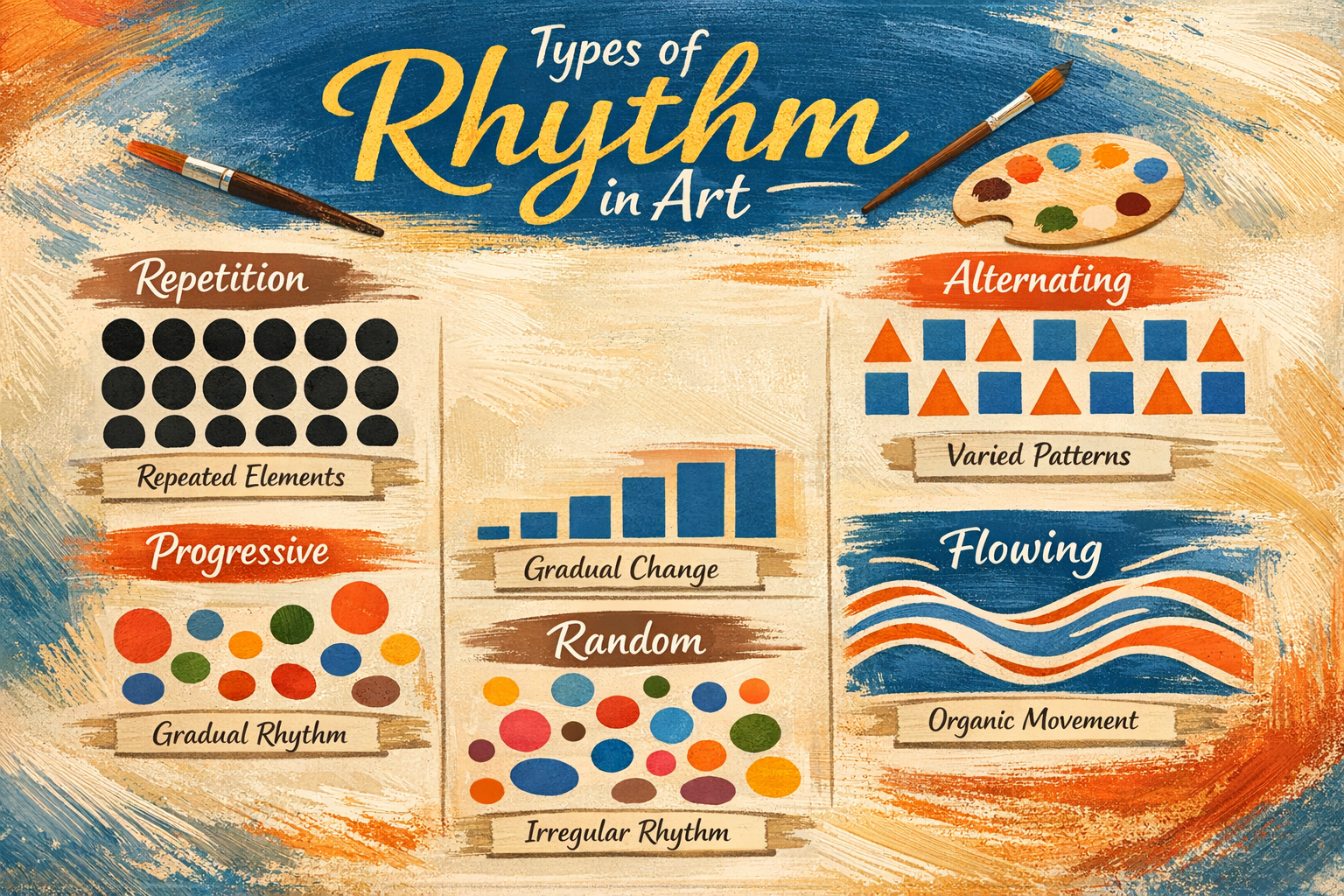
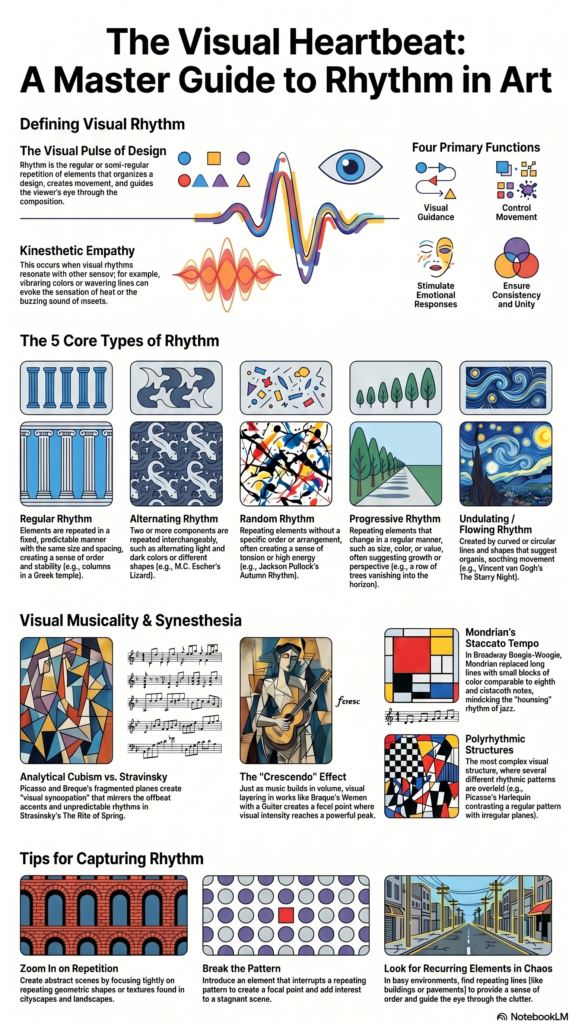
The five main types of visual rhythm are regular, alternating, progressive, flowing, and random. These categories describe how an artist repeats lines, shapes, or colors to create a specific tempo or a sense of movement throughout a composition.
Think of regular rhythm as a steady heartbeat. One element repeats at equal intervals with no variation, like a row of brick columns. Alternating rhythm adds one layer of complexity. Instead of repeating element A over and over, you alternate between A and B, much like a checkerboard.
Progressive rhythm happens when repeated shapes gradually change in size or color. Flowing rhythm uses curved, organic lines mimicking nature. Random rhythm ignores predictable spacing to create high energy.
How Does Rhythm Create Movement in a Painting?
Rhythm creates movement by providing a visual path for the eye to follow. By repeating elements at intervals, the brain naturally connects the dots. This pulls the viewer’s gaze through the artwork like stepping stones across a pond.
A painting does not have a tempo you can measure with a metronome. What it does have is an aesthetic sequence built on interval, repetition, and variation. A 2024 eye-tracking study found that compositional techniques heavily influence where viewers focus.
Rhythm is your ultimate control mechanism. If you place a bright red shape in three different spots, the viewer will automatically bounce between them.
Why is Progressive Rhythm the Secret to Depth?
Progressive rhythm tricks the eye into seeing three-dimensional space on a flat surface. It occurs when elements are arranged in a sequence that suggests a gradual increase or decrease in size or color.
If you draw a series of identical triangles but make each one slightly smaller, your brain interprets the smaller ones as being further away. This simple manipulation of size and texture instantly creates the illusion of depth.
Using Flowing Rhythm for Natural Landscapes
Flowing rhythm uses curved lines and organic shapes to mimic the movement found in nature. It recreates the look of waves, wind, or rolling hills. This creates a sense of grace and continuity that feels deeply soothing to the viewer.
You will see this everywhere in Art Nouveau or the swirling skies of Van Gogh. When you are getting started with watercolors, flowing rhythm is incredibly forgiving. Water naturally creates smooth, curved edges as it dries. You can harness this fluid motion to build gentle, drifting shapes.
Regular vs. Random Rhythm
Choosing between predictable and unpredictable patterns completely changes the mood of your piece. Regular rhythm lowers visual tension. It provides comfort and order. You see this in classical architecture or calming minimalist paintings.
On the other hand, random rhythm happens when elements repeat without a fixed pattern or predictable interval. It feels jazzy and chaotic.
Recent design forecasts show that high-energy styles are trending because they express raw spontaneity. This element of surprise is exactly what makes a good abstract painting so engaging.
Rhythm is the heartbeat of your artwork. By choosing the right type of repetition, you control the energy and the story of your painting. Do not feel like you need to master all five at once. Start by experimenting with a simple regular or flowing rhythm in your next sketch. If you are ready to dive deeper into the building blocks of a great piece, check out our guide on color theory basics to see how hue and visual tempo work together. Grab your brushes and go find your flow.
Frequently Asked Questions
- What is the difference between pattern and rhythm? A pattern is a simple, structured repetition of an element, like wallpaper. Rhythm is the directional visual flow that repetition creates. Pattern is the structure, while rhythm is the feeling of time and movement the structure gives the viewer.
- Can colors create rhythm? Absolutely. A recurring hue placed at intervals across a painting creates rhythm just as effectively as a repeated shape. Your eye picks up the color and jumps from one occurrence to the next.
- How do I practice rhythm as a beginner? Start by analyzing master paintings. Ask yourself what element repeats most obviously and where the rhythm breaks. Then, practice making simple, repetitive marks with varied texture and detail in a sketchbook.
- Is random rhythm actually considered art? Yes. Random rhythm creates a sense of disorder and high energy. Jackson Pollock’s drip paintings are a perfect example of random rhythm turning chaos into a compelling visual experience.
- How does negative space affect visual rhythm? The spaces between repeated elements act as visual punctuation. Tight spacing feels fast and urgent, while wide spacing feels slow. Intentional use of negative space gives the rhythm room to breathe and prevents visual fatigue.