
Summary: Art journaling prompts offer a low-pressure way to explore your feelings and build a creative habit. You do not need artistic talent to start this journey. This guide provides 30 easy ideas to help you reflect, use everyday materials, and discover your personal aesthetic. Grab a notebook and start your self-discovery process today.
Staring at a blank white page can feel deeply intimidating. The pressure to create a flawless masterpiece stops many beginners before they even pick up a brush. Art journaling removes that pressure completely. It is about the physical process of exploring your inner world, not creating something for a gallery wall.
By using art journaling prompts, you give your mind a specific starting point. This practice aligns perfectly with the current trend of personal mythology. Creators use private symbols to map their emotions and process their daily lives. You do not need expensive supplies or formal training to do this. We focus entirely on the no-talent approach. Your journal is a safe space for messy, raw, and honest expression. When we implemented this for our students, we saw immediate breakthroughs in creative confidence. As an arts educator with over a decade of teaching experience, I am dedicated to making painting accessible, mindful, and therapeutic for artists of all levels. Let’s look at how a simple daily habit brings joy back to creativity.
What Are Art Journaling Prompts and Why Use Them?
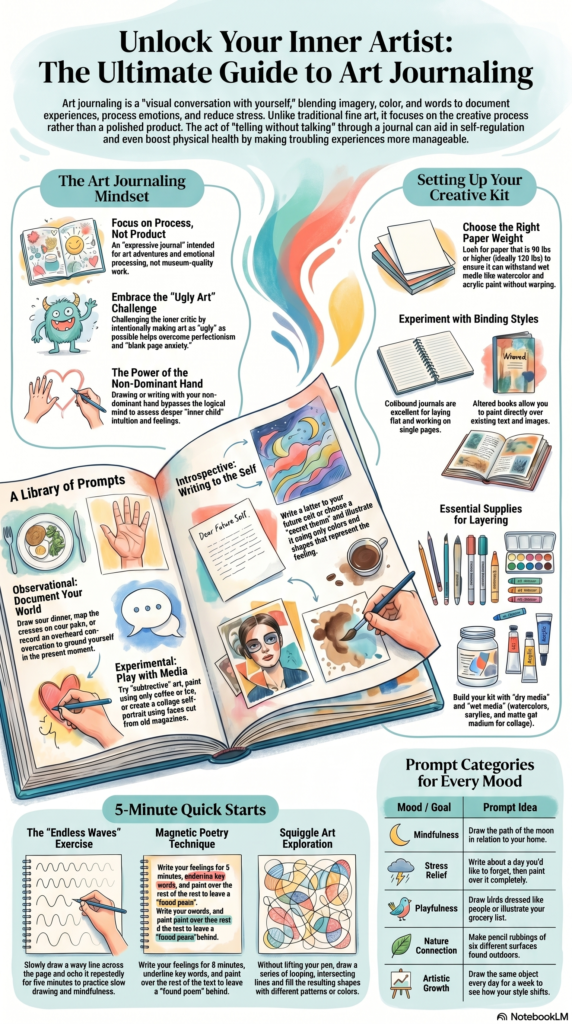
Art journaling prompts are specific ideas or instructions designed to spark creativity and self-reflection in a visual diary. They help beginners overcome creative block by providing a clear focus for daily artistic practice. This makes the entire process of self-discovery much less intimidating.
Using a prompt gives you absolute permission to play. It bridges the gap between wanting to create and actually making marks on paper. Research published by the American Art Therapy Association indicates that regular creative engagement significantly lowers stress hormones. By focusing on the emotional side of art-making, you build a habit that supports your mental wellness. You can read more about this in our guide covering art for well-being and mental health.
How to Start Your Art Journaling Habit
You can begin with items you already have lying around the house. Use found objects, recycled paper, or even leftover coffee stains. This keeps the barrier to entry extremely low and removes the fear of wasting good materials. Incorporating everyday items is a fantastic way to practice sustainable art.
Dedicate just ten minutes a day to your journal. The main goal here is consistency. Do not worry about perfect proportions, rigid color theory, or clean lines. You are building a mental and emotional toolkit. You can dive deeper into the clinical benefits of this approach by understanding art therapy.
What Are the Best Art Journaling Prompts for Beginners?
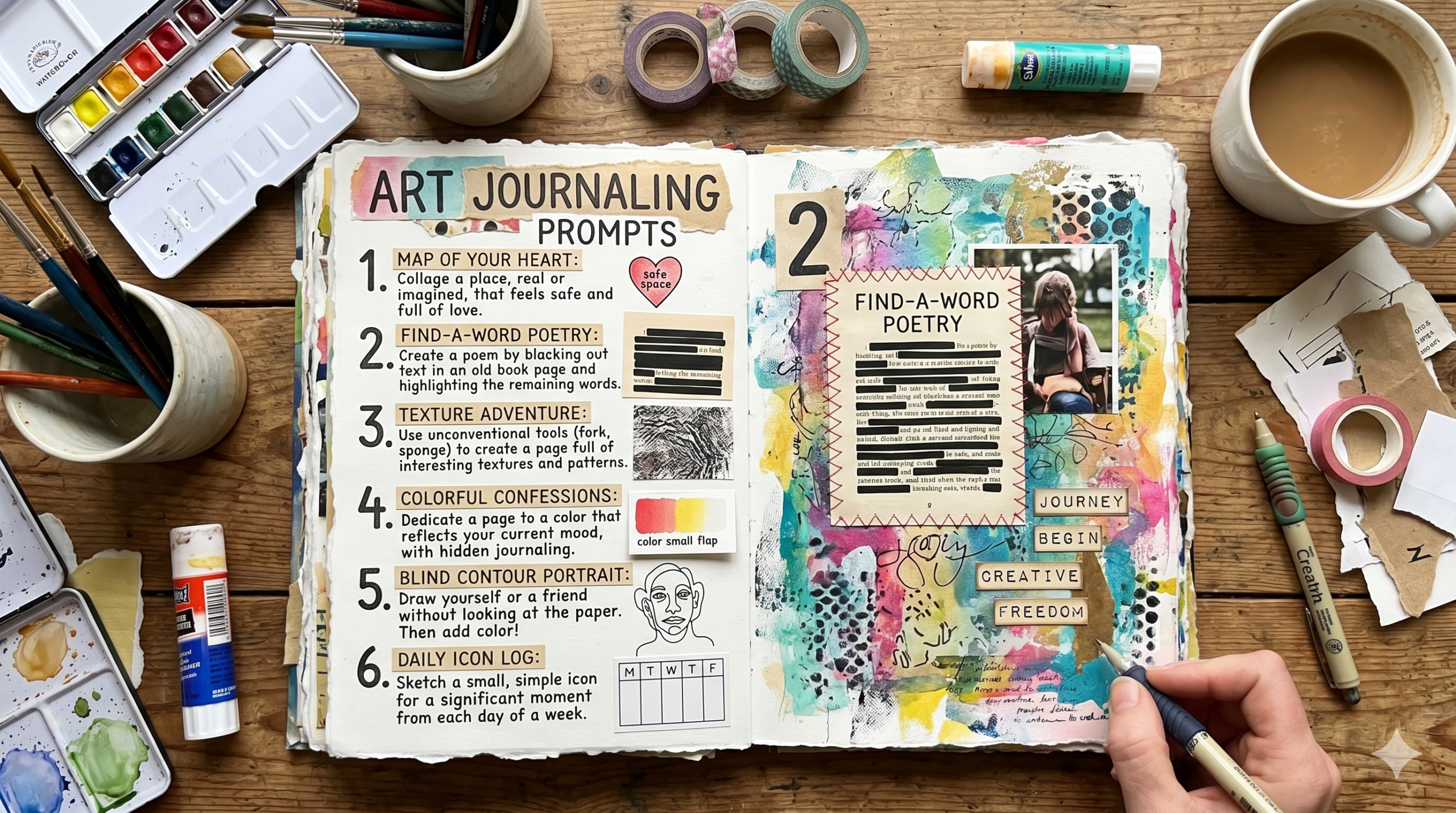
The best art journaling prompts for beginners focus on simple emotional expressions rather than complex technical skills. Examples include painting a weather report of your mood, drawing a map of your heart, or using abstract colors to represent a recent memory.
Here are 30 creative ideas to guide your first month of journaling. We divided them into categories to keep your daily practice fresh and engaging.
Emotion Mapping Prompts
- 1. Paint a “weather report” of your current mood using only colors and textures.
- 2. Draw a map of your heart and fill it with your favorite memories.
- 3. Splash three colors that represent your day and let them blend naturally.
- 4. Create a page dedicated to a specific fear and paint over it with bright colors.
- 5. Illustrate the physical feeling of relief.
Personal Mythology & Memory Prompts
- 6. Draw the front door of a childhood home purely from memory.
- 7. Use the naive art style to illustrate a childhood dream without worrying about realism.
- 8. Sketch an everyday object that holds a special family story.
- 9. Create a private symbol for strength and repeat it across the entire page.
- 10. Paint a visual timeline of your proudest moments.
Exploration Prompts (Days 11-30)
| Day | Prompt Idea | Day | Prompt Idea |
| 11 | Paint the feeling of your favorite song. | 21 | Draw a plant that represents your growth. |
| 12 | Use coffee stains to create a landscape. | 22 | Sketch the clutter on your desk. |
| 13 | Illustrate a boundary you need to set. | 23 | Paint your ideal safe space. |
| 14 | Write a worry and cover it in thick paint. | 24 | Fill a page with circles of different sizes. |
| 15 | Draw your current energy level as a battery. | 25 | Use non-dominant hand to sketch a face. |
| 16 | Mix colors until you find your “happy” shade. | 26 | Paint the taste of your favorite meal. |
| 17 | Document a conversation using only shapes. | 27 | Illustrate a word you love the sound of. |
| 18 | Create a pattern using a household object. | 28 | Draw your breath moving in and out. |
| 19 | Paint a letter to your past self. | 29 | Collage ripped magazine pages into a mood. |
| 20 | Map out your perfect morning routine. | 30 | Paint a messy abstract of your future goals. |
How Does Art Journaling Help You Find Your Style?
Art journaling helps you find your style by acting as a low-stakes testing ground where you naturally gravitate toward specific colors, shapes, and techniques over time. This consistent documentation reveals your unique visual voice and builds long-term artistic confidence.
Documenting your journey in a journal is highly revealing. Over time, you will notice distinct patterns in the colors you choose and the physical marks you make. This helps you find your painting style organically. Once you understand your own aesthetic, you become a much more confident creator. It also changes how you view other artists. This awareness eventually makes you a sharper, more confident art collector when navigating the broader market.
Conclusion
Art journaling is a profound and accessible tool for self-discovery. It requires absolutely no talent, just a simple willingness to explore and make a mess. By using these 30 prompts, you will build a consistent, joyful habit that prioritizes your inner world over outward perfection. Grab your notebook, pick prompt number one, and start mapping your mind today.
Frequently Asked Questions
Do I need expensive supplies for art journaling?
No, you do not need expensive supplies. You can start with a basic notebook, pens, pencils, or whatever materials you already have at home. The focus is always on expression rather than the quality of the materials.
What if I cannot draw at all?
Art journaling is about the process, not the final product. You can use abstract shapes, colors, collages, and writing to express yourself. There is zero pressure to create realistic drawings.
How often should I use art journaling prompts?
Aim for a few times a week or whatever fits comfortably into your schedule. Consistency is much more important than duration. Even ten minutes a day can yield massive mental health benefits.
Can art journaling improve my mental health?
Yes, it acts as a highly effective form of mindfulness. By focusing on the present moment and processing your emotions visually, you can reduce stress and increase your overall self-awareness.
What size journal is best for beginners?
A smaller A5 size is usually less intimidating for beginners. It takes less time to fill a page, which helps prevent blank-page anxiety and keeps the practice feeling achievable.