Every painting hits a point where it looks awful. This is the ugly stage of painting. It happens because your brain cannot process flat blocks of color without final details. Do not throw your canvas away. This guide explains why the messy middle occurs and gives you exact steps to push through it. Keep painting. You are closer to the finish line than you think.
You step back from your easel and feel a sudden drop in your stomach. The colors are blocked in. The shapes are there. But the piece looks terrible. You have officially hit the ugly stage of painting.
Every beginner thinks this means they ruined their work. They panic. They scrape off the paint or toss the canvas in a corner. I see this happen constantly. In my ten years of teaching art, the halfway point is where most students give up.
Your painting is not ruined. It is just unfinished. You are looking at a house with framing but no walls. It is supposed to look disjointed right now. The messy middle is a required step in every successful piece of art. If you understand the mechanics of how a painting gets built, you stop panicking when it looks awkward.
What Is the Ugly Stage of Painting?
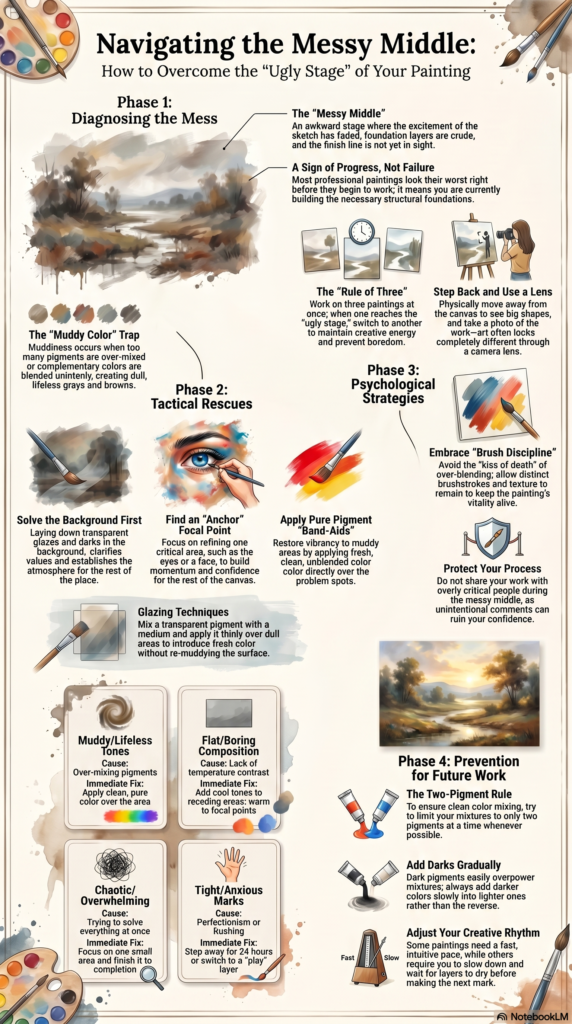
The ugly stage of painting is the awkward middle phase where a piece looks disjointed, flat, and wrong. It occurs after you block in the main colors but before you add the unifying details, highlights, and shadows that give the image depth and context.
Your brain struggles to make sense of incomplete visual data. Vision science researchers explain that our eyes need contextual clues to interpret depth. When those clues are missing, the painting looks like a chaotic mess of shapes.
The Anatomy of a Painting: When to Expect the Messy Middle
Art relies on structure. You do not paint the final details first. You build from the ground up.
Most classical approaches start with a sketch. Next comes a structural base like verdaccio underpainting. Then you block in your local colors. This is exactly where the train derails visually.
The blocking-in phase looks chaotic. You have covered the canvas with raw pigment. None of the edges are soft. None of the colors have been glazed or adjusted. Art historians note that even Renaissance masters experienced this disjointed phase before applying their final glazes. Expect the mess. It means you are doing it right.
Why Does My Painting Look Disjointed?
Your painting looks disjointed because you are viewing isolated blocks of color without refined edges or tonal transitions. Colors heavily influence one another. Until the entire canvas is covered and the final shadows are placed, the values will look incorrect and visually jarring.
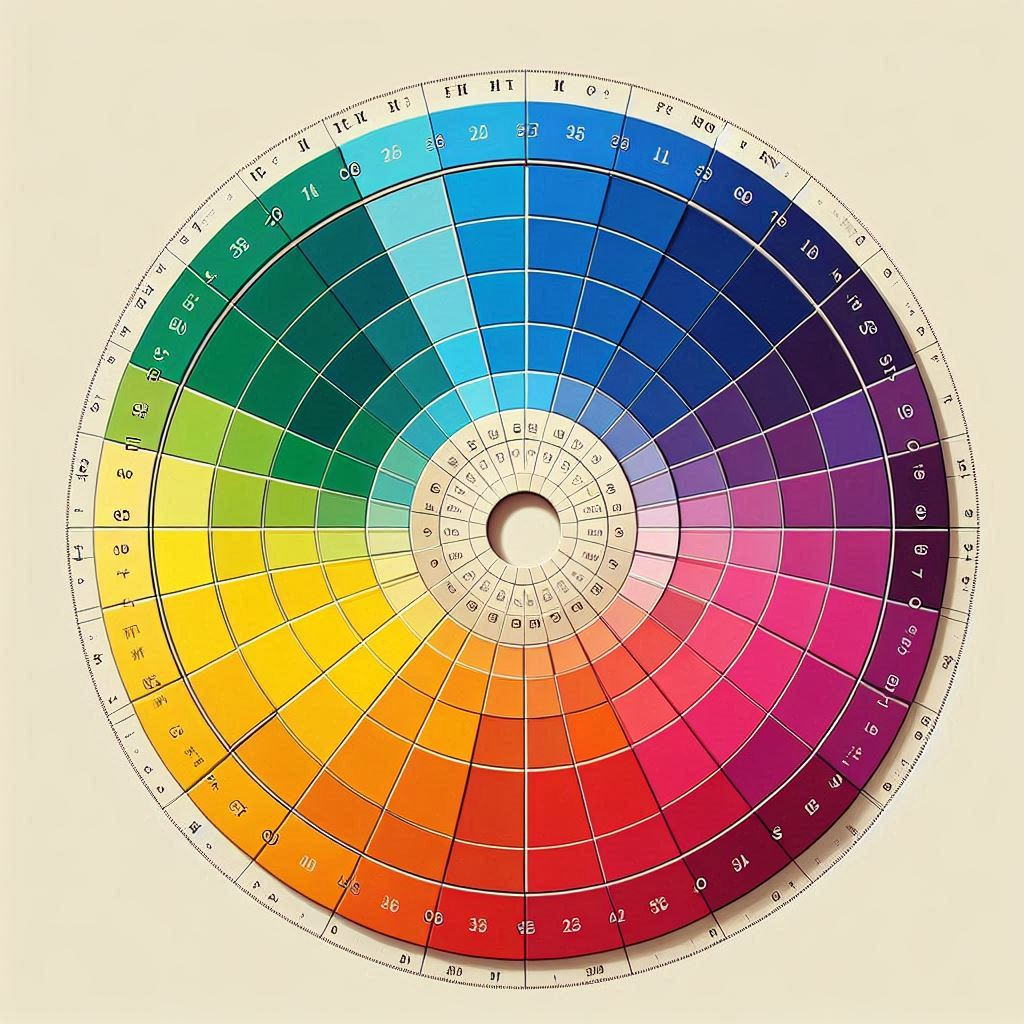
Josef Albers famously proved this. His color theory research demonstrated that a color changes its appearance based on the colors surrounding it. During the messy middle, you are judging unfinished colors against a stark white canvas or an unrefined background. It throws off your entire perception.
How Do I Push Past Canvas Fatigue?
You push past canvas fatigue by stepping away from your painting for a full twenty-four hours. Stop staring at it. Put it in another room. When you look at it with fresh eyes the next day, you will instantly see what needs to be fixed.
When you stare at a canvas for three hours, you lose objectivity. Cognitive psychologists call this perceptual adaptation. Your brain gets used to the flaws. When I implemented the mandatory overnight break for my classroom students, we saw a massive drop in abandoned projects. If you are struggling with fixing painting mistakes, a break is your best tool.
Trusting the Layers for Final Realism
The magic happens in the final ten percent of the work. You cannot judge a layered medium halfway through the process.
Oils and acrylics build depth through accumulation. Conservation studies on classical paintings show that true realism requires dozens of thin glazes and adjustments. When you apply proper layering techniques, you slowly pull the piece together.
You push the shadows deeper. You pull the highlights forward. You soften the harsh edges where two colors meet. The painting will look ugly right up until the moment it suddenly looks finished.
Do not throw away the piece you are working on. The ugly stage is a required step. You just need to keep adding layers until the context makes sense.
Take your 24-hour break. Come back tomorrow and add your deepest darks and brightest lights. If you still feel stuck, you are likely just dealing with standard creative blocks. Pick up the brush and paint the next layer.
Frequently Asked Questions
1. Is the ugly stage of painting normal? Yes. Every single painting goes through a phase where it looks awkward and disjointed. Studies on creative processes confirm that this friction is a standard part of complex tasks. It is temporary.
2. How long does the messy middle last? It lasts until you establish your final values. Once you add your darkest shadows and lightest highlights, the painting starts to make sense. This usually happens in the final 20 percent of the work.
3. Can I fix an overworked painting during this stage? Yes. You can let the layer dry and paint directly over it. Acrylics and oils are highly forgiving mediums that allow for endless corrections. You are never completely stuck.
4. Should I paint over a piece I hate? Only if you have finished it and still hate it. Quitting in the middle teaches you nothing. Push through to the end so you can learn how to resolve visual problems.
5. Why do my colors look muddy in the middle phase? Colors get muddy when you over-blend wet paint on the canvas. Chemical analysis of pigments shows that mixing too many opaque colors destroys their vibrancy. Let the layer dry before adding more paint.