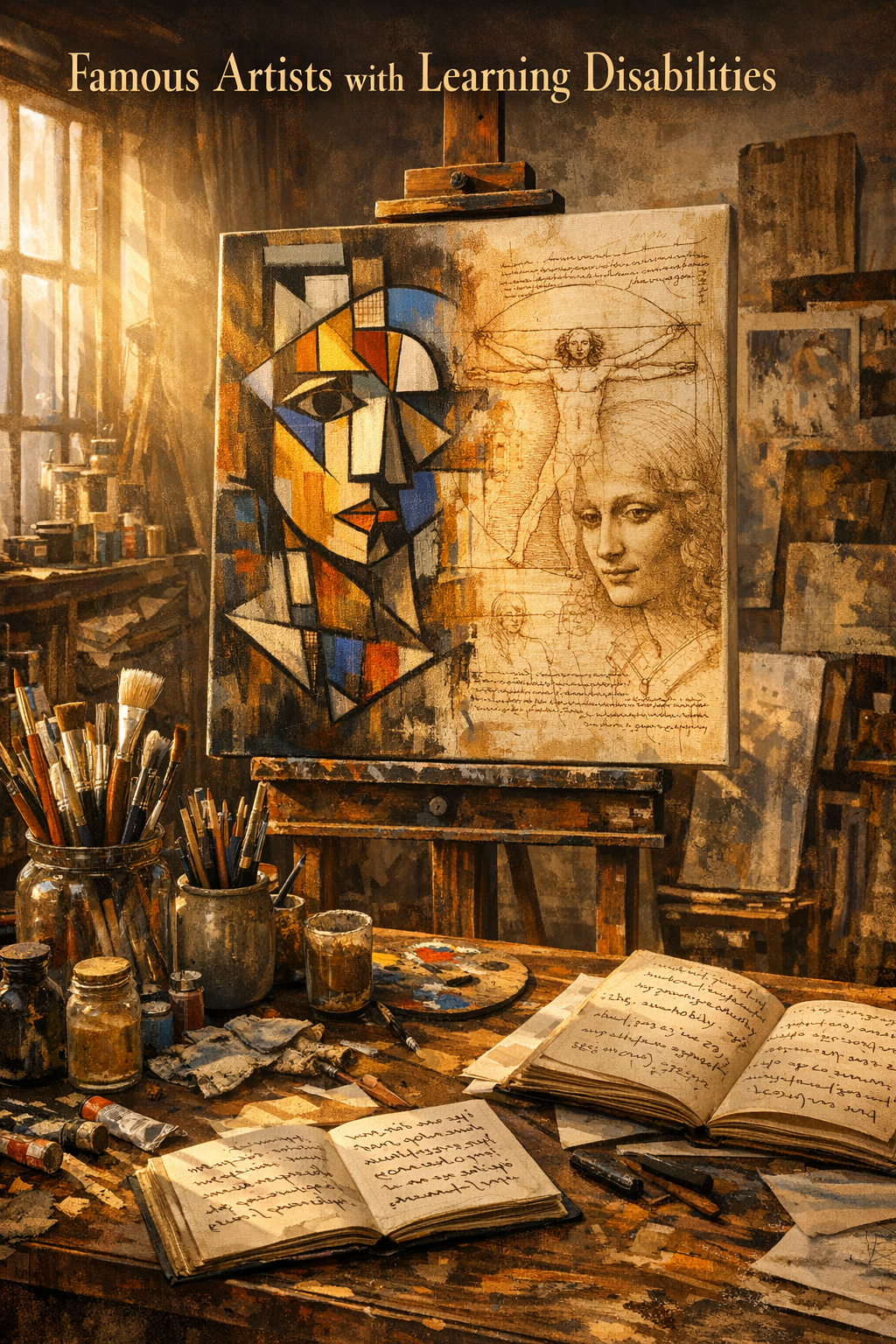
Many iconic painters lived with learning disabilities like dyslexia and ADHD. Instead of stopping them, these traits often fueled their creative output. This post highlights masters like Leonardo da Vinci and Pablo Picasso who used their unique wiring to reshape art history. You will see how neurodiversity can be a spatial superpower in the studio. Use their stories to spark your own artistic path today.
Your brain is not broken if it sees letters as puzzles. Many beginners think they are not smart enough to paint because school was a struggle. This is a myth. History shows that famous artists with learning disabilities often reached the highest levels of success because they saw the world differently. They looked at things through a lens that traditional classrooms could not understand.
As an arts educator with a decade of teaching experience, I have seen hundreds of students find their voice in paint when words failed them. A canvas does not care about your spelling. It only cares about your vision. When we implemented accessible painting methods for students with learning differences, we saw a massive increase in confidence. Let’s look at the masters who proved that being neurodivergent is exactly what the art world needs.
What learning disabilities did famous artists have?
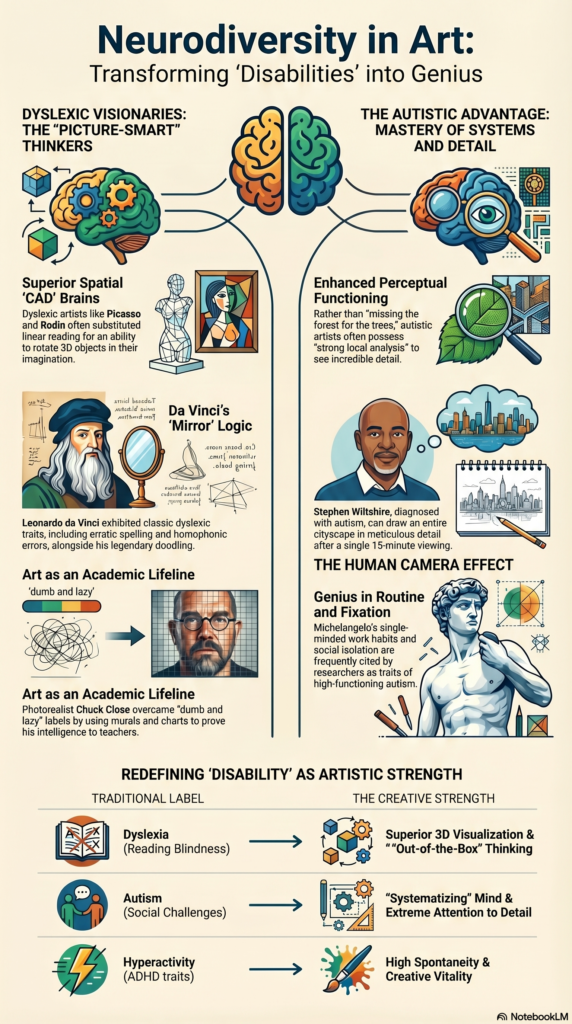
Many legendary artists lived with learning disabilities like dyslexia, ADHD, and prosopagnosia (face blindness). Leonardo da Vinci and Pablo Picasso likely had dyslexia, which gave them high spatial intelligence. Chuck Close managed severe dyslexia and face blindness, while modern painters often use ADHD traits to fuel intense creative bursts.
Finding Strength in Neurodiversity
For these artists, the struggle to process written language often led to a heightened ability to process visual information. They swapped words for shapes. They traded logic for intuition. This trade-off allowed them to find new ways of seeing that a typical brain might miss. Research on learning disabilities shows a long list of creators who found success by leaning into their visual strengths.
Leonardo da Vinci: The Mirror-Writing Master
Leonardo is the ultimate example of a busy mind. He often left projects unfinished, a trait many researchers link to ADHD. His notebooks are filled with mirror writing. This was not a secret code. It was likely the most natural way for his brain to move the pen because of his dyslexia.
ADHD and the Habit of Unfinished Work
You can see this creative energy in Leonardo da Vinci’s most famous paintings. His challenges likely contributed to his obsession with light, shadow, and anatomy. He did not just paint a face. He investigated the mechanics behind the smile.
How did Picasso’s dyslexia influence Cubism?
Pablo Picasso’s dyslexia made it hard for him to read words, so he focused on the shapes and orientation of objects instead. This difficulty with letters pushed him to paint subjects from multiple angles at once. This unique way of seeing the world eventually led to the birth of Cubism.
Breaking the Rules of Perspective
Letters often looked backward or upside down to him. Instead of fighting it, he embraced the confusion of perspective. Pablo Picasso’s life was a constant experiment in breaking traditional rules. Recent studies on his “reading blindness” show his struggle with the standard page became his greatest strength on the canvas.
Chuck Close: Painting Through Face Blindness
Chuck Close is famous for his massive, hyper-realistic portraits. What many do not know is that he suffered from prosopagnosia. This meant he could not recognize faces, even of people he knew well. He also dealt with severe dyslexia throughout his education at Yale.
Grids as a Technical Breakthrough
To solve this, he developed a grid system to break faces down into small squares. This technique allowed him to recognize people through patterns and colors. His 2026 exhibitions show how a limitation can become a technical breakthrough. He proved that you do not need to see the “whole” to capture the soul of a subject.
Can learning disabilities make you a better artist?
Yes, studies show that people with dyslexia often have better 3D spatial awareness and “big picture” thinking. While traditional schoolwork is hard, these traits help artists visualize complex scenes and navigate shapes more accurately. This compensation helps neurodivergent artists spot patterns that others might miss.
The Advantage of 3D Thinking
A study from Middlesex University suggests that dyslexic men are significantly faster at spatial tasks. They can rotate objects in their mind with ease. This advantage is a gift in the studio. It helps you translate the 3D world onto a flat surface without getting lost.
Modern Perspectives: The 2026 Neurodiversity Index
We finally have the data to back up what artists have known for centuries. The 2026 Neurodiversity Index Report shows that neurodivergent individuals are thriving in creative roles. We are moving away from seeing these conditions as problems.
A Global Shift in Creative Value
Instead, we recognize neurodivergent artistic expression as a vital part of our world. Figures like Richard Rogers have spoken about being labeled “stupid” in school before becoming world-class creators. The creative industry is finally learning to value different ways of thinking.
Conclusion
Your brain is your most important tool. If you have been putting off art because you think you are “not the academic type,” look at the masters. They did not win by following the rules. They won by inventing their own. Learning to overcome creative blocks starts with accepting how you think. Painting is a place where your unique wiring is a benefit. I believe that creativity can improve your life by giving you a space where there are no wrong answers. Pick up a brush today. Your perspective is the only thing that matters.
Frequently Asked Questions
1. Was Vincent van Gogh neurodivergent? Many historians believe Van Gogh lived with ADHD and bipolar disorder. His intense focus and emotional depth are traits often associated with these conditions.
2. How does dyslexia help with spatial awareness? Dyslexia often forces the brain to rely on the right hemisphere. This part of the brain handles visual processing. This can make it easier to mentally rotate 3D objects or see patterns in complex scenes.
3. What is prosopagnosia and how did it affect Chuck Close? Prosopagnosia is “face blindness,” which prevents someone from recognizing faces. Chuck Close used a grid system to translate faces into abstract shapes. This helped him manage this challenge while creating art.
4. Can people with ADHD focus long enough to paint? Yes. While ADHD can make routine tasks hard, it often allows for “hyperfocus” on interesting projects. Many artists use these intense bursts of energy to complete detailed works.
5. Are there famous modern artists with learning disabilities? Modern visionaries like architect Richard Rogers and painter Chuck Close have been open about their struggles with dyslexia. They use their platforms to encourage other neurodivergent creators.