Art is more than just pretty pictures hanging on museum walls—it’s a fascinating window into different times, cultures, and human emotions. Every piece of art tells a story, and often, that story is shaped by a particular art style or movement. Think of popular art styles as different languages artists use to express themselves, each with its own rules, vocabulary, and unique flavor. Whether you’re standing in front of a Monet painting with its shimmering water lilies or puzzling over Picasso’s geometric faces, understanding these art movements helps you appreciate not just what you’re seeing, but why it looks the way it does.
Key Points:
- Art styles are distinctive characteristics that make artworks unique to specific artists, groups, or eras
- Major movements include Impressionism, Cubism, Surrealism, Pop Art, and Abstract Expressionism
- Each movement reflects social, political, or technological changes in society
- Understanding these styles enhances art appreciation and cultural literacy
- Popular art styles continue to influence contemporary art and design today

What Exactly is an Art Style or Movement?
Before diving into specific examples, let’s clarify what we mean by an art style or movement. An art style refers to the distinct characteristics that make artwork unique to a particular artist, group, or era. It’s about the techniques, materials, subjects, and even the philosophy behind the art. When you look at different styles of artwork, you’re examining everything from brushstroke patterns to color choices and compositional approaches.
An art movement, on the other hand, is a trend or style in art with a specific common philosophy or goal, followed by a group of artists during a defined period. These movements often react to previous styles or reflect major social, political, or technological changes happening in the world. They provide a framework for understanding how art has developed over time and help us identify different art movements more effectively.
The distinction matters because while Renaissance is a movement, specific techniques like linear perspective or chiaroscuro are styles within that movement. Understanding both concepts enriches your ability to discuss and appreciate art.
From Classical Beauty to Romantic Emotion: Early Influences
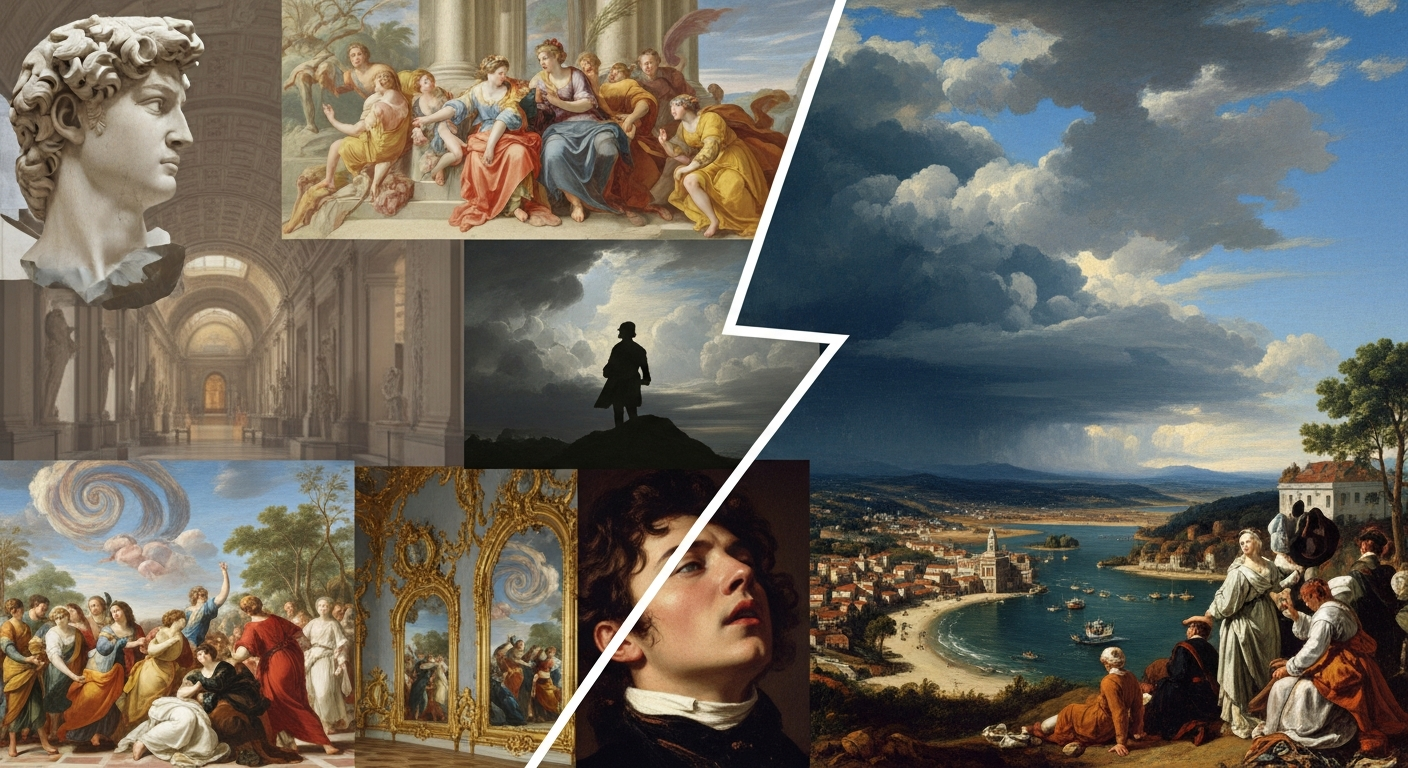
To appreciate modern art movements, it’s helpful to glance back at their roots. The Renaissance (roughly 14th-17th centuries) brought European art back to classical ideas of beauty, humanism, and realistic portrayal. Think of Leonardo da Vinci’s perfectly proportioned figures and Michelangelo’s anatomically accurate sculptures. This period established techniques like accurate anatomy, mathematical perspective, and grand religious themes that would influence artists for centuries. Renaissance art emphasized harmony, proportion, and classical ideals with balanced compositions.
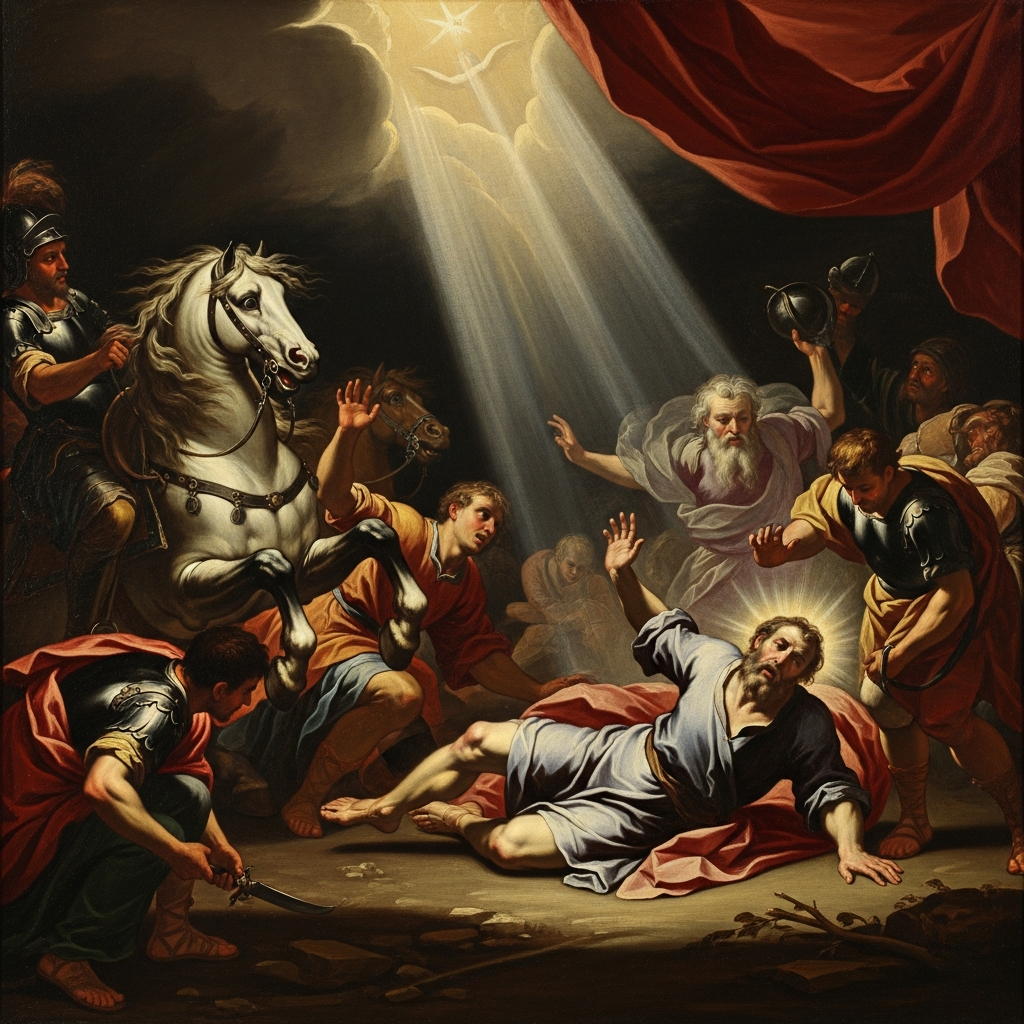
Following this came the Baroque period (17th-18th centuries), which introduced drama, rich colors, and intense emotion. Baroque artists like Caravaggio and Bernini created works with a sense of movement and theatrical grandeur. They mastered dramatic lighting techniques—called chiaroscuro—using sharp contrasts between light and dark to create powerful emotional effects. Imagine a spotlight hitting an actor on a dark stage; that’s the visual impact Baroque painters achieved on canvas.
Then came Romanticism (late 18th-mid 19th centuries), which shifted focus toward individual feelings, imagination, and the awesome power of nature. Romantic artists like Eugène Delacroix moved away from strict classical rules, instead celebrating emotion, dramatic landscapes, and sometimes even political rebellion. This movement set the stage for even more radical departures from tradition.
Revolutionizing Art: Key Modern Movements (1860s-1960s)
The late 19th and early 20th centuries were an explosion of revolutionary ideas in art. Artists began challenging traditional ways of seeing and representing the world, leading to some of the most famous and impactful movements. This era truly transformed what art could be.
Impressionism: Capturing the Moment
Impressionism (late 1860s-1880s) changed everything. These artists focused on capturing fleeting moments and the effects of light and color, using visible, broken brushstrokes. Impressionist art characteristics include painting outdoors (en plein air), using bright colors, and emphasizing the overall impression rather than perfect details.
Claude Monet, the movement’s pioneer, painted his famous water lilies series by observing how light changed throughout the day. Pierre-Auguste Renoir captured joyful scenes of people enjoying life with warm, shimmering colors. Edgar Degas focused on ballet dancers and everyday moments, often using unusual angles inspired by photography.
The Impressionists were initially rejected by the official Paris Salon, so they organized their own exhibition in 1874. Critics mocked their work, with one sarcastically calling Monet’s “Impression, Sunrise” just an “impression”—and the name stuck! What started as an insult became one of art history’s most beloved movements.
Post-Impressionism: Beyond Visual Reality
Post-Impressionism (late 1880s-early 1900s) took Impressionist ideas further but added more personal expression and structure. Artists like Vincent van Gogh used thick, bold brushstrokes and vibrant, emotional colors. His famous “The Starry Night” doesn’t just show what he saw—it reveals what he felt.
Paul Cézanne organized nature into geometric forms, laying groundwork for Cubism. Georges Seurat developed pointillism, creating images from tiny dots of pure color. Paul Gauguin explored symbolic uses of color and simplified forms. These famous artist styles pushed beyond capturing visual impressions to expressing deeper meanings and emotions.
Cubism: Multiple Perspectives at Once
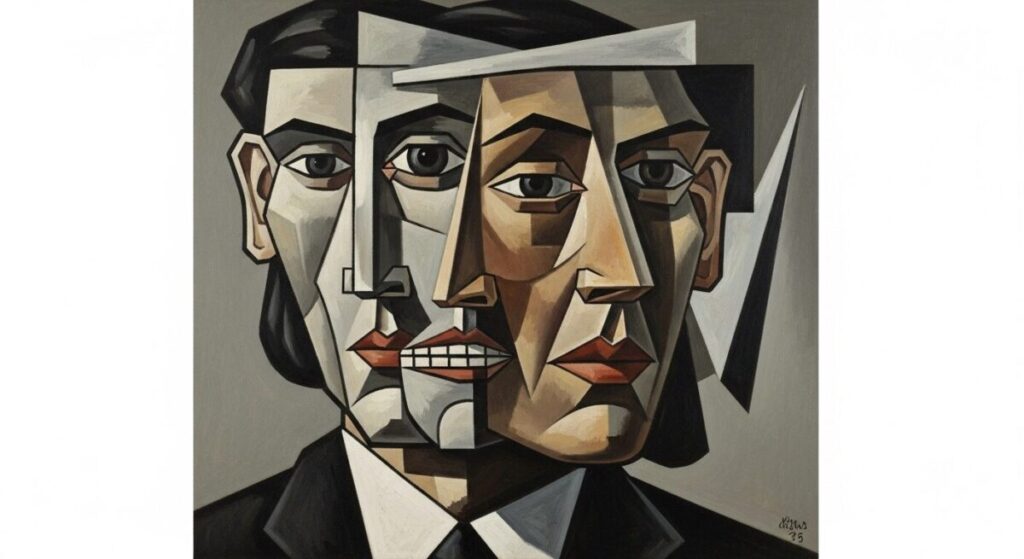
Cubism (early 1900s) was perhaps the most radical departure from traditional representation. Pablo Picasso and Georges Braque broke objects into geometric shapes, showing multiple viewpoints simultaneously. Instead of painting what something looks like from one angle, Cubist artists showed you the front, side, and back all at the same time—like walking around an object and seeing it from every direction at once.
Picasso’s groundbreaking painting “Les Demoiselles d’Avignon” (1907) shocked viewers with its angular, fragmented figures. The movement challenged fundamental assumptions about how art should represent reality, influencing virtually all subsequent modern art.
Surrealism: Dreams on Canvas
Surrealism (1920s-1960s) explored dreams and the subconscious mind with strange and fantastical imagery. Influenced by psychoanalyst Sigmund Freud’s theories about dreams and the unconscious, Surrealist artists created bizarre, dreamlike scenes that challenged logical reality.
Salvador Dalí painted melting clocks in barren landscapes (“The Persistence of Memory”), while René Magritte created mysterious paintings like a pipe with text reading “This is not a pipe.” Frida Kahlo, though not strictly a Surrealist, created deeply personal works exploring identity, pain, and Mexican culture with surreal elements. These artists tapped into the irrational and strange, creating thought-provoking work that still captivates viewers today.
Art in the Modern Age: Pop Art and Beyond (1950s-Present)
The mid-20th century saw art become even more daring and diverse, reflecting a rapidly changing world shaped by mass media, consumer culture, and new technologies.
Abstract Expressionism: Pure Emotion
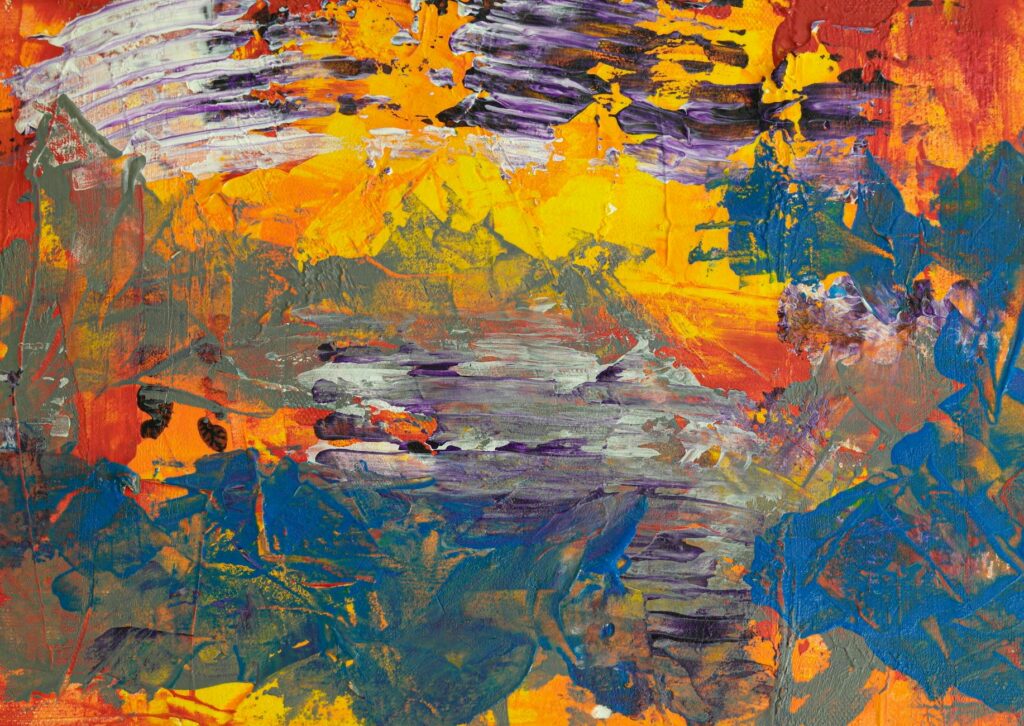
Abstract Expressionism (1940s-1950s) focused on pure emotion and the act of painting itself. Artists like Jackson Pollock created his famous “drip paintings” by literally dripping and splashing paint onto large canvases laid on the floor. Mark Rothko painted enormous color fields designed to evoke deep emotional responses. This movement represented America’s first major contribution to international art and shifted the art world’s center from Paris to New York.
Abstract Expressionists didn’t try to paint recognizable objects. Instead, they expressed feelings through color, gesture, and the physical act of painting. The process itself became part of the art.
Pop Art: Everyday Objects as High Art
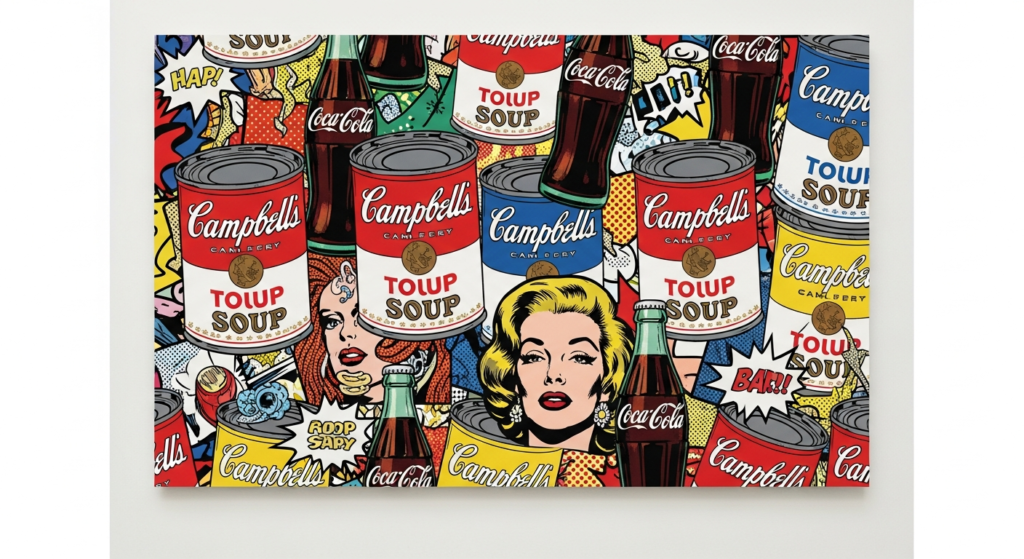
Pop Art (1950s-1970s) revolutionized art by bringing everyday objects, popular culture, and commercial images into museums and galleries. Andy Warhol’s soup cans and Marilyn Monroe silkscreens are iconic examples of this movement.
Pop artists turned to advertising, celebrities, comic books, and consumer products for inspiration. Roy Lichtenstein created paintings that looked like enlarged comic book panels, complete with Ben-Day dots. David Hockney brought a British perspective to Pop Art with his California swimming pool paintings.
This movement asked important questions: What makes something art? Can a soup can be as worthy of artistic attention as a classical portrait? By embracing mass culture and commercial imagery, Pop Art democratized art and made it more accessible to everyday people.
“Pop Art is for everyone. I don’t think art should be only for the select few. I think it should be for the mass of the American people.”
Andy Warhol
![pop-art-consumer-culture-collage.jpg | A vibrant Pop Art composition featuring bold primary colors, commercial imagery, consumer products, and celebrity references in the style of Andy Warhol and Roy Lichtenstein | Pop Art collage showcasing the movement’s embrace of consumer culture and mass media imagery]
Contemporary Art: Breaking All the Rules
Contemporary Art (roughly 1970s-present) is incredibly diverse, encompassing everything from installations and performance art to digital creations and street art. Today’s artists use video, sound, found objects, and even the internet as their materials.
Contemporary artists continue pushing boundaries and challenging definitions of what art can be. Some create immersive installations you can walk through. Others use social media as their canvas. The digital age has opened entirely new possibilities for artistic expression, from AI-generated art to virtual reality experiences.
Key Characteristics of Popular Art Movements
Understanding the distinctive features of each movement helps you recognize and appreciate different artworks. This comparative overview highlights the main characteristics, typical subjects, and famous artists of several influential art styles:
| Art Movement | Period | Key Characteristics | Typical Subjects | Famous Artists |
|---|---|---|---|---|
| Impressionism | Late 1860s-1880s | Visible brushstrokes, focus on light and atmosphere, capturing fleeting moments, painting outdoors | Landscapes, cityscapes, everyday life, water scenes, portraits | Claude Monet, Pierre-Auguste Renoir, Edgar Degas |
| Cubism | Early 1900s | Geometric shapes, multiple viewpoints shown simultaneously, fragmented objects, limited color palette | Portraits, still life, figures, guitars and musical instruments | Pablo Picasso, Georges Braque |
| Surrealism | 1920s-1960s | Dream-like imagery, exploration of subconscious mind, irrational juxtapositions, precise detail in impossible scenes | Fantastical landscapes, strange figures, distorted reality, symbolic objects | Salvador Dalí, Frida Kahlo, René Magritte |
| Pop Art | 1950s-1970s | Mass culture imagery, commercial techniques, bright colors, repetition, often ironic or satirical | Consumer products, celebrities, comic strips, advertisements, everyday objects | Andy Warhol, Roy Lichtenstein, David Hockney |
| Abstract Expressionism | 1940s-1950s | Emotional intensity, large scale canvases, spontaneous application, non-representational forms, emphasis on process | Abstract forms, color fields, gestural marks, no recognizable subjects | Jackson Pollock, Mark Rothko, Willem de Kooning |
This table provides a quick reference for distinguishing between major movements. Notice how each period developed unique visual languages to express their artists’ goals and respond to their cultural moments.
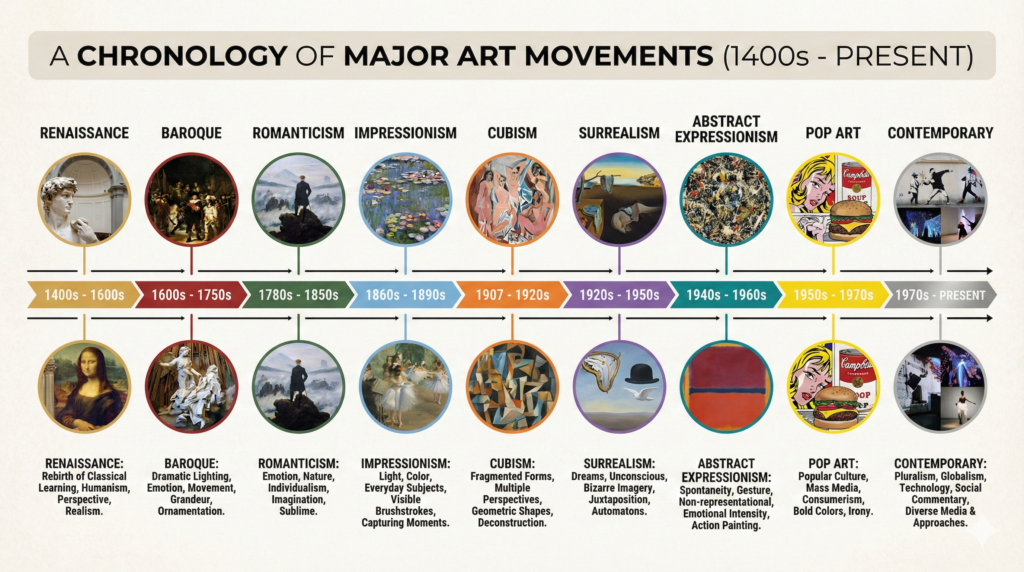
How Art Movements Influence Each Other
Art movements rarely exist in isolation—each responds to what came before, creating an evolutionary chain of artistic development. Understanding these connections helps you appreciate the full story of art history.
Impressionism rejected the polished, detailed finish of Academic painting, choosing instead to capture fleeting light effects. Post-Impressionism then reacted against Impressionism’s emphasis on visual perception, with artists like Cézanne seeking more structure and van Gogh pursuing emotional expression.
Cubism took Cézanne’s geometric approach even further, completely abandoning traditional perspective. Surrealism borrowed Cubism’s freedom from realistic representation but redirected it toward exploring dreams and the unconscious mind. Abstract Expressionism embraced Surrealism’s interest in the subconscious but made the approach completely non-representational.
Pop Art emerged as a direct reaction to Abstract Expressionism’s serious, introspective tone. Where Abstract Expressionists looked inward, Pop artists looked outward to the everyday world of consumer culture and mass media. This constant dialogue—building upon, reacting against, or transforming previous styles—drives artistic evolution forward.
Understanding this evolution of art movements reveals that no movement appears from nowhere. Each is part of an ongoing conversation across centuries, with artists responding to their predecessors while addressing their own contemporary concerns.
How to Identify Different Art Styles
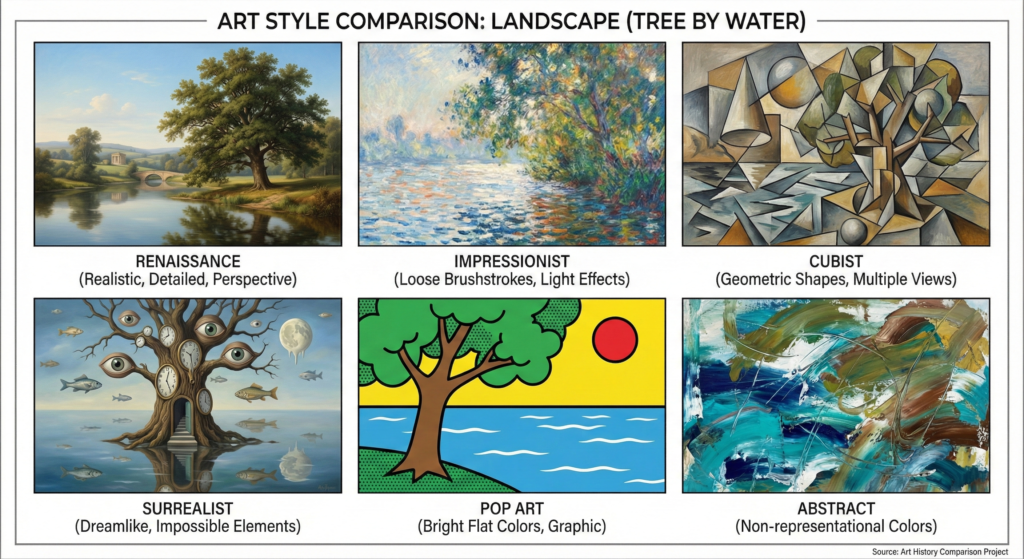
Developing the ability to recognize art movements enhances your museum visits and deepens your appreciation. Here are key elements to examine:
Brushwork and Technique
- Are brushstrokes visible (Impressionism, Expressionism) or hidden (Renaissance, Realism)?
- Is the paint applied thickly (van Gogh’s impasto) or in thin layers (traditional techniques)?
- Does the technique emphasize spontaneity (Abstract Expressionism) or careful planning (Renaissance)?
Subject Matter
- Religious or mythological themes (Renaissance, Baroque)
- Everyday life and ordinary people (Impressionism, Realism)
- Dreams and the subconscious (Surrealism)
- Consumer products and popular culture (Pop Art)
- No recognizable subjects (Abstract art)
Color Palette
- Natural, realistic colors (Realism, Renaissance)
- Bright, unmixed colors (Impressionism, Fauvism)
- Limited, muted palette (Cubism)
- Bold, artificial colors (Pop Art, Expressionism)
Composition and Space
- Mathematical perspective (Renaissance)
- Flattened picture plane (Cubism, Japanese influence)
- Dynamic, diagonal compositions (Baroque)
- Unconventional cropping (Impressionism, influenced by photography)
Emotional Quality
- Calm and balanced (Renaissance)
- Dramatic and intense (Baroque, Expressionism)
- Dreamlike and mysterious (Surrealism)
- Cool and detached (Pop Art, Minimalism)
Practice comparing similar works from different periods. Notice how Renaissance artists used linear perspective differently than Baroque artists employed dramatic lighting. Observe how Impressionists captured light compared to Post-Impressionists’ emotional use of color. These comparisons sharpen your recognition skills.
Why Understanding Popular Art Styles Matters
You might wonder: why bother learning about these different movements? Understanding popular art styles enriches your life in several meaningful ways.
Enhanced Appreciation When you recognize an Impressionist painting’s characteristic broken brushstrokes or a Surrealist work’s dreamlike imagery, you’re not just seeing paint on canvas—you’re understanding an artist’s intentions and the historical context that shaped their vision. This knowledge transforms a simple viewing experience into a deeper engagement with human creativity.
Cultural Literacy Art movements reflect the times that produced them. Baroque art expressed religious fervor during the Counter-Reformation. Impressionism captured modern urban life as Paris transformed. Pop Art commented on post-war consumer culture. Understanding these connections helps you grasp broader cultural and historical patterns.
Personal Connection As you explore famous artists and their styles, you’ll discover which movements resonate with you personally. Maybe you’re drawn to Impressionism’s gentle beauty, Cubism’s intellectual puzzles, or Pop Art’s bold statements. Identifying your preferences helps you articulate your taste and discover new artists you might enjoy.
Informed Collecting For those interested in acquiring art, understanding styles helps you make smarter decisions. You’ll recognize quality work, understand fair pricing, and build a collection with coherent themes or interesting contrasts.
Creative Inspiration Even if you’re not an artist yourself, understanding different approaches to visual expression can inspire creativity in your own field. The way Cubists showed multiple perspectives might spark ideas for problem-solving. The Surrealists’ embrace of the unconscious might encourage creative brainstorming techniques.
The Lasting Impact of These Movements
The influence of these popular art styles extends far beyond museum walls. Every day, you encounter designs, advertisements, and visual media shaped by these historical movements.
Modern graphic design owes enormous debts to movements like Bauhaus and Pop Art. The bold colors and commercial imagery of Pop Art directly influence contemporary advertising and branding. Minimalism’s clean lines appear in everything from smartphone interfaces to modern architecture.
Fashion designers regularly draw inspiration from art movements—from Mondrian’s geometric abstractions appearing on Yves Saint Laurent dresses to Surrealist imagery in Alexander McQueen’s collections. Music videos, film aesthetics, and digital art all reference and reinterpret historical art styles.
Understanding these connections helps you see how art continues evolving and influencing culture. The movements of the past aren’t dead history—they’re living traditions that contemporary artists build upon, react against, and reinterpret for new audiences and technologies.
FAQs: Popular Art Styles and Movements
What is the easiest way to start understanding different art styles?
The easiest approach is to focus on one or two styles that catch your eye first. Visit a museum or browse art types and styles online, paying attention to what naturally attracts you. Look at many examples of those styles, read about the main artists, and notice what makes them unique—like the colors, brushstrokes, or subjects. Websites, books, virtual museum tours, and educational videos make learning accessible from anywhere.
Are new art styles still being created today?
Absolutely! Art constantly evolves. Contemporary artists experiment with new materials, technologies like digital art and AI, and fresh concepts reflecting our modern world. While some new approaches may not immediately receive formal “movement” names, innovative ways of creating and thinking about art emerge continually. Street art, digital art, and installation art represent relatively recent developments that continue branching into new directions.
How did photography influence art movements?
Photography’s invention in the 1800s profoundly impacted painting. Since cameras could capture realistic images quickly and accurately, many artists felt liberated from pursuing perfect realism. This technological shift helped spark Impressionism, as painters explored what they could do that photography couldn’t—capturing fleeting light effects, visible brushwork, and subjective impressions. Photography also influenced composition, with artists like Degas adopting unconventional cropping and unusual viewpoints inspired by photographic perspectives.
What’s the difference between modern art and contemporary art?
Modern art typically refers to artistic work produced from roughly the 1860s to the 1970s, including movements like Impressionism, Cubism, Surrealism, and Abstract Expressionism. These movements broke from traditional artistic conventions and representation. Contemporary art describes work created from the 1970s to today, often incorporating new media, diverse global perspectives, and current social or political themes. Modern art established new ways of seeing; contemporary art builds on those innovations while addressing present-day contexts.
How do art movements influence each other?
Art movements often build upon, react to, or rebel against earlier styles. Impressionism reacted against Academic art’s strict rules. Post-Impressionism developed from Impressionist ideas while adding more structure and emotion. Cubism took Cézanne’s geometric approach further. Pop Art emerged as a reaction to Abstract Expressionism’s seriousness. Artists learn from the past and then push boundaries to create something new, creating an ongoing dialogue across time that drives artistic evolution.
Can artists work in multiple styles?
Yes! Many artists experiment with various styles throughout their careers. Picasso, for example, moved through Blue Period, Rose Period, Cubism, and later styles. Contemporary artists often blend multiple influences, creating hybrid approaches that don’t fit neatly into single categories. The richest artistic development frequently comes from artists who aren’t limited to one approach but draw from multiple traditions.
What makes a painting “Impressionist” versus “Post-Impressionist”?
Impressionism focuses on capturing fleeting visual impressions of light and atmosphere using broken brushstrokes and painting outdoors. Post-Impressionism used similar bright colors and visible brushwork but emphasized personal expression, emotional content, and structural elements more than visual perception alone. Post-Impressionists like van Gogh, Cézanne, and Gauguin each developed highly individual styles that went beyond Impressionism’s original goals.
How can I learn more about specific artists?
Start by exploring museum websites like The Museum of Modern Art (MoMA), which offers extensive educational resources. Khan Academy’s Art History section provides free, comprehensive lessons on movements and artists. Google Arts & Culture offers high-resolution images and virtual museum tours. Reading artist biographies, watching documentaries, and visiting museums in person provide deeper understanding of individual creators and their historical contexts.
Conclusion: Your Ongoing Art Journey
Our journey through understanding popular art styles and movements has revealed the incredible richness and diversity of human artistic expression. From the harmonious beauty of the Renaissance to the fragmented perspectives of Cubism and the bold statements of Pop Art, each movement offers a unique window into human creativity and historical change.
These popular art styles aren’t just historical footnotes—they’re living traditions that continue shaping how we see, create, and think about visual culture today. Understanding Impressionism helps you appreciate why some paintings feel full of light and movement. Recognizing Surrealist influences helps you understand contemporary advertising and film imagery. Knowing about Abstract Expressionism reveals why some artists prioritize emotion and process over representation.
Whether you’re standing in a museum, scrolling through images online, or creating your own art, this knowledge deepens your connection with the visual world around you. Each style represents artists responding to their moment in history while contributing to an ongoing conversation about what art can be and do.
Keep exploring, keep questioning, and let the diverse world of art styles continue inspiring you. Visit museums, read about artists, try creating art yourself, and share your discoveries with others. The more you engage with art, the more you’ll discover—not just about artistic techniques and historical periods, but about human nature, cultural values, and the endless ways we find to express our experiences of being alive.
The journey through understanding popular art styles never really ends. There’s always another movement to discover, another artist to appreciate, another connection to make between past and present. That ongoing exploration is part of what makes art one of humanity’s most rewarding and enduring achievements.
Citations:
- The Museum of Modern Art (MoMA). “MoMA Learning.” https://www.moma.org/learn/moma_learning/themes/
- Khan Academy. “Art History.” https://www.khanacademy.org/humanities/art-history
- Smarthistory. “Smarthistory – Art History Resources.” https://smarthistory.org/
- Metropolitan Museum of Art. “Heilbrunn Timeline of Art History.” https://www.metmuseum.org/toah/
- Tate Gallery. “Art Terms and Glossary.” https://www.tate.org.uk/art/art-terms
- Google Arts & Culture. “Art Movements and Styles.” https://artsandculture.google.com/