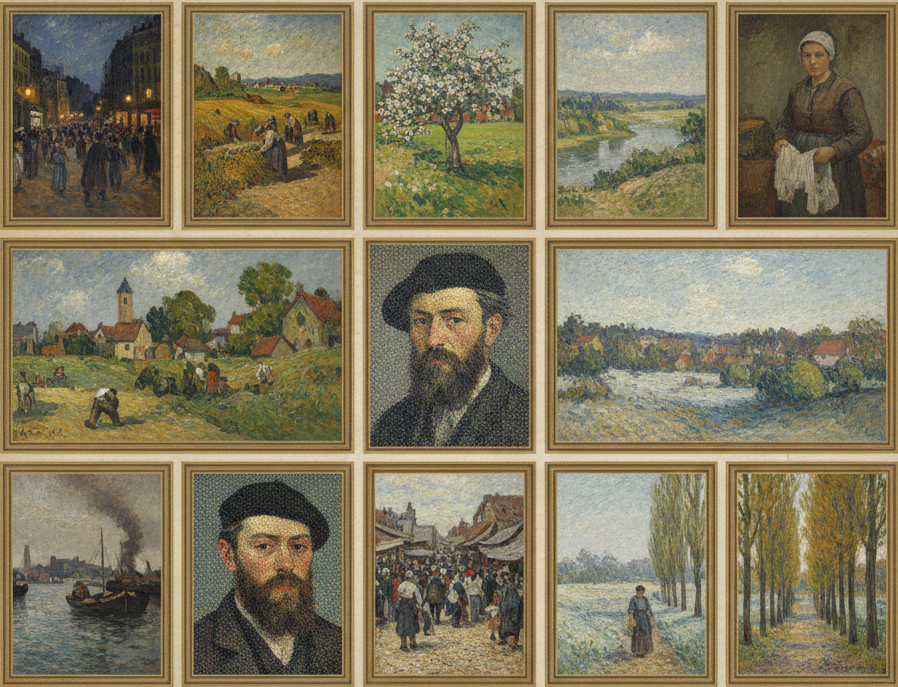
Imagine stepping into a world where sunlight dances on city streets and country fields shimmer with color. That’s the magic you’ll find in Camille Pissarro paintings. Often called the ‘Father of Impressionism,’ Camille Pissarro was a groundbreaking artist who saw beauty in everyday life. Unlike painters who focused on kings or grand historical events, Pissarro painted the world around him—bustling Parisian boulevards, quiet rural landscapes, and hardworking people. He was a kind teacher and a dedicated friend to other famous artists like Monet and Cézanne, and his work helped change the art world forever. Join us as we explore ten of his most incredible masterpieces.
The Boulevard Montmartre at Night (1897)
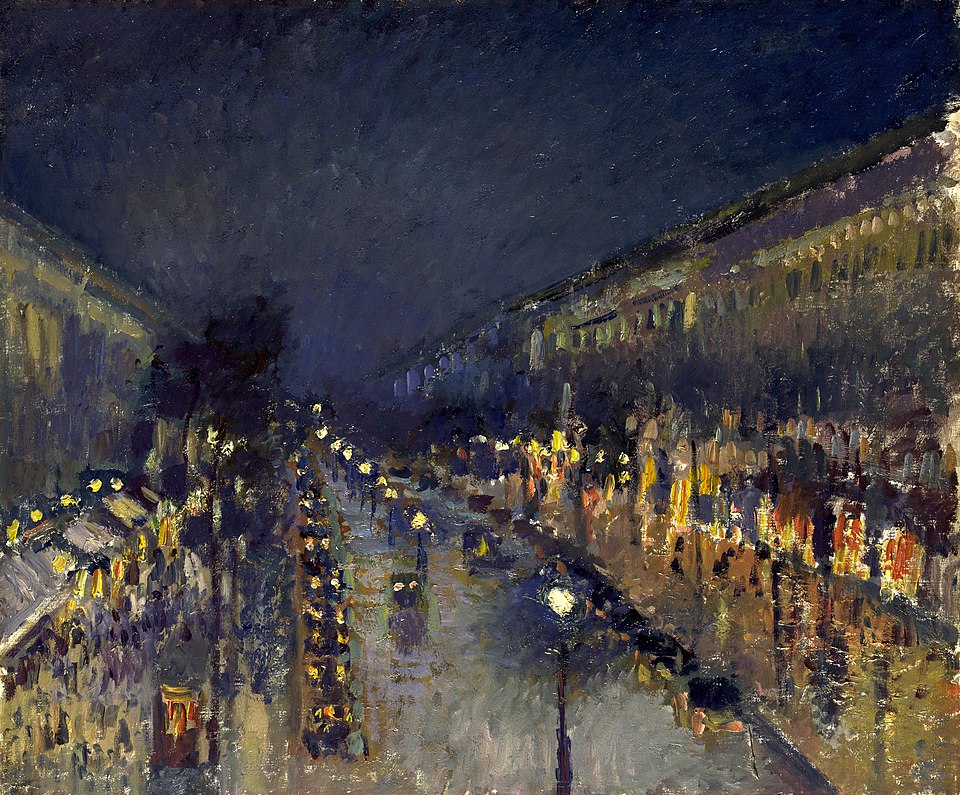
The dazzling city lights in ‘The Boulevard Montmartre at Night’ by Camille Pissarro.
Description: This painting is like looking out a window into a rainy, gaslit Paris night. Pissarro masterfully captures the glowing lights of shops and street lamps reflecting on the wet pavement, creating a scene that feels both busy and magical. It’s one of a series of paintings he made of this same street at different times of day and in different weather. To paint his famous series of the Boulevard Montmartre, Pissarro rented a room in a hotel for several months so he could capture the exact same view under various conditions.
Painting Techniques: Pissarro used quick, energetic brushstrokes and a dark palette highlighted with vibrant yellows, oranges, and blues to convey the artificial light and bustling atmosphere of the city at night.
Location: The Courtauld Gallery, London, UK
Estimated Value: Priceless
The Red Roofs, Corner of a Village, Winter (1877)
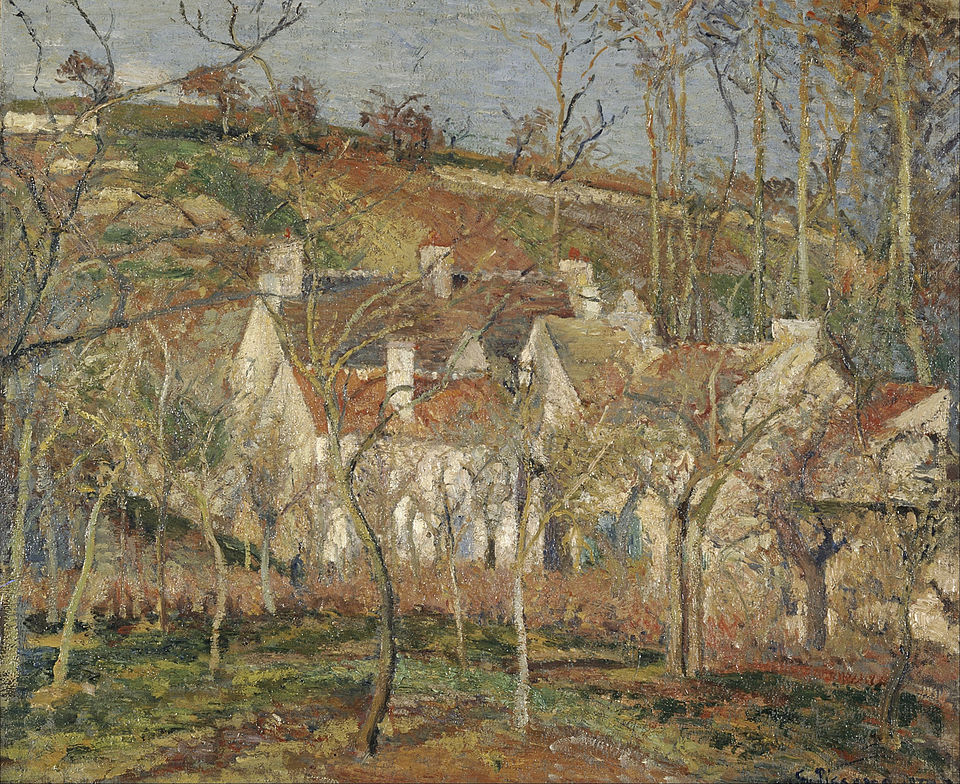
A vibrant winter scene in ‘The Red Roofs, Corner of a Village, Winter’ by Camille Pissarro.
Description: This piece shows a quiet corner of a French village in winter. Pissarro uses the bright, terracotta-red roofs to create a beautiful contrast with the cool colors of the winter landscape and the bare, tangled tree branches. It makes you feel the crisp, cold air of the countryside. When this painting was first shown, one critic mockingly said the houses looked like they were covered in ‘tongues of fire’.
Painting Techniques: He applied thick dabs of paint, a technique called impasto, to create a rich texture. The painting is a mosaic of short, distinct brushstrokes that blend together when you view them from a distance.
Location: Musée d’Orsay, Paris, France
Estimated Value: Priceless
Hoarfrost (1873)
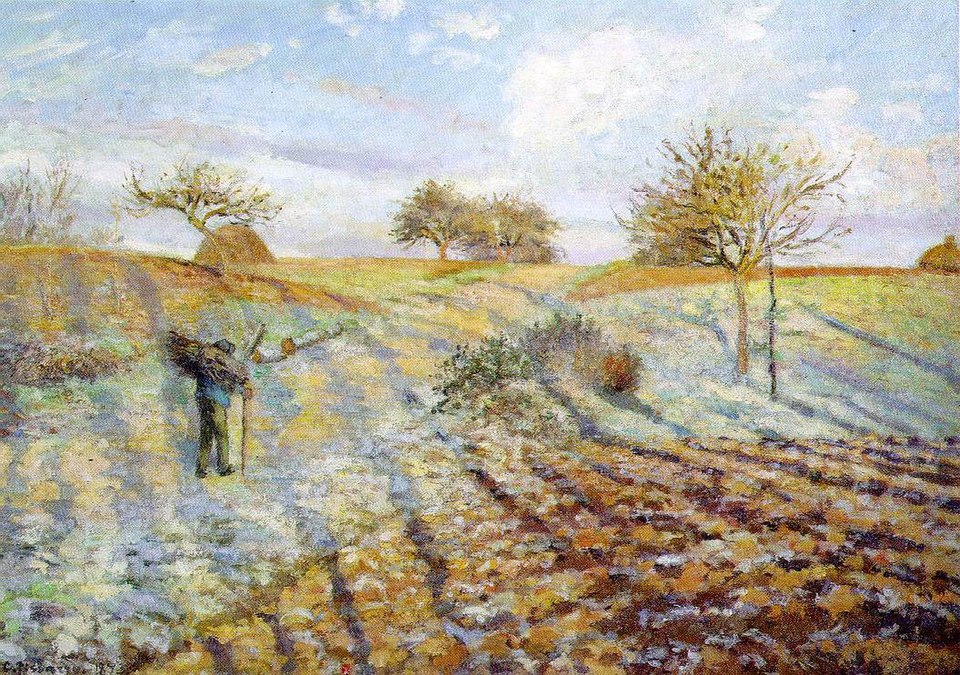
The crisp, cold morning light in ‘Hoarfrost,’ a classic Camille Pissarro painting.
Description: In ‘Hoarfrost,’ Pissarro captures a chilly morning where the ground is covered in a delicate layer of frost. You can almost feel the cold. The long shadows stretching across the field tell you the sun is low in the sky, and the lone figure working adds a touch of human life to the serene landscape. This painting was controversial at the first Impressionist exhibition in 1874, with critics complaining that the shadows were painted blue and the plowed earth looked like ‘palette scrapings’.
Painting Techniques: Pissarro used a palette of cool blues, whites, and earthy tones with small, comma-like brushstrokes to mimic the texture of the frosted ground and the crisp morning light.
Location: Musée d’Orsay, Paris, France
Estimated Value: Priceless
Jalais Hill, Pontoise (1867)
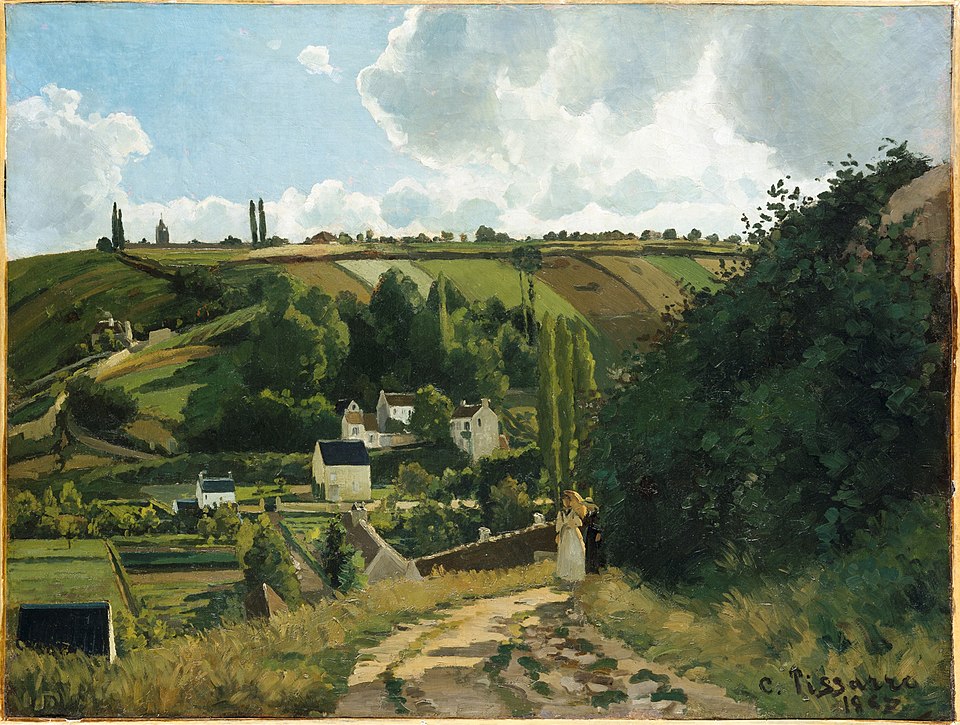
A serene country path in ‘Jalais Hill, Pontoise’ by Camille Pissarro.
Description: This is an early masterpiece that shows Pissarro’s skill at creating a sense of depth and space. The winding path leads your eye up the hill through a peaceful, sun-drenched landscape. It’s a perfect example of his love for painting the French countryside where he lived. This painting was exhibited at the famous Paris Salon of 1868, one of the few times Pissarro’s work was accepted by the traditional art establishment.
Painting Techniques: While still showing the influence of Realism, Pissarro used a brighter color palette and visible brushwork, especially in the sky and foliage, hinting at the Impressionist style he would later pioneer.
Location: The Metropolitan Museum of Art, New York, USA
Estimated Value: Priceless
The Harvest of Hay in Éragny (1887)
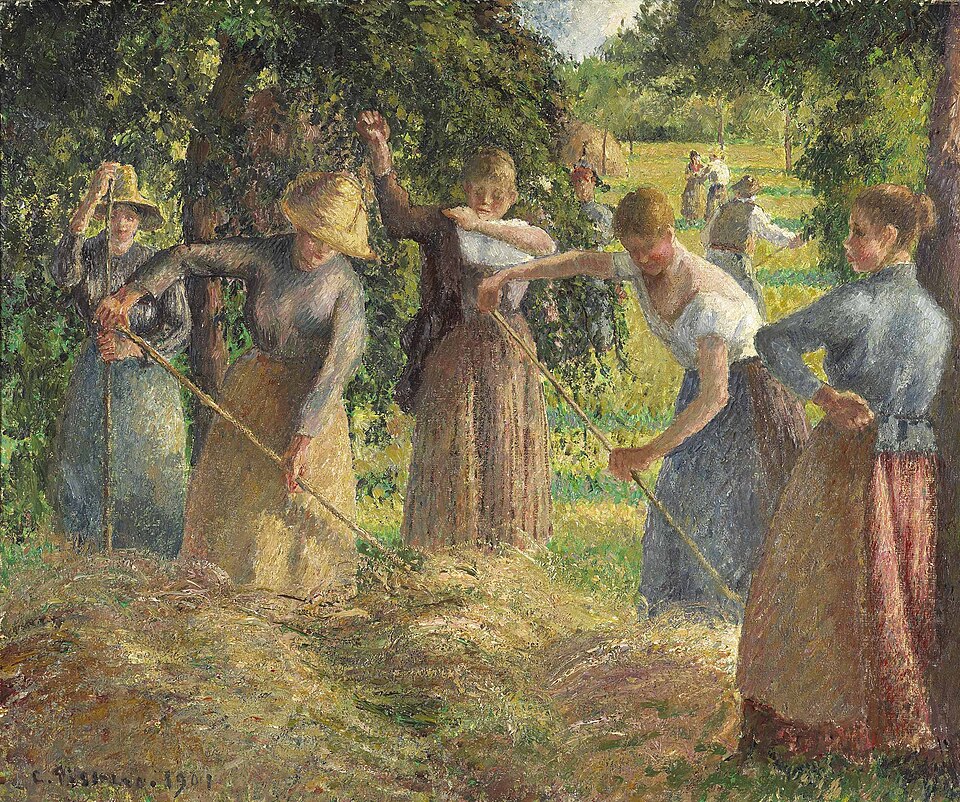
The shimmering summer heat of ‘The Harvest of Hay in Éragny’ by Camille Pissarro.
Description: This painting buzzes with the energy of a warm summer day. It shows workers gathering hay in the fields near Pissarro’s home in Éragny. The scene is filled with golden light, celebrating the beauty of rural labor and community. Pissarro was influenced by the younger artist Georges Seurat to try Pointillism, but he eventually returned to a freer Impressionist style, finding the dot technique too rigid.
Painting Techniques: During this period, Pissarro experimented with Pointillism, using tiny dots of pure color that mix in the viewer’s eye. This creates a shimmering, luminous effect that perfectly captures the heat of summer.
Location: Van Gogh Museum, Amsterdam, Netherlands
Estimated Value: Priceless
Two Young Peasant Women (1892)
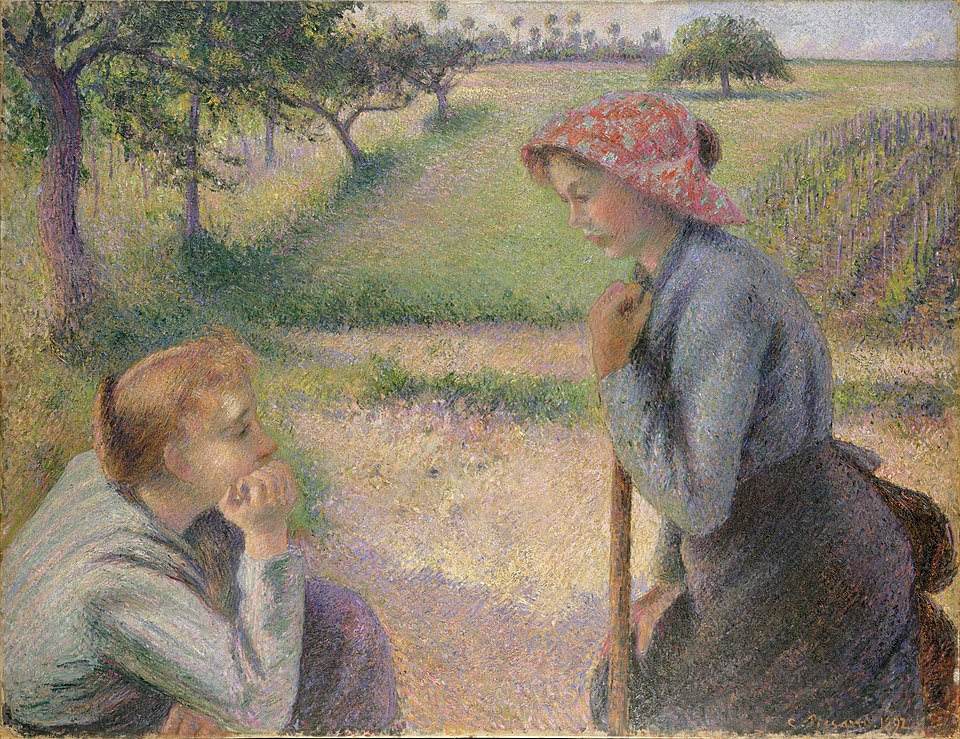
A quiet moment of rest in ‘Two Young Peasant Women’ by Camille Pissarro.
Description: Here, Pissarro focuses on people rather than just the landscape. Two young women are resting and chatting in a sun-dappled field. The painting has a gentle, intimate feel, showing Pissarro’s respect for the people who worked the land. Pissarro often painted his family members and neighbors, giving his depictions of peasant life an authentic and sympathetic quality.
Painting Techniques: By this time, Pissarro had moved away from strict Pointillism. He used a combination of small dots and short, feathery brushstrokes to model the figures and create a soft, warm atmosphere.
Location: The Metropolitan Museum of Art, New York, USA
Estimated Value: Priceless
The Garden of the Tuileries on a Winter Afternoon (1899)
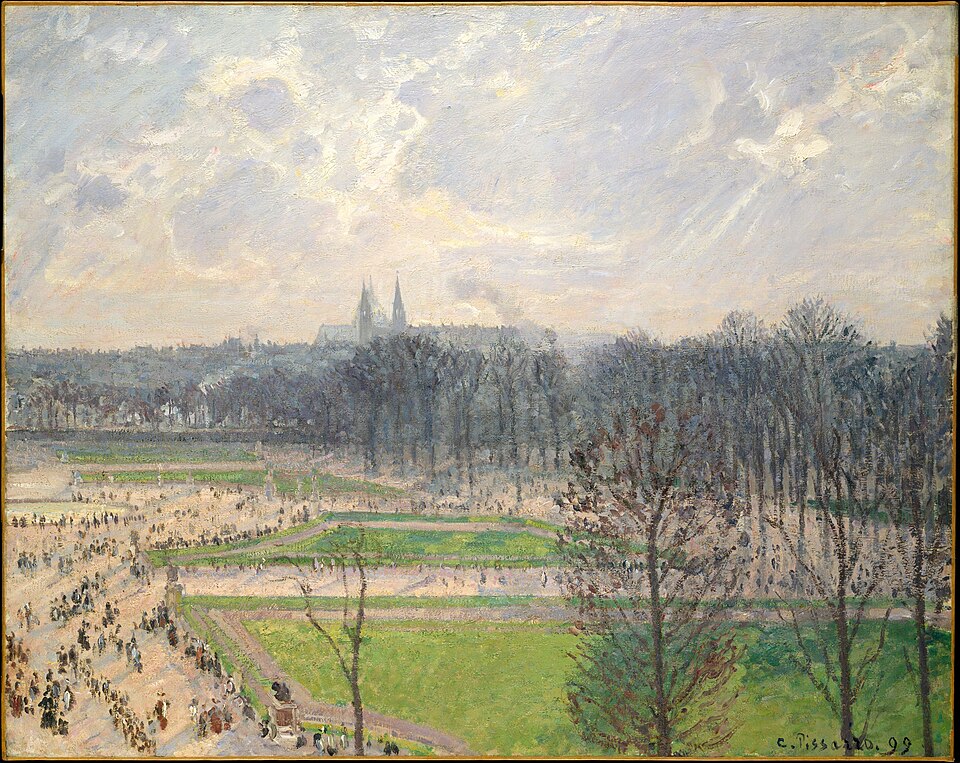
The hazy winter light of Paris in ‘The Garden of the Tuileries on a Winter Afternoon’ by Camille Pissarro.
Description: Part of another series painted from a hotel window, this work shows a famous Parisian park in winter. Even without leaves on the trees, the scene is full of life with people strolling along the paths. Pissarro brilliantly captures the hazy, pale light of a winter afternoon. Pissarro suffered from a recurring eye infection later in life, which is why he often painted cityscapes from the safety of a window rather than outdoors.
Painting Techniques: Pissarro used a high viewpoint to create a sweeping, panoramic scene. His soft brushwork and muted color palette of grays, purples, and browns perfectly evoke the chilly, overcast day.
Location: The Metropolitan Museum of Art, New York, USA
Estimated Value: Priceless
The Pont Boieldieu in Rouen, Rainy Weather (1896)
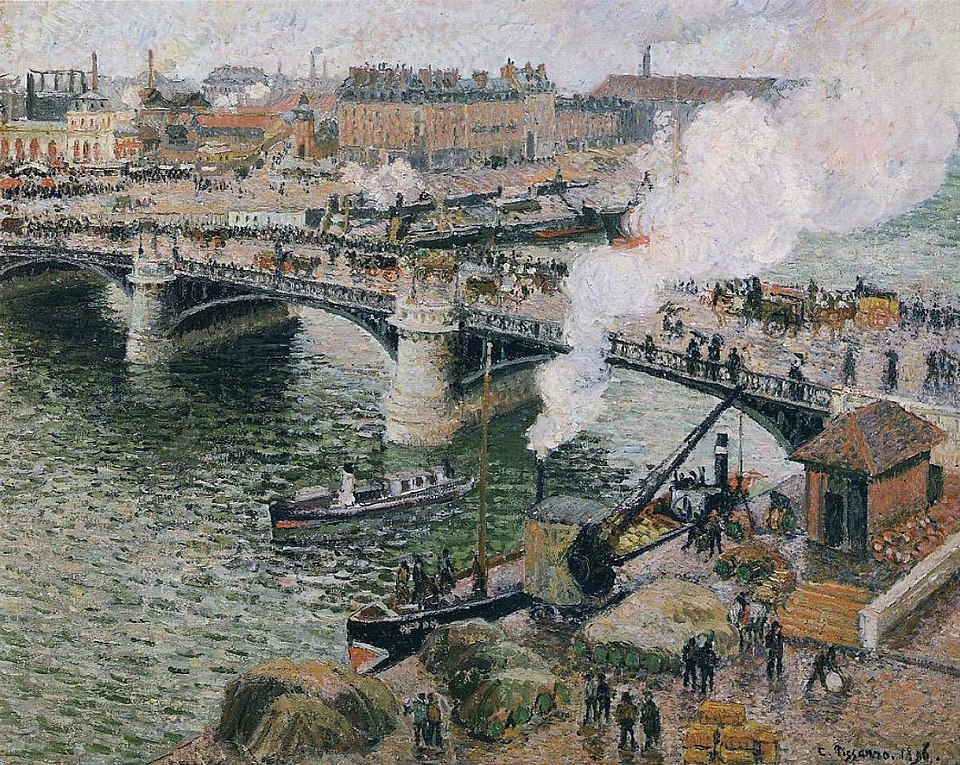
A beautiful rainy day in ‘The Pont Boieldieu in Rouen, Rainy Weather’ by Camille Pissarro.
Description: This painting makes a rainy day look beautiful. Pissarro captures the industrial city of Rouen with its smoking chimneys and busy bridge, all seen through a curtain of rain. The reflections on the wet ground and the gray river create a moody but captivating atmosphere. This work is part of a series where Pissarro explored the effects of weather and light on an industrial landscape, showing that beauty could be found even in modern, bustling cities.
Painting Techniques: He used vertical and diagonal brushstrokes to suggest falling rain and layered shades of gray, blue, and purple to create the damp, misty atmosphere, with small touches of color for the figures and carts.
Location: Art Gallery of Ontario, Toronto, Canada
Estimated Value: Priceless
A Cowherd at Pontoise (c. 1874)
A tranquil rural scene in ‘A Cowherd at Pontoise’ by Camille Pissarro.
Description: This charming painting shows a young girl watching over her cow in a lush, green field. It’s a classic example of Pissarro’s love for rural subjects and his ability to create a sense of peace and harmony between humans and nature. The scene feels timeless and tranquil. The artist Paul Cézanne, who was Pissarro’s student and friend, also painted very similar landscapes around Pontoise during the same period.
Painting Techniques: Pissarro used a rich texture of varied brushstrokes to depict the grass, leaves, and the cow’s hide. The composition is carefully balanced, with the vertical trees contrasting with the horizontal lines of the landscape.
Location: The Metropolitan Museum of Art, New York, USA
Estimated Value: Priceless
Le Pont Neuf (1901)
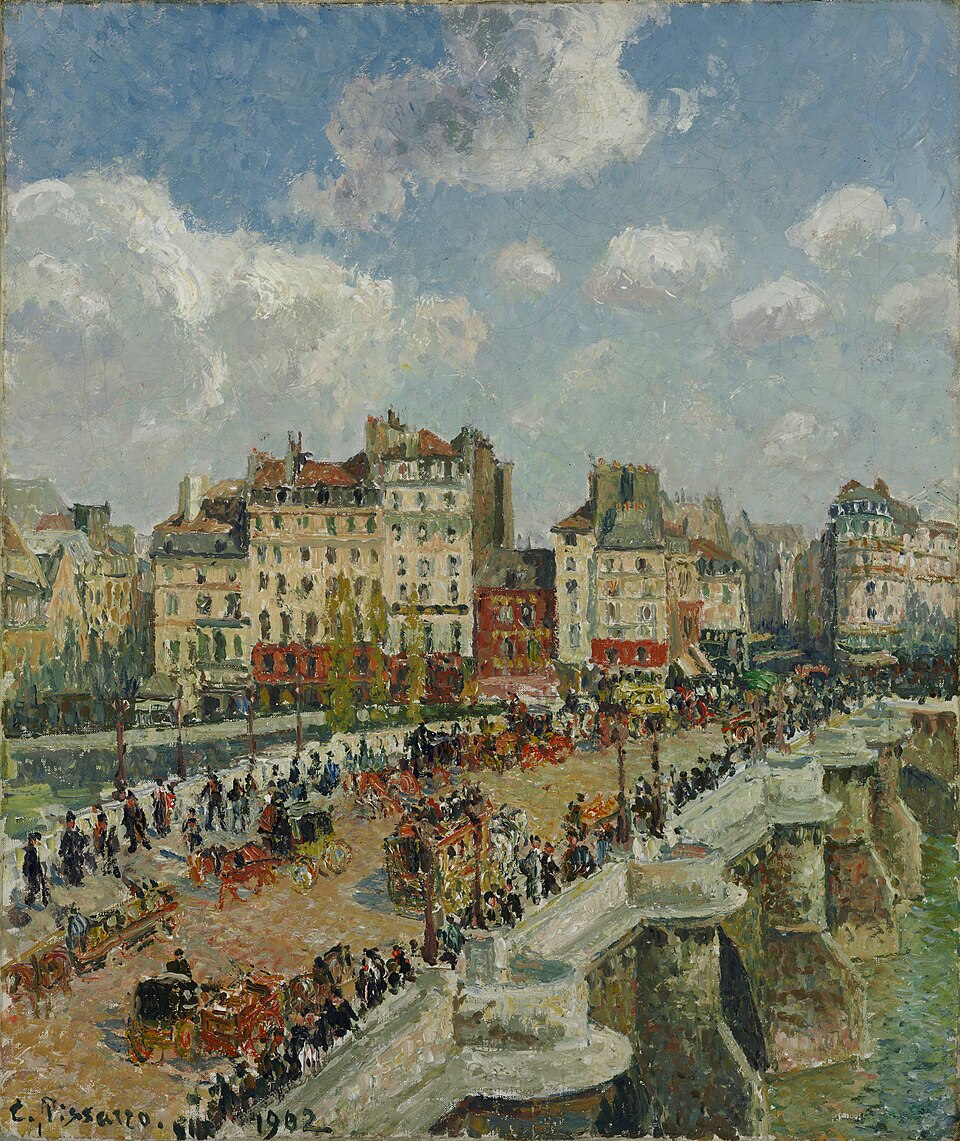
The bustling energy of Paris captured in ‘Le Pont Neuf’ by Camille Pissarro.
Description: This painting shows one of the oldest bridges in Paris, the Pont Neuf, bustling with activity. From his high viewpoint, Pissarro captures the flow of carriages, pedestrians, and the shimmering Seine river below. It’s a snapshot of modern life in the heart of the city. Despite being an anarchist who was often critical of the government, Pissarro loved painting the iconic, historic structures of Paris.
Painting Techniques: Using loose, fluid brushstrokes, Pissarro captures the sense of movement and the fleeting effects of sunlight on the stone bridge and water. The composition is dynamic, drawing the viewer’s eye across the scene.
Location: Allen Memorial Art Museum, Oberlin, USA
Estimated Value: Priceless
Inspiration and Legacy
Camille Pissarro drew early inspiration from the French Realist painters Jean-Baptiste-Camille Corot and Gustave Courbet, who taught him to paint outdoors and capture the truth of a landscape. However, his true legacy lies in his role as a central figure in Impressionism. He was the only artist to exhibit his work in all eight Impressionist exhibitions from 1874 to 1886. More than just a painter, Pissarro was a mentor and father figure to many younger artists. He provided crucial guidance and encouragement to Paul Cézanne, who called him ‘the first Impressionist,’ and briefly taught Paul Gauguin. His willingness to experiment, seen in his brief but influential adoption of Pointillism alongside Georges Seurat, shows his open-mindedness. Pissarro’s dedication and supportive nature helped shape the course of modern art, influencing countless artists who followed.
Final Thoughts
Camille Pissarro’s contribution to art is immeasurable. He was the steady anchor of the Impressionist movement, a master of both rural landscapes and urban cityscapes. He found poetry in the ordinary, turning a frosty field, a red-roofed house, or a rainy street into something extraordinary. His dedication to capturing light and atmosphere changed how we see the world. The enduring appeal of Camille Pissarro paintings lies in their honesty, warmth, and the profound sense of peace they communicate to the viewer, securing his place as one of the most beloved painters in art history.
FAQs about Camille Pissarro
What was Camille Pissarro most famous for?
Camille Pissarro was most famous for being a key figure in the Impressionist movement. He is celebrated for his beautiful landscapes of the French countryside and his bustling cityscapes of Paris, as well as for being a mentor to other famous artists like Cézanne and Gauguin.
Why is Pissarro sometimes called the ‘Father of Impressionism’?
He earned this title because he was older than most of the other Impressionists, acted as a teacher and guide to many of them, and was the only artist to participate in all eight of the Impressionist exhibitions. His commitment and leadership were essential to the group.
Did Pissarro’s style change during his career?
Yes, his style evolved significantly. He started with a more traditional, Realist style, then became a leading Impressionist. For a few years in the 1880s, he even experimented with the scientific, dot-based technique of Pointillism before returning to a freer Impressionist style.