
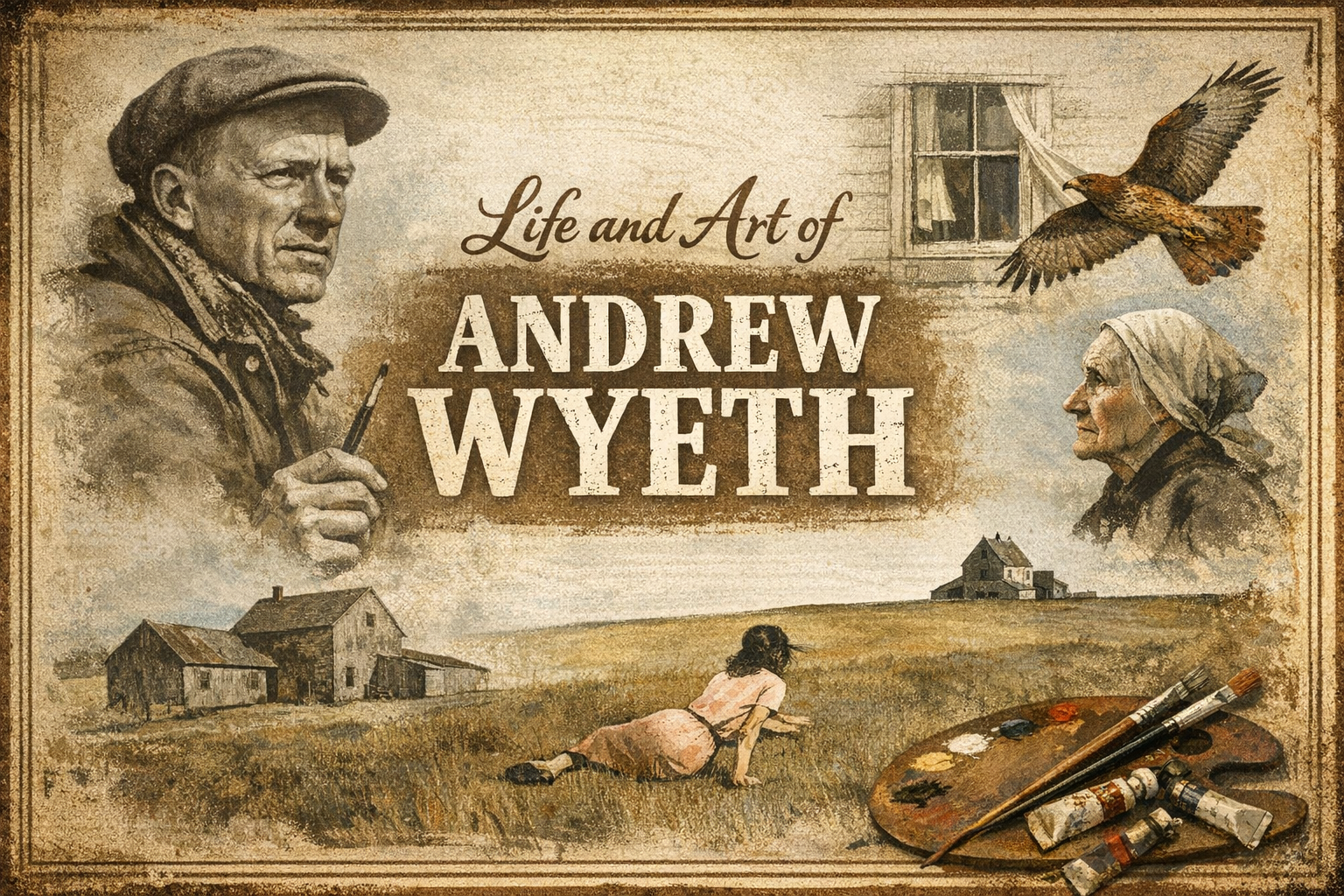
Andrew Wyeth remains one of the most recognizable and enigmatic figures in American art. While the mid-20th century saw the explosive rise of Abstract Expressionism, Wyeth quietly turned his gaze inward—and to his immediate surroundings—to create highly detailed, emotionally charged paintings.
If you are new to Wyeth’s work, his muted landscapes and solitary figures might seem simple at first glance. However, a closer look reveals a profound meditation on memory, isolation, and the passage of time.
Key Points Summary
- A Master of Two Mediums: Wyeth favored egg tempera and drybrush watercolor to achieve his signature highly detailed, muted aesthetic.
- A Hyper-Local Focus: He rarely traveled, drawing a lifetime of inspiration from just two locations: his hometown in Pennsylvania and his summer home in Maine.
- Christina’s World: His most famous masterpiece was inspired by his neighbor’s quiet determination in the face of a severe physical disability.
- An Independent Vision: While his contemporaries painted bold abstracts, Wyeth stayed true to a distinct style that blurred the lines between stark realism and psychological tension.

Who Was Andrew Wyeth?
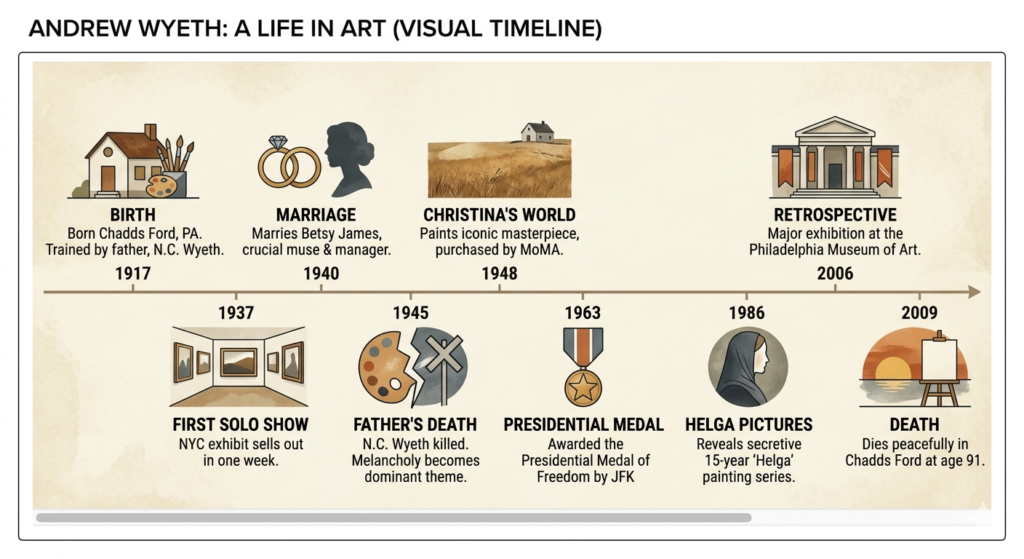
Born in 1917, Andrew Wyeth was the youngest child of N.C. Wyeth, a famous American illustrator. Despite growing up in a highly creative and bustling household, Andrew was a sickly child who spent much of his time indoors, receiving rigorous art training directly from his father.
What makes Wyeth’s story so fascinating is his extreme dedication to the familiar. He refused to travel the world seeking inspiration. Instead, he found an entire universe in just two locations: his hometown of Chadds Ford, Pennsylvania, and his summer residence in Cushing, Maine. He painted the people and landscapes he knew intimately, particularly his neighbors, the Kuerners in Pennsylvania and the Olsons in Maine. By restricting his world, Wyeth was able to observe the minute, seasonal changes in the land and the quiet, hidden lives of the people who lived there.
“I prefer winter and fall, when you feel the bone structure of the landscape. Something waits beneath it; the whole story doesn’t show.”
Andrew Wyeth
Wyeth’s Mastery of Egg Tempera and Watercolor
Wyeth is perhaps best known for his mastery of egg tempera. This centuries-old medium, made by mixing dry pigments with egg yolk and water, was perfect for Wyeth’s temperament. It is quick-drying and dries to a dull, matte finish, allowing him to build up hundreds of tiny, cross-hatched strokes to create astonishingly precise textures—from the rough grain of weathered wood to individual blades of dried grass.
He also worked extensively in watercolor. Rather than focusing on the sweeping, fluid washes typical of the medium, Wyeth often employed a “drybrush” technique. By squeezing most of the water out of his brush, he could weave tight, controlled layers of color.
For a deeper dive into the mechanics of these specific watercolor applications, check out our guides on Mastering The Blending Painting Technique and The Ripple Effect.
What Is the Meaning Behind Christina’s World?
Painted in 1948, Christina’s World is Wyeth’s undisputed masterpiece. The painting depicts a woman in a pink dress lying in a sweeping field of tawny grass, gazing up at a distant, weathered farmhouse.
To a beginner, the painting might look like a simple rural landscape, but it carries a heavy emotional weight. The woman is Anna Christina Olson, Wyeth’s neighbor in Maine. She suffered from a degenerative muscle condition (likely polio or Charcot-Marie-Tooth disease) that paralyzed her lower body. Refusing to use a wheelchair, she preferred to crawl across her property. Wyeth was deeply moved by her fierce independence and dignity. The painting isn’t just a portrait of a landscape; it is a psychological portrait of Christina’s psychological landscape—the house feels impossibly far away, illustrating the monumental physical challenge she faced every day.
Why Did Wyeth Paint Such Melancholy?
Wyeth’s paintings often feature overcast skies, bare trees, and lonely figures gazing out of windows. This melancholy wasn’t an artistic affectation; it was deeply personal. A major turning point in his life occurred in 1945 when his father was tragically killed at a railroad crossing in Chadds Ford. Wyeth’s grief permanently altered his vision, bringing a haunting, elegiac quality to his work.
While he is technically categorized as a Realist, his paintings often feel dreamlike or slightly unsettling. To explore how Wyeth fits into the broader art world, read our foundational guides: What Is Realism Art? and Magic Realism In Painting.
Beginner’s “Try It Yourself” Prompt
Ready to bring a little of Wyeth’s magic into your own practice? Bridge the gap between art history and your canvas with this quick exercise:
- Limit Your Palette: For your next painting session, restrict your colors to just three earth tones (e.g., Yellow Ochre, Burnt Umber, and Raw Sienna) plus white and black. Notice how forcing a limited palette creates a unified, moody atmosphere.
- Practice the Drybrush: Load a small brush with watercolor or heavily thinned acrylic, then wipe most of the moisture off on a paper towel. Lightly drag the nearly dry bristles over your paper to capture the rough texture of dried winter grass or old wood.
FAQs: Art of Andrew Wyeth
Where is Christina’s World currently displayed? The painting is part of the permanent collection at The Museum of Modern Art (MoMA) in New York City.
Why did Andrew Wyeth use egg tempera instead of oil paint? Wyeth disliked the slow drying time and glossy sheen of oil paints. Egg tempera allowed him to work with meticulous, rapid precision and achieve the muted, chalky textures that perfectly suited his stark landscapes.
Did Andrew Wyeth paint from photographs? No. Despite the photorealistic quality of some of his work, Wyeth painted from intense observation, memory, and hundreds of rough pencil sketches and watercolor studies done on-site.
Updated: May 2026