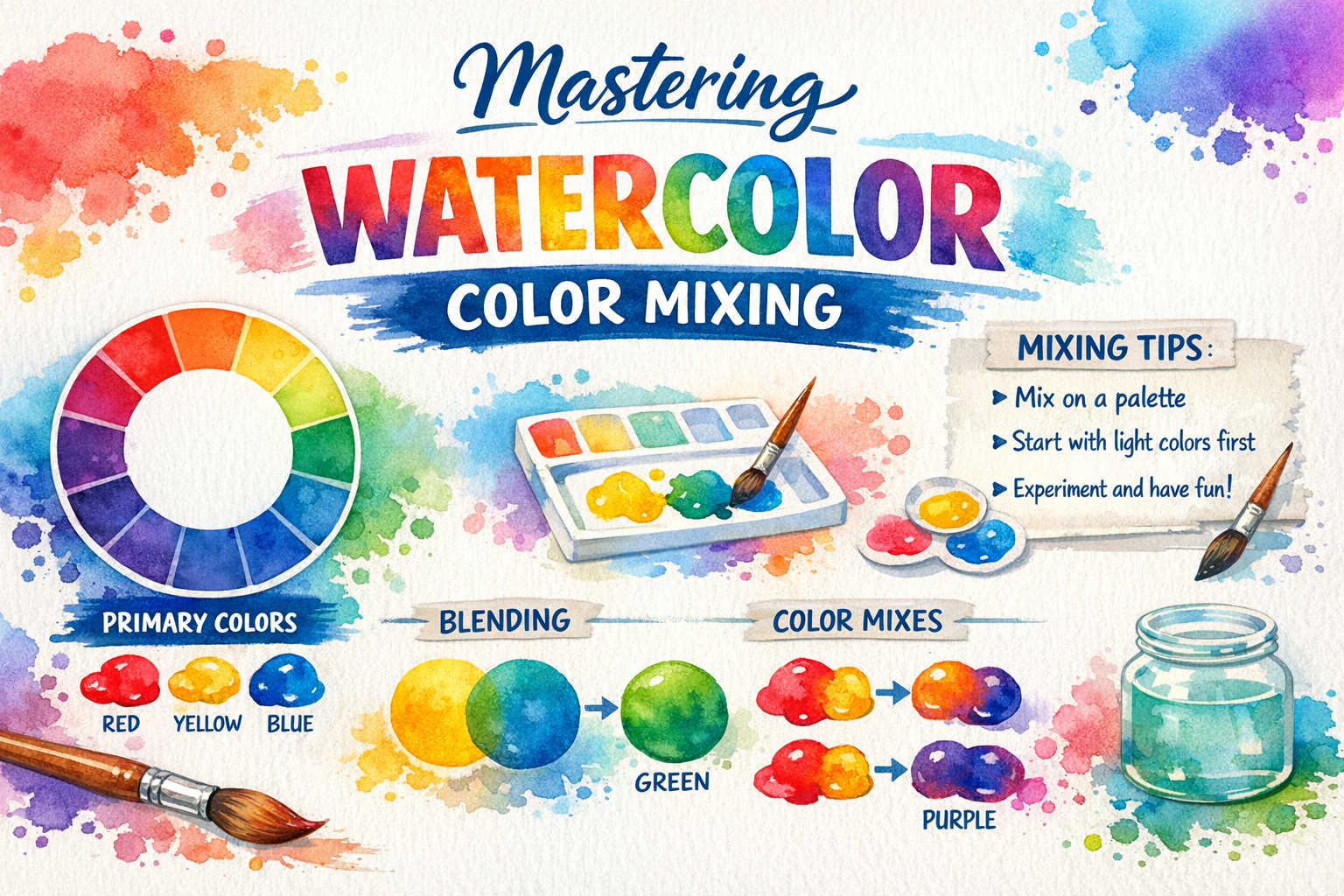
Mastering watercolor mixing does not require a chemistry degree. This guide breaks down the essential techniques to combine colors confidently and avoid muddy results. You will learn how to use the color wheel, control your water-to-paint ratio, and build a reliable beginner palette. Grab your brushes and start creating vibrant, breathtaking paintings today.
You mix a beautiful color on your palette, only to watch it dry dull and lifeless on the paper. It happens to every new painter. Unleashing your inner color alchemist starts with mastering watercolor color mixing. Watercolor is inherently transparent. The white of the paper acts as your light source. It shines upward through the layers of pigment.
If you understand how pigments interact with that light and with each other, you control the outcome. Most beginners panic when colors turn to mud. They assume they need to buy more pre-mixed tubes to get it right. They do not. You can mix almost any shade imaginable using just a few fundamental pigments.
Backed by over a decade of teaching experience, I see the breakthrough happen when my students stop guessing and start observing. By breaking down color bias, managing your water ratio, and limiting your palette, you can transform muddy messes into vibrant masterpieces. Let us look at how color theory actually works in practice so you can begin getting started with watercolors properly.
What Is the Secret to Clean Watercolor Mixing?
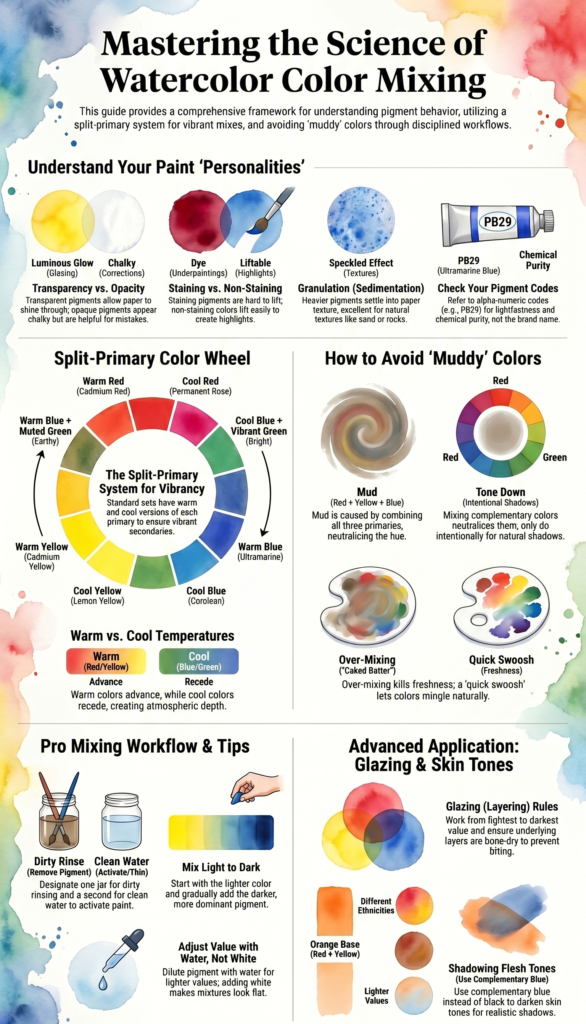
The secret to clean watercolor mixing is understanding color bias and controlling your water-to-paint ratio. Every primary color leans either warm or cool. Mixing colors with compatible biases keeps them vibrant, while combining opposing biases creates neutral, muted tones.
Paint mixing is called subtractive mixing. Every pigment you add absorbs more light, reflecting less back to your eye. This is why throwing too many colors together ruins your mix. To get a vibrant green, you need a yellow that leans green and a blue that leans green.
If you use a warm, red-leaning blue instead, that tiny bit of red will neutralize the green. It will instantly dull your mixture. Understanding your color theory basics determines your overall success. A smart approach is to test the tinting strength of your pigments first. Yellows are often weak, so you should always start with yellow and add darker colors gradually.
The Color Wheel Explained for Beginners
You need a map before you can navigate. The color wheel organizes primary, secondary, and tertiary colors into a highly visual guide. Primary colors are the parents. You cannot mix other colors to create red, yellow, or blue.
Secondary colors happen when you mix two primaries together. Tertiary colors fill the gaps between them. But the real magic lies in complementary colors.
These sit directly opposite each other on the color wheel. Placing them side-by-side makes both colors look noticeably brighter. Mixing them together, however, is a completely different story.
How Do You Avoid Muddy Watercolor Mixtures?
You avoid muddy watercolor mixtures by limiting the number of pigments in your mix and knowing when to stop brushing. Mud happens when you accidentally combine all three primary colors or when you overwork damp paper, destroying the watercolor binder.
Green and red are complementary colors. Because green reflects green and red reflects red, mixing them absorbs almost all light. This creates a very dark neutral color. This is exactly how you make beautiful browns and grays on purpose.
When you do it accidentally, we call it mud. Opaque earth pigments can also contribute to a cloudy or muddy look if they are layered incorrectly. A common painting mistake beginners make is scrubbing the brush repeatedly over the exact same spot. This lifts the underlying pigments and damages the paper, creating a dull texture. Mix your colors confidently on the palette, apply them to the paper, and leave them alone.
Mastering Water Control and Transparency
Water is your white paint. Instead of reaching for a tube of white, you simply add more water to make a color lighter. Too much water dilutes the binder and causes unpredictable spreading.
Too little water makes the paint thick and streaky. Finding the sweet spot requires patience and practice. Always keep a piece of scratch paper nearby. You must test your watercolor transparency and color saturation before touching your final piece.
By mastering this delicate balance, you allow the light to bounce off the paper and through the pigment. This gives watercolors their signature, luminous glow.
Which Essential Colors Should Beginners Buy?
Beginners should buy a split-primary palette consisting of six colors. This includes a warm and a cool version of red, yellow, and blue. Limiting your palette forces you to learn how pigments interact without the confusion of endless pre-mixed options.
A reliable split-primary system might include a cool Lemon Yellow, a warm Cadmium Yellow Pale, a warm Ultramarine Blue, a cool Phthalo Blue, a cool Permanent Rose, and a warm Cadmium Red. You can mix almost anything from these six tubes.
Adding an earth tone like Burnt Umber allows you to mix a rich, dark black when combined with Ultramarine. Start small and learn your pigments deeply.
🎨 Color blending tips
One of the most challenging aspects of watercolor painting is achieving beautiful and smooth color blends. Blending colors seamlessly can add depth and dimension to your watercolor paintings. Here are some helpful tips for achieving successful color blends in watercolor:
- Use a clean watercolor palette or mixing tray: It’s important to have a clean surface to mix your colors. Any residual pigment from previous mixes can contaminate your desired colors and affect the blending outcome.
- Start with light colors and gradually add darker shades: When attempting to blend colors, it’s best to start with lighter hues and gradually introduce darker shades. This allows for better control and avoids overpowering the lighter color.
- Experiment with different brush sizes: Different brush sizes can produce different blending effects. Larger brushes can create smoother transitions, while smaller brushes allow for more precise detailing.
- Practice working with a wet-on-wet technique: The wet-on-wet technique mentioned earlier is particularly useful for achieving smooth color blends. By wetting the paper before applying the paint, the colors naturally blend and fuse.
- Don’t be afraid to mix colors directly on the paper: While mixing colors on a palette is common practice, experimenting with mixing colors directly on the paper can yield interesting and unique color blends. This technique can create unexpected variations and add visual interest to your watercolor paintings.
Tool: Color Palette Generator
Need inspiration for a new palette colors for your next masterpiece use our tool to suggest endless palettes!
Color Palette Generator
Suggested Paintings
Conclusion
Your palette is an alchemy lab. Every time you pick up a brush, you have the chance to manipulate light and pigment to build something entirely new. Stop relying on convenience colors. Grab your six split-primary tubes, a clean palette, and a sheet of watercolor paper. Spend thirty minutes today creating a structured mixing chart. Paint a swatch of every possible two-color combination you can make. The results will surprise you, and your intuition for color will skyrocket. When you are ready to see these techniques in action, dive into our comprehensive watercolor mixing tutorials and watch the theory come alive.
Frequently Asked Questions
Can you mix white watercolor with other colors? Yes, but it makes the color opaque and pastel-like. Traditional watercolor relies entirely on the white of the paper for lightness.
Why do my watercolors dry lighter than they look on the palette? Watercolors dry lighter because the water evaporates, leaving only a very thin pigment layer. The white paper underneath reflects more light once the paint is fully dry.
How do you mix black using watercolors? You can mix a rich, complex black by combining Ultramarine Blue and Burnt Umber. Adjusting the ratio allows you to create either a warm or cool black.
What is the difference between student and professional grade watercolors? Professional watercolors contain a higher ratio of pure pigment to binder. Student grades use more fillers, which can make color mixing slightly chalkier or less vibrant.
How long should you let layers dry before mixing on the paper? You should let the first layer dry completely until it is cool to the touch if you want crisp edges. For soft, blended effects, work while the paper is still wet.
Updated: April 2026