Picture two scenes from the current cultural moment. In one, a storied opera house in an affluent suburb plays to rows of empty velvet seats, continuing a decades-long slide in traditional attendance. In the other, a teenager in a rural township finishes a digital illustration on a tablet and, within hours, sells it to a collector in Dubai via an Instagram DM.
We are often told that high culture is dying, yet the art market is currently awash in record-breaking capital. This is the central paradox. To understand it, we have to look past the binary of “growth or decline” and recognize a fundamental divergence in how we engage with beauty. We have entered a “Dual-Track” cultural landscape: while the traditional physical track faces a crisis of accessibility, a decentralized, digital-first creative track is exploding. We aren’t losing our grip on culture; we are transitioning from an economy of passive consumption to one of active contribution.
The “Economic Equalizer”: Digital as the New Cultural Gateway
The digital realm isn’t just a mirror of the gallery world; it’s a structural correction. While physical attendance at museums and theaters remains heavily stratified by wealth—functioning as a playground for the top income quintiles—the virtual track is where the demographic reality of the arts actually lives.
Roughly one-third of those consuming or creating art online earn less than $50,000 annually. This distribution closely mirrors the wider population, effectively bypassing the socioeconomic “gatekeepers” that have historically policed the boundaries of the art world. Far from being a pale imitation of the physical experience, digital engagement acts as a vital psychological bridge. As Marc van Bree noted in his analysis of the Audience 2.0 report:
“Using electronic media to view or listen to the arts does not ‘replace’ live arts attendance… encouraging arts participation through electronic media may lead to greater interest in the arts overall.”
The Rise of the Disruptor: Women and Gen Z are Outspending the Old Guard
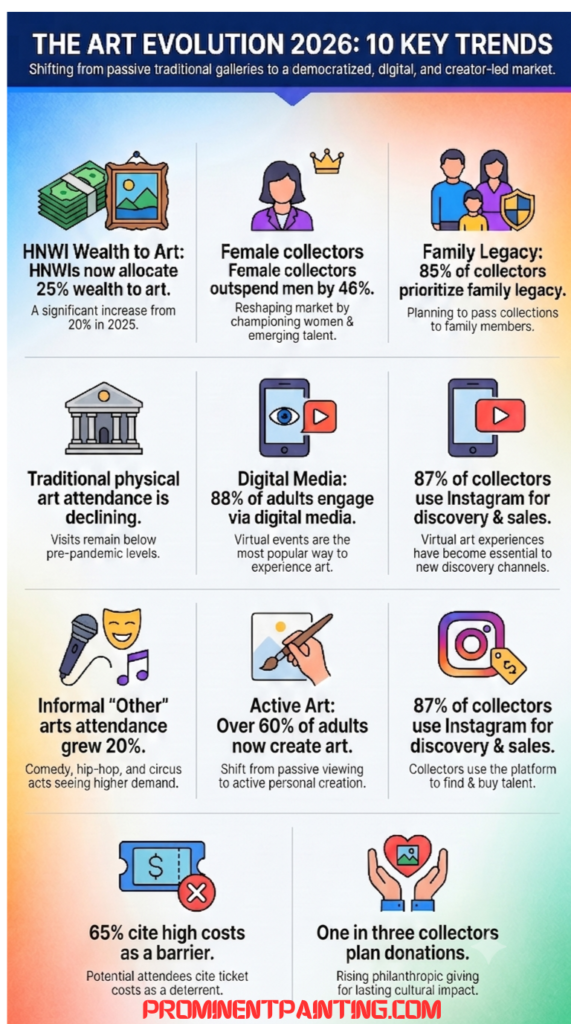
The profile of the global collector is undergoing a radical re-shuffle, moving away from the “Old Guard” and toward cohorts with entirely different motivations. The most striking shift is the ascent of the affluent female collector. In 2024, female High-Net-Worth (HNW) collectors outspent their male peers by a staggering 46%. This isn’t just about volume; it’s about values. These women allocate 47% of their budgets to female artists, a deliberate move to rectify historical representation gaps.
We are also seeing an intergenerational transfer of wealth—roughly $83 trillion—that is fundamentally redefining “taste.”
- The Boomer Legacy: Older collectors remain anchored in traditional fine art, with paintings accounting for 27% of their spending.
- The Millennial Lifestyle: This cohort merges collecting with a “cross-disciplinary” ethos, spending an average of $378,000 on decorative art and jewelry—more than triple the spend of older generations.
- The Gen Z Digitalist: Younger collectors lead the charge in digital and video art, while also treating luxury “alternative assets” like collectible sneakers and handbags with the same reverence once reserved for sculpture.
Crucially, the “advisor” has been decentralized. 38% of new art buyers and 35% of Millennials now purchase art directly through Instagram, using the platform for discovery rather than relying on gallery networks.
The Childhood Engine: Why Early Exposure Trumps a Graduate Degree
What makes a person value the arts as an adult? It isn’t a high-paying job or a PhD. Sociological data identifies one factor as the single strongest predictor of adult arts participation: childhood arts education.
Being taught a craft or an instrument during school years establishes cognitive and emotional pathways that adult education simply cannot replicate. The impact is staggering: adults with childhood arts exposure have an 80% attendance rate at cultural events, compared to just 58% for those without it. This suggests that cultural sustainability is a “long-game” requiring structural investment in youth rather than temporary subsidies for adults. As the Creative Australia report forcefully concludes:
“Arts access for children and young people emerged as Australians’ top priority for public arts investment, overtaking free and low-cost events.”
From Spectators to Creators: The Personal Renaissance
While the “spectacle” of live performance struggles—with jazz and classical attendance dropping significantly since 2002—we are seeing a massive surge in the “substance” of personal creation.
We are living through a “Personal Renaissance.” The proportion of adults personally creating or performing art—singing, creative writing, photography, or woodworking—jumped by 10.9 percentage points according to recent NEA data. This shift from audience to studio is fueled by the digital gateways mentioned earlier; the democratization of tools has turned the spectator into a participant.
Even at the highest levels of the market, the mood has shifted from the anonymous auction block to “direct, immersive encounters.” HNW collectors now average five artist studio visits per year, seeking a level of authenticity and personal connection that a catalog entry cannot provide.
The Geographic Truth: The Myth of the Urban Monopoly
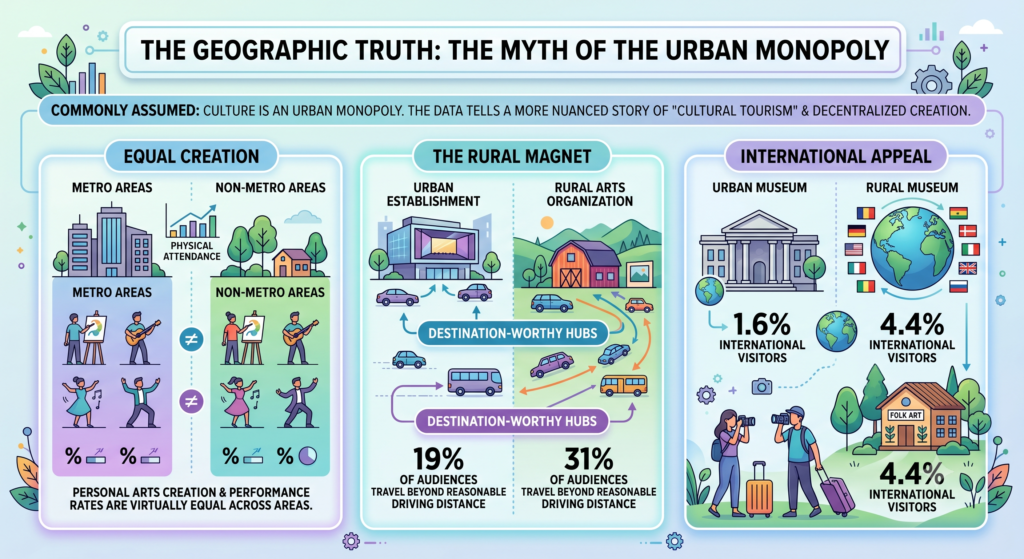
There is a common assumption that culture is an urban monopoly. The data, however, tells a more nuanced story of “Cultural Tourism” and decentralized creation.
- Equal Creation: While metropolitan areas lead in physical attendance, the rates of personal arts creation and performance are virtually equal across metro and non-metro areas.
- The Rural Magnet: Rural arts organizations are becoming destination-worthy hubs. 31% of their audiences travel “beyond a reasonable driving distance,” compared to only 19% for urban establishments.
- International Appeal: Perhaps most surprising is the international draw. Rural museums attract a significantly higher share of international visitors (4.4%) than their urban counterparts (1.6%).
Conclusion: A Market Grounded in Meaning
As we look toward the remainder of the decade, the cultural landscape appears more balanced and relationship-driven. While the speculative “million-dollar” auction markets have faced a necessary correction, the underlying mood is one of optimism. HNW collectors are now allocating an average of 20% of their portfolios to art, viewing it not just as an asset, but as a source of “emotional depth” and “legacy.”
However, we face a new tension: the rise of the machine. While 7% of novice collectors have already purchased AI-generated art, the general public remains wary; 93% of Australians express deep concern over AI’s impact on human creativity.
In an era where technology can perfectly simulate the “look” of creativity, we must ask: Will the ultimate value of art shift entirely away from the final product and toward the provable, human authenticity of the process?
Citations:
- Demographics of US Museum-Goers: A 2025 Annual Survey
- Demographics of US Museum-Goers: A 2024 Annual Survey Update
- Participation in the arts, culture and heritage – Ethnicity facts and figures (UK Government)
- New Data Reveal How Adults Participated in the Arts During COVID-19 (NEA)
- Main report for the Participation Survey (April 2024 to March 2025) (UK Government)
- Participation in Cultural Activities – Scottish Household Survey 2020
- A Full Report of the 2022 Survey of Public Participation in the Arts (NEA)
- Art + Inclusion – High Museum of Art
Note: AI has been used to summarise and analyse the data. AI can make mistakes.