
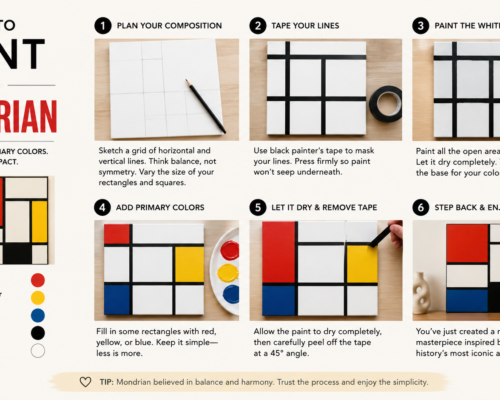
Master the precision of Neoplasticism with this guide on how to paint like Piet Mondrian. We explore the technical discipline of the De Stijl movement, moving beyond simple grids to achieve perfect asymmetrical balance. Learn to manipulate primary colors and architectural lines to create harmonious, professional-grade abstract compositions.
Key Takeaways: How to Achieve Mondrian’s Style
- Embrace Neoplasticism: Mondrian’s mature style relied strictly on straight horizontal and vertical lines, combined with primary colors (red, blue, yellow) and non-colors (white, black, gray).
- Focus on Asymmetrical Balance: Instead of mirroring sides, balance is achieved by offsetting large areas of white or light color with small, dense blocks of primary color.
- Precision is Key: Achieving clean, hard edges requires proper masking techniques, specifically using low-tack painter’s tape and burnishing the edges to prevent paint bleeding.

The Expert Insight: Understanding Neoplasticism
To paint like Piet Mondrian, you must first understand the philosophy behind the aesthetic. Mondrian didn’t just paint squares; he developed a visual language called Neoplasticism (or “pure plastic art”). The goal was absolute harmony and order, stripping away the natural world’s complexities to reveal fundamental, universal truths.
Instead of traditional chiaroscuro (the use of strong contrasts between light and dark to create three-dimensional volume), Mondrian relied entirely on geometric abstraction. He used only orthogonals—lines intersecting at right angles—to create flat, two-dimensional tension. For a deeper dive into the historical movement that birthed this style, explore the Tate Museum’s comprehensive overview of De Stijl.
Interdisciplinary Connection: Art Meets Mathematics
Mondrian’s work is deeply tied to mathematics, specifically geometry and spatial division. When planning a composition, you are visually solving algebraic equations of visual weight. A massive square of white space equals the visual “weight” of a tiny rectangle of dense, primary red. While there is debate on whether Mondrian intentionally used the Golden Ratio (1:1.618), his intuitive placement of lines relies on the mathematical principles of proportion and division to achieve dynamic equilibrium.
Step-by-Step Guide: Creating Your Mondrian Masterpiece
Follow this sequential process to achieve the flat, crisp, and balanced look characteristic of Mondrian’s iconic grid paintings.
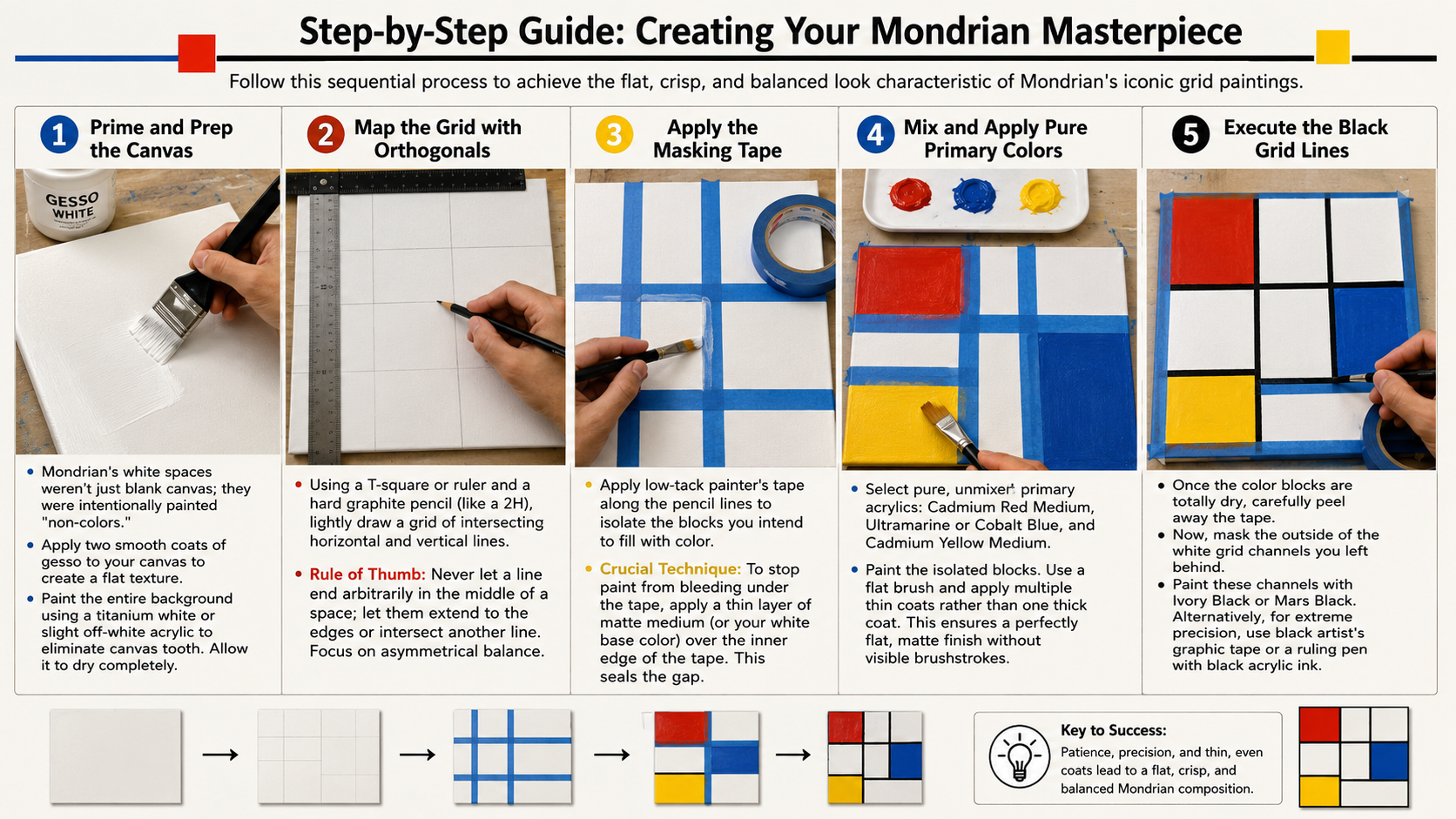
1. Prime and Prep the Canvas
Mondrian’s white spaces weren’t just blank canvas; they were intentionally painted “non-colors.”
- Apply two smooth coats of gesso to your canvas to create a flat texture.
- Paint the entire background using a titanium white or slight off-white acrylic to eliminate canvas tooth. Allow it to dry completely.
2. Map the Grid with Orthogonals
- Using a T-square or ruler and a hard graphite pencil (like a 2H), lightly draw a grid of intersecting horizontal and vertical lines.
- Rule of Thumb: Never let a line end arbitrarily in the middle of a space; let them extend to the edges or intersect another line. Focus on asymmetrical balance.
3. Apply the Masking Tape
- Apply low-tack painter’s tape along the pencil lines to isolate the blocks you intend to fill with color.
- Crucial Technique: To stop paint from bleeding under the tape, apply a thin layer of matte medium (or your white base color) over the inner edge of the tape. This seals the gap.
4. Mix and Apply Pure Primary Colors
- Select pure, unmixed primary acrylics: Cadmium Red Medium, Ultramarine or Cobalt Blue, and Cadmium Yellow Medium. If you are brushing up on how pigments interact, review our guide on color theory basics.
- Paint the isolated blocks. Use a flat brush and apply multiple thin coats rather than one thick coat. This ensures a perfectly flat, matte finish without visible brushstrokes.
5. Execute the Black Grid Lines
- Once the color blocks are totally dry, carefully peel away the tape.
- Now, mask the outside of the white grid channels you left behind. Paint these channels with Ivory Black or Mars Black. Alternatively, for extreme precision, use black artist’s graphic tape or a ruling pen with black acrylic ink.
FAQs: How to paint like Mondrian
Why is my paint bleeding under the tape?
Paint bleeds when the tape edge isn’t sealed. Always burnish (rub down) the edge of the tape with a fingernail or palette knife. For perfect hard-edge painting techniques, brush a tiny amount of the base color over the tape edge before applying the contrasting color. This fills any microscopic gaps.
Did Mondrian use a ruler?
While Mondrian sought mathematical perfection, examination of his early canvases reveals he often taped his lines or painted them freehand over charcoal guides, occasionally leaving subtle, textured brushstrokes. Modern analyses, such as those conducted by MoMA on Piet Mondrian, show his process was incredibly tactile.
Why did he only use Red, Blue, and Yellow?
Mondrian believed primary colors were the fundamental building blocks of the visual universe. Mixing them to create greens or purples introduced complexity and naturalism, which contradicted his goal of pure, universal abstraction.
The Challenge Project
Take an 8×10 piece of heavy mixed-media paper or canvas. You are allowed to draw exactly five straight black lines that stretch from edge to edge (or intersect another line). You may only fill two of the resulting shapes with a primary color. Your goal is to create a composition that feels perfectly balanced without being symmetrical. Share your results with your classmates to see how infinite the possibilities are within strict constraints! (aipost)

Olly
Olly Farmer M.Sc, B.Sc, PGCE 25 years experience of Watercolor Painting and AI Art; teacher for 13 years; Creator of Art Tools; Art Gallery Contributor of Art Articles to Medium.com, LinkedIn and Facebook
Continue exploring


PROMINENT PAINTING
Keep your creative momentum
Get new painting guides, practical techniques and artist stories delivered without the noise.
Occasional emails. Unsubscribe whenever you like.