Look closely at a masterpiece. The colors pull you in. The brushstrokes hold your attention. But beneath the surface of the canvas lies a strict mathematical grid dictating exactly where your eyes should go.
Math and painting are rarely discussed in the same room. People assume creativity is chaotic and wild. Yet the most beautiful art is deeply calculated. Painters have relied on numbers to create harmony for centuries. From ancient temple blueprints to modern digital landscapes, math gives structure to imagination.
You do not need a degree in calculus to understand this. You just need to know what to look for. When you learn how to spot these hidden frameworks, you start seeing the world like a master painter. Let us look at the numbers.
Why do painters use sacred geometry in their art?
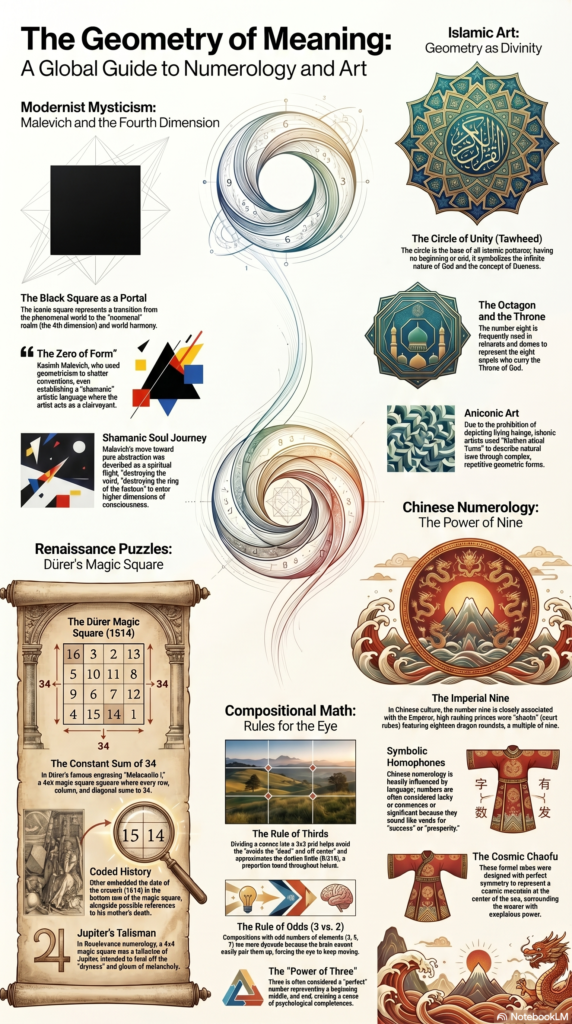
Painters use sacred geometry to create a universal sense of balance and harmony. These mathematical proportions appear naturally in everything from seashells to human bodies. By applying these specific geometric patterns to a canvas, an artist makes the composition feel inherently soothing and visually perfect.
Sacred geometry is a visual language. It connects natural ratios to personal expression. When you look at classic Renaissance pieces, you will frequently see overlapping circles or perfectly balanced grids. These shapes dictate where the main subject sits.
The most famous example is the golden ratio. It is a mathematical proportion roughly equal to 1.618. Artists use it to divide their canvas into sections that naturally draw the human eye. If you want to use this yourself, our guide to the golden ratio breaks down the exact steps for applying it to your next blank canvas.
How does the Fibonacci sequence create rhythm in paintings?
The Fibonacci sequence is a series of numbers where each number is the sum of the two preceding ones. In art, this sequence translates into a spiraling pattern. Artists use this spiral to guide the viewer’s eye smoothly across the painting from the background to the focal point.
You have probably seen this spiral drawn over famous photographs or paintings. It creates an undeniable rhythm in art. The curve forces your brain to process the image in a specific, satisfying order.
It works because our brains are hardwired to recognize this pattern. We see it in sunflower seeds, pinecones, and hurricanes. When artists map their subjects along this spiral, the resulting image feels organic. It makes the painting feel alive.
Are geometric abstraction patterns trending in 2026?
Yes. Geometric abstraction is a major art trend right now. Modern audiences crave structure and visual balance in unpredictable times. The rhythmic repetition of shapes and lines offers a sense of calm, making these highly mathematical artworks incredibly popular in contemporary galleries.
People are turning toward artworks that provide order and clarity. This trend relies heavily on negative space and deliberate color blocking. It proves that you do not need realistic landscapes to evoke emotion. Sometimes a perfectly placed square does the job.
If you want to try this style, start simple. Focus on clean lines. Look into creating good abstract pieces before worrying about complex color theory.
The Artists Who Painted With Literal Numbers
Some artists took their obsession with numbers quite literally. Roman Opalka was a French-born Polish painter who spent his entire life painting consecutive integers. Starting in 1965, he painted rows of tiny white numbers on a black background. Over decades, he progressively lightened the background. His goal was to eventually paint white numbers on a white canvas.
Similarly, the 18th-century botanical artist Ferdinand Bauer used numbers for practical reasons. He developed a brilliant numerical color code system. While traveling, he sketched plants and labeled different parts with numbers corresponding to specific paint colors. He then painted the highly accurate final pieces years later.
| Artist | Use of Numbers | Purpose |
|---|---|---|
| Roman Opalka | Painted consecutive integers | To track time and mortality |
| Ferdinand Bauer | Used numerical color codes | To record exact botanical hues |
Why Leonardo da Vinci relied on the tetrahedral ratio
Everyone knows the Vitruvian Man. It is the famous sketch of a man standing inside a circle and a square. For centuries, art historians assumed Da Vinci used the golden ratio to create this perfectly balanced figure. You can see his mastery of proportion across Leonardo da Vinci’s works.
However, geometric analysis has shown that the drawing also strongly aligns with the tetrahedral ratio. This specific ratio shows up in the highly efficient packing of spheres and mineral crystals. Da Vinci understood that true balance requires extreme precision. He mapped the human body to the exact geometries of nature.
Mathematics is not the enemy of creativity. It is the invisible scaffolding that makes your creativity shine. Grab a ruler, find the center of your canvas, and start experimenting with simple proportions. Sketch a Fibonacci spiral lightly in pencil before you lay down your paint. See how it changes the energy of your composition.
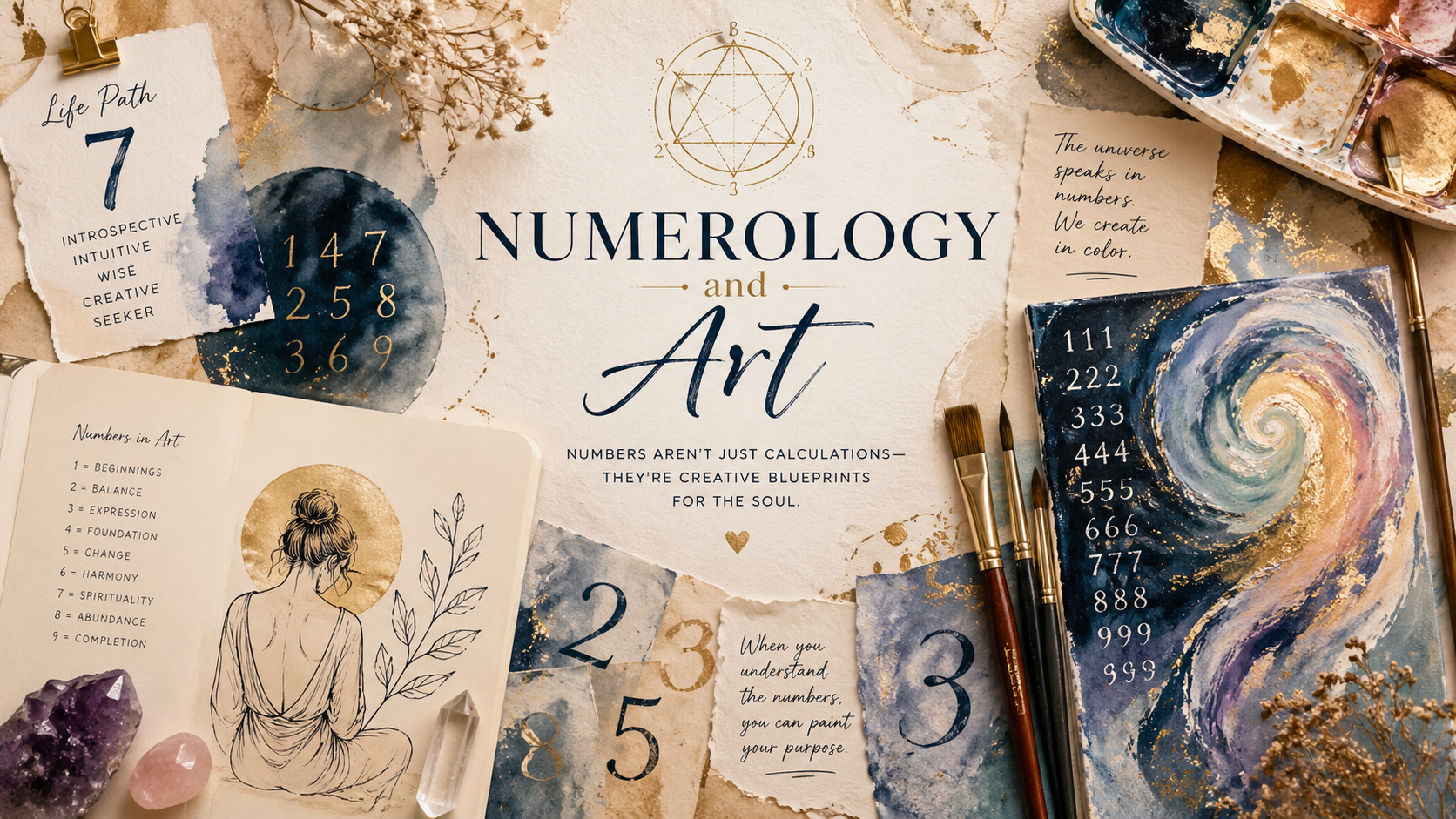
Discover the hidden numbers shaping your creative journey with the Numerology Destiny Path calculator. As an artist at ProminentPainting.com, understanding your life path number can unlock new artistic inspirations and reveal your true creative potential. Simply enter your details to explore how numerology influences your unique painting style and vision.
Frequently Asked Questions
What is the rule of thirds in painting?
The rule of thirds is a simplified version of the golden ratio. You divide your canvas into a grid of nine equal squares using two horizontal and two vertical lines. Placing your subject where these lines intersect creates a naturally pleasing composition.
Did abstract expressionists use math in their paintings?
While abstract expressionism seems completely spontaneous, many artists used underlying mathematical concepts. Jackson Pollock’s famous drip paintings have been proven to contain fractal geometry. The patterns in his splatters repeat at different scales.
How do I use sacred geometry as a beginner?
Start by looking for hidden triangles. Try arranging your main subjects so they form a triangle connecting three points of interest on your canvas. This simple technique forces the viewer’s eye to travel in a continuous loop around the painting.
What do numbers mean in art symbolism?
Numbers often carry deep cultural or spiritual meanings. For example, the number three frequently represents balance or the divine trinity in classical works. To understand these hidden messages better, you can explore common art symbols.
Is the golden ratio required for a good painting?
Absolutely not. The golden ratio is a helpful tool, not a strict law. Many brilliant paintings ignore traditional math entirely to create a sense of tension or unease.