
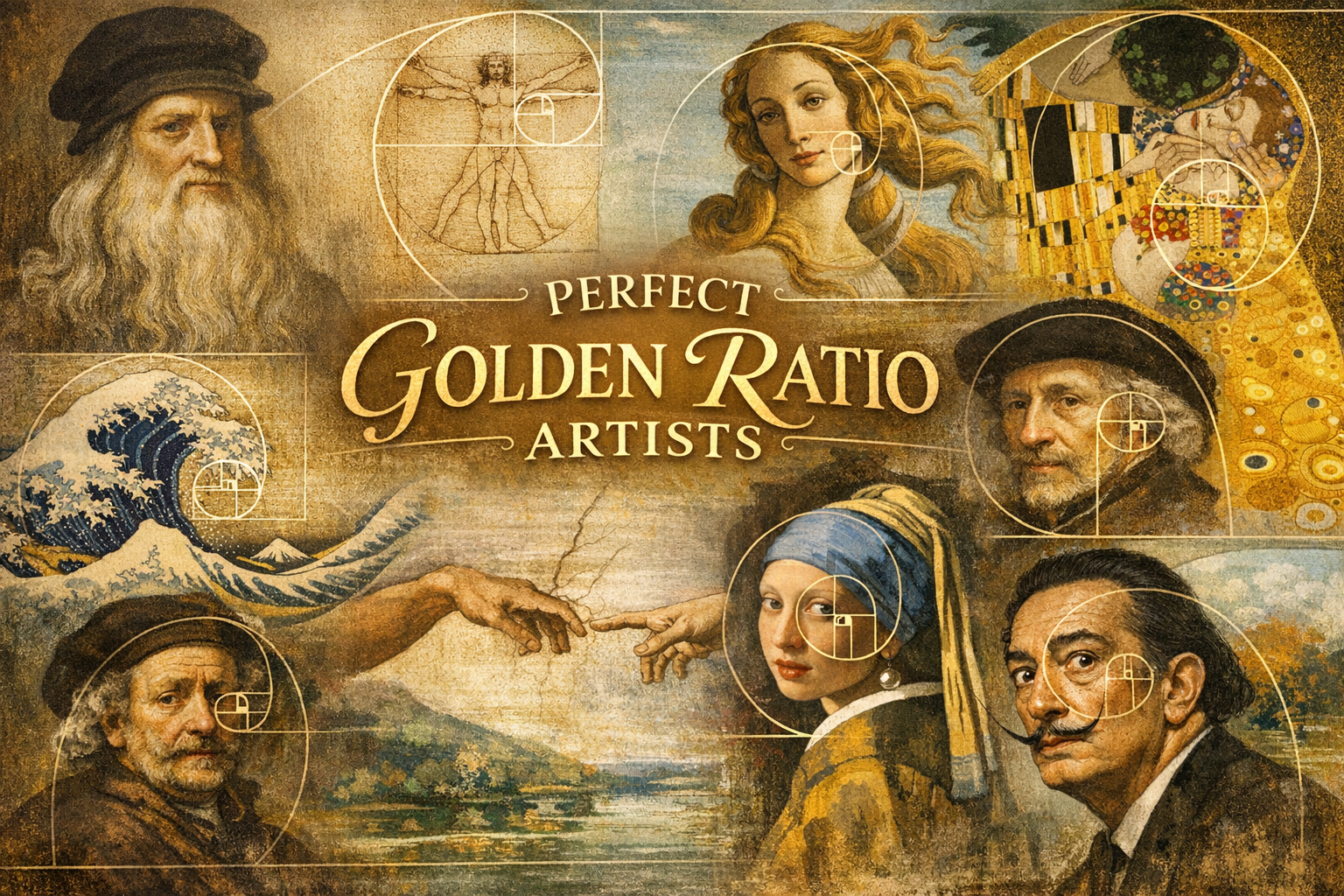
The golden ratio (1.618) is a mathematical proportion that artists like Leonardo da Vinci and Salvador Dalí used to create visually pleasing compositions. This post explains how the ratio works in famous paintings and whether it actually guarantees beautiful art. You will learn how to identify the divine proportion in art history and apply it practically to your own blank canvases.
Artists have chased geometric perfection for centuries. When we look at masterworks, we often want a simple formula to explain why they look so good. You hear a lot about perfect golden ratio artists who supposedly cracked the code to human aesthetics. The truth is a bit messier.
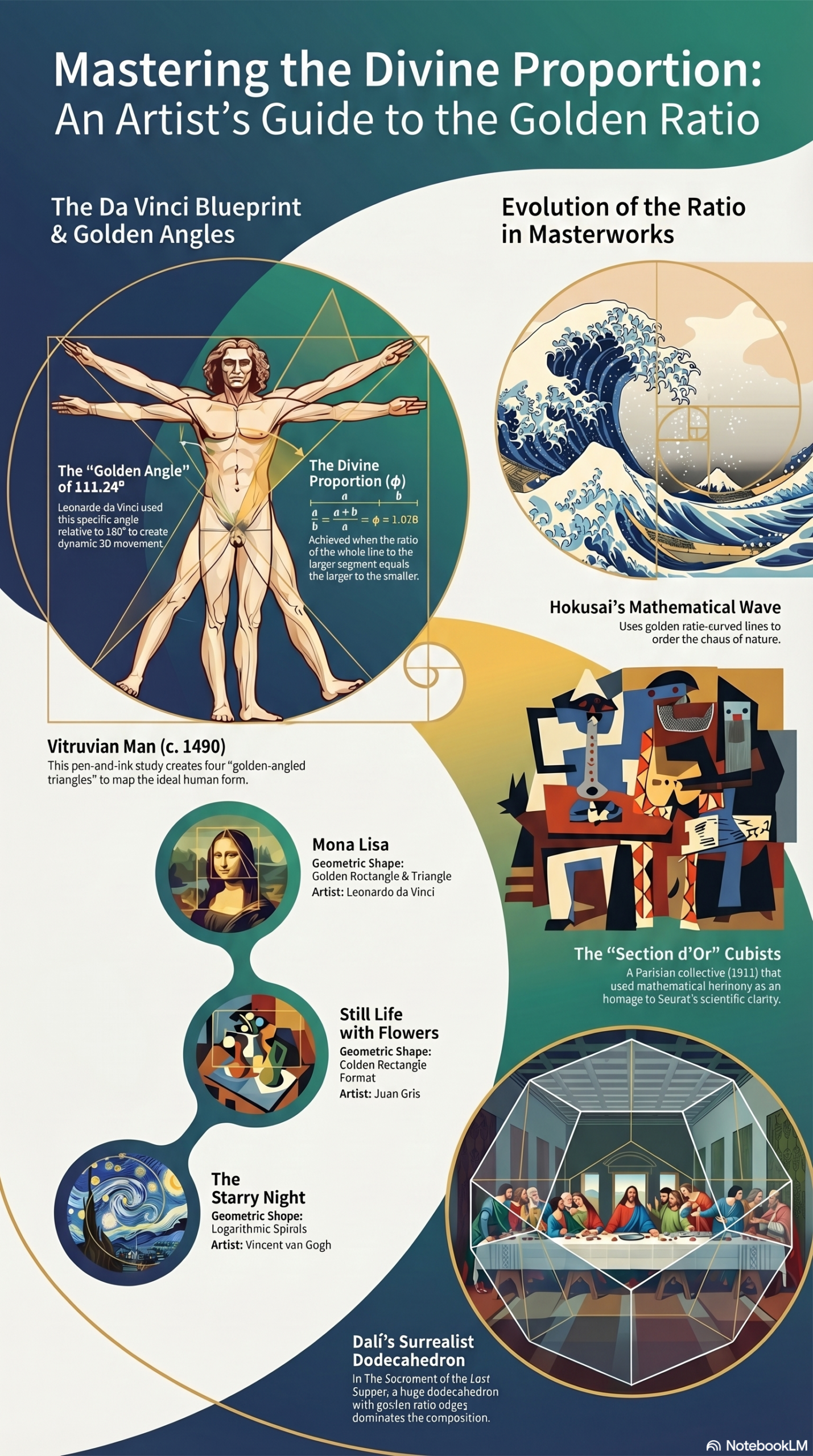
The golden ratio, or Phi (1.618), is a real mathematical concept. People have obsessed over it since the ancient Greeks. You will see it cited alongside legends like Leonardo da Vinci and Salvador Dalí. But while the math is real, many claims about the golden ratio are exaggerated. Not every beautiful painting aligns perfectly with this number. Some famous artists and their styles rely entirely on instinct rather than rigid geometry.
We are going to look at the history of this famous number. We will see who actually used it, what scientists say about it, and how you can use a simplified version of it in your own work.
What Is the Golden Ratio in Painting?
The golden ratio is a mathematical proportion equaling roughly 1.618. In painting, it is used to divide a canvas so that the longer part divided by the smaller part is equal to the whole length divided by the longer part. This creates a visually balanced, naturally pleasing composition.
Mathematicians call this number Phi. Euclid defined this geometric ratio over two thousand years ago. When you apply this proportion to a rectangle, you get a shape that humans supposedly find naturally beautiful. As you divide that rectangle into smaller golden sections, it forms a spiral. You see this spiral pattern in nature all the time, from seashells to storm clouds.
Did Leonardo da Vinci Really Use the Golden Ratio?
Yes, Leonardo da Vinci used the golden ratio. He famously collaborated with mathematician Luca Pacioli in 1509 to illustrate a book entirely about this divine proportion. Da Vinci intentionally applied these mathematical principles to structure his most famous religious paintings and portraits.
Da Vinci was as much a scientist as an artist. He worked directly with Pacioli on De Divina Proportione, a foundational text on mathematics and aesthetic proportions. When you look at The Last Supper, you can see structural evidence of the ratio. Scholars have mapped golden rectangles directly over the architecture framing Jesus and his disciples.
The Mona Lisa is a different story. People love to overlay the golden spiral on her face. Many historians argue Da Vinci did not intentionally use the exact ratio there. If you study enough famous painters and paintings, you learn that artists often paint what looks right naturally. Sometimes the math just happens to line up later.
How Did Salvador Dalí Apply Mathematical Proportions?
Salvador Dalí applied mathematical proportions explicitly in works like The Sacrament of the Last Supper. He framed the entire composition inside a massive dodecahedron, a 12-sided geometric shape built entirely on golden ratio proportions. He treated the math as a strict compositional rule.
Dalí was obsessed with science and classical geometry. While many surrealists painted pure dreamscapes, Dalí anchored his bizarre visions in rigid structures. You can see this tension in many Salvador Dali paintings. His use of the dodecahedron was not a subtle suggestion. He painted the geometric lines directly into the background of the scene.
What Do Scientific Studies Say About Aesthetic Perfection?
Art historians love the golden ratio, but scientists are more skeptical. The idea that 1.618 is a universal standard for beauty actually faces quite a bit of pushback. Back in 1876, Ver PDF – ujaen.es showing that only about 35% of people naturally prefer a golden rectangle.
More recent data tells a similar story. A 1997 study analyzed 594 pieces of art to see if painters naturally gravitated toward the golden proportion. They found that the average aspect ratio of these paintings was 1.3, which is significantly shorter and wider than 1.618. Even painters famous for structural geometry, like Georges Seurat, relied on simpler geometric boundaries rather than strict Phi calculations.
How Can Beginners Test the Ratio in Their Work?

Beginners can test the golden ratio by using a simplified grid instead of complicated math. Divide your canvas into three sections horizontally and vertically, but make the middle sections slightly narrower than the outer edges. Place your main subject where those lines intersect.
You do not need a calculator to paint a beautiful picture. Modern artists generally agree that the ratio is just a helpful tool for aesthetic framing. In my decade of teaching as an arts educator, I see beginners freeze up when they try to make their sketches mathematically perfect.
When I teach my students how to place their focal points, we ignore the decimals. We use the Rule of Thirds as a stand-in for the golden ratio. It is close enough to trick the eye and much easier to draw on a blank canvas. Math should support your creativity, not hold it hostage.
Conclusion
The golden ratio is a fascinating piece of art history. Geniuses like Da Vinci and Dalí used it to push the boundaries of composition. But as the data shows, you do not need to hit 1.618 exactly to create something people want to look at. Math is a great starting point when you feel stuck on a blank canvas.
Do not let the geometry intimidate you. On your next painting, try sketching out a basic offset grid before you pick up a brush. Place your subject on one of the intersecting lines and see how it changes the balance of your piece.
Frequently Asked Questions
- What is the exact number of the golden ratio? The golden ratio is an irrational number that begins with 1.6180339. Mathematicians usually round it to 1.618 for practical use. It is represented by the Greek letter Phi.
- Did Michelangelo use the golden ratio? Yes, Michelangelo used the golden ratio in several works. The most famous example is The Creation of Adam on the Sistine Chapel ceiling. The point where God and Adam’s fingers almost touch perfectly aligns with the golden proportion of the fresco.
- What is the Fibonacci sequence in art? The Fibonacci sequence is a series of numbers where each number is the sum of the two preceding ones. When you map these numbers as squares on a canvas, they create a spiral. This spiral acts as a visual guide that mimics the golden ratio.
- How do I find the golden ratio on a blank canvas? You can find it by multiplying the length of your canvas by 0.618. Draw a line at that exact measurement. This splits your canvas into two sections that perfectly represent the golden proportion.
- Do modern artists still use mathematical proportions? Yes, many modern artists and graphic designers use the golden ratio to structure their layouts. It is especially common in logo design and digital illustration. However, most painters prefer simpler techniques like the Rule of Thirds to achieve a similar balanced look.

Olly
Olly Farmer M.Sc, B.Sc, PGCE 25 years experience of Watercolor Painting and AI Art; teacher for 13 years; Creator of Art Tools; Art Gallery Contributor of Art Articles to Medium.com, LinkedIn and Facebook
Continue exploring

PROMINENT PAINTING
Keep your creative momentum
Get new painting guides, practical techniques and artist stories delivered without the noise.
Occasional emails. Unsubscribe whenever you like.