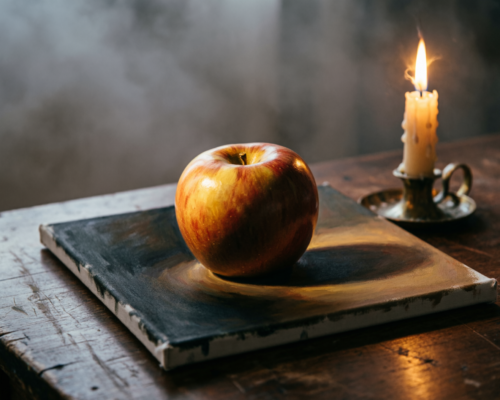
Imagine a canvas where darkness isn’t empty—it’s alive. Where a single beam of light doesn’t just illuminate… it reveals. Where every fold of fabric, every tear on a cheek, every glint in an eye feels so real you can almost reach out and touch it.
This is the power of Caravaggio’s painting technique—a revolutionary approach that changed art forever.
Michelangelo Merisi da Caravaggio (1571–1610) didn’t just paint—he staged dramas with light. His use of chiaroscuro (Italian for “light-dark”) wasn’t subtle. It was bold, theatrical, and emotionally charged. He turned ordinary people into saints, sinners, and heroes—not by idealizing them, but by illuminating their humanity through stark contrasts.
And here’s the best part: you don’t need to be a master to learn from him. In fact, his techniques are perfect for beginners who want to add instant depth, mood, and realism to their work—even with simple materials.
Let’s break down Caravaggio’s method—and show you how to apply it today.
Why Caravaggio Still Matters Today
Before Caravaggio, Renaissance art favored balanced compositions, soft transitions, and idealized beauty. Caravaggio shattered those rules.
He painted directly from life—using street performers, prostitutes, and laborers as models. He skipped preliminary sketches. He worked fast, often finishing paintings in days. And he used light not just to see forms—but to tell stories.
His influence? Immense. Rembrandt, Velázquez, Goya, even modern filmmakers like Scorsese and Nolan owe a debt to his visual language.
For today’s artist, studying Caravaggio means learning:
- How to create focus using light
- How to evoke emotion through contrast
- How to simplify complex scenes into powerful statements
The Core of Caravaggio’s Technique: Tenebrism + Chiaroscuro
While often used interchangeably, these terms have distinct meanings:
🔹 Chiaroscuro: The general use of strong contrasts between light and dark to model three-dimensional form. Used by Leonardo, Raphael, and others before Caravaggio—but softened.
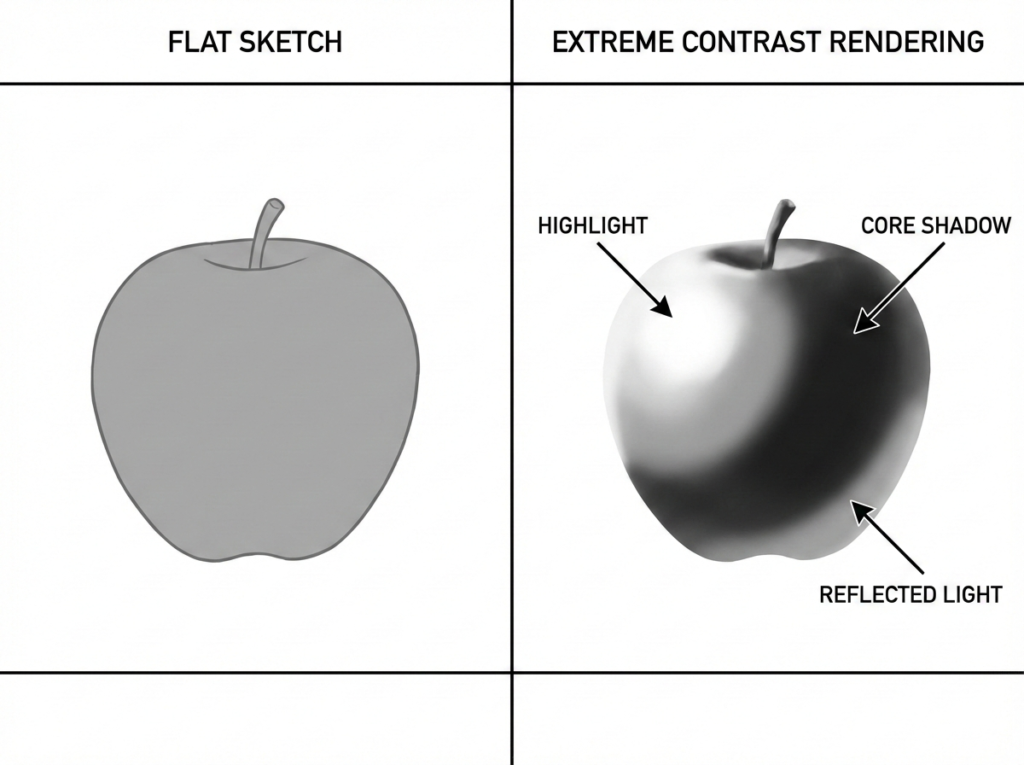
🔹 Tenebrism (“tenebroso” = murky/dark): Caravaggio’s signature style. Extreme, almost violent contrasts. Deep blacks swallow most of the scene; light slashes through like a spotlight. Think of it as “dramatic chiaroscuro.”
💡 Think of tenebrism as theater lighting: one actor lit, everything else in shadow. That’s Caravaggio.
Step-by-Step: How to Paint Like Caravaggio (Beginner-Friendly)
You don’t need oil paints or a studio. Try this adapted version with acrylics or watercolors.
🎨 Step 1: Choose Your Subject Wisely
Caravaggio focused on intense moments: a hand reaching, a face turning, a knife being drawn. Pick something simple but emotionally charged:
- A fruit half-lit by a window
- A hand holding a candle
- A face partially in shadow
Avoid busy backgrounds. Let darkness do the work.
🎨 Step 2: Block in the Darkest Darks First
Unlike traditional methods (light to dark), Caravaggio started with the deepest shadows.
→ Mix your darkest tone (black + burnt umber or ultramarine).
→ Paint ALL areas that will remain in shadow—including background.
→ Don’t worry about details yet. Just establish the “void.”
✅ Pro Tip: Use a large brush. Speed matters. Caravaggio worked quickly to capture raw energy.
🎨 Step 3: Define the Light Source
Decide where your light comes from: a candle? a window? a divine glow?
→ Mark the brightest highlight area lightly with pencil or thin white wash.
→ Everything else should gradate toward darkness.
🎨 Step 4: Build Mid-Tones with Bold Strokes
Now, layer mid-tones between your blacks and whites.
→ Use thick, directional brushstrokes following the form (e.g., curves around a cheekbone).
→ Leave some edges sharp, some blurred—Caravaggio loved ambiguity at the edge of light.
🎨 Step 5: Add Highlights Last — Sparingly
The final touch: pure white or near-white highlights.
→ Apply only to the very peak of forms: tip of nose, edge of lip, glint in eye.
→ Keep them small. Too many = loss of drama.
⚠️ Warning: Over-highlighting kills tension. Less is more.
3 Key Principles to Steal from Caravaggio
1. Light Is a Character
In Caravaggio’s world, light isn’t passive—it acts. It reveals truth, exposes guilt, guides the viewer’s eye. Ask yourself: What story does my light tell?
2. Shadow Creates Mystery
Don’t fear the dark. Let it hide, suggest, imply. What’s hidden often intrigues more than what’s shown.
3. Imperfection Is Power
Caravaggio’s models had wrinkles, dirt, uneven skin. He didn’t airbrush reality—he amplified it. Embrace flaws. They make your work human.
Common Mistakes Beginners Make (and How to Fix Them)
❌ Too much gradient → loses drama
→ Solution: Harder edges between light and dark. No blending unless necessary.
❌ Highlights too big or scattered → weakens focal point
→ Solution: Limit highlights to 1–3 key spots per subject.
❌ Background too detailed → distracts from main subject
→ Solution: Flatten background into solid black or deep brown. Let subject pop.
❌ Overworking the painting → loses spontaneity
→ Solution: Set a timer. Finish in under 90 minutes. Capture the moment, not perfection.
Modern Applications: Where You See Caravaggio Today
You don’t need to paint religious scenes to use his techniques.
🎬 Film & Photography: Noir films, horror movies, portrait photography—all use tenebristic lighting to create mood.
🎮 Video Games: Games like Dark Souls, Resident Evil, and The Last of Us rely heavily on chiaroscuro for atmosphere.
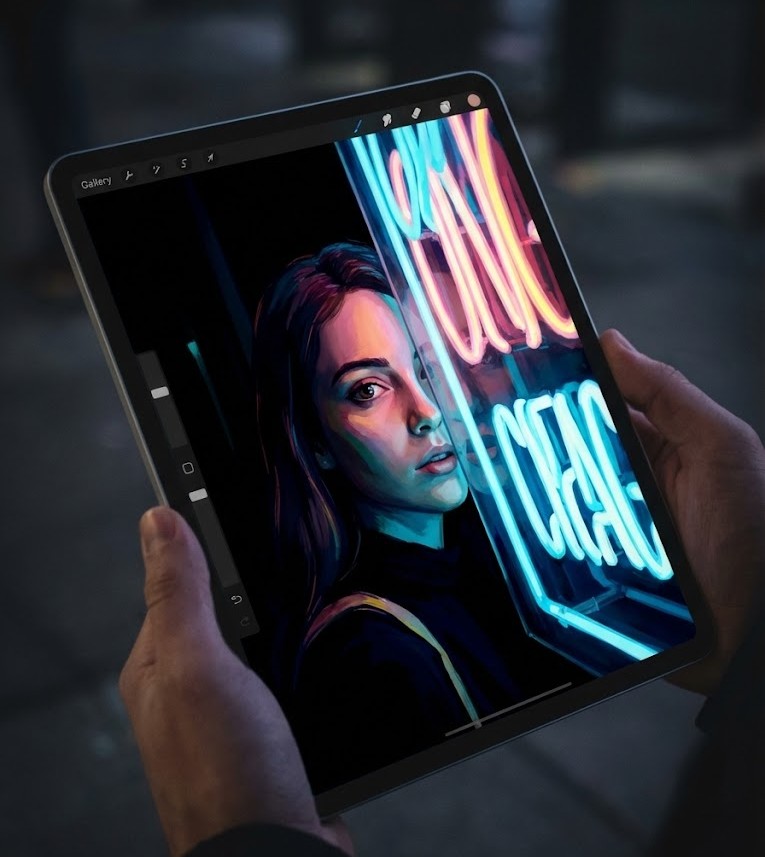
🖼️ Digital Art: Concept artists and illustrators use digital brushes mimicking Caravaggio’s stroke patterns for cinematic effects.
Even Instagram filters named “Noir,” “Drama,” or “Moody” are essentially digital tenebrism.
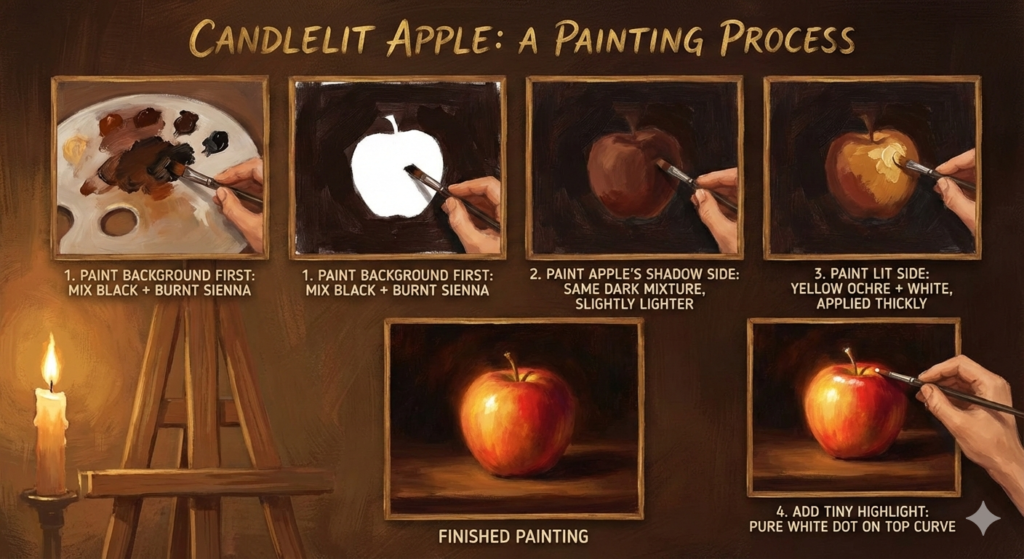
Try This Quick Exercise: “Candlelit Apple”
Perfect for beginners. Takes 20 minutes.
Supplies: One apple, one candle, phone flashlight (optional), acrylic paints (black, white, burnt sienna, yellow ochre), small canvas or paper.
Steps:
- Place apple on table. Light candle beside it (or use phone flashlight angled low).
- Observe: Where is the brightest spot? Where does shadow fall hardest?
- Paint background first: mix black + burnt sienna → cover entire surface except apple.
- Paint apple’s shadow side: same dark mixture, slightly lighter.
- Paint lit side: yellow ochre + white, applied thickly.
- Add tiny highlight: pure white dot on top curve.
- Step back. Does it feel dramatic? If yes—you’ve channelled Caravaggio.
Final Thought: Darkness Isn’t Empty—It’s Full of Possibility
Caravaggio taught us that light needs darkness to matter. Without shadow, there’s no depth. Without contrast, no emotion. Without risk, no revelation.
You don’t need to paint martyrs or murderers to use his genius. Just pick up your brush, embrace the dark, and let one beam of light change everything.
Start small. Be bold. Let your shadows speak.
Ready to go deeper? Explore our guide on mastering value scales or learn how to build dramatic composition. For more historical technique breakdowns, visit our Art History for Painters section.