Imagine a classroom where every student is eager to speak. There are no “wrong” answers, only observations backed by evidence. The quietest student in the back raises their hand to point out a detail everyone else missed, and suddenly, the whole class shifts their perspective. This isn’t a fantasy; it is the practical result of Visual Thinking Strategies (VTS).
As art experts and educators, we often focus on the history or the technique of a piece, perhaps debating how to identify Realism art or the nuances of brushwork. But VTS flips the script. It uses art not just as a subject to be learned, but as a tool to teach critical thinking, visual literacy, and communication skills that transcend the art room.
Whether you are a museum guide, a math teacher, or a parent, mastering VTS can transform the way your students process information.
Key Takeaways:
- VTS is an inquiry-based method centered on three specific questions.
- It is scientifically proven to boost critical thinking and language skills.
- It is not limited to art; it is highly effective in Science, Math, and for English Language Learners.
- It differs significantly from routines like “See, Think, Wonder” by focusing on facilitated group discourse.
What Are Visual Thinking Strategies (VTS)?
Defining VTS: More Than Just Looking at Art
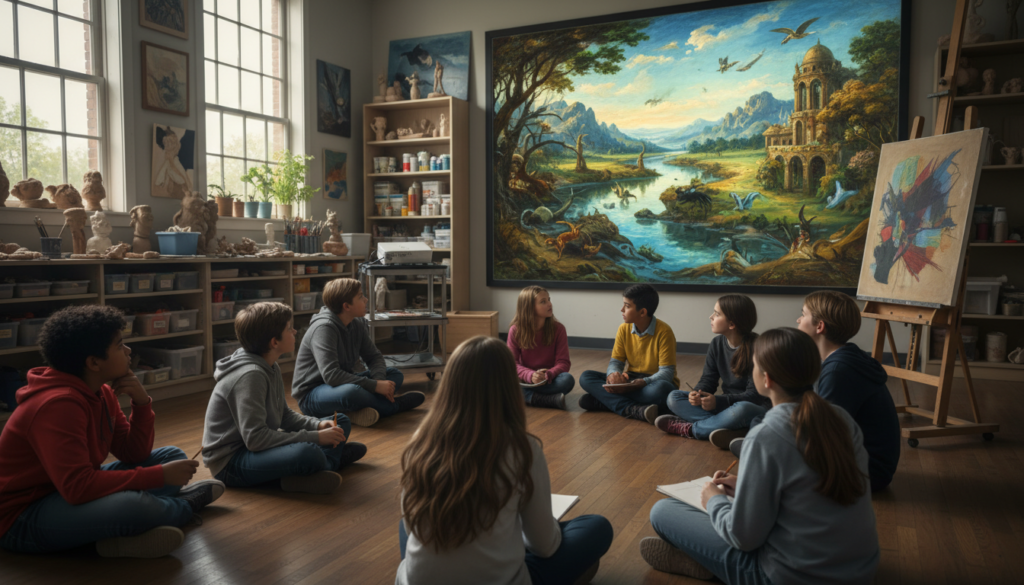
At its simplest, Visual Thinking Strategies is a facilitation method initiated by Philip Yenawine (former Director of Education at the Museum of Modern Art, MoMA) and cognitive psychologist Abigail Housen. It is a system of open-ended inquiry where a facilitator (the teacher) guides a group discussion about an image.
However, unlike a typical art history lecture where the teacher provides facts (like the dates of famous painters and paintings), VTS asks the students to do the work. It relies on Constructivism—the idea that learners build their own understanding through experience and reflection.
The Core Component: The Three VTS Questions
The magic of VTS lies in its simplicity. The entire method revolves around three rigorous questions. You cannot change them, and you cannot skip them. They are designed to scaffold thinking.
Question 1: “What’s going on in this picture?”
This is an invitation. It is broader than “What do you see?” asking “What is happening?” encourages narrative building. It allows students to enter the conversation at their own level.
Question 2: “What do you see that makes you say that?” (The Evidence Anchor)
This is the most critical question. When a student says, “The man looks sad,” the facilitator asks this question to force the student to provide evidence-based reasoning. The student must look back at the image and say, “Because his head is down and the colors are dark.” This builds the bridge between opinion and fact.
Question 3: “What more can we find?”
Notice it says “we,” not “you.” This implies a group effort. It also suggests that the image is not “finished” after one comment. It encourages exhaustiveness and deeper looking.
The Role of the Facilitator: Neutrality, Paraphrasing, and Pointing
In VTS, the teacher is not the authority; they are the guide. Your role involves three specific behaviors:
- Pointing: You must physically point to what the student mentions. This anchors the group’s attention.
- Paraphrasing: You repeat what the student said, validating their contribution but using neutral language. You might link their comment to a previous one (“So, you agree with Sarah that…”).
- Neutrality: You do not praise (“Good job!”) or correct (“Actually, that’s not right”). This creates a safe environment where students take risks.
The History and Science Behind VTS
Origins at MoMA: Philip Yenawine and Abigail Housen
In the late 1980s, MoMA discovered a problem. Despite their educational tours, visitors weren’t retaining information or engaging deeply with the art. They were engaging in “drive-by” viewing. Yenawine teamed up with Housen to figure out why. They realized that teaching facts doesn’t work if the viewer hasn’t developed the aesthetic development necessary to process them.
Housen’s Theory of Aesthetic Development
Abigail Housen’s research identified five stages of aesthetic development. Most casual viewers (and students) start at Stage I or II. VTS is designed to move them through these stages.
- Stage I: Accountive: Listeners are storytellers. They use their senses and personal memories to make concrete observations. “That looks like my dog.”
- Stage II: Constructive: Viewers demand that the image looks “realistic” and matches their social values. If it’s weird or abstract (like Abstract Art Movements), they might reject it.
- Stage III: Classifying: The viewer acts like an art historian, identifying the style, school, or time period.
- Stage IV: Interpretive: Viewers seek subtle emotional encounters and symbols.
- Stage V: Re-creative: A rare stage where the viewer suspends disbelief and engages in a long history of viewing.
Constructivism in Practice: How Students Build Meaning Together
VTS relies on social learning. When one student notices a shadow, another notices the light source. A third student synthesizes this to determine the time of day. They are “constructing” knowledge together. This is vastly different from a teacher explaining what is Renaissance Art and expecting students to memorize it.
The Evidence: Does VTS Actually Work?

Educators love theories, but we need data. VTS is one of the few arts-integration methods with rigorous empirical backing.
Impact on Critical Thinking and Literacy
Research consistently shows that VTS improves Visual Literacy and critical thinking. But interestingly, these skills transfer to other subjects. A student who learns to back up an observation about a painting with visual evidence will later back up a literary analysis with textual evidence.
Case Study: Isabella Stewart Gardner Museum
One of the most compelling studies came from the Isabella Stewart Gardner Museum. They implemented a VTS curriculum called “Thinking Through Art.” The results were staggering. After one year, students showed a 65% increase in feeling connected to the museum. More importantly, the treatment group demonstrated significantly higher critical thinking skills—specifically in providing evidence for their claims—compared to the control group.
Data Table: VTS vs. Traditional Methods (Student Outcomes)
To understand the impact, let’s look at a comparison based on aggregated data from the Gardner study, San Antonio Independent School District (SAISD), and 3M visual research.
| Metric | Traditional Instruction / Control Group | Visual Thinking Strategies (VTS) Group |
|---|---|---|
| Evidence-Based Reasoning | Students often guess or rely on opinion without support. | Significant increase in using “Because…” statements to support claims. |
| Museum Connection | Baseline engagement. | 65% Increase in feeling connected to the content (Gardner Study). |
| Aesthetic Growth | Minimal movement between developmental stages. | Significantly outperformed control in aesthetic stage growth (SAISD). |
| Retention of Concepts | Standard verbal retention rates (~10-20%). | Visuals increase retention; Color adds 39% to memorability (Xerox/SafetyCulture). |
| Observation Time | Average 10-30 seconds per image. | Extended engagement (often 10-20 minutes per image). |
How to Facilitate a VTS Session (Step-by-Step)
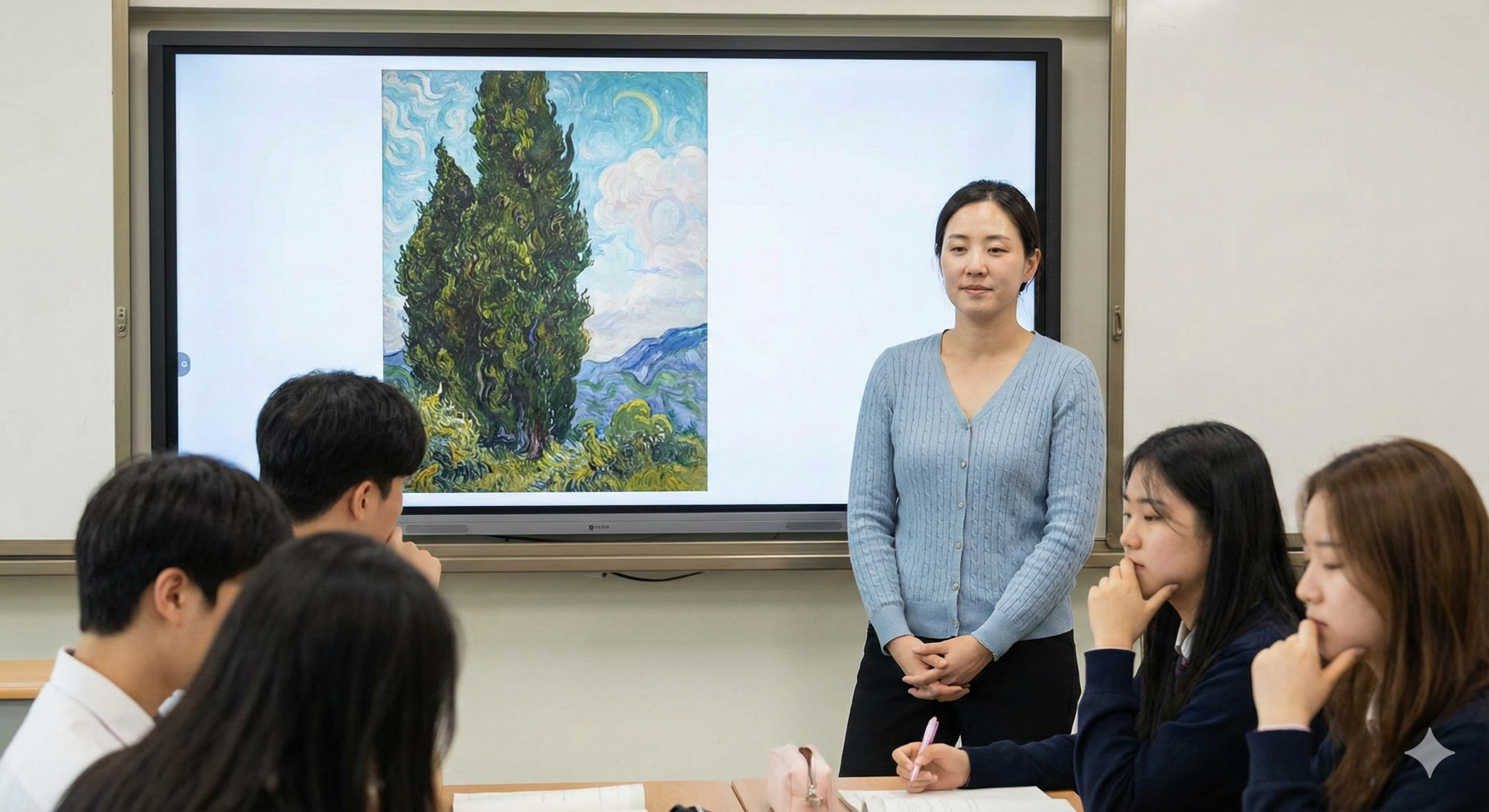
You don’t need a PhD in Art History to run a VTS session. In fact, knowing too much can sometimes get in the way. If you are worried about art gallery etiquette or history, set that aside. Here is your roadmap.
Step 1: Selecting the Right Image (Ambiguity is Key)
Do not pick a picture of a simple apple. You need a narrative, something with ambiguity. Paintings that tell a story, like famous art thefts or complex historical scenes, work best. The image must have enough detail to sustain a 15-minute conversation.
Step 2: The Silent Observation Period
Display the image. Tell the class, “Take a minute to look at this picture silently.” Wait for at least 30 to 60 seconds. This silence allows slower processors to catch up and ensures everyone has seen the details before the “fast talkers” jump in.
Step 3: Facilitating the Discussion (The Loop)
Start with Question 1: “What’s going on in this picture?”
Call on a student.
Listen intently.
Paraphrase what they said.
Ask Question 2 if they didn’t give evidence: “What do you see that makes you say that?”
Ask Question 3: “What more can we find?”
Step 4: Paraphrasing Techniques (Validating without Praising)
Paraphrasing is the hardest skill to master. You must prove you understood them without adding your own opinion.
- Student: “It looks like a war.”
- Teacher: “You’re noticing the conflict here, suggesting a battle scene.” (Validates, elevates vocabulary, remains neutral).
Step 5: Closing the Session
There is no “Ta-da!” moment. You don’t reveal the “right” answer. You simply thank the students for their observations. This reinforces that the process of thinking was the goal, not the answer.
VTS Beyond the Art Room: Cross-Curricular Application

One of the biggest misconceptions is that VTS is just for art class. In reality, Visual Understanding in Education (VUE) supports using VTS in Math and Science to meet Common Core standards.
Visual Thinking Strategies in Science
In science, observation is the first step of the scientific method.
- Example: Instead of an art piece, show a high-resolution image of water droplets on a cold glass.
- Strategy: Use VTS questions.
- Student: “The glass is sweating.”
- Facilitator: “What do you see that makes you say it’s sweating?”
- Student: “Well, there are drops on the outside, but the water is inside.”
- Outcome: The class moves from “sweating” (misconception) to observing the barrier and eventually hypothezing about condensation. You can find inspiration for these observations in nature journal ideas.
Visual Thinking Strategies in Math
Math is highly visual, especially geometry and data analysis.
- Example: “Build, Write, Say.” Show a complex geometric pattern or a graph without labels.
- Strategy: Ask, “What’s going on in this graph?” Students might notice trends (“The line goes up here”) before they understand the variables. This builds conceptual understanding before procedural calculation. It relates closely to finding patterns, much like the Golden Ratio in Art.
VTS for English Language Learners (ELLs)
For students learning English, a text-heavy lesson is a high barrier. An image is a low barrier. Everyone can see the image. VTS allows ELLs to participate using the vocabulary they have, while hearing the facilitator rephrase their ideas with more complex grammar, providing real-time scaffolding.
Visual Thinking Strategies vs. See-Think-Wonder
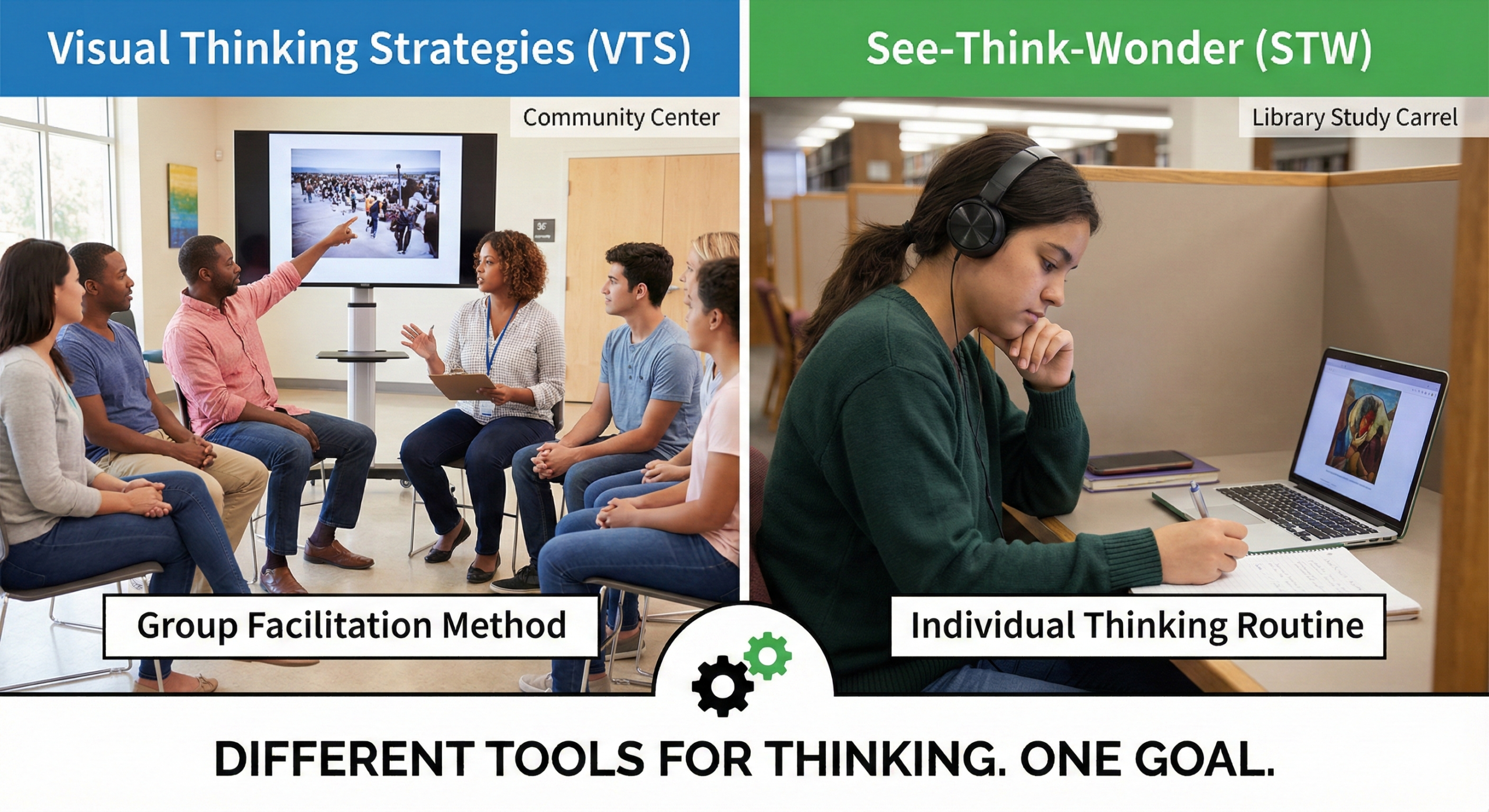
Teachers often confuse VTS with Project Zero’s “See, Think, Wonder” (STW). While both promote thinking, they are different tools.
Key Differences in Structure and Intent
- VTS is a facilitated group discussion. It requires a teacher to paraphrase and link ideas. It is about social construction of meaning.
- STW is a thinking routine. It asks: “What do you see? What do you think? What do you wonder?” It is often done individually on paper or as a quick warm-up.
When to Use Which?
- Use VTS when you have 15-20 minutes and want to build community, oral language skills, and deep critical thinking.
- Use STW when you need a quick entry ticket, a journaling prompt, or independent work.
Comparison Table: VTS vs. STW
| Feature | Visual Thinking Strategies (VTS) | See-Think-Wonder (STW) |
|---|---|---|
| Format | Group Discussion | Individual or Group |
| Facilitator Role | Active (Paraphrasing/Linking) | Passive (Prompting) |
| Goal | Aesthetic Development, Visual Literacy | Curiosity, Routine Thinking |
| Questions | Strict (3 Fixed Questions) | Flexible (Routine based) |
Common Challenges and Criticisms
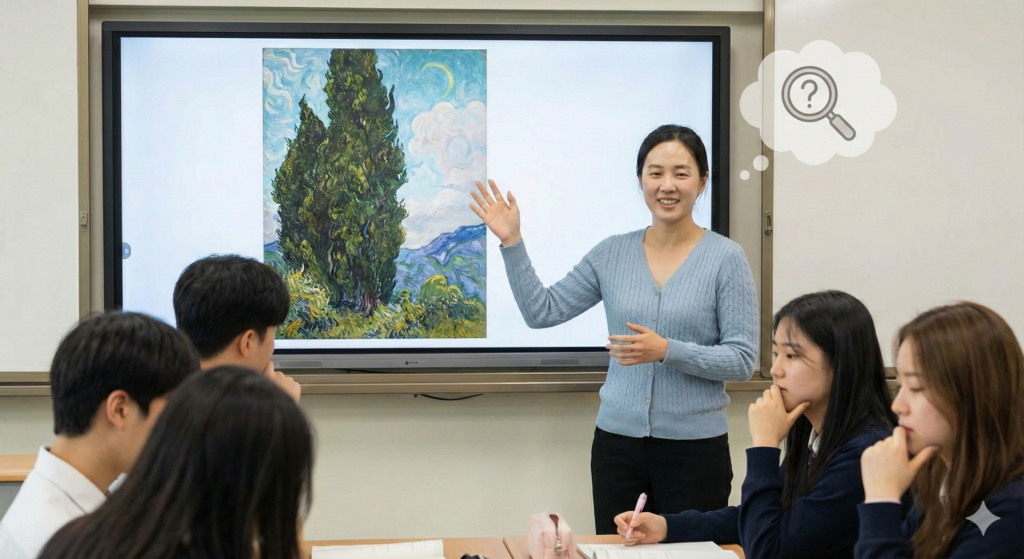
“The Silence is Awkward”: Managing Lulls in Discussion
When you ask, “What more can we find?” and get silence, do not panic. In VTS, silence is thinking time. If the lull lasts too long, simply rephrase: “We have noticed the colors and the man’s expression. What else can we find in the background?”
Teacher Anxiety: “What if I Don’t Know the History?”
This is the most common fear. “What if they ask who painted it?” In VTS, you can simply say, “That’s a great question. We can look that up later, but for now, let’s stick to what we see.” You are not the encyclopedia; you are the facilitator. If you encounter a complex piece, perhaps something resembling Conceptual Art, rely on the students’ eyes, not your knowledge.

Virtual VTS: Limitations of Online Implementation
A 2021 study by Ferrara & Wilkins explored VTS in a virtual setting. While students still improved in linguistic expression, the study found no significant improvement in critical thinking or observation skills compared to in-person sessions. The physical act of pointing and the shared environment are crucial. If you are doing digital painting or virtual classes, you must be extra intentional about the “pointing” mechanism (using digital cursors).
Resources and Lesson Planning
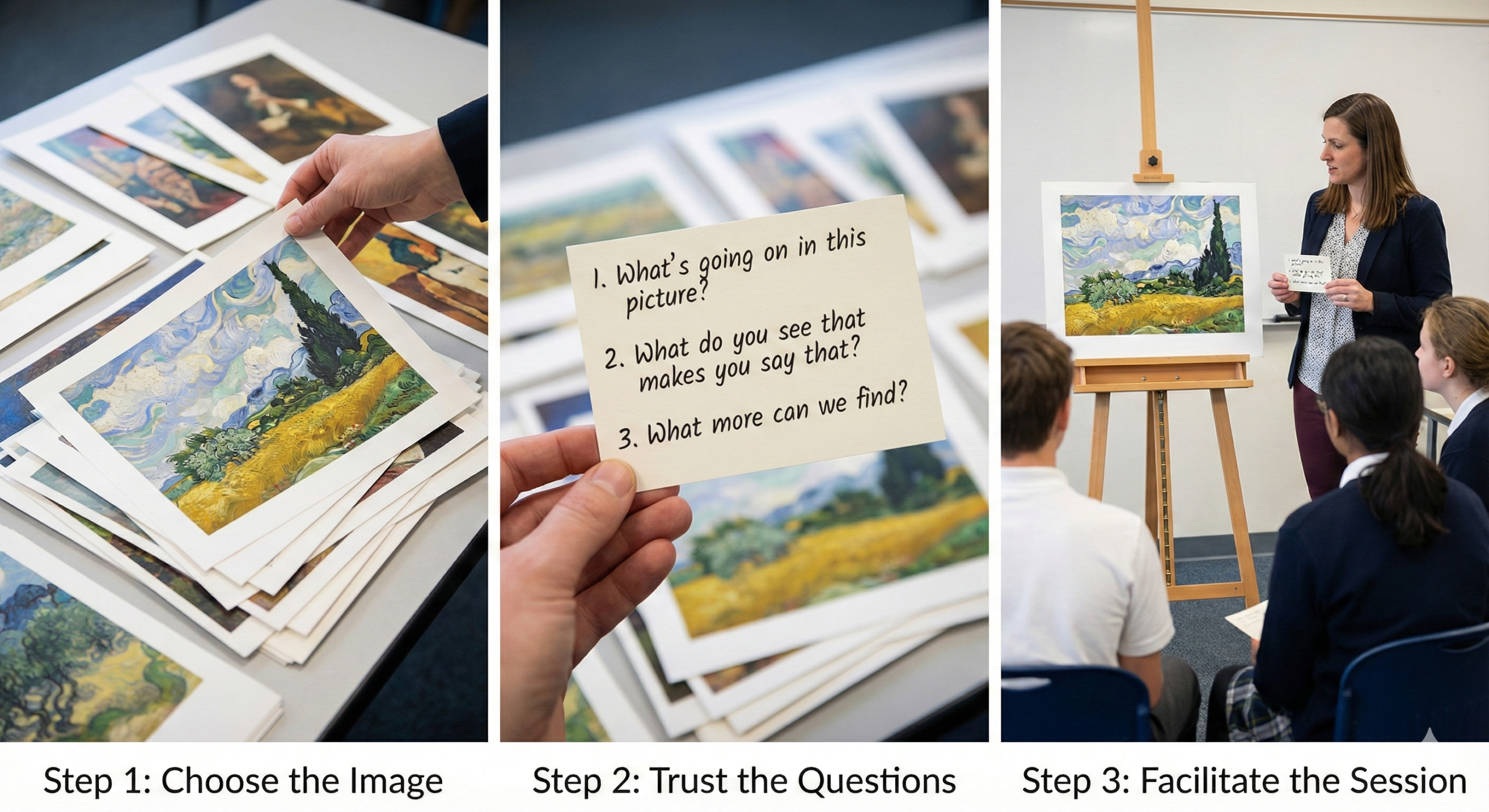
Ready to start? Here is how to plan your first session.
Where to Find VTS Images
You need high-quality, ambiguous images.
- New York Times: “What’s Going On in This Picture?” (Weekly feature).
- Museum Websites: The Met, MoMA, or even specialized collections like Diamond Painting patterns (if they are complex enough).
- Clip Art? Generally, avoid simple clip art unless it has a narrative. You want depth.
Sample Script for a 15-Minute Session
- 0:00-1:00: Display image. “Take a moment to look.”
- 1:00-12:00: The Loop (Questions 1, 2, 3). Aim for 5-8 comments. Paraphrase every single one.
- 12:00-15:00: Wrap up. “Thank you for these observations. We found [Summary of points].”
Here is a sample script for a VTS session which can be downloaded:
Conclusion: Cultivating a Culture of Thinking
Visual Thinking Strategies is more than a teaching trick; it is a philosophy. It trusts that students have the capacity to observe, analyze, and debate complex ideas without being spoon-fed the answers. By using VTS, you are not just teaching art, science, or math—you are teaching students how to think.
Whether you are analyzing Salvador Dali paintings or a biological diagram, the skills of evidence-based reasoning will serve your students for a lifetime. So, the next time you face a class, put up an image and ask: “What’s going on in this picture?”
FAQ: Visual Thinking Strategies
What are the three Visual Thinking Strategies questions?
The three core questions are:
- “What’s going on in this picture?”
- “What do you see that makes you say that?”
- “What more can we find?”
Can VTS be used in Math and Science?
Absolutely. In science, it is used to analyze phenomena and form hypotheses. In math, it helps students deconstruct graphs, patterns, and word problems before attempting calculations.
What is the difference between VTS and See-Think-Wonder?
VTS is a facilitated group discussion led by a teacher using specific paraphrasing techniques. See-Think-Wonder is a “thinking routine” often done individually or as a quick warm-up, without the rigorous facilitation loop of VTS.
Does VTS help English Language Learners?
Yes. VTS lowers the barrier to entry because visuals are a universal language. It allows ELL students to participate in critical thinking exercises without needing advanced reading proficiency, while the teacher’s paraphrasing models proper syntax and vocabulary.
How do I handle it if a student gives a “wrong” interpretation?
In VTS, there are no wrong answers, only observations. If a student says something factually incorrect (e.g., “That’s a dog” when it’s a cat), asking “What do you see that makes you say that?” usually leads them to self-correct or allows other students to offer differing views respectfully.