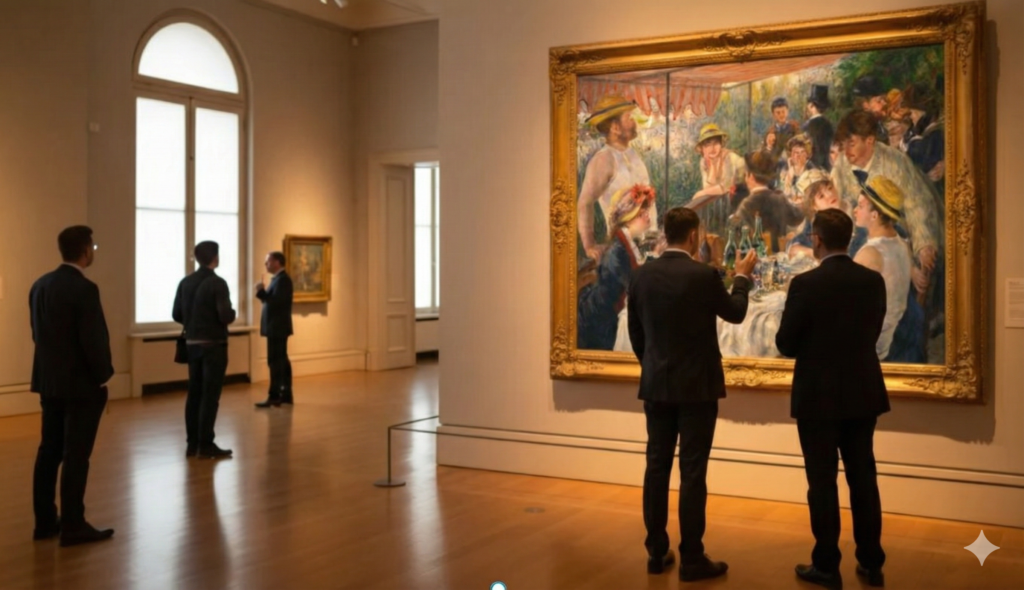
Imagine a perfect Sunday afternoon. The sun is shining, the wine is flowing, and you are surrounded by your closest friends on a balcony overlooking the Seine River. The air is filled with laughter and the clinking of glasses. This is the “joie de vivre” (joy of living) that Pierre-Auguste Renoir captured in his 1881 masterpiece, Luncheon of the Boating Party.

While it looks like a simple snapshot of 19th-century French leisure, this painting is actually a complex puzzle of artistic rebellion, technical challenges, and personal stories. In this comprehensive Luncheon of the Boating Party analysis, we will peel back the layers of paint to reveal who these people really are, the secrets hidden by X-ray technology, and how Renoir managed to paint this despite a major physical injury.
Key Takeaways:
- The Transition: This work marks Renoir’s shift from pure Impressionism to a sharper, more classical style.
- The Injury: Renoir painted a significant portion of this canvas while recovering from a broken right arm.
- Hidden Details: X-rays reveal that the iconic awning was not part of the original plan.
- The Value: Purchased for $125,000 in 1923, it is now considered priceless, comparable to works selling for over $70 million.
A Sunday at Maison Fournaise: Historical Context
To understand the painting, you must understand the place. The scene is set at the Maison Fournaise, a restaurant and boat rental spot on an island in the Seine river located in Chatou, France. In the late 1800s, this area was known as the “Island of the Impressionists.” It was the perfect escape for Parisians looking to get away from the city’s noise.
Renoir was a regular here. He loved the mix of people—socialites, artists, seamstresses, and boatmen all mingled together. But creating this masterpiece wasn’t just a fun weekend project; it was a battle.
In January 1880, just months before he started this painting, Renoir fell from a bicycle (some sources say he slipped in the rain) and broke his right arm—his painting arm. Not one to give up, he trained himself to paint with his left hand while he healed. This determination is visible in the painting. It was created partly en plein air (outdoors) on the balcony and finished in his studio. This mix of environments created a unique lighting challenge that Renoir solved brilliantly.
[YOUTUBE: Luncheon of the Boating Party – Art History Analysis]
The painting was exhibited at the 7th Impressionist Exhibition in 1882. It was Renoir’s answer to critics like Emile Zola, who claimed the Impressionists were losing their touch. With this painting, Renoir proved he could combine the fleeting light of Impressionist art characteristics with the solid, defined forms of classical art.
The Cast of Characters: Who is Who?
One of the most fascinating aspects of a Luncheon of the Boating Party analysis is identifying the models. These weren’t random strangers; they were Renoir’s real-life friends, colleagues, and crushes. Renoir famously said, “I like a painting which makes me want to stroll in it.” By painting his friends, he invited the viewer to join his inner circle.
Here is the breakdown of the party guests:
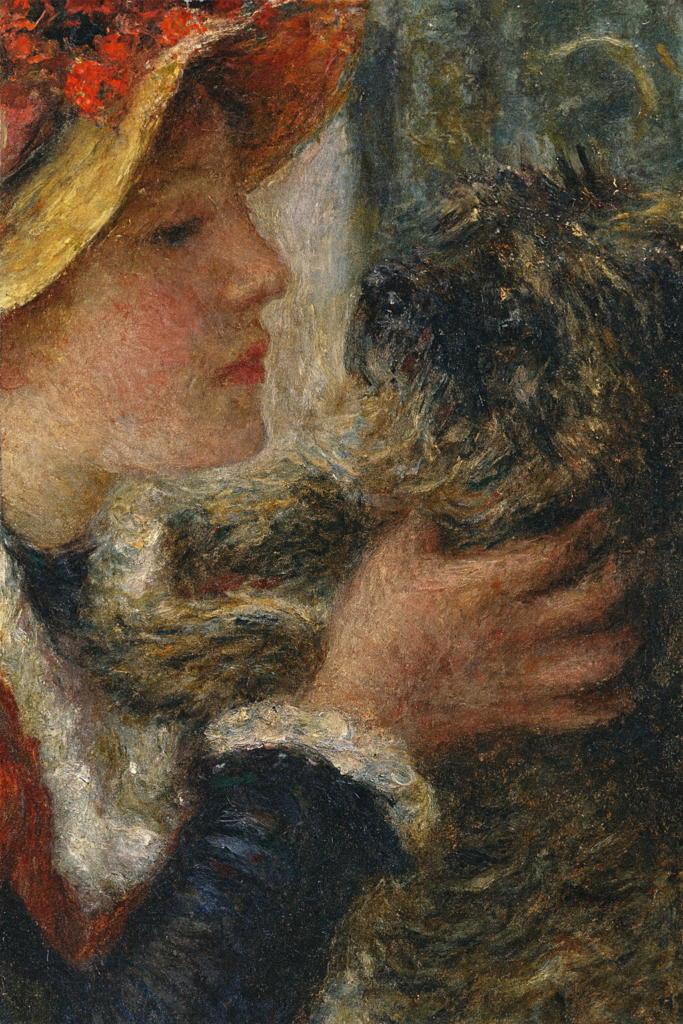
- The Future Wife (Aline Charigot): In the bottom left foreground, the woman cooing at the Affenpinscher dog is Aline Charigot. She was a seamstress and one of Renoir’s favorite models. They would marry later in 1890. Her placement in the front suggests her growing importance in his life.
- The Proprietor’s Children: The man leaning against the railing on the left, flexing his muscular arm, is Alphonse Fournaise Jr., the son of the restaurant owner. His sister, Alphonsine Fournaise, is the woman leaning on the balcony railing in the center, looking dreamy.
- The Artist & Patron: In the bottom right foreground, straddling his chair backward, is Gustave Caillebotte. He was a wealthy painter and a major patron of the Impressionists. He is looking at Aline (or perhaps the dog).
- The Actress: Sitting in the center, drinking from a glass, is Ellen Andrée, a famous actress who also modeled for Degas and Manet.
- The Intellectuals: In the background, you can see two men talking. The man in the top hat is Charles Ephrussi, a wealthy art collector and critic. He is chatting with Jules Laforgue, a younger poet and critic.
- The Journalist: The man with the monocle and brown hat wrapping his arm around the woman in the upper right is believed to be Paul Lhote, a close friend of Renoir.
- The Other Actress: The woman adjusting her hat in the upper right corner is Jeanne Samary, a distinct figure in many Top 10 Renoir Paintings.
Many of these figures were crucial to the art world. Understanding their relationships helps us see this painting not just as a lunch, but as a snapshot of the French cultural elite of 1881. For more on the lives of creators like Caillebotte, explore our guide to Famous Painters and Paintings.
Technical Analysis & Composition
Renoir didn’t just throw people onto the canvas; he engineered the scene.
The Compositional Triangle
The painting is divided by the diagonal line of the railing. This separates the lush, green background (nature) from the crowded, social foreground (humanity). Renoir arranges the figures to guide your eye. Start at Aline Charigot in the bottom left, follow the gaze of the standing figures, and you eventually loop back to Caillebotte in the bottom right. It creates a sense of movement and conversation.
Brushwork Evolution
This painting represents a turning point. If you look at the background—the river Seine and the foliage—it is painted with the loose, rapid strokes typical of Impressionism. However, look at the faces of the people, especially Aline and the boatman. They are sharper, smoother, and more defined. Renoir was beginning to feel that Impressionism was too “messy” and wanted to return to the discipline of classical drawing. This mix of styles is what makes the painting so vibrant.
Color Palette
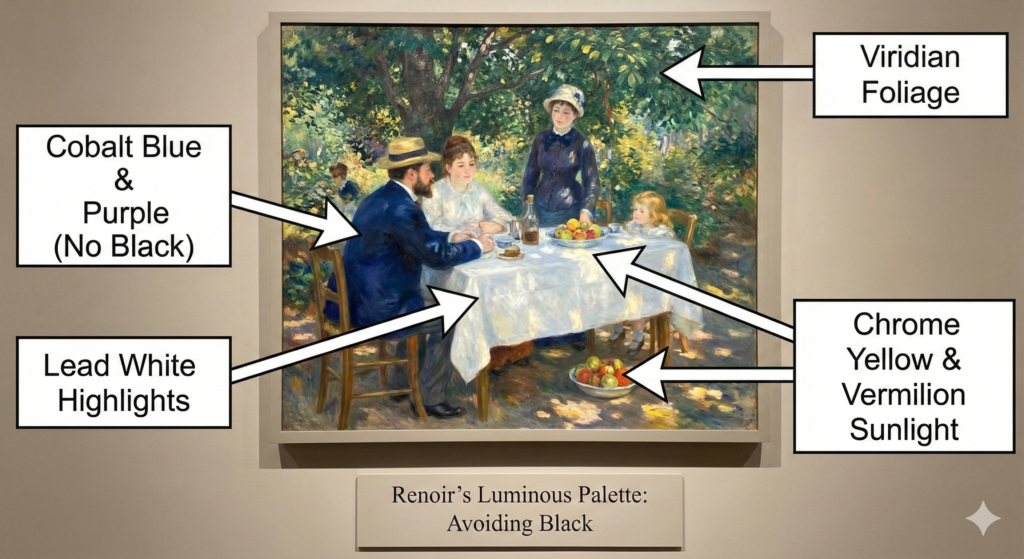
Renoir used a specific set of pigments to achieve this luminosity. He avoided black almost entirely. The dark coats of the men are actually painted with dark blues and purples.
- Cobalt Blue: Used for the sky and clothing.
- Lead White: Used to create the bright tablecloth and highlights.
- Chrome Yellow & Vermilion: Used to capture the sunlight and the vibrant fruit on the table.
- Viridian: The deep greens of the foliage.
For artists interested in how these colors work together, check out our Color Mixing Chart Printable.
Secrets Beneath the Canvas: X-Ray Discoveries
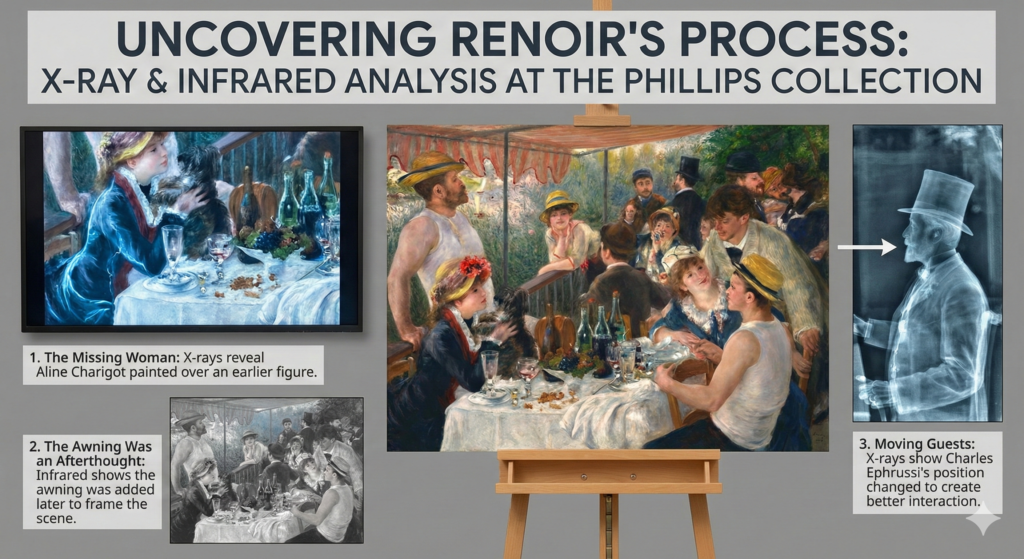
Art historians and scientists at The Phillips Collection have used X-ray and infrared technology to look beneath the surface of the painting. What they found changes our understanding of the scene.
1. The Missing Woman
X-rays revealed that the figure of Aline Charigot (the woman with the dog) was painted over a different woman! Renoir originally had another model there, but likely replaced her when he began his relationship with Aline.
2. The Awning Was an Afterthought
One of the most striking features of the painting is the red-and-white striped awning. However, infrared analysis shows that Renoir didn’t plan it. Originally, the top of the painting was open sky and foliage. He added the awning later, likely to frame the group better and to explain the diffused lighting on the figures. This is a classic example of how location inspires artists to adapt their composition on the fly.
3. Moving Guests
Renoir struggled with the composition. The X-rays show that Charles Ephrussi (the man in the top hat) was originally facing a different direction. Renoir turned him to face the poet Laforgue, creating a better interaction between the figures.
These changes prove that Renoir didn’t just capture a moment; he constructed it carefully over months. Discovering these changes is part of the thrill of Famous Painting Secrets Hidden Stories.
Vital Statistics and Valuation
How much is Luncheon of the Boating Party worth? Today, it is priceless and will likely never be sold. However, we can estimate its value based on history and comparable sales.
Duncan Phillips, an American art collector, bought the painting in 1923. He called it “one of the greatest paintings in the world.” He paid $125,000 for it, which was a massive sum at the time. To put that in perspective, another version of Renoir’s work, Bal du moulin de la Galette, sold for $78.1 million in 1990. Adjusted for inflation and the current art market boom, Luncheon of the Boating Party would likely fetch hundreds of millions today.
Below is a data table summarizing the vital statistics of this masterpiece.
| Attribute | Detail |
|---|---|
| Artist | Pierre-Auguste Renoir |
| Year | 1880–1881 |
| Medium | Oil on Canvas |
| Dimensions | 129.9 cm × 172.7 cm (51 in × 68 in) |
| Current Location | The Phillips Collection, Washington, D.C. |
| Original Purchase Price | $125,000 (Paid by Duncan Phillips in 1923) |
| Inflation Adjusted Price | Approx. $2.3 Million (2025 USD) |
| Est. Market Value | Priceless (Comparable: Moulin de la Galette sold for $78.1M in 1990) |
| Pigments Identified | Cobalt Blue, Lead White, Viridian, Chrome Yellow, Red Lake |
For more on high-value art, you can read about Art Auctions 2025 Record Sales.
Why This Painting Matters Today
Luncheon of the Boating Party is more than just a pretty picture. It represents the end of an era. It was the last great group scene Renoir painted in the Impressionist style before he moved toward a drier, more formal technique.
It captures a fleeting moment of modern life—men in undershirts drinking with men in top hats, actresses laughing with poets. It broke social boundaries. In 1881, showing this level of casual mixing between classes was modern and slightly rebellious.
The painting has seeped into pop culture, appearing in movies like Amélie. It remains a symbol of friendship and the fleeting nature of happiness. It reminds us why we look at Famous Art: to see our own lives reflected in the past.
Frequently Asked Questions
Who is the woman with the dog in Luncheon of the Boating Party?
That is Aline Charigot. At the time of the painting, she was Renoir’s girlfriend and model. They later married, and she remained the love of his life. The affection he felt for her is evident in the soft way he painted her face.
Did Renoir paint Luncheon of the Boating Party with a broken arm?
Yes, partially. Renoir broke his right arm in a bicycle accident (or a fall) in January 1880. While the painting took months to complete, he had to adapt his technique and use his left hand for periods of the work, which makes the detailed brushwork even more impressive.
Is the awning in Luncheon of the Boating Party original?
No. Infrared reflectography has shown that the striped awning was not in the initial sketch. Renoir added it later to control the light in the composition and frame the figures, replacing what was originally open sky.
What is the difference between Moulin de la Galette and Boating Party?
Bal du moulin de la Galette (1876) is a pure Impressionist work with dappled, flickering light and softer forms. Luncheon of the Boating Party (1881) shows Renoir moving away from that style; the figures are more solid, the outlines are clearer, and the composition is more structured.
Is the restaurant real?
Yes, the Maison Fournaise in Chatou is a real place. You can still visit the location today, though it has been renovated. It remains a pilgrimage site for lovers of Impressionist art.
Conclusion
The Luncheon of the Boating Party analysis reveals a work that is much more than a sunny lunch. It is a testament to Renoir’s resilience after an injury, a catalog of his social circle, and a battlefield where he fought to evolve his artistic style. By combining the fresh light of the outdoors with the permanence of studio figures, Renoir created a timeless image of happiness.
Whether you are an art historian or just someone who appreciates a good lunch with friends, this painting resonates because it captures a universal desire: to stop time and enjoy the moment.