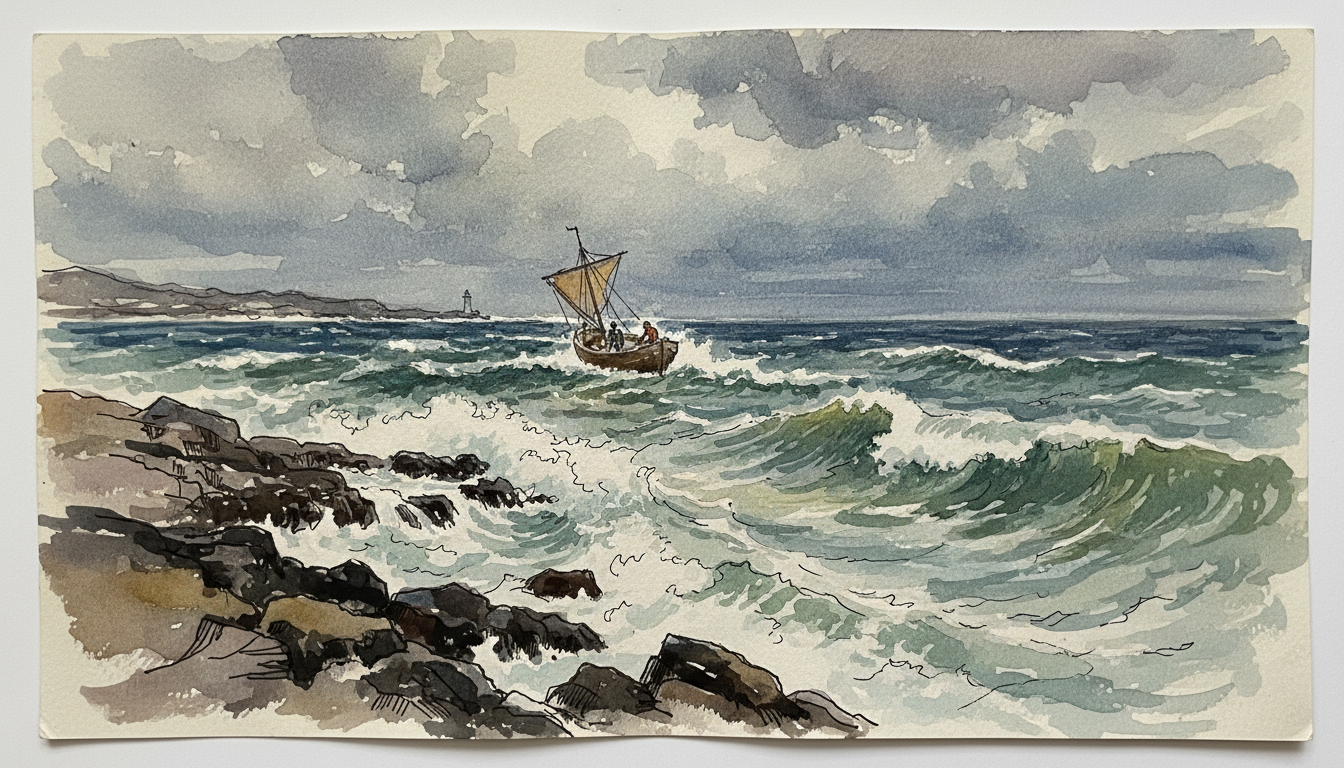
There is a distinct magic that happens when the rigid precision of ink meets the chaotic fluidity of watercolor. This technique, known as line and wash watercolor, creates artwork that feels both structured and spontaneous. It is the preferred style for urban sketchers capturing a busy street corner, botanical illustrators detailing a flower, and architects rendering a new concept.
Whether you call it “pen and wash,” “ink and watercolor,” or “mixed media sketching,” the core concept is the same: you are marrying the defining power of line with the atmospheric emotion of color.
In this comprehensive guide, we will explore everything from the chemistry of waterproof inks to the economics of disposable pens versus fountain pens. We will tackle the debate of “ink first vs. paint first” and help you master this timeless medium.
Key Takeaways
- The Medium: A hybrid technique combining ink outlines (structure) and watercolor washes (color/mood).
- The Tools: Why fountain pens with archival ink are cheaper in the long run than disposable fineliners.
- The Warning: Why you must never put India Ink in a fountain pen.
- The Technique: How to avoid the “coloring book look” by breaking your lines.
What is Line and Wash?
Defining the Medium: The Marriage of Structure (Ink) and Fluidity (Watercolor)
At its heart, line and wash is a dialogue between two very different partners. The ink provides the skeleton—the edges, the details, and the contrast. The watercolor provides the flesh and spirit—the shadow, the light, and the atmosphere.
Pure watercolor can sometimes feel too soft or undefined for beginners. Pure pen and ink can feel too stark or labor-intensive to shade. Line and wash watercolor solves both problems. The ink handles the heavy lifting of defining shapes, allowing the artist to be looser and more expressive with the paint.
Historical Context: From 13th-Century China to Renaissance & Modern Urban Sketching
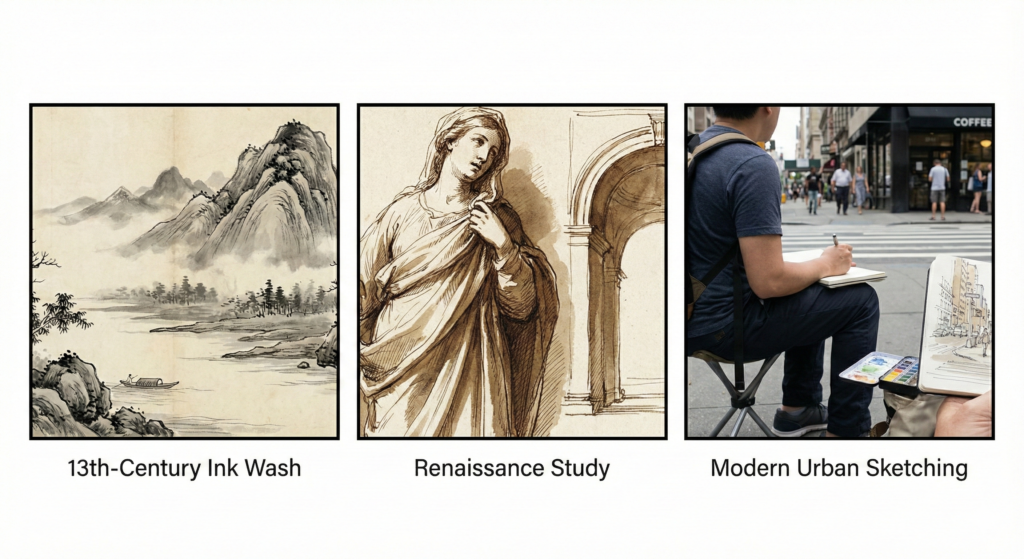
While modern social media feeds are full of urban sketches, this technique is ancient. It traces its roots back to 13th-century China and Japan, where ink wash painting (Sumi-e) combined calligraphic lines with tonal washes.
In the West, the technique flourished during the Renaissance. Masters like Leonardo da Vinci and later Rembrandt used pen and bistre (a brown ink) with wash to create rapid studies of light and form. Today, the movement has been revitalized by communities like Urban Sketchers, who use portable kits to document the world on location.
If you are interested in how historical movements shape current styles, you might enjoy reading about famous painters and paintings that utilized these foundational techniques.
Essential Tools for Line and Wash
The barrier to entry for line and wash is low, but buying the wrong tools can lead to smeared art and ruined pens.
The Great Pen Debate: Disposable vs. Refillable
For beginners, the first question is usually: “What pen should I buy?”
Disposable Fineliners
The industry standards are the Micron Pigma and the Uni Pin.
- Pros: They are widely available, relatively cheap upfront, and reliable. The ink is chemically stable and waterproof almost immediately.
- Cons: The felt tips wear down quickly on rough watercolor paper (specifically Cold Press), and once the ink is gone, the whole plastic barrel goes into the landfill.
Fountain Pens
The pro choice often shifts to fountain pens like the Lamy Safari, TWSBI Eco, or pens with Sailor Fude Nibs (bent nibs that allow for variable line widths).
- Pros: Incredible line variation, smooth gliding over paper, and significantly cheaper over time (see our cost analysis below).
- Cons: Higher upfront cost and requires maintenance (cleaning).
Dip Pens & Twigs
For a looser, more organic look—similar to the style of artist John Hoar—many artists use dip pens, bamboo reeds, or even sharpened matchsticks dipped in ink. This creates unpredictable, scratchy lines that add immense character to landscapes.
Understanding Inks: The “Waterproof” Test
This is the most critical technical section of this guide. Not all inks are created equal.
Pigment vs. Dye Inks
- Dye Inks: Water-soluble. If you paint over them, they will bleed and dissolve (unless that is your intended effect).
- Pigment Inks: Particles sit on top of the paper. Once dry, they are generally waterproof.
Fountain Pen Safe Waterproof Inks
If you are using a fountain pen, you need specific inks that flow well but won’t clog.
- Platinum Carbon Ink: The “Gold Standard” for artists. It is deeply black, flows well, and is completely bombproof once dry.
- De Atramentis Document Ink: Another favorite that comes in various colors and is mixable.
RED ALERT: The India Ink Danger
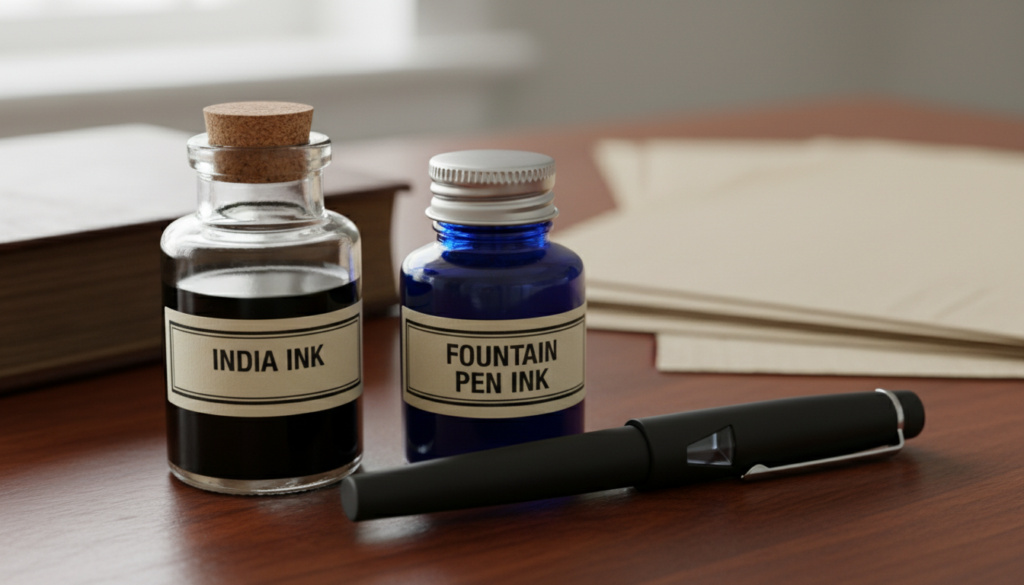
Never, under any circumstances, put India Ink or inks containing Shellac into a fountain pen. Shellac is a binding agent that dries into a hard, varnish-like solid. It will cement the delicate feed of your fountain pen, destroying it permanently. India Ink is strictly for dip pens only.
For more on mixing your own colors or understanding pigment properties, check out our color mixing primer.
Paper Selection Strategy
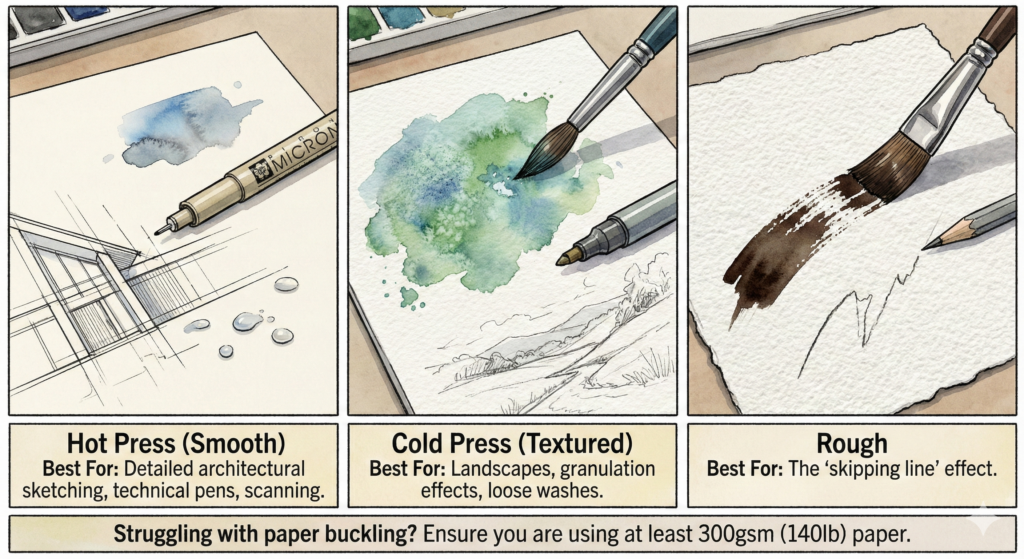
- Hot Press (Smooth): This paper has been pressed between hot rollers. It is very smooth.
- Best For: Detailed architectural sketching, technical pens (Microns), and scanning work.
- Trade-off: Water sits on top longer, and you get less texture.
- Cold Press (Textured): The most common watercolor paper (like Fabriano Artistico or Arches).
- Best For: Landscapes, granulation effects, and loose washes.
- Trade-off: The texture can chew up felt-tip pens quickly.
- Rough: Very textured.
- Best For: The “skipping line” effect where the pen glides over the peaks of the paper, leaving gaps that the eye fills in.
If you are struggling with paper buckling, ensure you are using at least 300gsm (140lb) paper. For those interested in buying locally, here is a guide on finding the best art supplies near me.
The Core Question: Line First or Wash First?
This is the most common debate in line and wash watercolor. There is no right answer, only different aesthetic results.
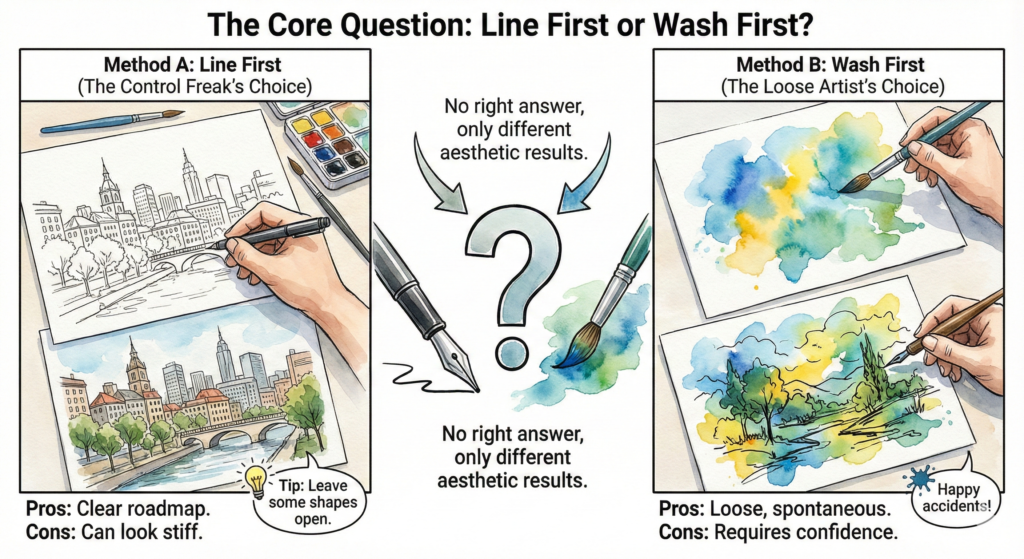
Method A: Line First (The Control Freak’s Choice)
You draw the entire scene in ink, let it dry, and then “color it in” with watercolor.
- Pros: You have a clear roadmap. It removes the anxiety of the blank page.
- Cons: It can look stiff or like a coloring book.
- Tip: Do not outline everything. Leave some shapes open for the paint to define.
Method B: Wash First (The Loose Artist’s Choice)
You paint abstract shapes and blobs of color first. Once dry (or while damp), you use the pen to define what those shapes are.
- Pros: incredibly loose, artistic, and spontaneous. The ink line doesn’t have to match the color edge, creating “happy accidents.”
- Cons: Requires confidence and a good understanding of drawing without a guide.
Method C: The Sandwich Technique
Sketch loosely in pencil, add some ink structure, apply watercolor washes, and then come back in with ink to reinforce the darkest shadows and textures. This is the most balanced approach for beginners.
To get started with the painting portion of this method, reviewing drawing for beginners basics can be very helpful for the initial sketch.
Step-by-Step Techniques & Texture Building
Pen Techniques for Tone and Value
In line and wash, the ink should handle the deepest values (shadows) and the sharpest details.
- Hatching & Cross-hatching: Parallel lines to create shading. The closer the lines, the darker the shadow.
- Scumbling: Scribbly, circular motions. Great for bushes and tree foliage.
- Broken Lines: Instead of drawing a solid line for a roof or a horizon, break the line. This allows the eye to “jump” the gap and makes the drawing feel more alive.
Watercolor Techniques for Atmosphere
- Glazing: Laying a transparent wash of color over dried ink. This tints the paper without obscuring the line work.
- Wet-on-Wet: Wet the paper first, then drop in color. This creates soft, fuzzy backgrounds that contrast beautifully with sharp ink lines in the foreground.
- Splatter: Flicking paint (or even ink) onto the paper to create noise and texture.
For a deeper dive into controlling your paint, check out this guide on mastering watercolor essential techniques.
Common Beginner Mistakes & How to Fix Them
The “Smudge” Disaster: Drying Times
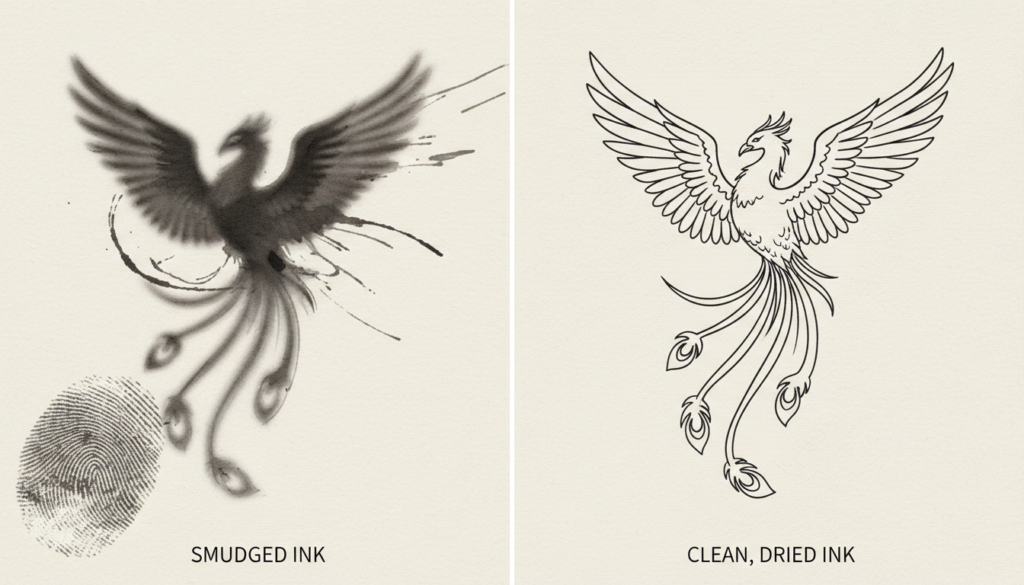
Just because a pen says “waterproof” doesn’t mean it is waterproof instantly.
- Microns: usually safe after 30 seconds.
- Fountain Pens (Platinum Carbon): May need 5 to 10 minutes depending on how heavy the ink flow is and how humid the room is.
- The Fix: If you are impatient, use a hairdryer (on low heat) before applying the wash.
The “Coloring Book” Effect
This happens when you outline every single object with a heavy black line and then fill it perfectly with color.
- The Fix: Use “lost and found” edges. Let the line disappear in light areas. Let the paint spill outside the lines in shadow areas.
Buckling Paper
Using standard printer paper or thin sketch paper will result in a wavy, buckled mess.
- The Fix: Always use watercolor paper meant for wet media (300gsm/140lb).
Cost Analysis: Starter Kit vs. Pro Setup
Many beginners shy away from fountain pens because a Lamy Safari costs $30, while a Micron costs $3. However, if you sketch regularly, the math changes drastically.
The “Economics of Art” Table
Below is a breakdown based on a user who sketches frequently (approx. 3-4 times a week).
| Item Type | Product Example | Cost Per Unit | Est. Annual Usage | Total Annual Cost |
|---|---|---|---|---|
| Disposable Fineliner | Pigma Micron / Uni Pin | ~$3.00 | ~10 pens/month (tips wear out) | ~$360.00 |
| Refillable Fineliner | Copic Multiliner SP | ~$9.00 (+$2 refills) | 1 Body + 12 Refills | ~$33 – $40.00 |
| Fountain Pen (Mid) | Lamy Safari + Converter | ~$35.00 | 1 Pen (lasts years) | $35.00 (One time) |
| Bottled Ink | Noodler’s / Platinum (60ml) | ~$15 – $25 | 1-2 Bottles/year | ~$40.00 (Recurring) |
| Fountain Pen Total | Pen + Ink | — | — | ~$75 (Year 1) / ~$40 (Year 2+) |
The Verdict: While the fountain pen feels like a luxury purchase, it pays for itself within 3 months compared to buying disposable pens that dry out or have their nibs crushed by textured paper.
If you are looking for unconventional ways to save money or add texture, consider exploring unconventional tools for watercolor.
Inspirational Artists to Study
To master line and wash watercolor, you must study the masters.
Masters of the Craft
- Raoul Dufy: A French Fauvist painter known for colorful, decorative scenes where the color washes often sat completely separate from the line work.
- John Blockley: A British artist who revolutionized watercolor landscapes with textured, scratchy line work and moody washes.
Contemporary Urban Sketchers
- Liz Steel: An architect-turned-artist known for her rapid, loose, yet structurally accurate teacup and building sketches.
- Teoh Yi Chie: A prolific sketcher and YouTuber who reviews almost every ink and pen on the market.
Discover more regarding influential figures in our list of top 10 watercolor artists.
FAQs: Line and Wash Watercolor

Is Noodler’s ink actually waterproof?
Noodler’s “Bulletproof” black is generally waterproof on cellulose paper because it bonds with the paper fibers. However, on some sizing-heavy cotton watercolor papers, it can sit on top and smear slightly when re-wet. Platinum Carbon Ink is generally considered more reliable for 100% cotton paper.
Can I use ballpoint pens for line and wash?
Yes, but be careful. Standard ballpoints are oil-based paste. They repel water (resist), which can be a cool effect, but low-quality pens may bleed purple or blue ink when hit with water. Always test on a scrap piece of paper first.
How do I fix a mistake in ink?
Since ink is permanent, you can’t erase it. However, you can use opaque gouache (white paint) to cover the line. Alternatively, embrace the mistake—draw over it and make the line thicker, or turn the stray line into a shadow or a bird! For more on using opaque paints, read our guide on what is gouache.
Do I need to stretch my paper?
If you use heavy washes on paper lighter than 300gsm, yes. If you use 300gsm (140lb) paper and are only doing light washes typical of sketching, you can usually tape it down to a board without full stretching.
Can I use digital tools to plan my line and wash?
Absolutely. Many artists now take a photo, use AI or apps to analyze the composition, and then sketch. You can learn more about using AI tools to analyze artwork to improve your composition before you put pen to paper.
Conclusion
Line and wash watercolor is perhaps the most liberating of all art forms. It allows the perfectionist to enjoy the structure of drawing and the free spirit to enjoy the flow of paint. By choosing the right waterproof ink, understanding your paper, and practicing the balance between loose and tight marks, you can create stunning, expressive art.
Whether you are sketching your coffee cup or a cathedral, remember: the beauty lies in the contrast. So, grab your fountain pen, load it with Carbon ink, and let the wash flow.