Have you ever noticed how some designs just seem to ‘flow’ or catch your eye with their repeated elements? That’s the magic of pattern in art! Patterns are everywhere, from the stripes on a zebra to the bricks on a wall, and they play a massive role in the world of art. Simply put, a pattern in art is created when an element (like a line, shape, or color) is repeated over and over in an organized way. But patterns are more than just pretty repetitions—they are powerful tools artists use to create rhythm, movement, and visual interest in their works.
Key Points:
- Pattern in art involves the deliberate repetition of visual elements
- Different types include geometric, organic, tessellations, and fractal patterns
- Patterns appear across cultures with deep symbolic meanings
- Master artists like M.C. Escher, Gustav Klimt, and William Morris revolutionized pattern use
- Understanding patterns helps us appreciate the hidden structures in art
What Exactly is Pattern in Art?
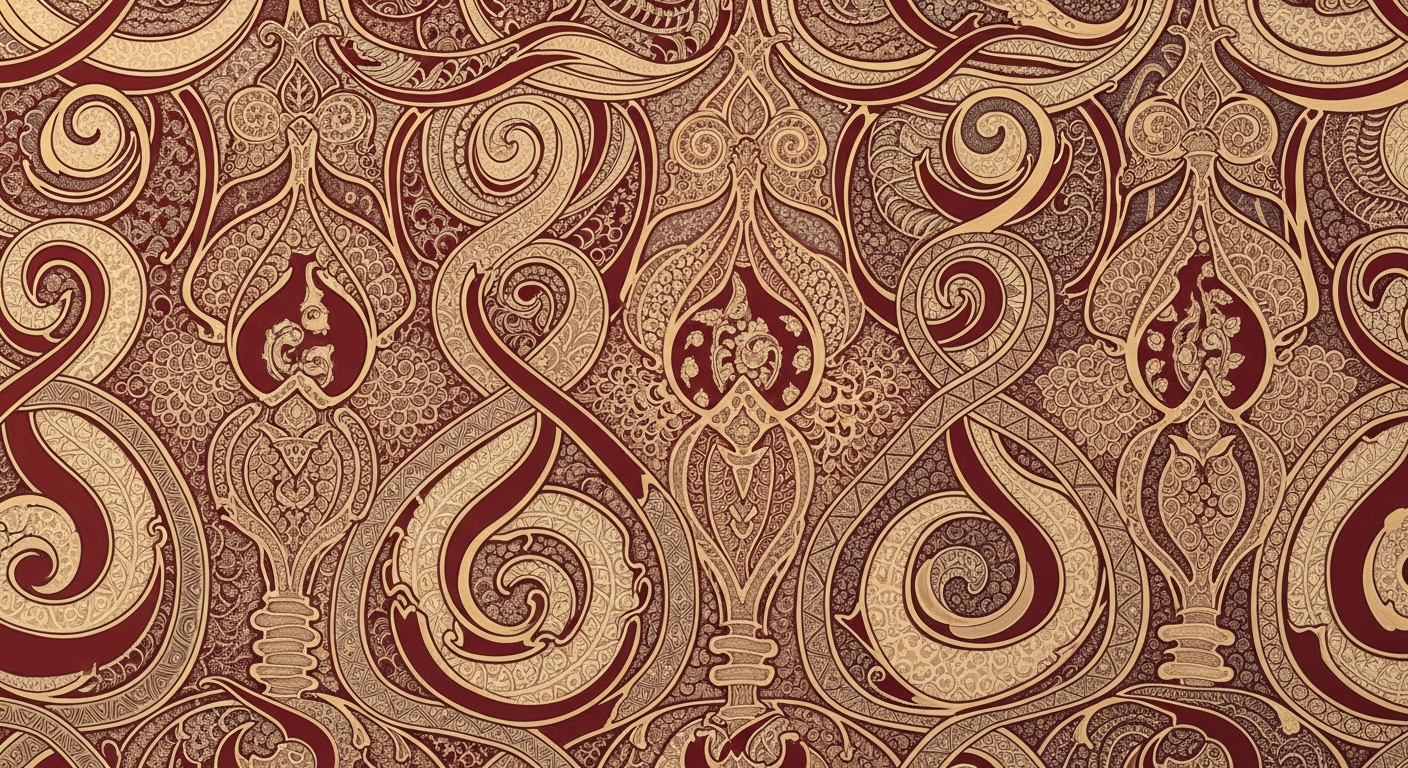
At its core, pattern in art refers to the repetition of a visual element. This element could be anything: a simple dot, a complex shape, a specific color, or even a texture. When these elements are repeated consistently, they form a pattern. Think of a checkerboard, a brick wall, or a floral wallpaper—these are all examples of patterns working their visual magic.
Patterns are fundamental because they provide structure and order to an artwork. They can guide your eye, create a sense of movement, or give a feeling of unity to a piece. Just like rhythm and movement work together in paintings, patterns create visual flow that keeps viewers engaged. Patterns can be very regular and predictable, like a grid, or more irregular and free-flowing, like the ripples on a pond. Regardless of their strictness, they all rely on the idea of repeated visual information to create an impact.
Artists use patterns as one of the key design elements to make their work more compelling. When you understand how patterns function, you start seeing them everywhere—in ancient mosaics, modern architecture, and even in nature itself. They’re like the hidden language that connects different artistic traditions across time and space.
The Building Blocks: Types of Patterns
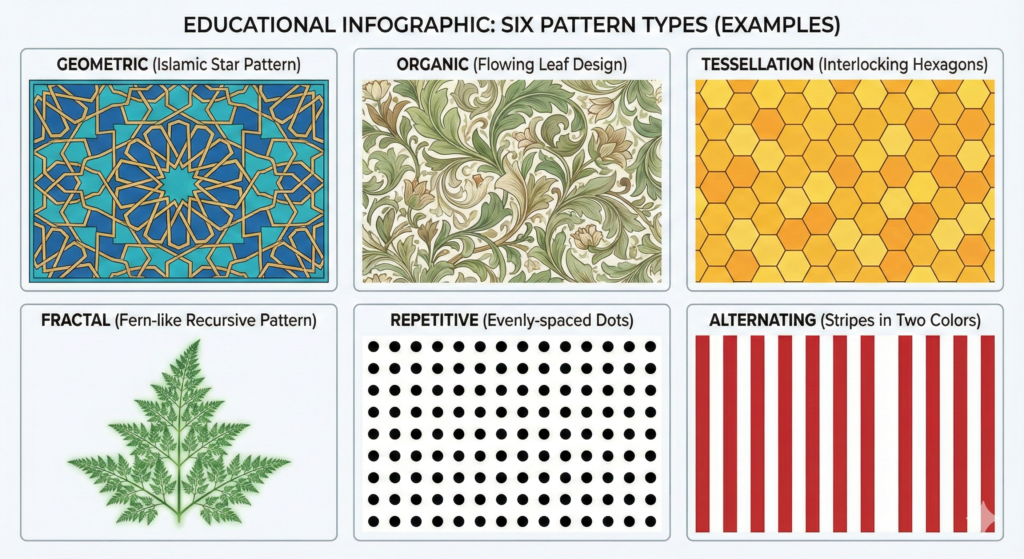
Patterns aren’t one-size-fits-all; they come in a wide variety of forms, each with its own look and feel. Understanding these types helps us appreciate the different ways artists use repetition and balance in their compositions.
Geometric Patterns
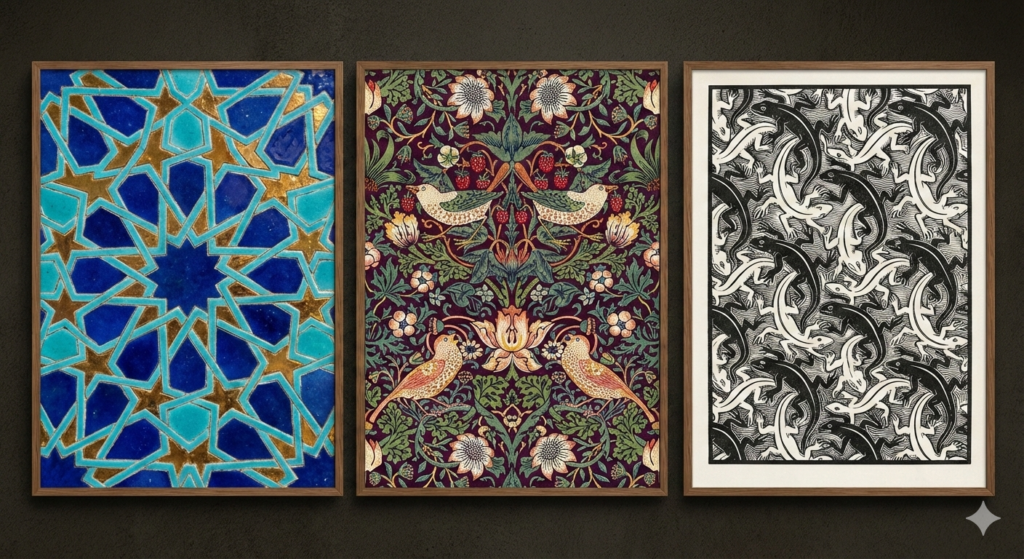
These are patterns made from mathematical shapes like circles, squares, triangles, and straight lines. They often appear precise, orderly, and symmetrical. You’ll find geometric patterns commonly in architecture, tile work, and Islamic art. The precision of geometric patterns creates a sense of stability and order that can be both calming and visually striking.
Organic Patterns
In contrast to geometric patterns, organic patterns are inspired by nature. They feature free-flowing, irregular shapes and lines, mimicking elements like leaves, flowers, waves, or animal prints. These patterns often feel more natural, fluid, and less structured. When artists incorporate organic patterns, they bring the essence of the natural world into their compositions, creating work that feels alive and breathing.
Tessellations
A special type of pattern where shapes fit together perfectly without any gaps or overlaps, covering an entire surface. Think of puzzle pieces or beehives. The famous artist M.C. Escher was a master of creating complex and imaginative tessellations. His work demonstrates how mathematical precision can create mind-bending artistic effects.
Fractal Patterns
These are patterns that repeat at different scales. If you zoom in on a part of a fractal pattern, it looks similar to the whole. They are often complex and intricate, seen in nature (like snowflakes, ferns, or coastlines) and increasingly in computer-generated art. Fractal art represents where mathematics meets visual beauty.
Repetitive Patterns
This is the most straightforward type, involving the simple, consistent repetition of a single element or a set of elements. It’s common in decorative arts like wallpaper, textiles, and borders. The power of repetitive patterns lies in their ability to create visual texture and rhythm through pure consistency.
Alternating Patterns
Here, two or more different elements or arrangements are repeated in a sequence (e.g., A-B-A-B). This creates variety within the repetition, adding a dynamic quality to the design. Alternating patterns prevent monotony while maintaining the structured feel that patterns provide.
Cultural Threads: Patterns Across History and Cultures
Patterns are a universal language that artists have used for thousands of years, serving different purposes in various cultures and time periods. They can tell stories, symbolize beliefs, or simply add beauty. Understanding how art shaped history and culture helps us appreciate why patterns hold such significance.
Islamic Art: The Mathematics of the Divine
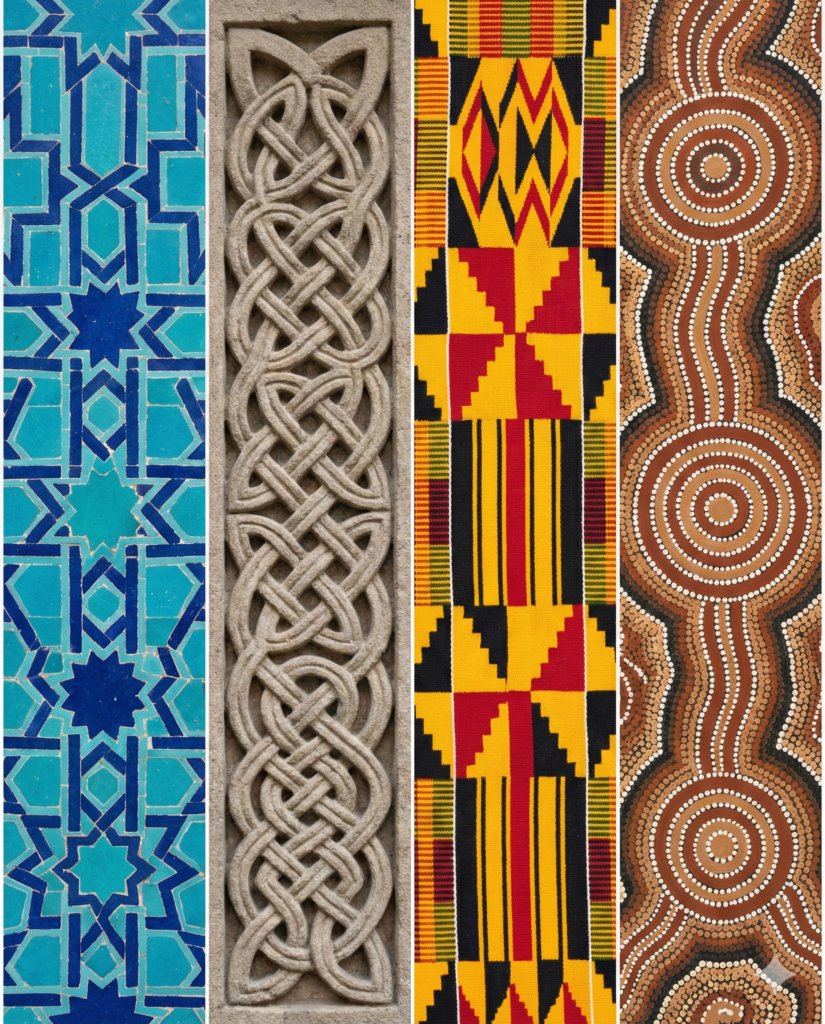
Patterns are incredibly central to Islamic art, especially geometric and calligraphic designs. Because Islam traditionally avoided depicting human or animal figures, artists turned to intricate patterns to express spiritual ideas of infinity and divine unity. The complex geometric patterns found in mosques and palaces aren’t just decorative—they represent the infinite nature of Allah and the mathematical order underlying creation.
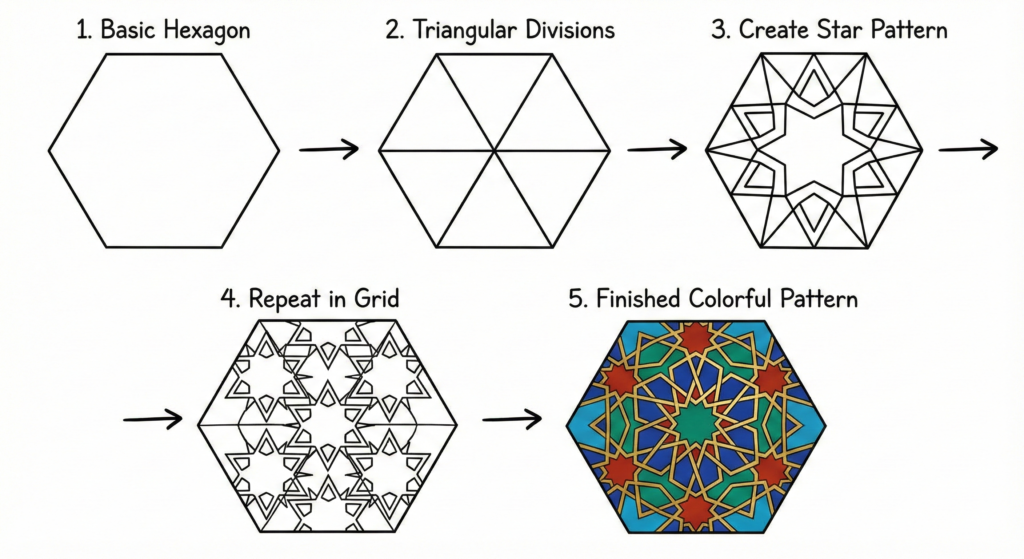
The tessellating patterns of Islamic art often feature stars, polygons, and interlacing lines that seem to extend forever. These designs required tremendous mathematical skill and spiritual contemplation. When you look at Islamic geometric patterns, you’re seeing centuries of mathematical and artistic evolution.
Celtic Art: Eternal Knots and Spirals
Known for its elaborate interlacing knotwork and spiral motifs, Celtic art uses patterns to create complex, continuous designs that often symbolize eternity or interconnectedness. The endless loops and knots represent the cyclical nature of life, death, and rebirth. Celtic artists rarely lifted their tools from the surface, creating continuous lines that weave over and under each other in mesmerizing ways.
African Textiles: Patterns That Speak
In many African cultures, patterns in textiles like Kente cloth or Adinkra symbols are not just decorative; they carry deep meanings, representing proverbs, historical events, or social status. Each pattern tells a story, communicates identity, or marks important life events. The bold geometric designs and vibrant color choices in African textiles create visual languages that communicate across generations.
Indigenous Art: Maps of the Sacred
From the dot paintings of Australian Aboriginal artists that map ancestral lands to the symbolic patterns in Native American basketry and weaving, patterns are often used to convey stories, cultural heritage, and spiritual connections to the land and cosmos. These aren’t random decorations—they’re sacred records, historical documents, and spiritual guides encoded in visual form.
This global presence shows that patterns are a fundamental way humans communicate, decorate, and understand the world around them through art. The repetition and rhythm inherent in patterns create a kind of visual music that transcends language barriers.
Masterful Repetition: Artists Who Excelled with Pattern
While many famous artists throughout history have used patterns, some have made it a defining feature of their unique style. Their work demonstrates the incredible versatility and impact of pattern in art, showing how repeated elements can create everything from mathematical puzzles to luxurious decoration.
M.C. Escher (1898-1972): The Master of Mathematical Art
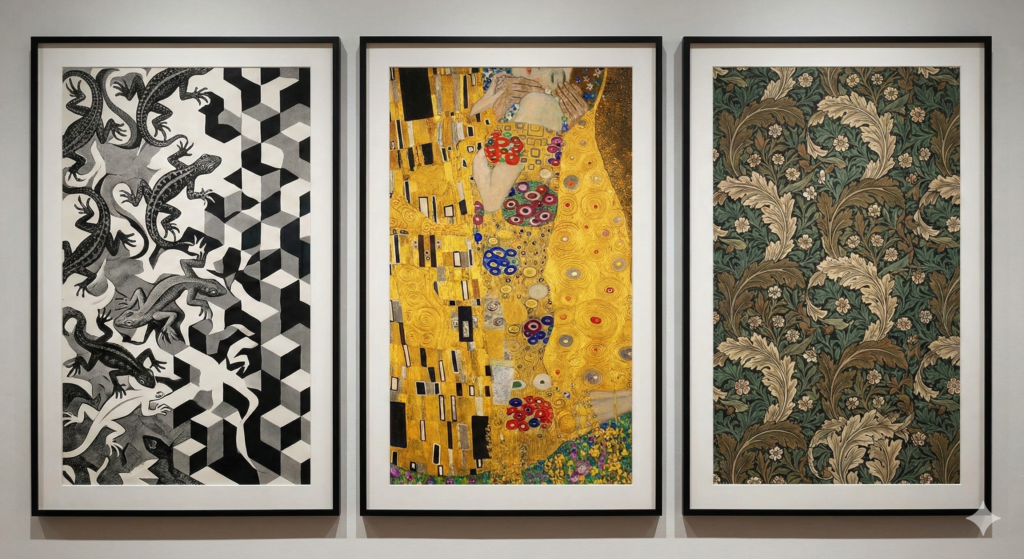
This Dutch graphic artist is perhaps the most famous for his mind-bending tessellations and impossible constructions. Escher’s patterns often featured animals or figures transforming seamlessly into one another, showcasing his fascination with mathematics and logic. His work “Metamorphosis” shows lizards transforming into hexagons, then into bees, demonstrating how patterns can create narrative and movement.
Escher studied Islamic patterns during his travels and was deeply influenced by their mathematical precision. He took these concepts further, creating tessellations that defied gravity and logic. His artwork proves that patterns can be intellectually challenging while remaining visually stunning. When you look at an Escher print, you’re seeing pure mathematics transformed into art.
Gustav Klimt (1862-1918): Golden Patterns of Opulence
An Austrian Symbolist painter, Klimt’s ‘Golden Phase’ is renowned for its luxurious, intricate patterns. His figures are often surrounded by rich, shimmering decorative elements, blending natural and geometric motifs that add symbolic depth and opulence to his works, like ‘The Kiss’. Klimt’s patterns weren’t just backgrounds—they were integral to the meaning of his paintings.
In “The Kiss,” the male figure’s robe features geometric rectangles and squares, while the female figure’s dress flows with organic circles and curves. This contrast in patterns represents masculine and feminine energies. Klimt’s innovative use of gold leaf and pattern-making techniques influenced Art Nouveau and modern decorative arts.
William Morris (1834-1896): Nature’s Pattern Prophet
A key figure in the British Arts and Crafts movement, Morris was a designer, artist, and writer passionate about traditional craftsmanship. He created iconic patterns for textiles, wallpapers, and tapestries, often inspired by flora and fauna, emphasizing natural beauty and hand-crafted quality. His “Strawberry Thief” wallpaper design remains one of the most recognized patterns in decorative arts.
Morris believed that beautiful surroundings improved people’s lives. His organic patterns brought nature indoors, creating living spaces filled with visual rhythm and harmony. He studied medieval manuscripts and Persian carpets, understanding how historical patterns could inform modern design. Morris proved that patterns could be both beautiful and functional, elevating everyday objects to art.
Contemporary Pattern Innovators
Contemporary artists also continue to explore patterns in innovative ways. From the immersive polka-dot installations of Yayoi Kusama to the intricate street art murals that transform urban spaces, pattern remains a vital element in modern artistic expression. Digital technology has opened new possibilities for pattern creation, allowing artists to explore fractals, algorithmic designs, and interactive patterns that respond to viewers.
Artists today combine traditional pattern-making techniques with digital art tools, creating hybrid works that honor the past while pushing into the future. The fundamental appeal of pattern—repetition, rhythm, and visual harmony—remains as powerful today as it was thousands of years ago.
Comparison of Pattern Types in Art
A comparison of different pattern types, their common characteristics, and typical artistic uses helps us understand when and why artists choose specific approaches to repetition.
| Pattern Type | Characteristics | Common Examples/Uses |
|---|---|---|
| Geometric | Uses mathematical shapes (lines, squares, circles); often symmetrical, precise | Islamic mosaics, Greek pottery, Mondrian’s paintings, architecture |
| Organic | Inspired by nature (leaves, waves, clouds); free-flowing, often asymmetrical, irregular | Art Nouveau designs, floral prints, Aboriginal art, Van Gogh’s brushstrokes |
| Tessellation | Shapes fit together perfectly without gaps or overlaps, covering a surface | M.C. Escher’s prints, floor tiles, patchwork quilts, some ancient Roman mosaics |
| Fractal | Patterns that repeat at different scales, appearing similar when zoomed in or out; often complex | Nature (coastlines, snowflakes, ferns), computer-generated art, abstract paintings |
| Repetitive | Simple identical elements repeated uniformly | Wallpaper, textile designs, pop art (Andy Warhol’s soup cans), basic borders |
| Alternating | Two or more elements repeated in a sequence (e.g., ABABAB) | Checkerboard patterns, striped fabrics, some architectural details |
This table shows how different pattern types serve different artistic purposes. Geometric patterns create order and stability, organic patterns evoke nature and growth, tessellations demonstrate mathematical precision, fractals reveal nature’s hidden structures, repetitive patterns provide visual texture, and alternating patterns add dynamic variety.
How to Use Patterns in Your Own Art
Understanding pattern in art isn’t just about appreciation—it’s about application. Whether you’re painting, drawing, or working digitally, patterns can elevate your compositions. Here are some practical tips for incorporating patterns effectively:
Start Simple: Begin with basic repetitive patterns before moving to complex tessellations. Practice creating consistent spacing and sizing in your repeated elements.
Consider Scale: Patterns work differently at various sizes. Small-scale patterns create texture, while large-scale patterns become focal points. Experiment with how changing the size of your repeated elements affects the overall feeling of your work.
Mix Pattern Types: Combining geometric and organic patterns creates visual interest and contrast. This technique, used masterfully by Klimt, adds depth and sophistication to your compositions.
Use Patterns for Emphasis: Just as color creates mood, patterns can direct attention and create focal points. Place your most intricate patterns where you want viewers to look.
Study Cultural Patterns: Research traditional patterns from different cultures. Understanding the symbolism and techniques behind Islamic geometry, Celtic knots, or Japanese mon designs will expand your creative vocabulary.
Break the Pattern: Sometimes the most interesting moments occur when you intentionally disrupt a pattern. This creates surprise and draws the eye to the variation.
The Psychology of Patterns: Why They Captivate Us
Why do patterns have such a powerful effect on viewers? The answer lies in how our brains process visual information. Humans are pattern-recognition machines—we’ve evolved to spot patterns because they help us understand and predict our environment. This is why patterns feel both comforting and fascinating.
Predictability and Surprise: Patterns provide visual predictability, which our brains find satisfying. When artists then introduce a variation or break in the pattern, it creates a moment of surprise that captures attention. This balance between expectation and surprise is what makes great pattern-based art memorable.
Rhythm and Movement: Patterns create visual rhythm similar to musical rhythm. Our eyes follow the repeated elements, creating a sense of movement even in static images. This is one of the fundamental principles of painting that artists have used for centuries.
Meditative Quality: The repetitive nature of creating and viewing patterns can be meditative and calming. This is why adult coloring books featuring intricate patterns have become so popular—the act of following and completing patterns provides psychological satisfaction.
Cultural Recognition: We often respond emotionally to patterns from our own cultural background. Seeing familiar patterns can trigger feelings of belonging, nostalgia, or cultural pride. This is why textile patterns and decorative motifs remain so important in preserving cultural identity.
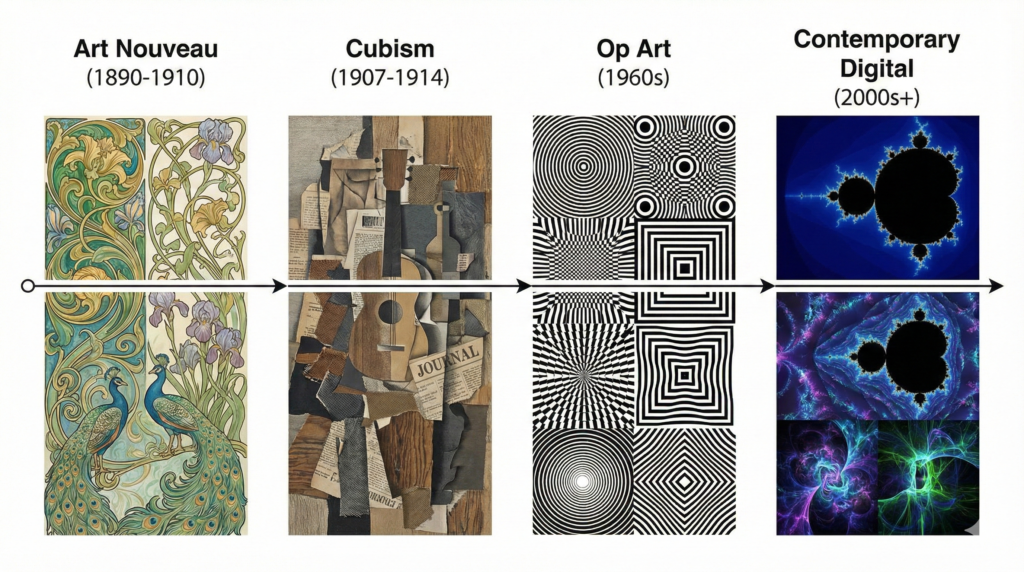
Pattern in Different Art Movements
Throughout art history and various movements, patterns have played different roles. Understanding how different periods approached pattern helps us appreciate the full scope of this design element.
Art Nouveau (1890-1910)
Art Nouveau artists embraced organic, flowing patterns inspired by natural forms. Their designs featured curving lines, stylized flowers, and nature-inspired motifs that covered everything from buildings to jewelry. The movement proved that patterns could be both decorative and deeply meaningful.
Cubism (1907-1914)
While not primarily about pattern, Cubist artists like Picasso and Braque often incorporated patterned elements—wallpapers, fabrics, newspaper text—into their fragmented compositions. These patterns provided visual anchors in otherwise abstract works.
Op Art (1960s)
Optical Art took pattern to its logical extreme, creating designs that seemed to move, pulse, or vibrate through precise geometric patterns. Artists like Bridget Riley used black and white patterns to create optical illusions that challenged perception.
Contemporary Digital Art
Modern digital artists use algorithmic patterns and fractal designs that would be impossible to create by hand. Technology has expanded the possibilities for pattern creation while maintaining connections to traditional approaches. Contemporary art styles continue to find new ways to incorporate both ancient and innovative pattern techniques.
Frequently Asked Questions (FAQs)
What is the main difference between pattern and texture in art?
Pattern involves the repetition of a design element, creating a predictable visual rhythm. Texture, on the other hand, refers to the surface quality of an artwork—how it looks or feels—which can be real (tactile) or implied (visual). While a pattern can create a visual texture, they are distinct concepts. Patterns are about repeated elements, while texture is about surface quality.
Why do artists use patterns in their work?
Artists use patterns for many reasons: to create unity and visual harmony, add decorative appeal, guide the viewer’s eye, create a sense of movement or rhythm, symbolize ideas, or even to fill space and create complexity. Patterns can evoke emotion and add depth to a piece. They’re fundamental tools in the artist’s toolkit for creating engaging, meaningful work.
Can patterns in art be abstract?
Yes, absolutely! Patterns can be very abstract, not representing any recognizable object. Abstract patterns focus purely on the arrangement and repetition of lines, shapes, and colors to create visual interest without a specific subject matter, allowing for a wide range of expressive possibilities. Many abstract and modern artists built their entire practice around exploring abstract patterns.
What’s an example of an everyday pattern in art?
Think of the repetitive brickwork on a building in a cityscape painting, the stripes on a character’s clothing in a portrait, or the repeated floral motifs on a decorative vase in a still life. Even the brushstrokes in some paintings can form a pattern, creating a sense of movement or texture. Patterns are everywhere once you start looking for them.
How do I start incorporating patterns into my artwork?
Start by observing patterns in your daily environment—architecture, fabrics, nature. Practice drawing simple repeating shapes with consistent spacing. Study how master artists used patterns in their work. Experiment with different types of patterns (geometric, organic, alternating) and see which ones resonate with your style. Remember, pattern-making is a skill that improves with practice.
What culture is most famous for geometric patterns?
Islamic art is perhaps most famous for its geometric patterns, though many cultures have strong geometric traditions. Islamic artists developed incredibly sophisticated mathematical patterns as alternatives to figurative representation, creating designs that express spiritual concepts through pure geometry. However, Celtic, Greek, Roman, and many indigenous cultures also have rich geometric pattern traditions.
Can digital tools create better patterns than hand-drawn ones?
Digital tools and hand-drawn patterns each have their strengths. Digital tools allow for perfect precision, easy repetition, and complex algorithmic patterns that would be impossible by hand. However, hand-drawn patterns have organic variations and human qualities that many find more appealing. The best approach often combines both—using digital tools to refine hand-drawn concepts or adding hand-drawn elements to digital patterns. Many contemporary artists work in both traditional and digital mediums, getting the best of both worlds.
Conclusion
From the precise geometry of ancient mosaics to the flowing organic forms of modern textiles, patterns are a timeless and universal element in art. They are more than just decoration; they are fundamental tools artists use to communicate ideas, evoke emotions, and bring order and beauty to their creations. Pattern in art represents one of humanity’s oldest and most enduring forms of visual expression.
By understanding the different types of patterns—from mathematical tessellations to nature-inspired organic designs—their cultural significance across civilizations, and the ways master artists like Escher, Klimt, and Morris employed them, we gain a deeper appreciation for the rich visual language that surrounds us. Patterns connect us to our ancestors who decorated cave walls, to medieval artisans creating illuminated manuscripts, and to contemporary digital artists exploring algorithmic designs.
So, the next time you look at a piece of art, take a moment to notice the patterns—you might be surprised by the stories they tell and the magic they create! Whether you’re admiring Islamic geometric tiles, Celtic knotwork, an Escher print, or a Klimt painting, you’re witnessing the power of repeated elements to create meaning, beauty, and visual harmony. The universal language of pattern in art continues to speak to us across cultures and centuries, proving that some forms of visual communication transcend time and space.
Citations
- The Metropolitan Museum of Art: Islamic Art – https://www.metmuseum.org/toah/hd/orna/hd_orna.htm
- M.C. Escher Official Website – https://www.mcescher.com/
- Victoria and Albert Museum: William Morris Collection – https://www.vam.ac.uk/collections/william-morris
- Google Arts & Culture: Pattern in Art – https://artsandculture.google.com/
- The Metropolitan Museum of Art’s Heilbrunn Timeline of Art History – https://www.metmuseum.org/toah/