Still life drawing is more than just sketching a bowl of fruit or arranging random objects on a table—it’s a powerful art practice that has shaped some of history’s greatest artists. From the masterful compositions of Paul Cézanne to the humble training sessions of art students worldwide, still life provides an incredible opportunity to study form, light, shadow, and texture in a controlled setting. Whether you’re a complete beginner picking up a pencil for the first time or an experienced artist looking to refine your observational skills, understanding the fundamentals of still life drawing will transform how you see and create art.
Key Takeaways:
- Still life drawing helps you master essential art fundamentals like form, perspective, and light
- You don’t need expensive materials—just basic pencils, paper, and everyday objects to start
- Proper composition and lighting setup are crucial for successful drawings
- Understanding value (light and dark) is more important than capturing every tiny detail
- Regular practice with still life builds skills that apply to all other types of art
Why Still Life Drawing Matters: History and Benefits for Artists
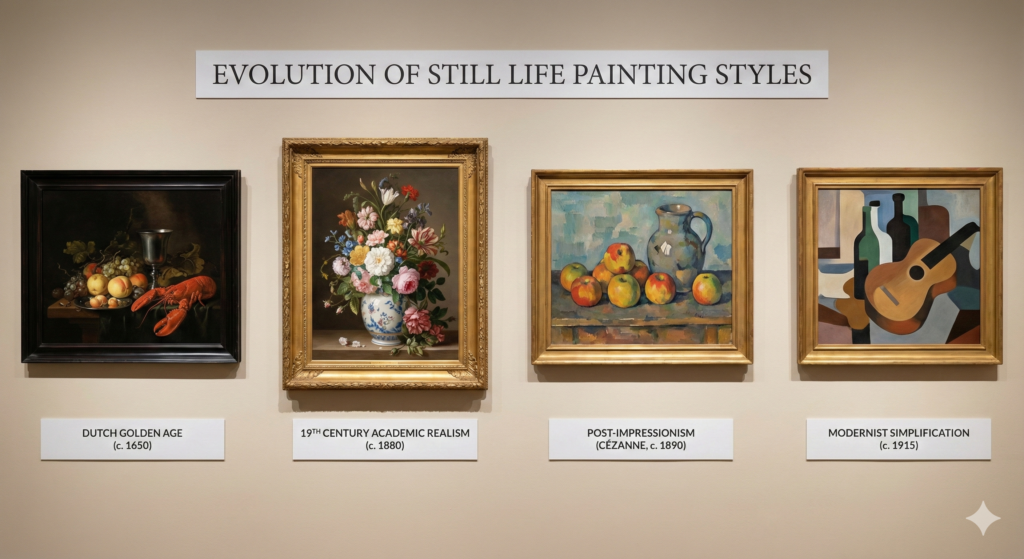
Still life drawing isn’t just a boring exercise—it’s a time-honored tradition that has helped artists develop their skills for centuries. When you look at the history of painting styles and movements, you’ll find that masters like Paul Cézanne, Jean-Baptiste-Siméon Chardin, and Vincent van Gogh all used still life to experiment with color theory, composition, and personal expression. These artists weren’t trying to simply copy what they saw; they were exploring visual problems and discovering new ways to represent the world around them.
For today’s developing artists, still life offers tremendous benefits that make it an essential practice. First, it teaches patience and careful observation—skills that are absolutely critical for any artist. When you spend time really looking at how light hits a surface or how shadows reveal the curve of an object, you’re training your eye to see like an artist sees. This observational skill becomes second nature with practice.
Second, still life gives you complete control over your subject. Unlike drawing from life models (who need breaks) or landscapes (where the lighting constantly changes), your still life setup stays exactly where you put it. You can work at your own pace, return to the same arrangement day after day, and really understand what you’re drawing. This controlled environment is perfect for learning foundational drawing techniques without the added pressure of time constraints.
Third, still life helps you understand three-dimensional form on a two-dimensional surface. Every object you draw—whether it’s a simple apple or a complex glass vase—teaches you about volume, weight, and how objects exist in space. These lessons translate directly to every other type of drawing you’ll ever do, from portraits to landscapes to abstract compositions.
“The day is coming when a single carrot, freshly observed, will set off a revolution.”
Paul Cézanne
This quote reminds us that even the simplest objects contain entire worlds of visual information when we truly observe them.
Essential Tools and Materials for Your Still Life Journey
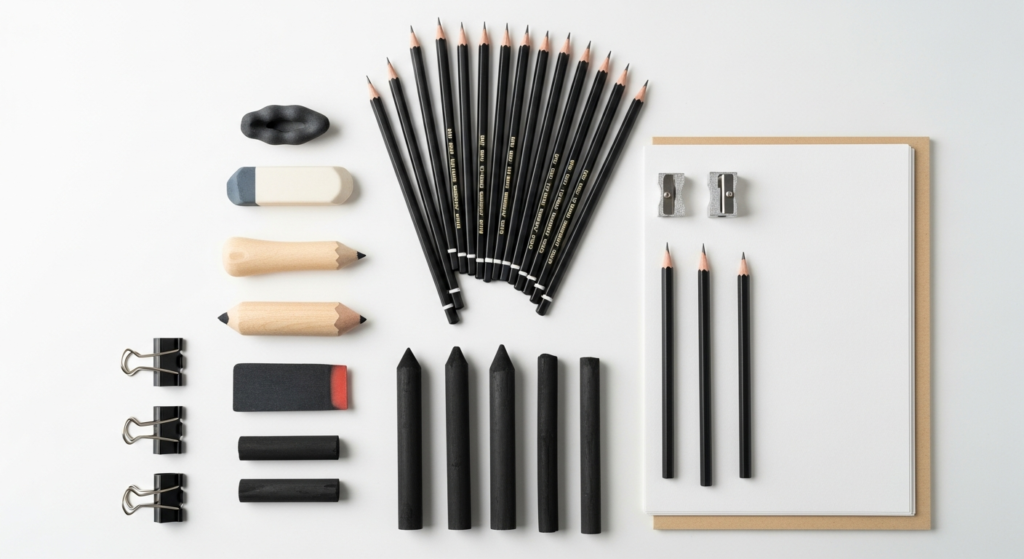
Before diving into your first still life drawing, let’s talk about materials. The good news is you don’t need to spend a fortune on fancy art supplies to create beautiful drawings. Here’s what you’ll need to get started:
Drawing Pencils: Start with a basic set that includes a range of hardness grades. The “H” pencils (hard) create lighter marks, while “B” pencils (soft) create darker, richer lines. A typical starter set includes:
- H or 2H (for light sketching and fine details)
- HB (middle ground, great for general drawing)
- 2B and 4B (for mid-tones and building value)
- 6B or 8B (for rich, dark shadows)
These different pencils give you control over the full range of values in your drawing, which is essential for creating realistic form.
Paper: Good quality drawing paper makes a significant difference. Look for paper with some “tooth” (surface texture) that holds graphite well. Bristol board offers a smooth surface perfect for detailed work, while cartridge paper has more texture that’s excellent for building up tone. Start with something in the 90-120 lb weight range—thick enough to handle erasing and layering without buckling.
Erasers: You’ll want two types. A kneaded eraser is soft and moldable, perfect for gently lifting graphite to create highlights or lighten areas without damaging the paper. A standard vinyl or plastic eraser gives you clean, sharp edges for corrections and precise highlight placement.
Additional Helpful Tools:
- Blending stumps or tortillons (tightly rolled paper used for smoothing graphite)
- Drawing board (to support your paper at an angle)
- Clips or masking tape (to secure your paper)
- Pencil sharpener or knife (for maintaining sharp points)
- White vinyl eraser pencil (for tiny highlights)
For Charcoal Enthusiasts: If you want to explore charcoal’s dramatic, expressive qualities, you’ll need vine charcoal (soft, easily blended) and compressed charcoal (darker, more permanent). Charcoal creates bold, atmospheric drawings quickly but requires fixative spray to prevent smudging.
Remember, these materials are similar to those used in various painting techniques, where understanding your medium’s properties helps you achieve better results.
Setting Up Your Still Life: Composition and Lighting Fundamentals
The success of your still life drawing often begins long before you pick up a pencil. A thoughtful, well-composed setup makes the drawing process easier and produces more compelling results. Think of arrangement and lighting as the foundation of your artwork.
Choosing Your Objects: Start by selecting items that genuinely interest you. Emotional connection to your subject matter shows in your work! Look for objects with different qualities:
- Varied shapes: Mix spherical (apples, oranges), cylindrical (cups, bottles), and irregular forms (shells, books)
- Different textures: Combine smooth (glass, glazed pottery), rough (fabric, wood), and reflective surfaces
- Interesting contrasts: Light objects against dark backgrounds (or vice versa) create visual interest
- Personal meaning: Objects from your daily life often make the most engaging subjects
Avoid cluttering your setup with too many items initially. Three to five objects is plenty for beginners. As you gain confidence, you can tackle more complex arrangements.
Composition Principles: Understanding composition fundamentals transforms random objects into compelling artwork. Consider these guidelines:
- Rule of thirds: Imagine your paper divided into a 3×3 grid. Placing your focal point at the intersection points creates more dynamic compositions than centering everything
- Overlapping: Allow objects to overlap slightly—this creates depth and spatial relationships
- Varying heights: Arrange objects at different heights to create visual rhythm
- Leading lines: Position objects so they guide the viewer’s eye through the composition
- Balance: Distribute visual weight (size, darkness, detail) across your composition
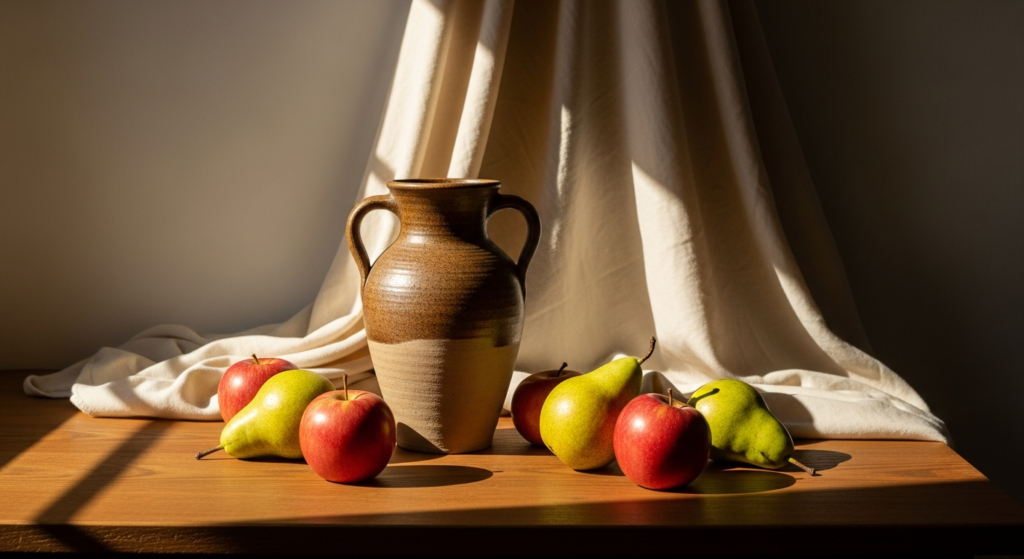
Lighting—The Most Critical Element: Lighting makes or breaks a still life drawing. Good lighting reveals form through clear value transitions from light to shadow. Follow these lighting principles:
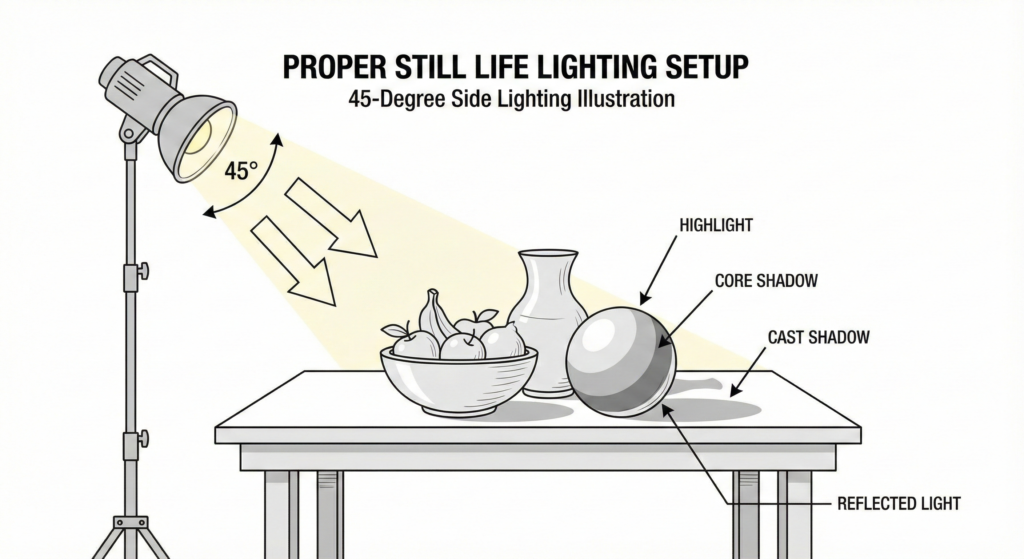
Single Light Source: Use one consistent light source—never multiple lights. A single lamp or window creates clear, understandable shadows that help define three-dimensional form. Multiple light sources flatten your drawing and create confusing, contradictory shadows.
Direction Matters: Side lighting (45-60 degrees from your setup) typically produces the most dramatic and informative shadows. Top lighting can work but sometimes flattens forms. Front lighting (between you and the objects) eliminates shadows and should be avoided.
Consistency: Natural window light is beautiful but changes throughout the day. If you’re working over multiple sessions, use artificial light (a desk lamp or spotlight) that stays consistent. This lets you work whenever you want without the lighting changing.
Observe the Shadow Patterns: Before you start drawing, spend time just looking at how light creates different types of shadows:
- Cast shadows: The shadows objects throw onto surrounding surfaces
- Form shadows: The shadowed side of the object itself
- Reflected light: Subtle light that bounces back into shadow areas from nearby surfaces
These shadow relationships are what make objects look three-dimensional, which relates directly to the principles of painting that apply to all visual arts.
Choosing Your Medium: Pencil vs. Charcoal vs. Pen & Ink
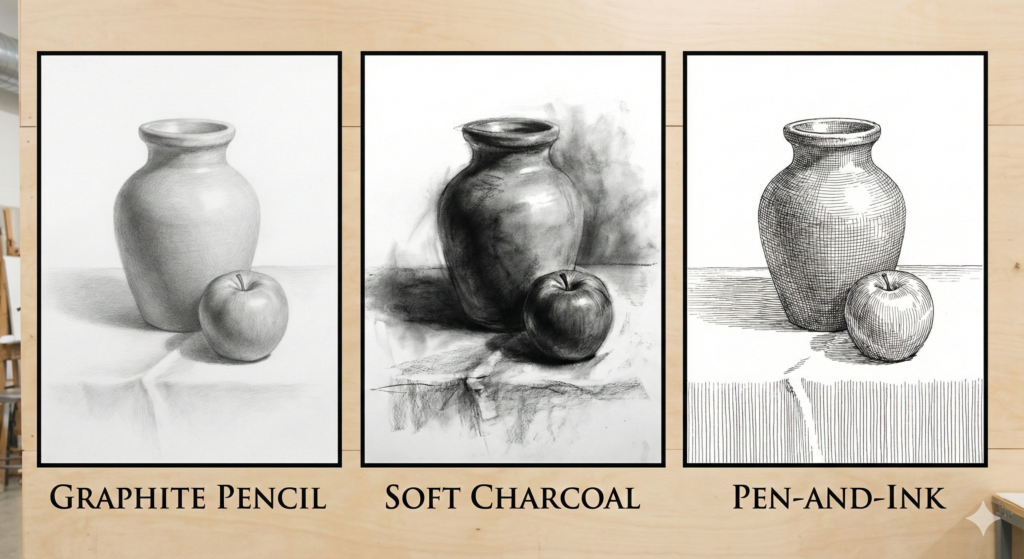
Each drawing medium offers unique characteristics that affect both the process and final appearance of your still life. Understanding these differences helps you choose the right tool for your artistic goals.
| Medium | Key Characteristics | Best For | Beginner Friendliness |
|---|---|---|---|
| Graphite Pencil | Wide range of values, precise lines, easily erasable, subtle textures, buildable tones | Detailed realism, intricate forms, subtle shading, architectural elements, tight rendering | Excellent (Forgiving and versatile) |
| Charcoal | Deep blacks, rich tones, soft blends, dramatic effects, good for large areas, expressive marks | Expressive drawings, dramatic light/shadow, capturing texture, quick sketches, atmospheric mood | Good (Can be messy but offers quick results) |
| Pen & Ink | Bold, permanent lines, strong contrasts, cross-hatching, stippling for values, precise details | Strong contours, graphic style, precise details, illustrative work, pattern creation | Moderate (Less forgiving of mistakes, requires confident lines) |
Graphite Pencil—The Versatile Classic: Graphite is the most forgiving medium for beginners learning still life drawing. You can easily erase mistakes, build up values gradually, and achieve both precision and softness. The range from H to 9B pencils gives you complete control over value. Start with graphite to build foundational skills before exploring other mediums.
Charcoal—The Dramatic Expresser: Charcoal produces stunning, dramatic drawings with rich blacks and beautiful blending. It’s particularly effective for larger drawings (18″ x 24″ or bigger) where you want atmospheric, expressive qualities. The downside? It’s messy, requires fixative to prevent smudging, and isn’t as precise as pencil for fine details. Many artists love charcoal for gesture drawings and preliminary studies.
Pen & Ink—The Confident Commitment: Pen work requires confidence since you can’t erase. Artists build values through techniques like cross-hatching (layered lines) and stippling (dots). This creates a distinctive graphic quality. Pen and ink work develops strong observational skills since you must commit to each mark. It’s excellent for practicing decisiveness and improving your line quality.
Interestingly, the principles you learn through these traditional drawing mediums apply to expressive art techniques in other contexts as well.
Step-by-Step: Drawing Your First Still Life Composition
Now comes the exciting part—actually creating your still life drawing! Follow this process to build your drawing methodically, just as professional artists do.
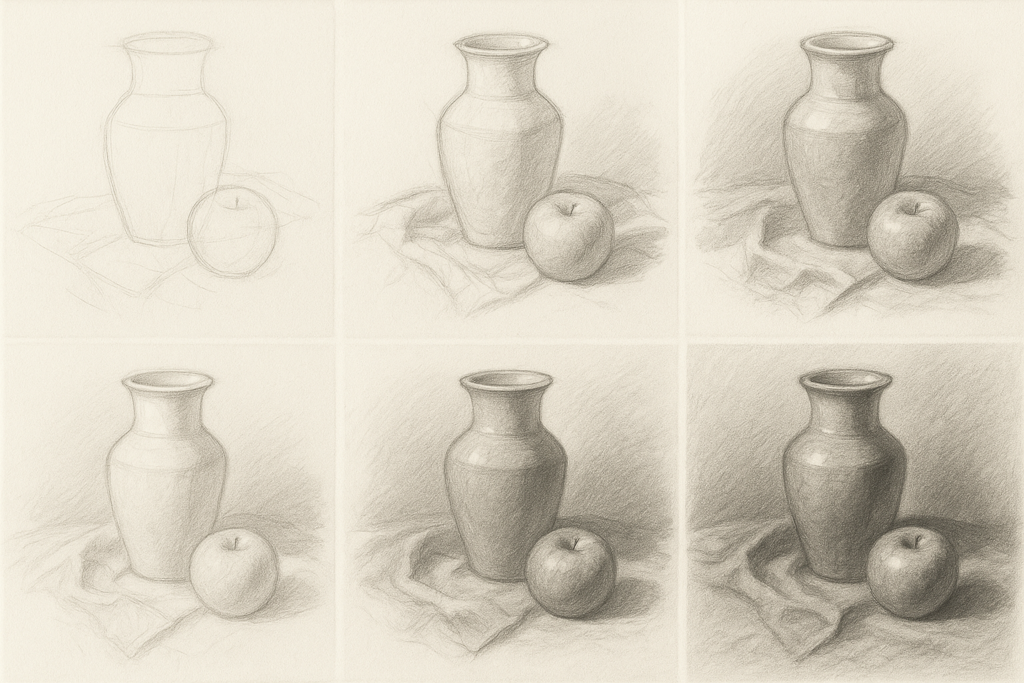
Step 1: Initial Observation (5-10 minutes) Before making any marks, spend time simply observing your setup. Notice the relationships between objects—their sizes relative to each other, how they overlap, where the light source creates highlights and shadows. Squinting your eyes helps you see the major value shapes more clearly by eliminating distracting details.
Step 2: Light Sketching the Basic Shapes (10-15 minutes) Using a light touch with an H or HB pencil, sketch the basic geometric forms that make up each object. An apple is essentially a sphere, a cup is a cylinder, a book is a rectangular box. Don’t worry about details or shading yet—just capture the essential forms and their placement.
- Keep your lines light (you’ll erase or cover them later)
- Check proportions constantly by measuring angles and distances
- Mark the placement of major shadow edges
- Establish the horizon line and any table edges
Step 3: Refining Shapes and Proportions (10-20 minutes) Now refine those basic shapes into more accurate contours. Look for the subtle curves, angles, and irregularities that make each object unique. Use light, searching lines—don’t commit to dark outlines yet. This is where you work out any proportion or perspective problems before investing time in shading.
Step 4: Establishing Major Value Shapes (15-30 minutes) This crucial step builds the foundation for realistic form. Identify and lightly block in the three major value zones:
- Lights: Areas facing the light source (leave these white or very light)
- Midtones: The transitional values between light and shadow
- Darks: Shadow areas both on objects and cast shadows
Use the side of your pencil for broader strokes. Don’t worry about smooth blending yet—just establish where the lights and darks live. This stage is about mapping value relationships, similar to the grisaille painting technique used by classical artists.
Step 5: Building Up Values Gradually (30-60 minutes) Now gradually develop your full value range, working from light to dark. Layer your graphite in multiple light passes rather than pressing hard—this gives you more control and creates richer, more nuanced tones. Pay attention to:
- Core shadows: The darkest area of the form shadow, usually found where the object curves away from the light
- Reflected light: Subtle light bouncing back into shadow areas (don’t make this too bright!)
- Cast shadows: Usually darkest near the object, lightening as they extend outward
- Highlights: The brightest spots where light directly hits smooth surfaces
Step 6: Refining Details and Final Touches (20-40 minutes) In the final stage, add specific details and refine transitions between values. Use your full range of pencils—H for light areas, 6B or 8B for rich darks. Create smooth blending with a tortillon where appropriate, but remember that visible pencil strokes add energy and interest to your drawing.
Don’t overwork it! Knowing when to stop is an important skill. Your drawing should capture the essence and form of your subjects without becoming tight or overworked.
Advanced Techniques: Mastering Light, Shadow, and Form
Once you’ve completed several still life drawings and feel comfortable with the basics, you can explore more advanced concepts that elevate your work from good to exceptional.
Understanding Value—The Foundation of Realism: Value (the lightness or darkness of a tone) is arguably the most important element in creating convincing three-dimensional form. Many beginning artists don’t push their values far enough—their lights aren’t light enough, and their darks aren’t dark enough. This creates flat, weak drawings.
Create a value scale with your pencils, showing the full range from pure white paper to the darkest black you can achieve. When drawing, constantly compare the values in your subject to this scale. Ask yourself, “Is this shadow really that light, or should it be two steps darker?” Accurate value relationships create the illusion of form more effectively than precise outlines ever could.
Chiaroscuro—The Drama of Light and Dark: Chiaroscuro (Italian for “light-dark”) refers to the strong contrast between illuminated and shadowed areas. Baroque artists like Caravaggio and Rembrandt mastered this technique, creating paintings with powerful, dramatic lighting. You can apply these same principles to your still life drawings.
To practice chiaroscuro:
- Use a single, strong light source (like a spotlight or bright lamp)
- Position objects to maximize dramatic shadow shapes
- Push the contrast—let your darks go very dark and your lights stay bright
- Pay attention to how shadows create mood and atmosphere
This technique relates to the dramatic lighting principles found in understanding art movements, particularly the Baroque period.
Capturing Form Through Light: Every object has a characteristic way that light reveals its form. Understanding these patterns helps you draw any object convincingly:
For Spherical Objects (apples, oranges, balls):
- Highlight (brightest point)
- Halftone (transition from light to shadow)
- Core shadow (darkest part of the form shadow)
- Reflected light (subtle light bouncing back into the shadow)
- Cast shadow (shadow thrown onto the surface)
For Cylindrical Objects (cups, bottles, pipes): Light creates a gradual transition from light to dark around the curved surface. The transition is more gradual than on a sphere, moving from highlight to midtone to shadow as the surface curves away from the light.
For Angular Objects (boxes, books): Each plane receives a different amount of light. One plane might be in full light, another in halftone, and a third in complete shadow. The transitions between planes are crisp rather than gradual.
The Power of Edges: Edges—where one value or object meets another—dramatically affect how we perceive form and space. Varying your edges creates more interesting, realistic drawings:
- Hard edges: Sharp transitions create focus and bring elements forward
- Soft edges: Blurred transitions suggest atmosphere, distance, or softness
- Lost edges: Where values are so similar that the edge disappears entirely, creating mystery
Don’t make every edge the same sharpness. Vary your edges to create hierarchy and direct the viewer’s attention.
Negative Space Drawing: Sometimes the best way to draw an object is to draw the space around it. Negative space—the areas between and around objects—has its own shapes. Drawing these “background” shapes accurately ensures your positive shapes (the actual objects) are proportionally correct. This technique is particularly helpful when dealing with complex forms or arrangements.
Finding Inspiration: Subject Ideas and Creative Approaches
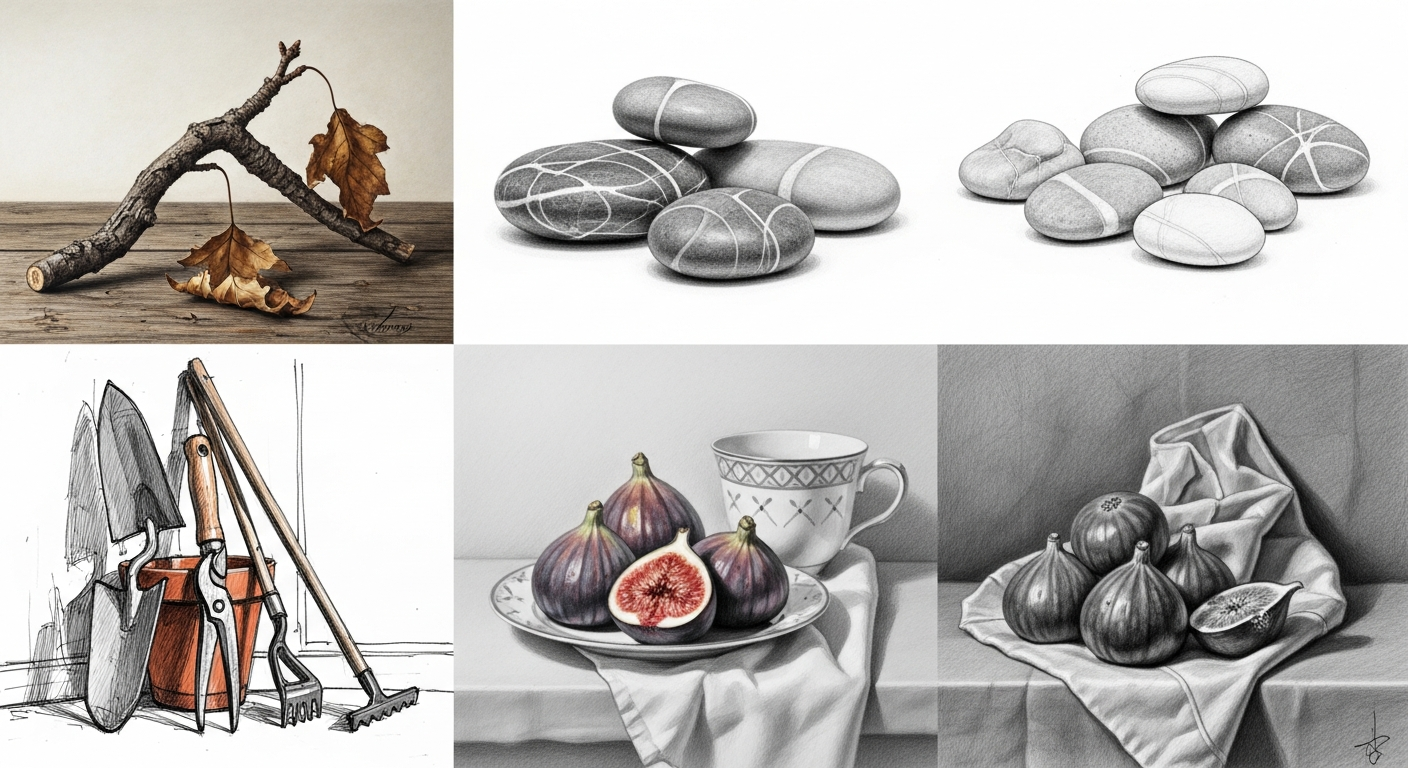
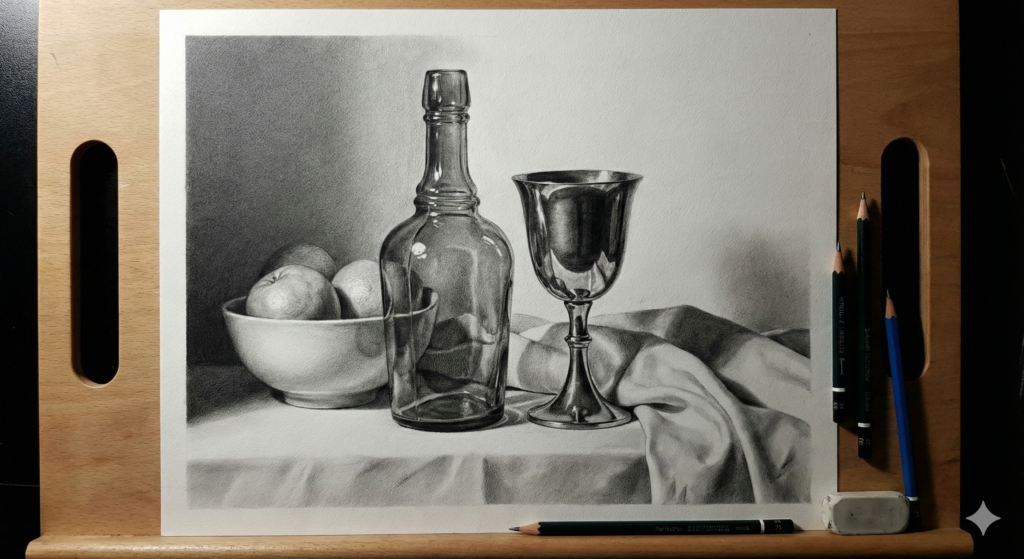
One of the beautiful aspects of still life drawing is that subject matter surrounds you. You don’t need exotic objects or expensive props—everyday items can become compelling subjects when arranged thoughtfully.
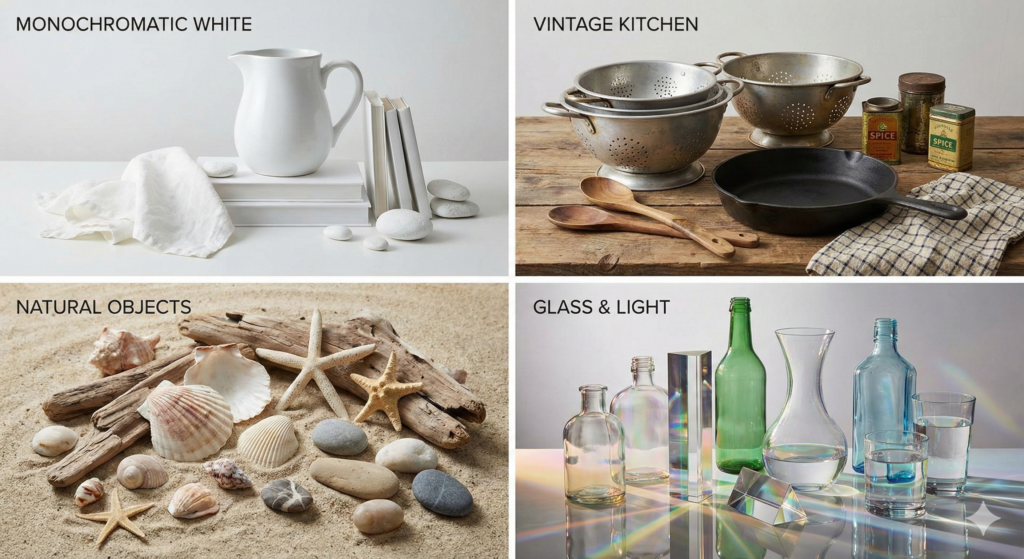
Classic Still Life Subjects:
- Food: Fruit (apples, pears, grapes), vegetables, bread, or dishes
- Household items: Coffee cups, teapots, vases, books, bottles
- Natural objects: Shells, flowers, plants, stones, driftwood
- Fabric: Draped cloth adds organic shapes and interesting folds
- Personal objects: Items that have meaning to you create more engaged drawings
Creative Arrangements:
- Thematic collections: All glass objects, all white objects, all rounded forms
- Contrasting textures: Combine rough with smooth, matte with reflective
- Mono-material studies: Draw the same object in different materials (wooden spoon vs. metal spoon)
- Seasonal themes: Autumn leaves and pumpkins, winter evergreen branches, spring flowers
- Kitchen compositions: Cooking utensils, ingredients, or vintage kitchenware
Challenging Yourself: As you progress, deliberately choose more difficult subjects:
- Transparent objects: Glass and liquids require understanding how light refracts
- Highly reflective surfaces: Metal objects mirror their surroundings
- Complex patterns: Decorative pottery or patterned fabric tests your observation
- Organic forms: Flowers and plants have irregular, complex structures
Remember, the subjects that fascinate master artists are often quite simple. Subject matter in painting has evolved throughout art history, but the fundamentals of good observation remain constant.
Conclusion: Your Journey into the World of Still Life Drawing
Still life drawing represents one of the most rewarding and accessible practices in the art world. It doesn’t require expensive equipment, exotic locations, or special circumstances—just everyday objects, basic materials, and your willingness to observe carefully and practice regularly. Through still life, you develop the foundational skills that support every other type of art you’ll create: understanding form, mastering value, composing effectively, and translating three-dimensional reality onto a two-dimensional surface.
Remember that every accomplished artist, from Leonardo da Vinci to contemporary masters, has spent countless hours drawing from observation. The simple act of setting up objects and drawing what you see builds your artistic muscles in ways that reading or watching tutorials alone never can. Don’t be discouraged if your early attempts don’t match your vision—that gap between aspiration and execution is simply showing you where to focus your practice.
Start simple. Set up a few objects with good lighting, pick up your pencil, and begin. Draw the same arrangement multiple times from different angles. Notice how your understanding deepens with each drawing. Experiment with different mediums—the various art mediums each offer unique expressive possibilities. Most importantly, enjoy the process. Still life drawing is meditative, focusing your attention on the present moment and the beauty of ordinary things.
Your artistic journey is uniquely your own, and still life drawing provides a solid foundation for wherever your creativity leads you. Keep your sketchbook nearby, practice regularly, and watch as your observational skills and technical abilities grow. The world is full of potential still life subjects waiting to teach you something new. Happy drawing!
Frequently Asked Questions (FAQs)
What are the easiest objects to draw for beginner still life?
Start with simple geometric forms like apples, oranges, cups, or boxes. These objects have clear, understandable forms that help you practice basic shading and proportions. Avoid transparent glass, highly reflective metals, or complex patterns until you’ve built foundational skills. Good beginner subjects include: single fruits, ceramic mugs, books, simple vases, or wooden objects.
How do I make my still life drawings look more three-dimensional?
Creating convincing three-dimensional form requires accurate value relationships. Make sure you’re using the full value range—from pure white highlights to rich, dark shadows. Pay special attention to the transitions between light and shadow (the halftones), and don’t forget reflected light in shadow areas. Also, ensure you’re working from a single, clear light source that creates consistent shadow patterns.
How long should I spend on a still life drawing?
This varies greatly depending on size, complexity, and your goals. A quick study might take 30-60 minutes, while a detailed, finished piece could require 4-8 hours or more spread across multiple sessions. For learning purposes, shorter studies (1-2 hours) repeated frequently often teach more than single marathon drawing sessions. The key is regular practice rather than perfect finish.
Should I use a photograph or draw from real objects?
Drawing from real, three-dimensional objects is vastly superior for learning. Photographs flatten three-dimensional information into two dimensions, making it harder to understand form. Real objects let you see how light actually wraps around forms, observe subtle value transitions, and even shift your viewing angle if needed. Once you’ve developed strong observational skills drawing from life, photographs become more useful as reference tools.
What’s the difference between sketching and drawing a still life?
Sketching typically refers to quick, loose studies focused on capturing essential information—gesture, major shapes, basic value relationships—often in 10-30 minutes. Drawing usually implies a more finished, detailed work where you refine edges, develop full value range, and add specific details, taking several hours. Both practices are valuable: sketching builds observational speed, while finished drawings develop patience and technical precision.
How do I choose a good composition for my still life?
Avoid centering everything or spacing objects evenly. Instead, use the rule of thirds to place focal points at visual interest areas. Vary the sizes and heights of objects, overlap them to create depth, and leave some “breathing room” (negative space) around your composition. Consider the overall shape your arrangement creates—interesting compositions often form triangular or L-shaped configurations rather than straight lines.
Can still life drawing help improve my other art skills?
Absolutely! Still life develops core skills that transfer to all art forms: observational accuracy, understanding light and shadow, value control, composition, proportion, and patience. Portrait artists use still life to practice without model fees. Landscape artists use it to understand form and atmosphere. Even abstract artists benefit from the formal understanding still life provides. It’s truly foundational practice.
What’s the best way to practice still life drawing regularly?
Set realistic goals like “three 30-minute studies per week” rather than “I’ll draw for hours every day.” Keep a dedicated space with basic supplies always ready. Draw the same setup multiple times rather than constantly arranging new compositions—this lets you focus on technique rather than setup. Consider joining online communities where artists share daily sketches for accountability and inspiration.
Citations and Sources
- The Metropolitan Museum of Art – Still Life Essay: https://www.metmuseum.org/toah/hd/stil/hd_stil.htm
- Art Is Fun – Still Life Drawing Tips: https://www.art-is-fun.com/still-life-drawing
- The Artist’s Magazine – Understanding Values in Drawing: https://www.artistsnetwork.com/art-mediums/drawing/understanding-values-drawing/