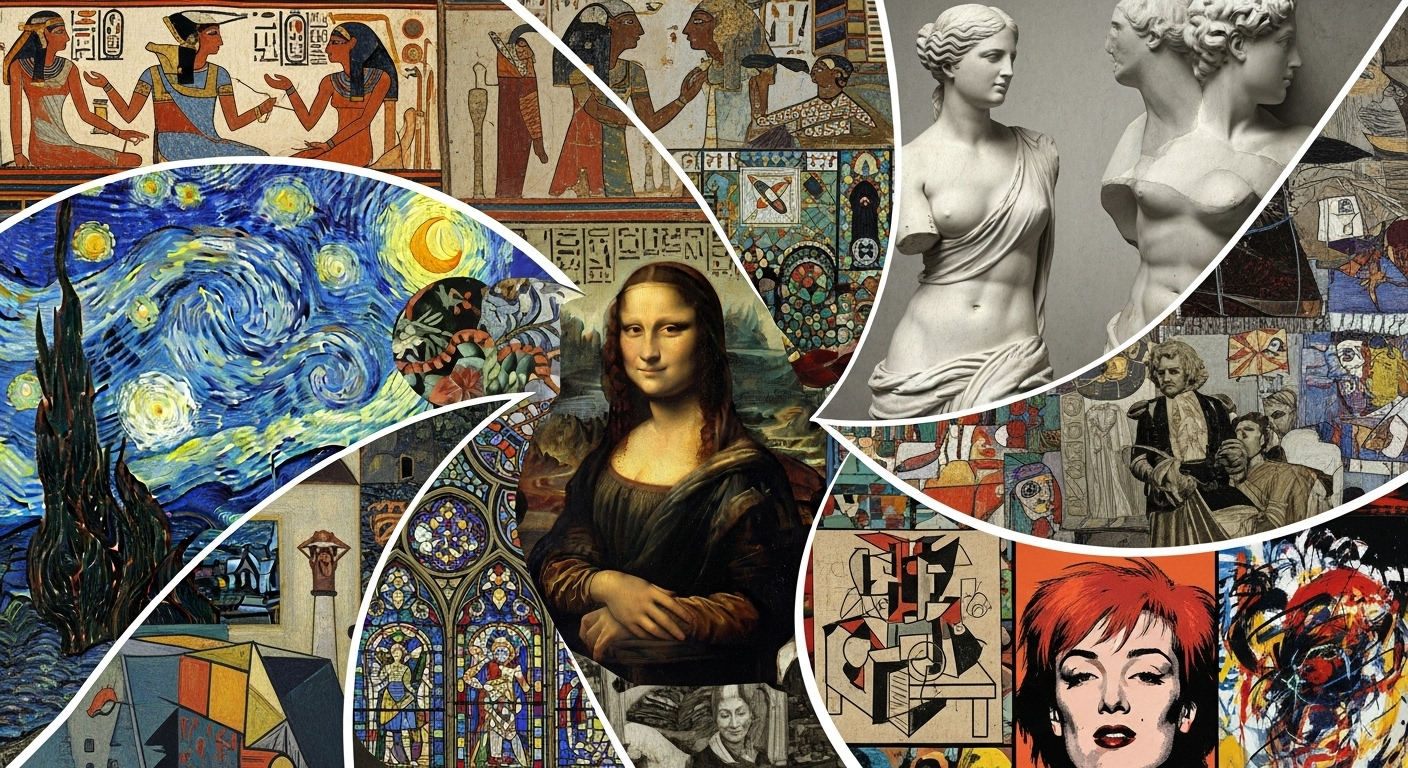
Have you ever wondered why a painting from 500 years ago looks completely different from one made in the 1950s? It’s not just that artists got better at painting; it’s because art, just like music and fashion, changes with time! Art history is like a massive, colorful timeline, and each section is a different famous art period—a set of years where artists shared similar ideas, styles, and goals. Understanding these movements isn’t just about memorizing names and dates; it’s about seeing how people across history saw their world and how they decided to leave their mark.
The art we study, the magnificent masterpieces and monumental sculptures, is a reflection of the society, politics, and technology of its time. Getting to know these famous art periods is like becoming a time traveler who can read the secret language of history written in paint and stone.
🔑 Key Point Summary: The Greatest Hits of Art History
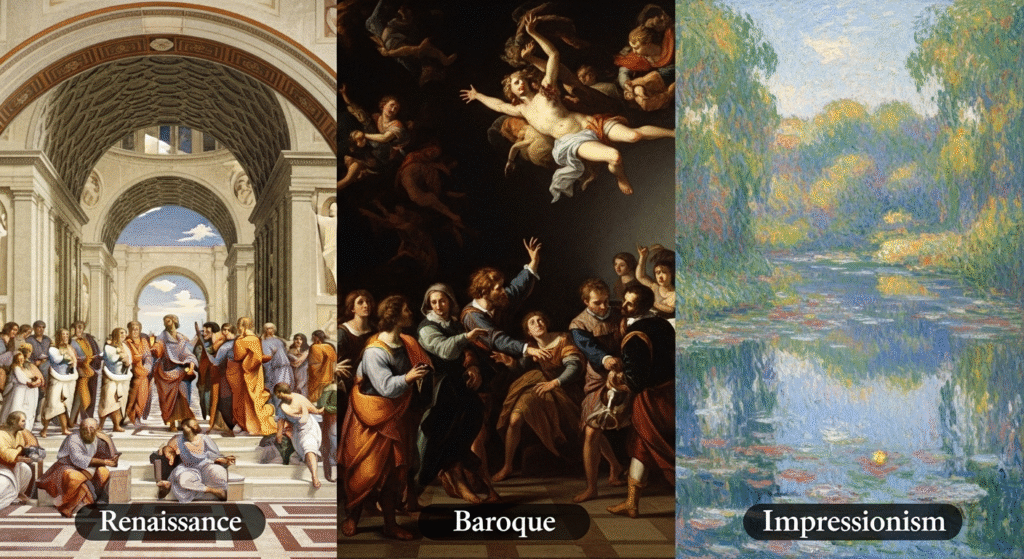
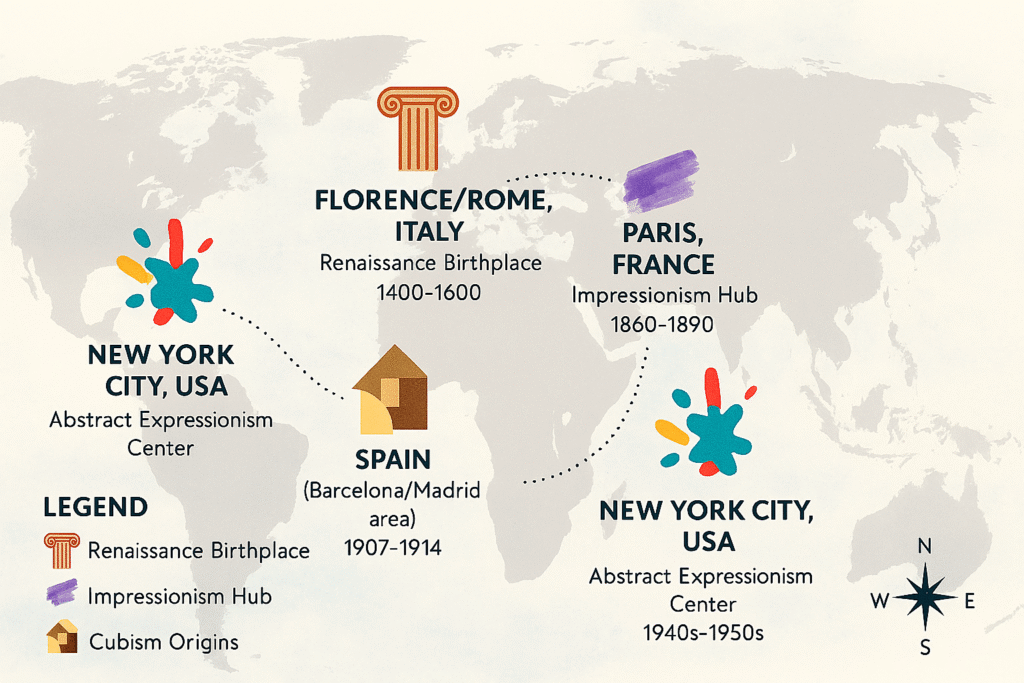
- Renaissance (c. 1400–1600): The “Rebirth” of classical ideas, focusing on humanism, perfect proportion, and realistic perspective. Artists like Leonardo da Vinci made humans look lifelike.
- Baroque (c. 1600–1750): The period of drama, emotion, and grandeur. Art was intense, with bold light/shadow (chiaroscuro) and lots of movement, often used by the Church to inspire awe.
- Impressionism (c. 1860–1890): A radical shift focused on capturing a fleeting moment and the effects of light and color, painted outdoors. Key artists include Claude Monet.
- Cubism (c. 1907–1914): A revolutionary style that shattered traditional perspective, showing objects from multiple viewpoints simultaneously using geometric shapes, pioneered by Picasso.
- Surrealism (c. 1920s–1950s): Art of the dreams and the unconscious mind, creating illogical, bizarre, and fantastic scenes to explore deep psychological truths.
Part I: The Old Masters (c. 1400–1750)
The Renaissance: The “Rebirth” of Beauty
Imagine a time in Europe after the “Dark Ages,” when people suddenly fell back in love with the brilliant ideas and flawless beauty of ancient Greece and Rome. That time was the Renaissance (meaning “rebirth” in French), stretching from roughly 1400 to 1600.
What was special about this era? Artists didn’t just paint flat, two-dimensional figures like in the Medieval period; they wanted to show things exactly as you see them in real life. They invented linear perspective, which is the trick that makes a hallway look like it goes deep into the canvas. But the biggest idea was Humanism: a belief in the importance of the individual person, their achievements, and their potential.
The art focused on balance, harmony, and ideal human forms. Think of the “Holy Trinity” of the High Renaissance: Leonardo da Vinci (the ultimate “Renaissance Man” who was a painter, inventor, and scientist), Michelangelo (who sculpted David and painted the ceiling of the Sistine Chapel), and Raphael (known for his perfect compositions like The School of Athens).
Characteristics of Renaissance Art:
- Use of scientific perspective (3D on a 2D surface)
- Idealized, muscular human figures
- Symmetry and calm composition
- Subjects often religious or based on Greek/Roman mythology
Understanding the vibrant evolution of colors between Renaissance and modern art gives us deeper insight into how this period transformed artistic expression.
Baroque: All the World’s a Stage
Right after the calm and perfect balance of the Renaissance, things got DRAMATIC. The Baroque period (c. 1600–1750) was a reaction, partly fueled by the Catholic Church’s desire to use art to excite and inspire worshippers in response to the Protestant Reformation.
Baroque art is like a Hollywood blockbuster movie compared to the Renaissance’s documentary. It’s all about emotion, movement, and intensity. Artists used extreme contrast between light and dark, called chiaroscuro, to highlight the most important parts of the scene and make it feel three-dimensional and immediate.
The Dutch master Rembrandt is famous for using this light/dark contrast to capture deep human emotion, especially in his portraits. Meanwhile, the Italian sculptor Bernini made marble look like fabric and flesh in mid-action, like his statue Apollo and Daphne. The dramatic intensity of Caravaggio’s rebel style perfectly captures the Baroque spirit.
Part II: The Birth of Modern Art (c. 1750–1900)
Neoclassicism and Romanticism: Brains vs. Heart
As Europe entered the age of revolution and scientific discovery (The Enlightenment), two styles—or famous art periods—wrestled for attention.
Neoclassicism (c. 1750–1830) was a return to the brainy ideas of Greek and Roman art. It was about logic, order, and morality. Artists like Jacques-Louis David painted scenes of heroism, civic virtue, and serious history, often with a clean, sharp look, as if saying, “We must be reasonable!”
Then came Romanticism (c. 1790–1850). This was the heart’s comeback! Romantic artists were all about emotion, imagination, and the awesome power of nature. They rejected the strict rules of Neoclassicism, favoring wild landscapes, dramatic moments, and deep feelings. The Spanish artist Francisco Goya painted the dark, emotional side of conflict, while J.M.W. Turner captured the sublime, overwhelming force of storms and light.
“The true use of art is to manufacture dreams.”
Winslow Homer, an American artist working in the Realism/Tonalism era, perfectly captures the Romantic idea that art is for escaping the everyday world.
Impressionism: The Blurry Snapshot
Think about a moment when you quickly glance at something—that blur of light and color is exactly what the Impressionists (c. 1860–1890) wanted to capture. This group of French artists, including Claude Monet, Pierre-Auguste Renoir, and Edgar Degas, rebelled against the old art world rules and took their easels outdoors (or en plein air).
They realized that light changes every second, and to capture a “fleeting moment,” they couldn’t paint with the precise detail of the past. Their work is known for:
- Visible, loose brushstrokes (you can actually see the paint dabbed onto the canvas)
- Focusing on light and color over line and form
- Depicting everyday, modern life: city streets, gardens, and picnics
The invention of pre-packaged paint tubes made it easy for them to leave their studios, truly starting what we call Modern Art. If you want to understand what makes Impressionism unique, exploring its key characteristics reveals how revolutionary this movement truly was.
Part III: The Leap into Modernity (c. 1890–1950)
Post-Impressionism: Beyond the Impression
Not long after Impressionism, a group of artists who were influenced by the style decided they needed a little more structure or more emotion. They became the Post-Impressionists (c. 1886–1905). This is where the individuality of the artist really exploded!
- Vincent van Gogh used color to express intense emotion, like swirls of anxiety and excitement in The Starry Night
- Paul Cézanne focused on the geometric shapes (cylinders, spheres, cones) that he believed made up all of nature, paving the way for the next major period
The transition from Impressionism to Post-Impressionism marked one of the most significant shifts in art history.
Cubism: Shattering Reality
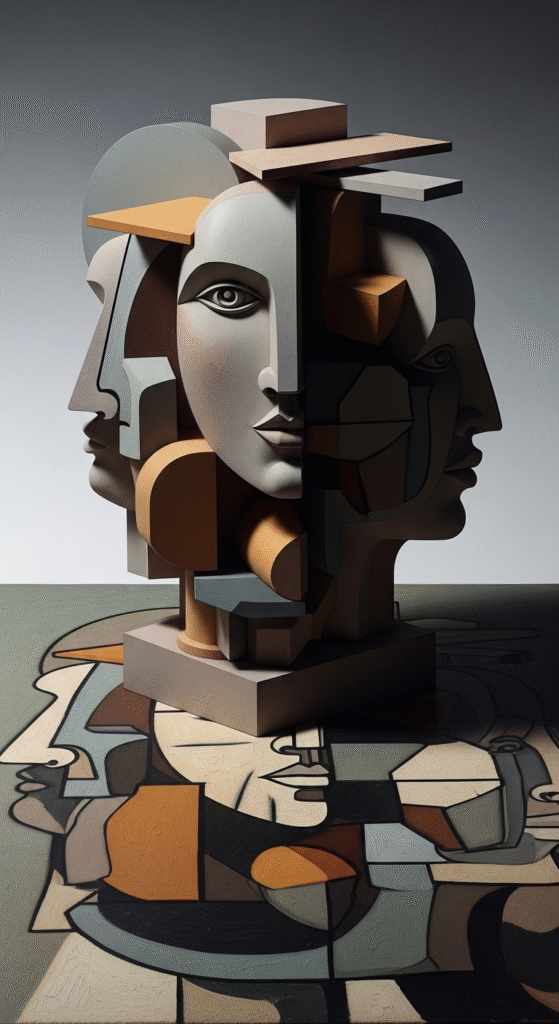
Cubism (c. 1907–1914) is arguably one of the most important leaps in art history. Pioneered by Pablo Picasso and Georges Braque, this movement shattered the traditional idea that a painting had to show a single, fixed viewpoint.
Imagine taking an object, breaking it into pieces, and then gluing the pieces back onto the canvas so you see the front, back, and sides all at once. That’s Cubism! It was a radical idea that forced viewers to think about form, space, and the canvas itself in a completely new way.
Surrealism: The Dream World
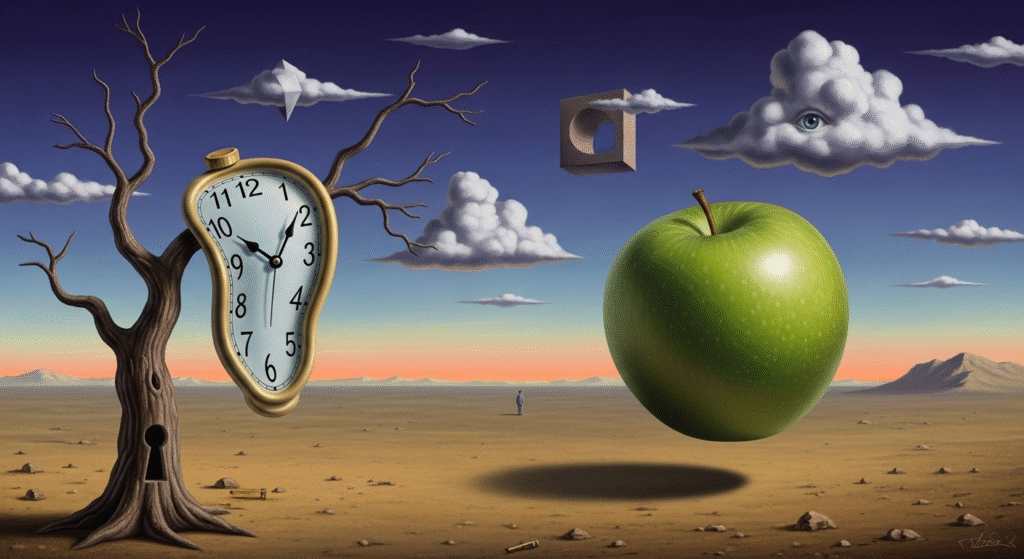
The horrors of World War I made many artists question the logic and reason that had been so important in earlier famous art periods. The chaos led to a few strange and wonderful movements, with Surrealism (c. 1920s–1950s) being the most lasting.
Inspired by the psychological theories of Sigmund Freud, Surrealists believed the unconscious mind—our dreams, our fears, and our deepest desires—held the real truth. Artists like Salvador Dalí (The Persistence of Memory) and René Magritte painted scenes that were impossibly realistic yet completely illogical, creating bizarre, dreamlike worlds where clocks melt and apples float in front of faces.
Part IV: The Global Contemporary Era
Pop Art: Art of the Everyday
Jumping forward to the 1950s and 60s, a new movement arose that loved the world of advertising, comic books, and mass production. Pop Art took everyday objects and popular culture icons and turned them into fine art.
Andy Warhol famously created silkscreen prints of Marilyn Monroe and Campbell’s Soup Cans. By making art from things you see every day, like a soda bottle or a comic book panel, Pop Art blurred the line between “high” art (what you see in museums) and “low” art (what you see everywhere else).
Abstract Expressionism: Pure Emotion
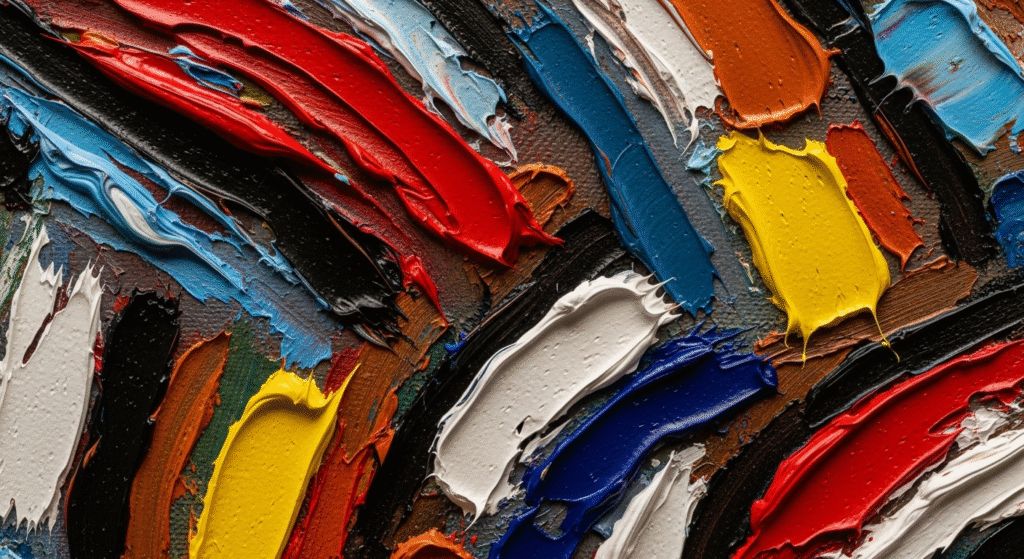
Right before Pop Art, American artists took the lead in a powerful new style called Abstract Expressionism (c. 1940s–1950s). These artists, like Jackson Pollock, rejected any recognizable subject matter and focused on the pure act of painting itself.
Pollock literally dripped, poured, and flung paint onto massive canvases placed on the floor—a style known as Action Painting. It wasn’t about painting a picture; it was about recording the artist’s physical energy and emotion. Understanding how abstract artists changed modern art helps us appreciate this revolutionary period.
📹 Video: A Quick Visual Tour of Art History
To see how these amazing changes looked on canvas, check out this great video that walks you through the major movements:
A Unique Perspective: Why Art Periods Overlap
It might seem messy that the dates for these famous art periods sometimes overlap, but that’s because art history isn’t a neat assembly line! A movement starts when a few artists get a revolutionary idea. But not every artist in the world instantly switches styles. For example, some French artists were painting in the super-detailed Neoclassical style while the Impressionists were just starting to capture blurry light outdoors. It’s proof that art is a conversation—a mix of arguments, influences, and new ideas that keep building on the past.
Understanding this constant conversation is what makes art history so fascinating. The evolution of art movements from Renaissance to Postmodernism shows how each period influenced the next. You can also explore how different art periods shaped famous painters throughout history.
| Art Period | Dates | Key Characteristics | Famous Artists |
|---|---|---|---|
| Renaissance | 1400-1600 | Perspective, humanism, classical beauty | Leonardo, Michelangelo, Raphael |
| Baroque | 1600-1750 | Drama, emotion, chiaroscuro | Rembrandt, Caravaggio, Bernini |
| Neoclassicism | 1750-1830 | Logic, order, classical themes | Jacques-Louis David |
| Romanticism | 1790-1850 | Emotion, nature, imagination | Goya, Turner, Delacroix |
| Impressionism | 1860-1890 | Light, color, visible brushstrokes | Monet, Renoir, Degas |
| Post-Impressionism | 1886-1905 | Individual expression, structure | Van Gogh, Cézanne, Gauguin |
| Cubism | 1907-1914 | Multiple viewpoints, geometric forms | Picasso, Braque |
| Surrealism | 1920s-1950s | Dreams, unconscious, illogical | Dalí, Magritte |
| Abstract Expressionism | 1940s-1950s | Pure emotion, action painting | Pollock, Rothko |
| Pop Art | 1950s-1960s | Popular culture, mass production | Warhol, Lichtenstein |
Understanding how to identify different art movements is an essential skill for any art enthusiast. The guide to color in art history also reveals how these movements used color to convey meaning.
🙋 Frequently Asked Questions (FAQs)
What is the most famous art period?
The most famous art period is generally considered to be the Renaissance (c. 1400–1600). It produced world-famous “superstars” like Leonardo da Vinci and Michelangelo and introduced foundational techniques, like perspective, that defined Western art for centuries. Learning about Renaissance art as a beginner can help you understand why this period remains so influential.
How are art periods and art movements different?
An Art Period (like the Renaissance or Baroque) usually covers a very long span of time, sometimes centuries, and includes art, architecture, music, and literature. An Art Movement (like Impressionism or Cubism) is usually shorter and more focused, often a rebellion against the style that came right before it, and is usually specific to painting and sculpture. All movements fit inside a larger period. Exploring painting styles and movements provides a comprehensive overview of these distinctions.
What is the name of the art period after Impressionism?
The period that immediately followed Impressionism is Post-Impressionism (c. 1886–1905). This is not one single style, but a group of artists (like Van Gogh, Cézanne, and Gauguin) who admired the Impressionists’ use of color but wanted to add more structure, symbolism, or personal emotion back into their work.
What is the current art period called?
The current period is generally called Contemporary Art (roughly c. 1970 to the present). This period is defined by its diversity and lack of a single, unifying style. Contemporary artists use all kinds of media, from painting and sculpture to video, performance, and digital art, and often focus on ideas, social issues, and challenging the meaning of “art” itself. The 20th century art movements laid the foundation for today’s diverse artistic landscape.
Which art period focused on emotion over reason?
Romanticism (c. 1790–1850) is the famous art period that emphasized emotion, imagination, and individual feeling over the logic and order valued by Neoclassicism. Romantic artists celebrated the power of nature, dramatic moments, and deep psychological experiences.
What are the key characteristics of Baroque art?
Baroque art is characterized by intense drama, emotional power, bold use of light and shadow (chiaroscuro), grand scale, and dynamic movement. It was often used by the Catholic Church to inspire awe and devotion during the Counter-Reformation.
How did Cubism change art history?
Cubism revolutionized art by abandoning the single viewpoint that had dominated Western painting since the Renaissance. By showing objects from multiple angles simultaneously and breaking them into geometric shapes, Cubism opened the door to abstract art and changed how artists thought about representing reality on a flat canvas.
Who were the most influential artists?
Throughout different famous art periods, certain artists stand out for their lasting impact. The most influential artists shaped not just their own time but also generations of painters who followed. From Renaissance masters to modern pioneers, these artists created techniques and styles that continue to inspire today.
Understanding famous art periods gives you a superpower: the ability to walk into any museum and immediately recognize what century a painting is from, what ideas the artist cared about, and how their work fits into the grand conversation of art history. Whether you’re drawn to the perfect balance of the Renaissance, the emotional intensity of Romanticism, or the dreamlike strangeness of Surrealism, each period offers a unique window into human creativity and expression across the ages.
Citations:
- Art in Context – Art Periods – A Detailed Look at the Art History Timeline (Accessed October 2025)
- FAD Magazine – List of the Most Important Art Periods (Accessed October 2025)
- StudioBinder – Art History Timeline — A Guide to Western Art Movements (Accessed October 2025)
- The Art Story – Modern Art Movement Timeline (Accessed October 2025)
- Dummies – Art History For Dummies Cheat Sheet (Accessed October 2025)
- WikiArt – Artists by art movement (Accessed October 2025)