If you’ve ever looked at L.S. Lowry’s paintings and thought “I could do that,” you’re missing something incredible. This British master turned simple scenes of factory workers and smoky cities into powerful art that still captivates viewers today. Learning from Lowry composition analysis for artists reveals how deceptively simple paintings can tell complex stories about everyday life. Let’s uncover the compositional genius behind those famous matchstick figures.
Key Takeaways
- Lowry’s “simple” style masks sophisticated compositional techniques that any artist can learn
- Elevated viewpoints and strategic space usage create depth without complex perspective rules
- Limited color palettes can generate powerful emotional responses and atmospheric effects
- Simplified forms and repeated patterns produce rhythm and movement in crowd scenes
- Observation of daily life provides endless narrative possibilities for compelling artwork
Who Was L.S. Lowry? More Than Matchstick Men
Laurence Stephen Lowry (1887-1976) spent most of his life in the industrial regions of northwest England, specifically Manchester and Salford. While working as a rent collector by day, he painted by night, capturing the working-class life surrounding him. Critics initially dismissed his work as primitive, but today his paintings sell for millions and hang in major museums worldwide.
What made Lowry special wasn’t technical perfection—it was his unique way of seeing. He transformed ordinary industrial landscapes into something almost dreamlike, where tiny figures moved through smoky streets beneath towering factories. Understanding essential elements of composition helps us appreciate what Lowry achieved with apparent simplicity.
Understanding Lowry Composition Analysis for Artists
Before diving into specific techniques, understanding Lowry’s overall approach helps explain his choices. He wasn’t trying to create photorealistic paintings or follow traditional academic rules. Instead, he developed a visual language that captured the essence of industrial Britain—the atmosphere, the loneliness within crowds, and the strange beauty of ordinary moments.
Lowry simplified complex scenes to their core elements. A figure didn’t need detailed facial features to convey isolation. A building didn’t require every brick to feel imposing. This reductionist philosophy freed him from unnecessary detail, allowing viewers to focus on mood, movement, and narrative.
The Power of the Elevated Viewpoint
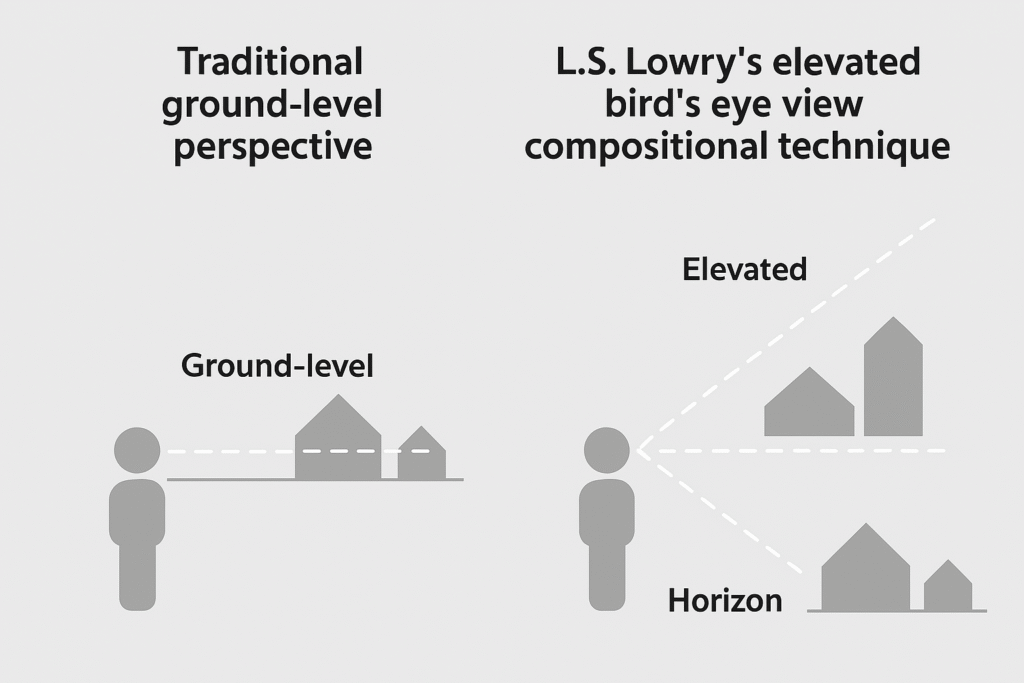
One of Lowry’s most distinctive techniques was his use of elevated, panoramic perspectives. Rather than placing viewers at ground level, he positioned us above the scene, looking down at an angle. This bird’s-eye view served multiple purposes.
The elevated position makes us observers rather than participants. We watch these tiny figures from above, almost like a benevolent spirit hovering over the scene. This distance creates a unique emotional tone—we feel sympathy for the workers without being overwhelmed by their individual stories.
From above, Lowry could show hundreds of figures without creating visual chaos. The elevated perspective naturally organizes space, allowing him to arrange figures in patterns that suggest movement and purpose. This approach works beautifully for artists exploring watercolor perspective techniques for beginners.
Figure Arrangement: The Dance of Matchstick Men
Lowry’s famous “matchstick men” might look simple, but their arrangement reveals sophisticated understanding of rhythm, repetition, and movement. He repeated similar figures throughout his compositions, but never identically. Each person leans slightly differently, walks at a unique angle, or stands in a distinctive pose.
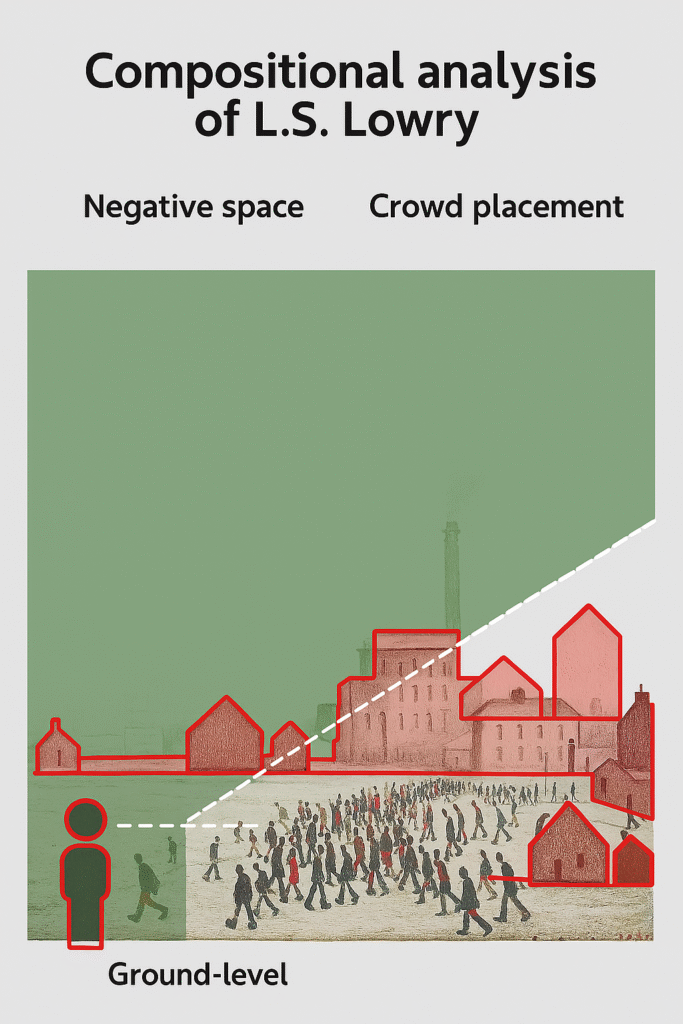
Notice how figures often group into clusters separated by negative space. These groupings create a rhythm across the canvas: cluster, space, cluster, space. Your eye moves naturally through the composition, following this rhythm from one area to another—a technique that creating focal points explores in depth.
Despite their simplicity, Lowry’s figures convey clear directional movement. Groups walk toward factory gates. Children run toward open spaces. Dogs trot purposefully through streets. These directional cues guide viewer attention and tell stories without words.
While showing crowds, Lowry maintained individual humanity. Zoom into any section and you’ll find figures that feel like real people—hurrying to work, stopping to chat, or standing alone despite the surrounding crowd. This balance between mass and individual creates the emotional power in his work.
Mastering the Limited Palette
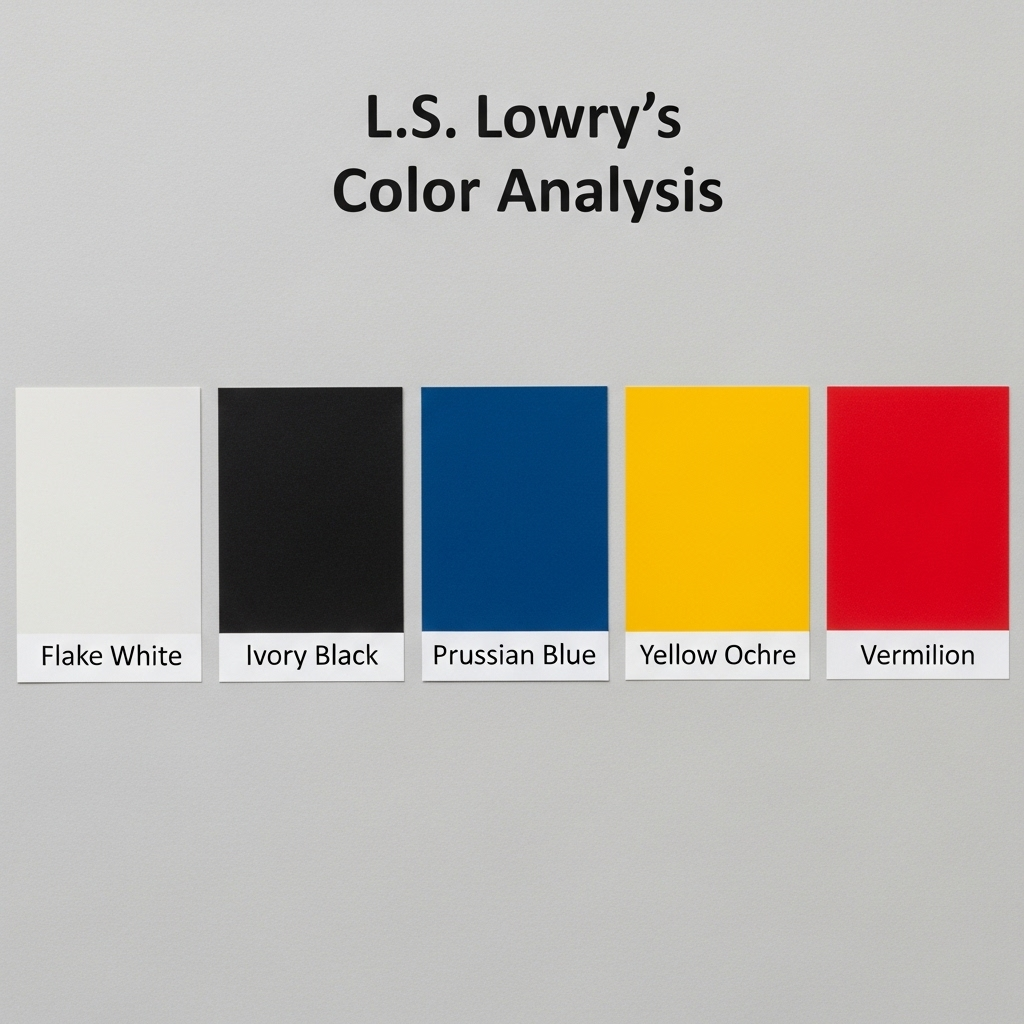
Lowry famously worked with a restricted color palette, primarily using flake white, ivory black, Prussian blue, yellow ochre, and vermilion red. This limitation wasn’t about inability—it was a deliberate choice that served his artistic vision.
Industrial Britain wasn’t colorful. Smoke, soot, and fog created a perpetually gray atmosphere. Lowry’s limited palette perfectly captured this environment’s mood. The muted tones evoke nostalgia, melancholy, and unity—without bright colors competing for attention, composition and form become paramount. Understanding color theory basics helps appreciate how Lowry used restriction creatively.
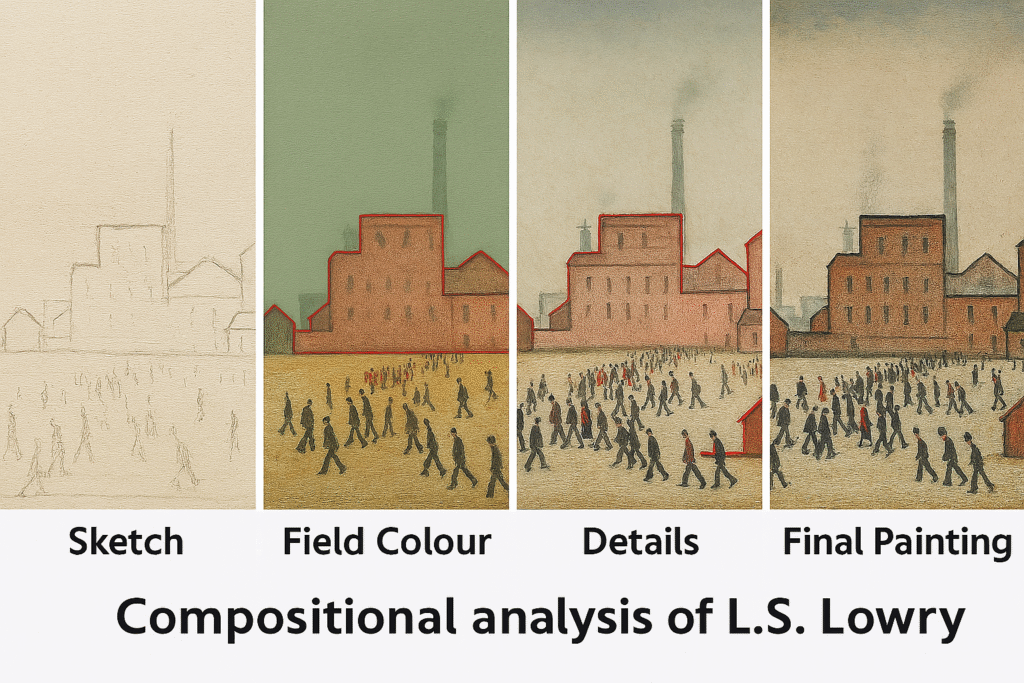
Lowry used white masterfully, often painting over darker underpaintings. This technique created his characteristic chalky appearance—figures and buildings seem to emerge from a gray mist. He also used white for highlights that weren’t traditionally lit areas, using it expressively rather than realistically.
Line, Form, and Graphic Quality
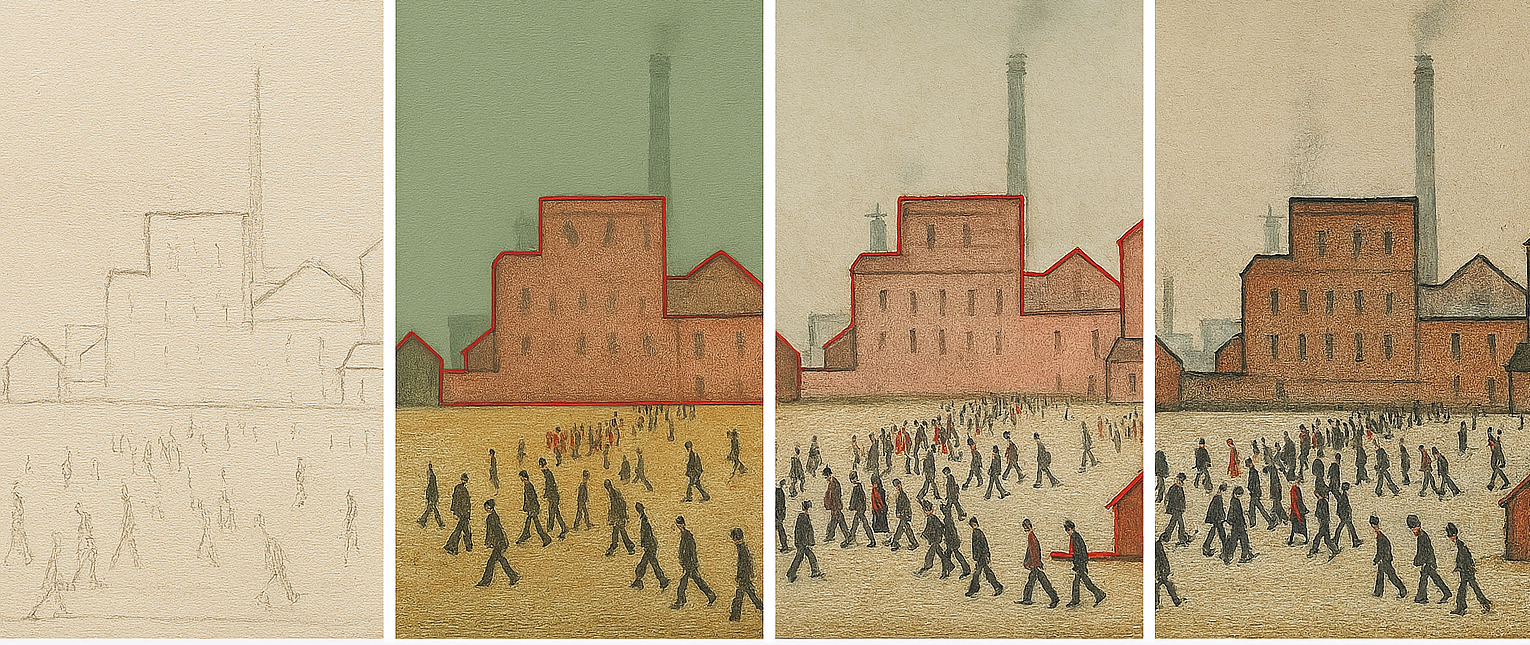
Lowry’s work has a distinctive graphic quality—almost like sophisticated sketches realized in paint. He reduced complex subjects to basic shapes: buildings became rectangles, chimneys became simple cylinders, figures became stick-like forms. This simplification wasn’t laziness—it was distillation.
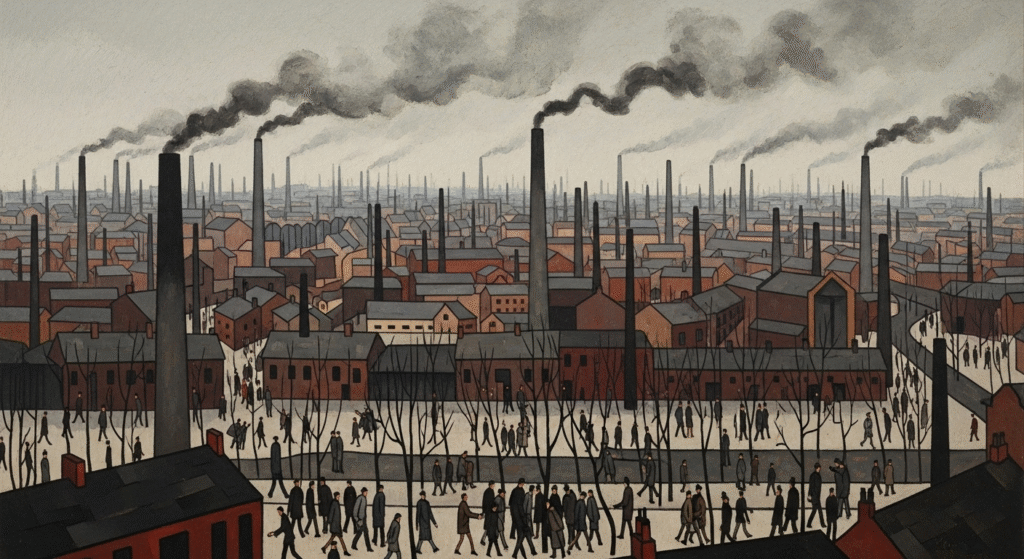
Buildings and industrial structures dominate Lowry’s compositions, serving multiple purposes. They create framework, establish scale, and add verticality. The massive industrial structures dwarf the tiny figures, emphasizing humanity’s smallness within industrial society. When examining famous artists and their styles, Lowry stands out for successfully combining naive appearance with complex composition.
Lowry often outlined forms with dark lines, giving his work an illustrative quality. These outlines define forms clearly against the hazy background, create solidity despite thin paint application, and add to the memory-like quality of the work.
Narrative and Implied Stories
Every Lowry painting tells stories—or rather, suggests them. Rather than showing dramatic moments, Lowry captured ordinary ones that hint at larger narratives. A lone figure standing apart from a crowd suggests loneliness. A small group huddled together implies shared secrets. Children playing near industrial sites evoke questions about childhood in harsh environments.
This narrative restraint engages viewers actively. We don’t just look at Lowry paintings—we interpret them, projecting our own stories onto the scenes. When learning how to critique your own paintings, consider whether your work invites interpretation or dictates meaning.
The Strategic Use of Space
Lowry understood negative space intuitively. Even in paintings packed with figures, he included empty areas: streets and plazas, large passages of sky, and sometimes sparse foregrounds with activity in the middle ground. These negative spaces rest the eye, emphasize filled areas by contrast, and create depth.
Lowry used negative space strategically to guide viewer attention. An empty area naturally draws the eye toward the activity at its edges. A lone figure in an empty space becomes instantly important. This sophisticated space management separates Lowry from truly naive painters.
Practical Lessons for Contemporary Artists
Embrace Simplicity Without Sacrificing Depth
Many artists overcomplicate compositions, thinking more detail equals better art. Lowry proves otherwise. Ask yourself what’s essential to convey your subject’s character, what can you eliminate without losing meaning, and whether every element serves the composition. This process mirrors how artists find their painting style through elimination and focus.
Develop Your Visual Language
Lowry created a consistent visual vocabulary—specific ways of depicting figures, buildings, smoke, and atmosphere. Develop your own visual shorthand by determining how you’ll consistently depict certain subjects, which shapes feel natural to your hand, and which simplifications maintain character while reducing complexity.
Observe Daily Life Intensely
Lowry spent decades observing the streets, factories, and people around him. He didn’t invent his scenes entirely—he distilled real observations. Build observation habits through sketching in public, photographing reference material, studying movement, and noting natural compositions. The process of observation appears frequently in discussions about the most influential artists.
Experiment with Perspective
Try elevated viewpoints in your work by sketching from second-story windows, imagining hovering above your subject, and using photos taken from above. Understanding how to create depth in paintings becomes easier from elevated viewpoints.
Practice with Limited Palettes
Challenge yourself to work with restricted color by choosing 3-5 colors maximum, trying Lowry’s exact palette, or using only grays, whites, and one accent color. Limited palettes force you to focus on value, composition, and form. Many artists find this approach transformative when mastering watercolor color mixing.
Practical Exercises for Artists
Exercise 1: The Five-Color Challenge – Choose an urban scene and paint using only five colors including white. Focus on value relationships rather than realistic color, learning how limited palettes create harmony.
Exercise 2: Elevated Perspective Sketch Series – Find an elevated vantage point and create 5-10 quick sketches of the scene below. Focus on how elements arrange from above and identify compositional advantages this viewpoint offers.
Exercise 3: Simplified Figure Studies – Observe people in public and create 20+ simplified figure drawings using minimal lines. Capture posture and gesture only, building a vocabulary of simplified figures.
Exercise 4: Story Implication Composition – Think of a simple narrative scenario and create a composition that suggests but doesn’t explicitly show this narrative. Use figure placement and gesture to imply the story while leaving elements ambiguous.
Lowry’s Legacy and Contemporary Relevance
Lowry worked in relative obscurity for decades before gaining recognition late in life. Today, his influence extends far beyond British art. Contemporary artists continue discovering inspiration in his work, particularly his ability to find beauty and meaning in ordinary subjects.
In our digital age of photographic realism and complex technical effects, Lowry reminds us that sophisticated art doesn’t require sophisticated techniques. His work proves that observation trumps imagination, simplicity can convey complex emotions, personal vision matters more than technical perfection, and ordinary moments contain profound meaning.
Artists exploring how to appreciate art find Lowry’s accessible style welcoming while offering depth for sustained study. His principles apply across media—digital artists, illustrators, urban sketchers, and abstract painters all find relevant lessons in his compositional strategies.
Final Thoughts
Studying Lowry composition analysis for artists reveals sophistication hiding behind apparent simplicity. His matchstick men weren’t childish—they were intentional simplifications that freed him to explore complex compositional relationships, atmospheric effects, and human narratives.
The lessons Lowry offers contemporary artists extend beyond specific techniques. He showed that developing a distinctive vision matters more than following trends, working within limitations often produces stronger results, and patient observation reveals endless possibilities. If you’ve been struggling with overcomplicated compositions or searching for your artistic voice, Lowry offers hope.
Next time you look at those deceptively simple matchstick men moving through gray industrial landscapes, look deeper. Notice the sophisticated spatial relationships, rhythmic figure arrangements, and mood created by limited color. That’s when you’ll truly appreciate the compositional genius—and understand how applying Lowry composition analysis for artists can transform your own artistic practice.
Frequently Asked Questions
What Was L.S. Lowry’s Painting Style?
L.S. Lowry’s painting style combined naive or primitive aesthetics with sophisticated compositional understanding. He simplified forms drastically, reducing figures to basic stick-like shapes and buildings to geometric forms. His work featured limited color palettes dominated by whites, grays, and muted tones. Despite appearing simple, his paintings demonstrated complex spatial organization, atmospheric perspective, and subtle narrative content. The style felt simultaneously childlike and mature, accessible yet profound—a unique combination that made his work instantly recognizable.
What Techniques Did L.S. Lowry Use?
Lowry employed several distinctive techniques. He typically painted on white backgrounds, building up thin layers of oil paint mixed with significant amounts of white, creating his characteristic chalky appearance. He often used elevated, panoramic viewpoints that simplified spatial relationships while allowing complex figure arrangements. His brushwork remained relatively simple and direct, avoiding elaborate blending. He outlined forms with dark lines, giving his work a graphic quality. Rather than traditional color mixing, he worked with a deliberately restricted palette of about five colors.
What Colors Did Lowry Use in His Paintings?
Lowry famously worked with an extremely limited palette consisting primarily of five colors: flake white, ivory black, Prussian blue, yellow ochre, and vermilion red. He mixed these colors to create the muted tones that dominate his work. White appeared in almost every mixture, creating the pale, chalky quality characteristic of his paintings. This restricted palette perfectly captured the sooty, smoke-filled atmosphere of industrial Britain while creating natural harmony across his compositions.
What Are Lowry’s “Matchstick Men”?
“Matchstick men” refers to Lowry’s distinctive simplified human figures that resemble stick figures or matches with rounded heads. These figures appear throughout his industrial scenes, reduced to essential lines and shapes without detailed anatomy or facial features. Despite their simplicity, these figures convey remarkable information through posture, gesture, and arrangement. They walk, stand, hurry, linger, and interact—all without complex rendering. The term sometimes diminishes Lowry’s achievement, but these simplified figures were deliberate artistic choices.
What Inspired L.S. Lowry’s Art?
Lowry drew inspiration directly from his surroundings—the industrial landscapes of Manchester and Salford in northwest England. He spent decades observing workers, factories, streets, and urban life, finding beauty and meaning in scenes others considered ugly or mundane. His work as a rent collector took him throughout working-class neighborhoods, providing endless opportunities for observation. Rather than exotic travels or art history, Lowry’s primary inspiration came from patient, sustained attention to familiar places and ordinary people.
Additional Resources
Museums and Collections:
- The Lowry Tate Gallery Collection – Comprehensive collection and analysis of Lowry’s work at Tate Britain
- The Lowry Arts Centre, Salford – Museum dedicated to L.S. Lowry featuring the world’s largest public collection
Video Resources:
- BBC Documentary: Lowry and the Painting of Modern Life – Exploring Lowry’s life and artistic techniques
Art Analysis:
- Royal Academy of Arts: L.S. Lowry – Exhibition archives and critical analysis
- Manchester Art Gallery Collections – Lowry works in context with other British industrial artists